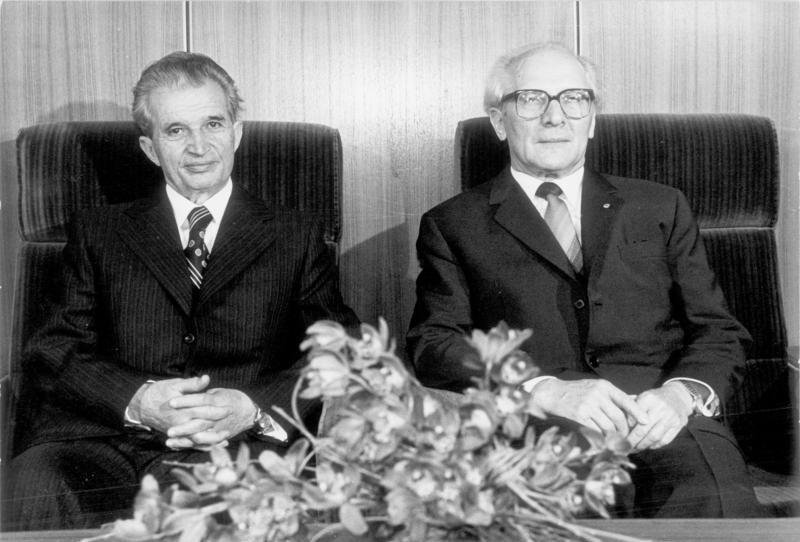
In one line: Nicolae Ceausescu, leader of the Romanian Communist Party from 1965 and president of Romania from 1974, was captured on 22 December 1989, sentenced to death by an extraordinary military tribunal on 25 December and shot at Targoviste (Târgoviște) the same afternoon, together with his wife Elena.
The final days
Ceausescu had led the Romanian Communist Party since 1965 and held the presidency of the republic since 1974. His wife Elena held senior state posts, among them first deputy prime minister. In December 1989 he was 71.


The crisis began in Timisoara in the west of the country. On 16 December 1989 a protest started there against the attempt to evict the Reformed Church pastor László Tokes, and on 16 and 17 December security forces and soldiers used force against the crowds. At the January 1990 trial of four of his former aides, observed by the human-rights group Helsinki Watch, defendants testified that at a meeting of the party's political executive committee on 17 December Ceausescu was angry that more force had not been used. Ceausescu then left for a visit to Iran. He returned on the evening of 20 December and gave a televised address that blamed foreign forces for the unrest.
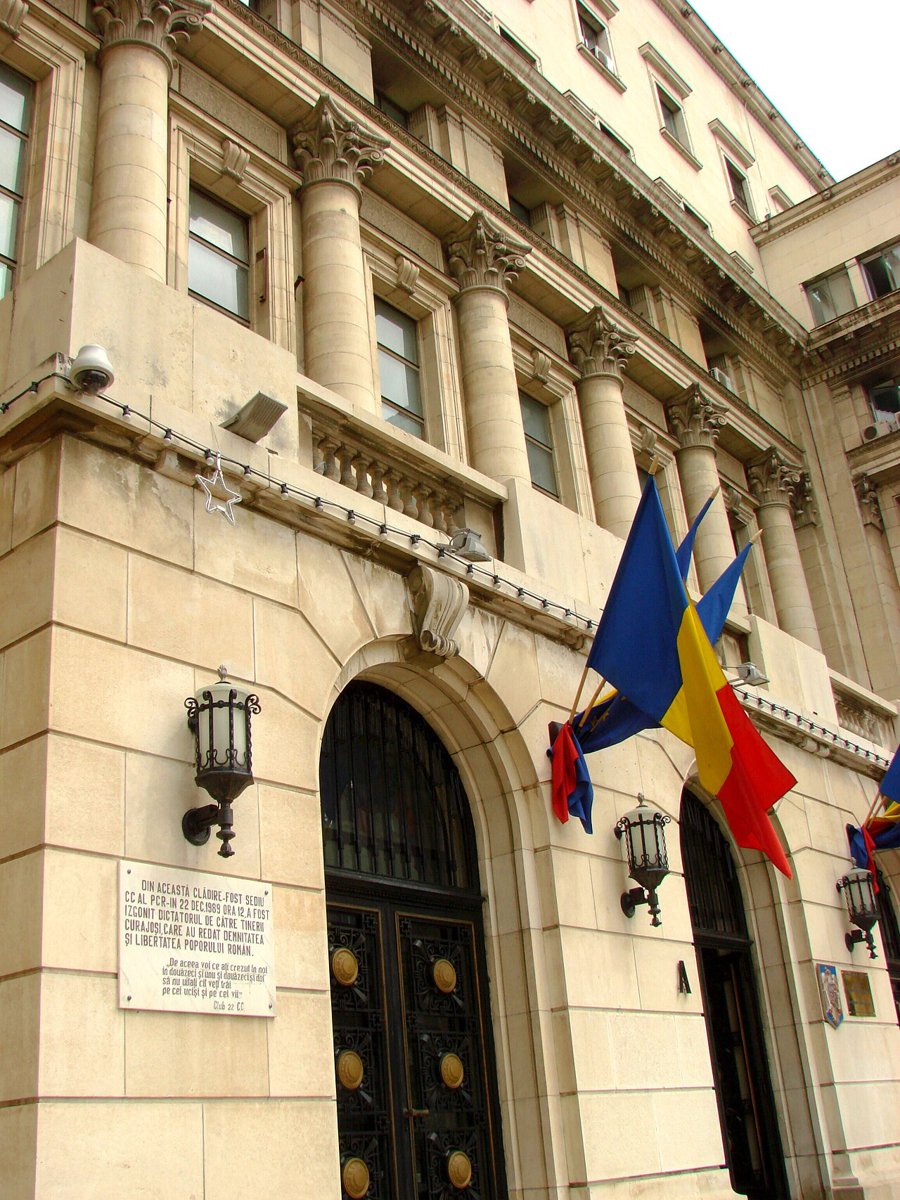
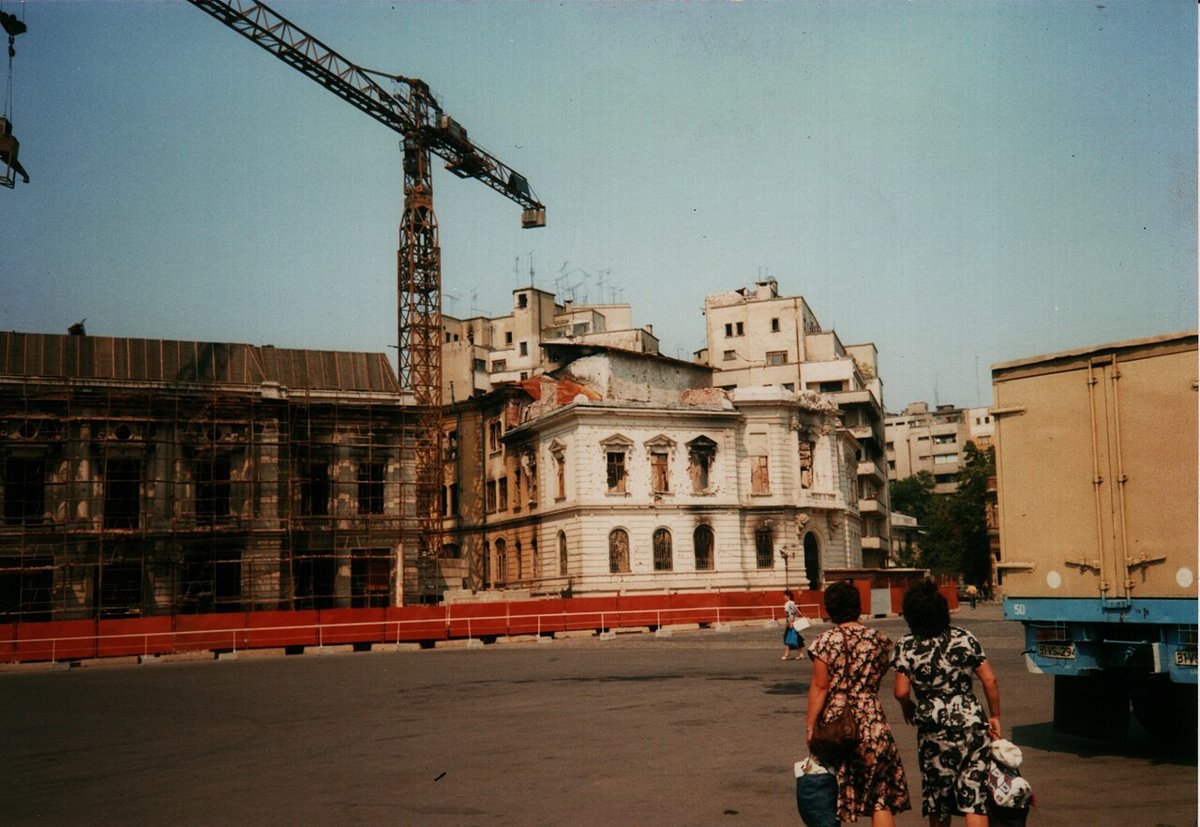
On 21 December he spoke from the balcony of the Central Committee building in Bucharest to a crowd usually estimated at around 100,000. Shouting broke out in the square, he stopped speaking and raised his hand, and the live broadcast was interrupted. Protests spread through the capital that evening and soldiers and security units fired on crowds. On the morning of 22 December the defence minister, General Vasile Milea, died; the circumstances are disputed. Milea was publicly described as having killed himself, and some accounts say he was shot for refusing to order troops to fire. A criminological report of 9 January 1990 records that the bullet entered the left chest, and a forensic re-examination in 2004 found, from damage to the ribs, that it travelled from front to back, which an academic article (Marcau, 2013, cited below) takes as against the claim that he was shot in the back. His successor, General Victor Stanculescu, ordered the army back to barracks. At about midday the Ceausescus left the roof of the Central Committee building by helicopter. They landed near Gaesti, went on by car, and were detained that afternoon by soldiers of the Targoviste garrison.
A body calling itself the National Salvation Front, led by Ion Iliescu, had announced itself in Bucharest on 22 December. A commemoration in 2019 recalled 1,142 people killed in the uprising, most of them, RTE wrote, after he had been toppled (RTE), and the 2019 charges against Iliescu and others cite 862 deaths in the period after the couple left power (Al Jazeera); counts differ by source and period.
The death
On 24 December the Front's council decreed an extraordinary military tribunal. It sat on 25 December in a military unit at Targoviste, in a room set up as a courtroom. Colonel Gica Popa is generally named as the presiding judge, and the identities of the other members were not disclosed on the broadcast. The prosecutor was Dan Voinea, then a junior military magistrate, who has said he had about three days to prepare. Defence counsel was assigned by the court.

The charges, as read out, were genocide (Article 356 of the penal code), armed attack on the people and on state power, destruction of buildings and state institutions, and undermining the national economy. The Irish Times reported that the couple were accused of causing 60,000 deaths and that it was unclear whether this meant the four days of revolution or their entire rule. Either reading is far above the totals later documented for the revolution.
The Foreign Broadcast Information Service's English translation of the broadcast (FBIS) records that Ceausescu refused to engage with the court. He said he recognized only the Grand National Assembly and "I do not recognize this court". He denied that shots had been fired in Palace Square, said the new authorities had carried out a putsch organised from abroad, and refused to sign anything. Elena Ceausescu mostly refused to answer. The defence counsel, appointed by the court and not recognised by Ceausescu, told the court that this military court was "absolutely legal" and told the accused that they "will be convicted on the basis of the points contained in the bill of indictment", while also saying he wanted a legal trial. The prosecutor asked for the death sentence and said he would have liked to oppose it as a lawyer, but that it would be incomprehensible to the Romanian people if the couple were not sentenced to death.
The verdict, announced on the broadcast after an interruption, was death and confiscation of all property. The couple were taken to the yard of the garrison and shot by a firing squad of paratroopers at about 14:50. One of the soldiers present, Dorin Cârlan, later described Nicolae Ceausescu trying to sing "The Internationale". Carlan also said in 2001 that the squad fired as soon as the couple appeared at the door, before any order was given, and that the widely circulated photographs of the execution were manipulated (Irish Examiner, 20 January 2001). Whether the verdict could have been appealed, and whether the couple were told so, is described differently in later accounts. The broadcast transcript contains no discussion of an appeal.
What happened to the body
The two were buried at Ghencea cemetery in Bucharest, in separate graves; Gelu Voican-Voiculescu, a former official who supervised the burial, told the Christian Science Monitor in 2010 that it took place on 30 December and was filmed. Al Jazeera reported that the burials took place at night and under false names, to prevent desecration. Some Romanians, including the family, doubted that the graves held the Ceausescus. Their daughter Zoia sued the defence ministry in 2005 for the graves to be opened. She died in 2006 and her brother Valentin continued the case.
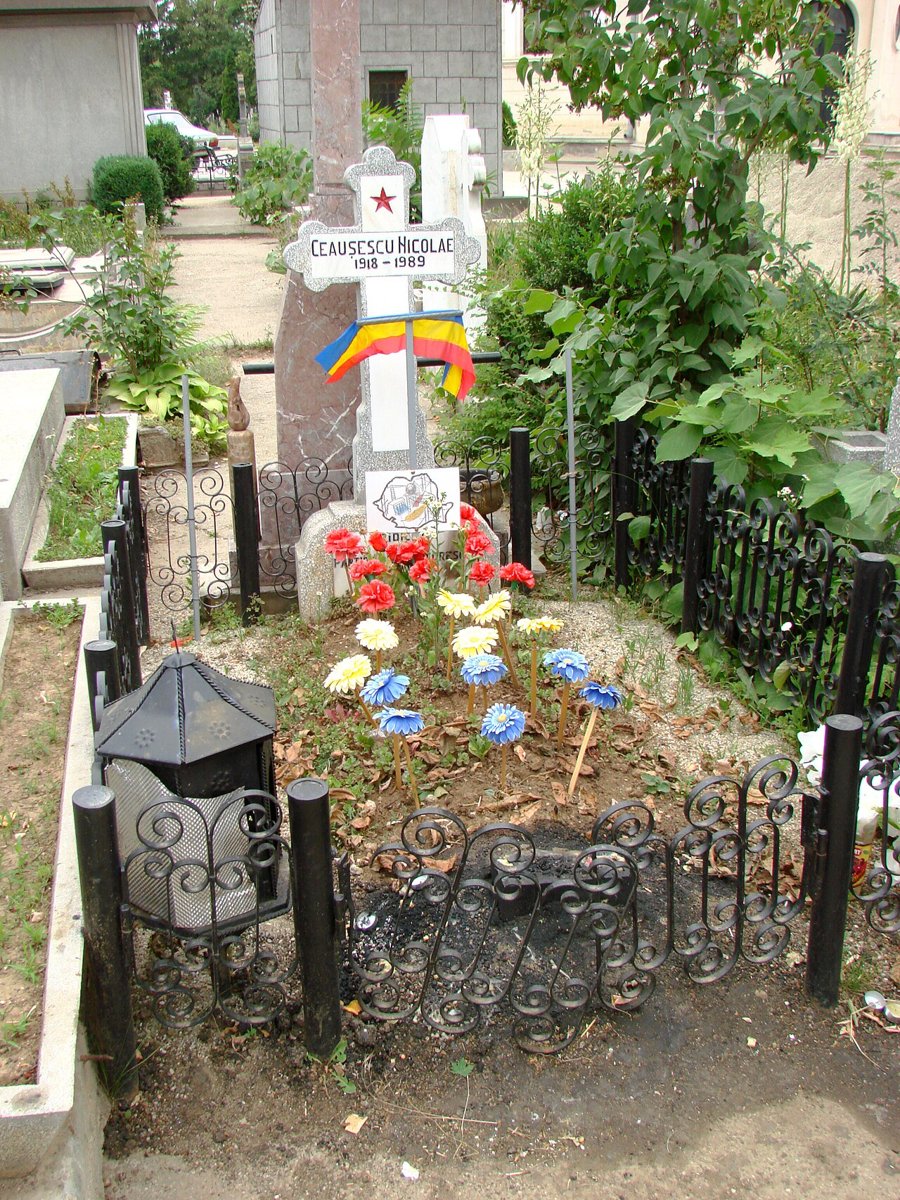

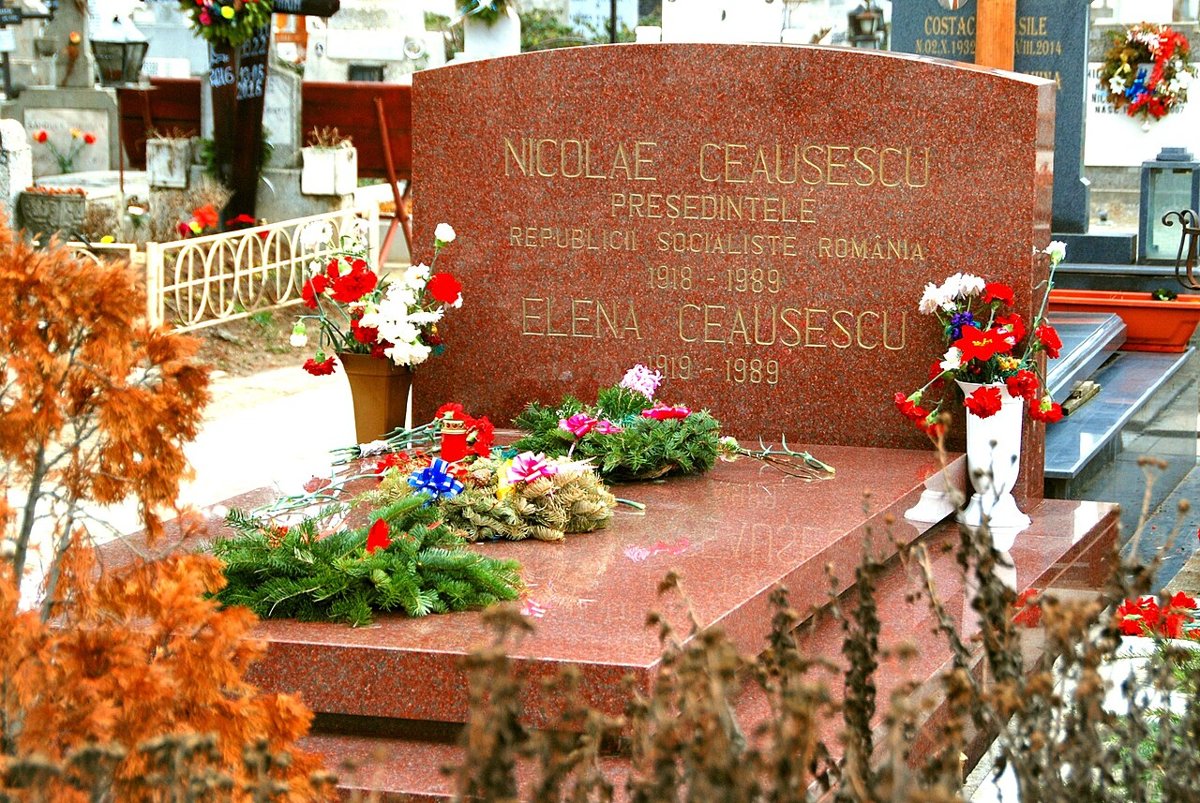

The graves were opened on 21 July 2010. Samples were taken and the coffins reburied. On 3 November 2010 Valentin Ceausescu announced that DNA tests by the national institute of forensic medicine had confirmed the remains. The institute's head, Dan Dermengiu, said the DNA matched that of Nicolae Ceausescu's brother and son. The couple were reburied at Ghencea, where supporters leave flowers, particularly on 26 January, Nicolae's birthday.
How the death was announced and used
Romanian Television announced the executions on the evening of 25 December. Wire reports of the time describe a short film of the trial and the bodies that night and extended extracts of the trial, ending with pictures of the bodies, late on 26 December. The execution itself was not filmed in full; the crew recorded the aftermath. Foreign broadcasters also carried the footage.
The National Salvation Front and its supporters argued that a rapid trial was needed to end fighting by forces still loyal to Ceausescu. The prosecutor made a version of the same argument in the broadcast. Asked in 1999 by Radio Free Europe/Radio Liberty, Iliescu said: "It would have been better for us, if we could have preserved him and then organized -- in normal conditions -- a trial. But we were under the pressure of this military confrontation, when people died every hour." Capital punishment was abolished on 7 January 1990; the Ceausescus were the last people executed in Romania.
The criticisms are several. Critics have argued that the tribunal was formed ad hoc by a political body, that the defendants did not choose their counsel and that the counsel assigned argued for conviction, which the transcript bears out. No evidence for the genocide count is presented in the broadcast transcript. In 2019 Romanian prosecutors charged Iliescu and others with crimes against humanity for the events of December 1989 and described the Ceausescu trial as a "simulated criminal trial" which a false "terrorist" threat, spread through state media, had helped set up. Iliescu denies wrongdoing, and his co-defendant Gelu Voican Voiculescu has called the prosecution "an act of political revenge". Ceausescu's supporters, for their part, have laid flowers at the grave.
Timeline
- 22 March 1965: Ceausescu becomes leader of the Romanian Communist Party.
- 28 March 1974: He takes the office of president of the republic.
- 16 to 17 December 1989: Protests in Timisoara; security forces and soldiers use force.
- 18 to 20 December 1989: Ceausescu visits Iran; he returns on the evening of the 20th and broadcasts an address.
- 21 December 1989: The Bucharest rally is interrupted; protests and shootings follow in the capital.
- 22 December 1989: Milea dies; the Ceausescus flee by helicopter and are detained at Targoviste; the National Salvation Front announces itself.
- 24 December 1989: The Front's council decrees an extraordinary military tribunal.
- 25 December 1989: Trial and execution at Targoviste; Romanian Television announces it that evening.
- 26 December 1989: Extended trial extracts broadcast.
- 30 December 1989: Burial in Ghencea cemetery (date from a former official, 2010).
- 7 January 1990: Capital punishment abolished.
- 21 July 2010: Graves opened.
- 3 November 2010: DNA confirmation announced.
- 8 April 2019: Prosecutors send the case against Iliescu and others to court.
Same-standard note
This page uses the project's working definitions: a death is described by who did what, when and where, and a court proceeding by its recorded procedure, not by whether the outcome was deserved. The circumstances differ from leader to leader. Here the leader was tried and shot within three days of losing power by a body created for the purpose, and what the sources dispute is the quality of that proceeding, not whether he was killed. Leaders who died in office, in custody without any trial or in bed are described in the same order, and the page does not treat those cases as equivalent.
Sources
- Transcript of the closed trial of Nicolae and Elena Ceausescu, FBIS English translation of the Romanian and Austrian television broadcasts, Wikisource: https://en.wikisource.org/wiki/Transcript_of_the_closed_trial_of_Nicolae_and_Elena_Ceau%C8%99escu
- Helsinki Watch (Human Rights Watch), "A Rush to Appease... And to Conceal", Romania, 1990: https://www.hrw.org/reports/pdfs/r/romania/romania903.pdf
- UPI, "Trial of Nicolae and Elena Ceausescu", 26 December 1989: https://www.upi.com/Archives/1989/12/26/Trial-of-Nicolae-and-Elena-Ceausescu/6777630651600/
- The Washington Post, "Romanian broadcast shows dead dictator", 27 December 1989: https://www.washingtonpost.com/archive/politics/1989/12/27/romanian-broadcast-shows-dead-dictator/f3fe0948-87ed-4eda-8fa3-d95e04c05cd9/
- TVR, "Trial and Execution", Google Arts & Culture: https://artsandculture.google.com/story/trial-and-execution-tvr-the-romanian-public-broadcaster/HQVhRMp6MAUA8A?hl=en
- Radio Free Europe/Radio Liberty, "Romania: 1989's Bloody Revolution -- Chaos As The Ceausescus Are Executed": https://www.rferl.org/a/1092891.html
- The Irish Times, "Christmas execution left revolution questions unanswered for Romania": https://www.irishtimes.com/news/world/europe/christmas-execution-left-revolution-questions-unanswered-for-romania-1.4122044
- Al Jazeera, "Romania exhumes Ceausescu's remains", 21 July 2010: https://www.aljazeera.com/news/2010/7/21/romania-exhumes-ceausescus-remains
- The Washington Post, "DNA test confirms Ceausescu's remains", 3 November 2010: http://www.washingtonpost.com/wp-dyn/content/article/2010/11/03/AR2010110301858.html
- Al Jazeera, "Romania's ex-leader Iliescu charged over 1989 uprising", 8 April 2019: https://www.aljazeera.com/news/2019/4/8/romanias-ex-leader-iliescu-charged-over-1989-uprising
- The Christian Science Monitor, "Nicolae Ceausescu and dictator's wife exhumed in Romania", 22 July 2010: https://www.csmonitor.com/World/Europe/2010/0722/Nicolae-Ceausescu-and-dictator-s-wife-exhumed-in-Romania.-Why
- Irish Examiner, "Ceausescu execution pictures false, says firing squad member", 20 January 2001: https://www.irishexaminer.com/world/arid-30002089.html
- RTE, "Romania marks 30 years since overthrow of Ceausescu", 25 December 2019: https://www.rte.ie/news/world/2019/1225/1102976-romania-ceausescu-1989/
- Flavius Cristian Marcau, "Revolution of 1989: Milea's suicide", Annals of the Constantin Brancusi University of Targu Jiu, 2013 (cites the 1990 criminological report and the 2004 re-examination): https://www.utgjiu.ro/revista/lit/pdf/2013-04/16_Flavius%20Cristian%20Marcau%20-%20Revolution%20of%201989%20-%20Milea%60s%20suicide.pdf
- Jeremy Bransten, "Romania: The Bloody Revolution In 1989: Communist, Ion Iliescu, Tells His Story", Radio Free Europe/Radio Liberty, 9 December 1999: https://www.rferl.org/a/1092901.html