In one line: when hardline officials seized control of Soviet state television on the morning of 19 August 1991, the flagship news programme Vremya read their statement once and then filled the schedule with a looped recording of Tchaikovsky's Swan Lake — the same broadcast that had covered three Politburo funerals since 1982 — so that Soviet viewers, trained by a decade of Kremlin deaths to decode the ballet as "something is being managed off-camera," understood a crisis was underway from the empty programme guide itself, while independent Soviet and foreign correspondents filled in what state television would not say.
This page is about the broadcast-substitution technique itself: why an anodyne classical ballet became a legible crisis signal, and how the vacuum it created was filled. The coup plotters' own statements, their eight-member committee and the case for and against their claim that Gorbachev was medically "unable" to govern are covered on From 'ill health' to Swan Lake: the GKChP's case for its own coup, 19-21 August 1991 and not repeated here.
What happened
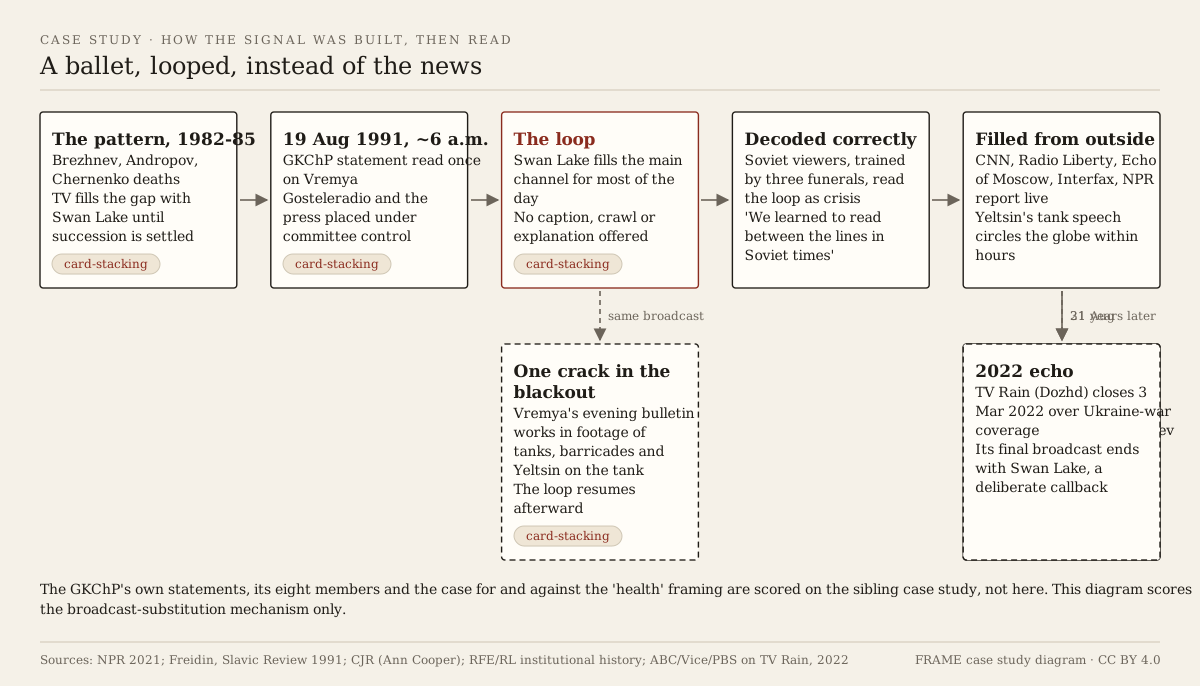
- 10 November 1982 - 11 March 1985: the pattern is set. Leonid Brezhnev dies on 10 November 1982; the state announcement follows only after a delay of roughly a day. Yuri Andropov dies on 9 February 1984 and Konstantin Chernenko on 10 March 1985; both announcements are likewise delayed by about a day while the Politburo settles succession. In each case, according to multiple retrospective accounts (NPR, 2021; Sky History; the Wilson Center; Hazlitt), Central Television's main channel breaks its schedule and fills the intervening hours with classical music, including recordings of Tchaikovsky's Swan Lake, until an announcer can read the news in the funeral register Soviet audiences expected. Viewers who noticed the ballet appearing outside its normal slot learned, across three deaths in under three years, to read it as a sign that a leadership crisis was being handled behind the scenes before the state was ready to name it.
- 18-19 August 1991, night. A delegation of hardline officials visits Mikhail Gorbachev at his holiday dacha in Foros, Crimea, and demands he declare a state of emergency or hand over power. He refuses. His telephone lines are cut.
- 19 August 1991, roughly 6:00 a.m. Moscow time. Soviet radio and Central Television broadcast a statement that Vice President Gennady Yanayev has assumed presidential authority because Gorbachev is "unable, for reasons of health," to carry out his duties, and that a State Committee for the State of Emergency (GKChP) — eight officials including Yanayev, Prime Minister Valentin Pavlov, KGB chairman Vladimir Kryuchkov, Defense Minister Dmitry Yazov and Interior Minister Boris Pugo — has taken power. Central Television announcers Yevgeni Kochergin and Vera Shebeko read the statement on that morning's edition of Vremya. The committee's own case, and how the "health" framing has been treated since, is covered on From 'ill health' to Swan Lake: the GKChP's case for its own coup, 19-21 August 1991.
- Same morning. The GKChP places Gosteleradio under its own control and suspends independent and opposition newspapers, leaving only a short list of official party and state papers publishing.
- Through the day, 19 August. With no further scheduled bulletins, Central Television's main channel loops a recording of Swan Lake for most of the day — accounts describe roughly twelve continuous hours. One detailed account (Re/visions Journal) identifies the print used as a 1983 filmed performance with Natalia Bessmertnova in the lead. No caption, crawl or announcer explains why; the ballet simply replaces the news.
- Midday, 19 August. Boris Yeltsin, president of the Russian SFSR, climbs onto a tank outside the Russian parliament building (the "White House") and reads a statement denouncing the takeover as unconstitutional and calling for a general strike. Western camera crews, CNN's among them, film it live, and the footage circles the world within hours — a scene state television had no comparable footage of anything to compete with.
- Evening, 19 August. Vremya's evening bulletin, produced under GKChP oversight, nonetheless carries brief footage of tanks in Moscow's streets, barricades around the White House and Yeltsin's appearance on the tank — material several retrospective accounts (Wikipedia's "Vremya" and "Yevgeni Kochergin" articles) describe staff working into the broadcast despite the takeover. It is a crack in the blackout, not its end: the loop resumes.
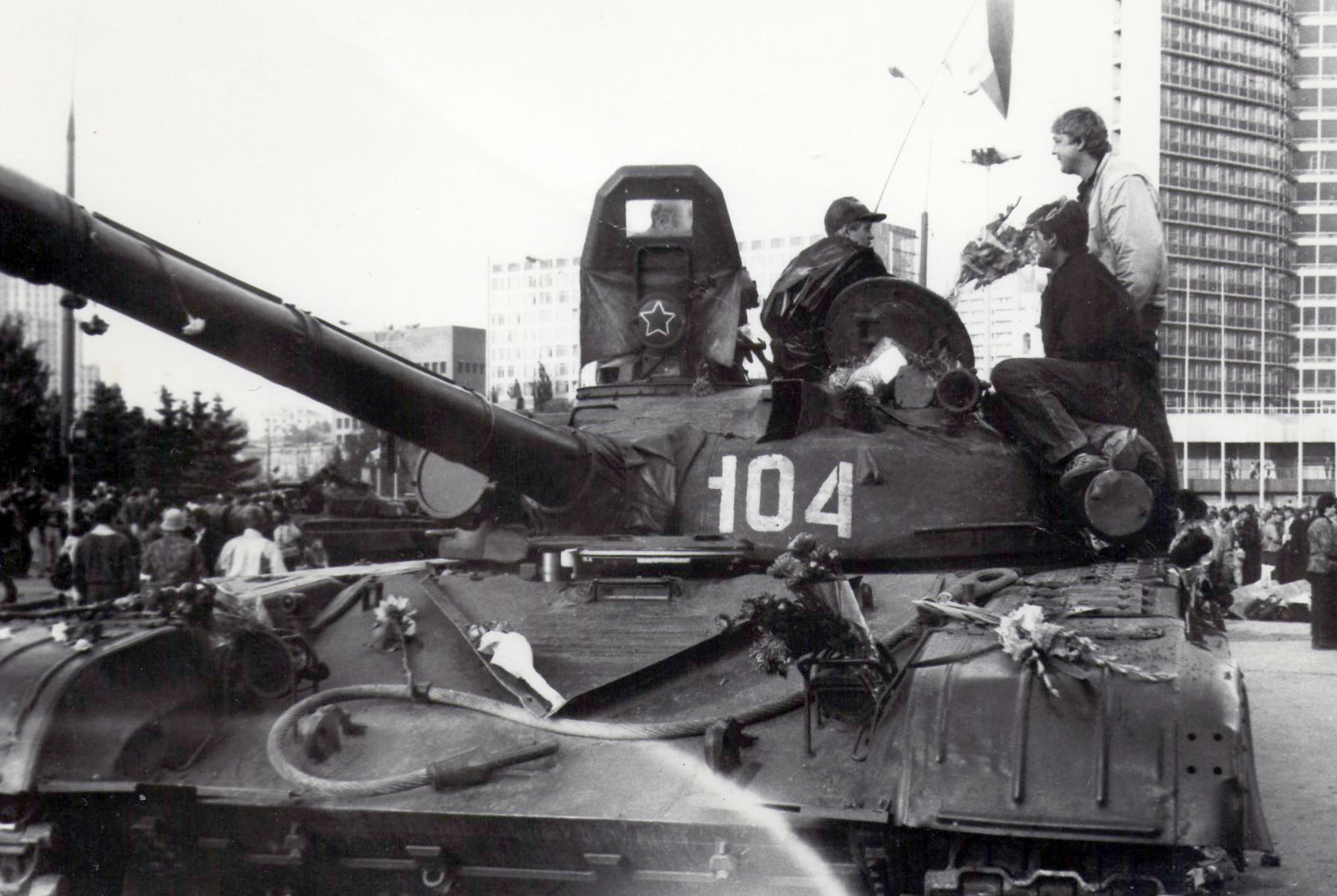
A T-72 tank, turret number 104, in Moscow during the coup, with civilians on and around it and flowers laid on the hull, August 1991 (photograph by Ivan Simochkin). CC BY-SA 3.0, via Wikimedia Commons. - 19-21 August. Independent and foreign outlets become the main channel of real information for many Soviet citizens and for the outside world. Echo of Moscow (Ekho Moskvy), the country's only independent news radio station, is taken off the air early in the coup but resumes broadcasting and becomes a trusted source through the crisis. Interfax, an independent news agency founded in 1989, keeps filing wire copy throughout. Radio Liberty/RFE correspondents report live from the White House barricades and the streets of Moscow and other cities (RFE/RL's own institutional history, "How Liberty Came to Russia"). NPR's Moscow bureau, headed by Ann Cooper, reports continuously (Columbia Journalism Review, Q&A with Ann Cooper); CNN's coverage of the three days later earns the network a Peabody Award. - Night of 20-21 August. Three young men — Dmitry Komar, Vladimir Usov and Ilya Krichevsky — are killed when an armored column clashes with barricades in an underpass on Moscow's Garden Ring. They are the coup's only fatalities in the capital and are posthumously named Heroes of the Soviet Union.
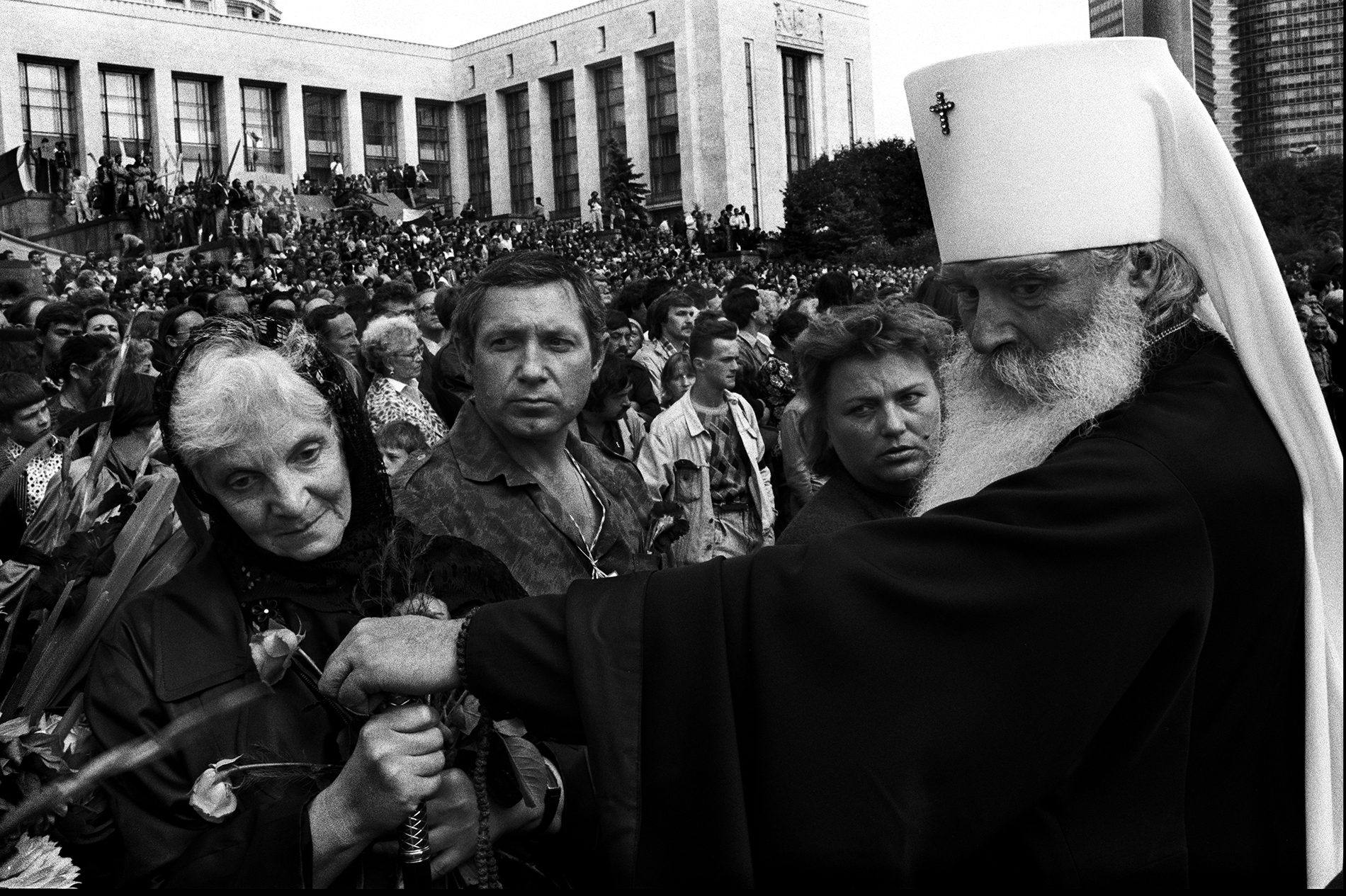
A crowd outside the Russian parliament building ("White House"), Moscow, August 1991, with an Orthodox bishop in the foreground (photograph by Oleg Klimov, Liberty.SU). CC BY-SA 4.0, via Wikimedia Commons. - 21 August. With troops refusing to storm the White House and GKChP members' resolve collapsing, the coup falls apart; committee members are arrested or, in the case of Pugo, die by suicide. - 22 August 1991. Gorbachev returns to Moscow. He is politically diminished; Yeltsin is now the visibly dominant figure. The Soviet Communist Party is suspended within days, and the USSR dissolves by the end of the year.
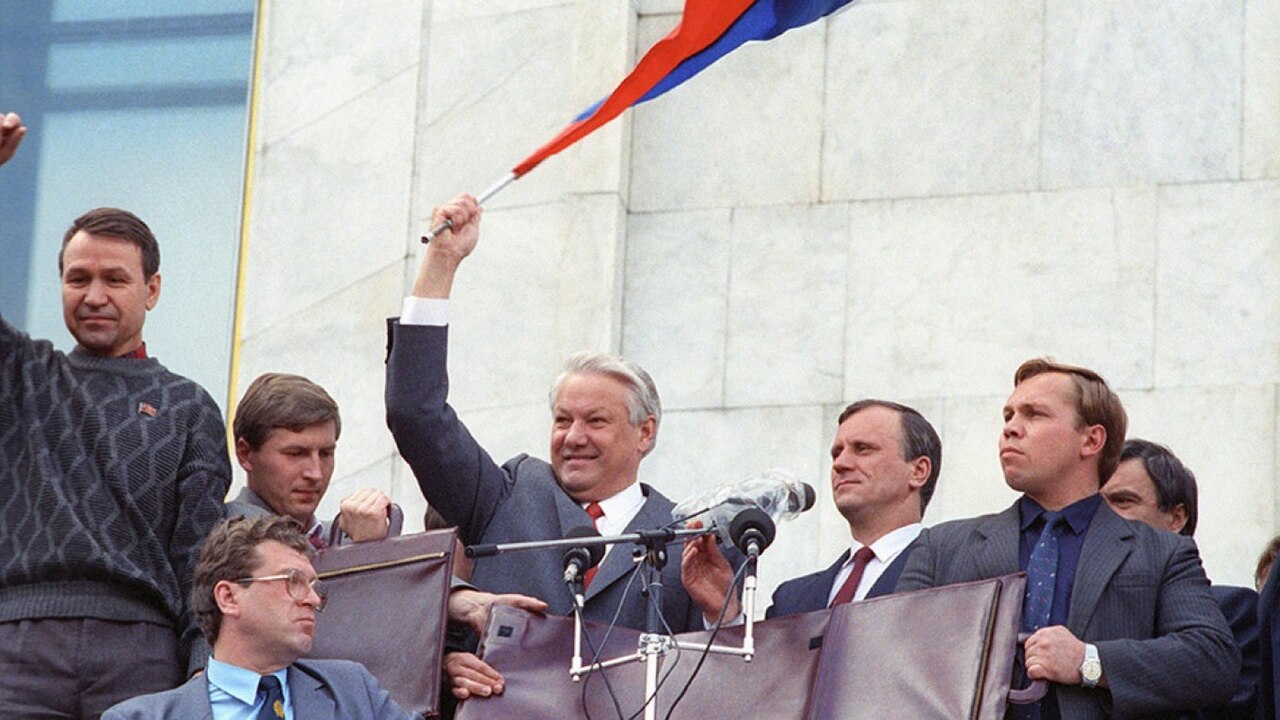
Boris Yeltsin waves the Russian tricolour at a rally near the Russian parliament building, Moscow, 22 August 1991, the day after the coup collapsed. ITAR-TASS photograph published on kremlin.ru. CC BY 4.0 (kremlin.ru terms), via Wikimedia Commons.
How it works
- Card stacking: card-stacking is usually selective — printing the confession and cutting the rebuttal, as Pravda did at the 1936-38 show trials. The GKChP's broadcast took the same device to its limit: rather than curate a favorable selection of the day's events, Central Television removed the entire pile and left a ballet in its place. That is still card-stacking — the "remaining pile" a viewer could read was reduced to nothing newsworthy at all — but because Soviet audiences had already been trained, across three funerals in 1982-85, to treat an unscheduled Swan Lake broadcast as itself a fact ("a crisis is being managed, and the state is not ready to say what it is"), the omission communicated almost as much as an honest bulletin would have. The technique's institutional history is what makes the 1991 instance interesting: it was not improvised. Gosteleradio had a decade-old, three-times-rehearsed answer to "what do we put on air while we decide what to say," and the GKChP simply reached for it — without apparently reckoning that reusing a known tell, on a fourth occasion under vastly more contested circumstances, would tip its own public and a global press corps off within hours rather than concealing anything.
Then and now
Soviet and Russian television is not the only broadcaster whose audience learned to read scheduling itself as news. International coverage of Thailand's military coups — in 1991 (the same year), 2006 and 2014 — has repeatedly noted the same mechanism at work: when the army moves, Thai television networks switch in unison to patriotic and military music, sometimes for hours, before any announcement is made, and Thai viewers have learned, the way Soviet viewers learned from Swan Lake, to treat that programming switch as the first confirmation that a coup is underway (contemporaneous international coverage of Thailand's coups: Reuters, the BBC, the Guardian, the New York Times). The mechanism is the same — an anodyne, non-news broadcast substituted for the schedule, legible only because the audience has seen the substitution before — even though the two states, eras and outcomes differ sharply: Thailand's military has used the device repeatedly and, unlike the GKChP, its coups have mostly succeeded.
The clearest sequel, though, is Russian television's own. On 3 March 2022, TV Rain (Dozhd), by then Russia's last major independent television channel, went off the air after the government ordered its closure over its coverage of the full-scale invasion of Ukraine; staff walked off the set saying "no war," and the channel's closing broadcast ended, several outlets reported, with a recording of Swan Lake — a deliberate, self-aware callback to 1991, this time used by journalists losing their airtime rather than by officials seizing it (ABC News; ABC Australia; Vice; PBS NewsHour). Echo of Moscow, the station whose 1991 broadcasts had helped fill the original vacuum, was forced off the air in the same week. The ballet's meaning as "something the state is not telling you" had outlived the state that first taught the public to read it that way.
Positions on the record
- The GKChP's public position. The committee's statements, read on Vremya, framed the takeover around Gorbachev's stated inability to govern for health reasons and promised order and continuity; they did not publicly address, then or later, the choice of Swan Lake as filler programming. Gosteleradio's own leadership left no public record explaining the specific decision either.
- How Soviet and foreign audiences read it, at the time. Multiple retrospective accounts describe viewers and Soviet officials recognizing the broadcast pattern immediately, some drawing on Soviet-era habits of "reading between the lines" to conclude something serious was happening even before independent bulletins confirmed it (globalsecurity.org, reproducing 2001 wire-service retrospective reporting).
- Scholarship. Gregory Freidin's "Televorot: The Role of Television Coverage in Russia's August 1991 Coup" (Slavic Review, 1991) treats Soviet television's coverage — including its failures and gaps — as a central actor in the coup's outcome, not a passive backdrop to it.
- What is documented. The 19 August statement and its 6:00 a.m. broadcast; Gosteleradio's seizure and the newspaper suspensions; the day-long loop of Swan Lake on the main channel; Yeltsin's tank-top address and its international broadcast; the roles of Echo of Moscow, Interfax, Radio Liberty/RFE, NPR and CNN in reporting the crisis independently of Soviet state media; the three deaths on the Garden Ring; the coup's collapse by 21 August.
- What is contested or under-documented. The precise hour count of the loop (accounts converge on "most of the day" or "about twelve hours" rather than a logged schedule); the exact print of Swan Lake used (one detailed source names a 1983 recording with Natalia Bessmertnova, which this page has not independently confirmed against a second primary source); and whether Swan Lake was chosen deliberately by GKChP figures for its established meaning or reached for reflexively by Gosteleradio staff following institutional habit from 1982-85 — the record supports either reading, and this page does not resolve it.
- Not ruled on here. Whether the GKChP's claim about Gorbachev's health had any basis, and the legal and political case for and against the takeover itself, which belong to From 'ill health' to Swan Lake: the GKChP's case for its own coup, 19-21 August 1991.
Same-method test
The same test — did a state broadcaster substitute anodyne programming for news while a leadership crisis was managed off-camera, and did the substitution itself function as the only public signal that anything was wrong — applies to North Korean state television's handling of Kim Jong-il's death. Kim died on 17 December 2011, but North Korean state media did not announce it until a special bulletin on 19 December, delivered by veteran anchor Ri Chun-hee in mourning black, roughly two days after the fact, while the succession of his son Kim Jong-un was arranged (contemporaneous December 2011 reporting: BBC, Reuters, AP, the New York Times). The underlying mechanism — a death or incapacity managed for days before the public was told, filled with something other than the news — scores the same way regardless of the two states' vastly different media systems. What is less documented in the English-language sources available to this page is precisely what filled North Korean airwaves during that specific 48-hour gap; unlike the Soviet case, no equivalent to the "twelve-hour Swan Lake loop" has been independently confirmed here, so this page states the comparison at the level of the delay-and-substitution pattern rather than claiming an identical broadcast mechanism.
How to spot it
- Notice when a broadcaster with a fixed schedule departs from it without explanation, especially into content with no news value and no connection to the day's events. The departure is information, even when the content is not.
- If the same substitution has happened before under similar circumstances, its recurrence is itself a stronger signal than any single instance — audiences learn a broadcaster's tells the way they learn a person's.
- When a domestic broadcaster goes dark or vague, check wire services, foreign correspondents and any surviving independent outlets before assuming nothing is happening; the vacuum a state broadcaster creates is often filled within hours by outlets it does not control.
- Ask whether the filler content was chosen for a reason — to reassure, to avoid the appearance of panic, to project normalcy — rather than assuming a silence is merely technical or accidental.
Images
| Image | Source | Licence |
|---|---|---|
| Mechanism diagram (above) | Drawn for FRAME from the sources below (make_diagrams_fall_swan_lake.py) |
CC BY 4.0, FRAME |
| T-72 tank in Moscow, 19 August 1991 | Wikimedia Commons, photo by Ivan Simochkin | CC BY-SA 3.0 |
| White House defenders, Moscow, August 1991 | Wikimedia Commons, photo by Oleg Klimov/Liberty.SU | CC BY-SA 4.0 |
| Yeltsin with the Russian tricolour at a rally, Moscow, 22 August 1991 | Wikimedia Commons, ITAR-TASS via kremlin.ru | CC BY 4.0 (kremlin.ru) |


Image gaps
- A frame or photograph of the actual 1991 Swan Lake broadcast, or of a Soviet television set showing it. Not included: no openly licensed screenshot or photograph of the broadcast itself was found. Soviet state television's own archival footage from this period is not published under an open licence, and photographs of ordinary television sets tuned to it in August 1991 do not appear to have been taken or preserved for public release. Not fillable without Gosteleradio's successor archives releasing footage under an open licence.
- The Vremya announcers reading the GKChP statement (Yevgeni Kochergin, Vera Shebeko), or a photograph of the GKChP's 19 August press conference. Not included: press-agency photographs of the 19 August press conference (Yanayev's visibly shaking hands, widely reproduced) are standard wire-service copyright (AP, Reuters, TASS), not openly licensed, and no openly licensed portrait of either announcer from this period was found.
- Echo of Moscow's studio or staff during the coup, or an Interfax wire printout from 19-21 August 1991. Not included: no openly licensed photograph or scan was found for this pass.
- TV Rain's (Dozhd) final broadcast, 3 March 2022. Not included: the broadcast itself and press photography of the newsroom that day are under standard copyright; this page describes it in text rather than reproducing an image.
Sources
- NPR, 19 August 2021: "In 1991, Soviet Citizens Saw Swans On The TV And Knew It Meant Turmoil"
- Sky HISTORY (history.co.uk): "Swan Lake's link to political turmoil in the Soviet Union"
- Re/visions Journal: "Swan Lake on Soviet TV in 1991: a failed ideological attempt"
- Wilson Center: "The Dissidence of Pussy Riot's Swan Lake"
- Hazlitt: "This Portentous Composition: Swan Lake's Place in Soviet Politics"
- tovima.com: "When Swan Lake Signaled Political Crisis in the Soviet Union"
- The Moscow Times, 18 August 2011: "Yeltsin Ally Saw 'Swan Lake' as Call to Arms"
- globalsecurity.org, reproducing 17 August 2001 wire-service retrospective reporting on the coup's tenth anniversary
- Gregory Freidin, "Televorot: The Role of Television Coverage in Russia's August 1991 Coup," Slavic Review 50, no. 4 (1991): Cambridge Core
- Columbia Journalism Review: "Q&A: Ann Cooper on a tale of two mutinies in Russia"
- Columbia Journalism Review: "The Russian Reporters Who Helped Topple the USSR"
- Association for Diplomatic Studies and Training: "CNN, Tanks, and Glass Walls: The August 1991 Coup"
- RFE/RL institutional history: "How Liberty Came To Russia"
- English Wikipedia, "Vremya" and "Yevgeni Kochergin," for the 19 August announcer and evening-bulletin details.
- English Wikipedia, "1991 Soviet coup d'état attempt" and "Timeline of the 1991 Soviet coup attempt," for the general chronology.
- ABC News: "How 'Swan Lake' became a symbol of protest in Russia"
- ABC News Australia, 4 March 2022: "Swan Lake TV broadcast signals turmoil in Russia as independent media outlets forced to close"
- Vice: "Russia's Last Independent News Channel Plays 'Swan Lake' as It Gets Shut Down"
- PBS NewsHour: "Putin regime cracks down on independent media in Russia"
- Newsweek: "Is Putin Dead? Pay Attention When Russia Starts Broadcasting 'Swan Lake'"
- International press coverage of Thailand's 1991, 2006 and 2014 military coups noting the same patriotic-music broadcast-substitution pattern: contemporaneous reporting (Reuters, the BBC, the Guardian, the New York Times), for the "Then and now" comparison.
- Contemporaneous December 2011 reporting on the announced death of Kim Jong-il (BBC, Reuters, AP, the New York Times), for the "Same-method test" comparison.
- Wikimedia Commons, File:T-72_tank_in_Moscow,_August_1991.jpg and File:1991_Oleg_Klimov_Liberty.SU_02.jpg, for the images used above.