Also called Selective omission, Cherry-picking
Select, omit, or order facts so the remaining pile can only be read one way.
The tell
Missing denominator, missing counterexample, missing dates.
Not this
A short item that flags its own limits.
History and effect
IPA 1937; the technique behind most propaganda that never states an outright falsehood, since every individual fact used can be accurate.
It leaves the audience with a factually correct but structurally misleading picture, without ever asking them to believe something false.
Lineage: IPA 1937
How it works
Card stacking works on the pile, not the individual card. Each item can be accurate and checkable; the distortion lies in which items were chosen, which were left out, and the order they are laid down in. The Institute for Propaganda Analysis listed it among its seven devices in 1937, and Alfred McClung Lee and Elizabeth Briant Lee's The Fine Art of Propaganda (1939) described it as assembling the best or worst possible case by choosing among facts, illustrations and statements. The IPA's wording allowed falsehoods into the stack; the harder form to catch is built entirely from true material.
The moving parts recur across eras. Selection: favourable cases, studies or witnesses appear and unfavourable ones are dropped. Missing context: a count without its denominator, a change without its baseline, a figure without its date range. Darrell Huff's How to Lie with Statistics (1954) catalogued the statistical forms: choosing which "average" to report, cutting off a chart axis to magnify a small change, sampling for convenience. Ordering: a strong verified item placed first lends credibility to weaker items after it. Choice of comparison: the categories in a table are picked so that one side wins.
Two variants need institutional power. In suppression, the unfavourable evidence is removed from public view, so the remaining pile is the only one available. In the structural variant, no single author need intend the result: many separate decisions about what is published or passed upward add up to a skewed record, as with unpublished drug trials or intelligence caveats filtered out before a final briefing.
Why it works
Readers judge from what is in front of them. Daniel Kahneman (Thinking, Fast and Slow, 2011) calls this "what you see is all there is": fast judgement builds the most coherent story from the evidence available and does not ask how much is missing. Consumer researchers Frank Kardes and colleagues describe the same pattern as omission neglect. Base-rate neglect (Kahneman and Tversky, 1973) explains why a vivid count without a denominator persuades.
Card stacking also defeats the usual defence. A reader who spot-checks claims finds each one true, and Timothy Levine's truth-default theory (2014) notes that people assume honesty until something triggers suspicion; accurate items give no trigger. For audiences already inclined to the conclusion, confirmation bias (reviewed by Raymond Nickerson, 1998) makes a one-sided pile feel like confirmation rather than selection.
Examples across eras and sides
- The Bryce Report (1915, United Kingdom, government committee). The Committee on Alleged German Outrages published summaries of depositions from Belgian refugees and soldiers, with witnesses unnamed and not cross-examined, placing documented mass killings beside unverified mutilation stories so that the first lent credibility to the second. Historians later established that German troops killed about 6,500 Belgian and French civilians in 1914, while finding many of the most lurid stories unsubstantiated (Horne and Kramer, German Atrocities 1914: A History of Denial, 2001).
- "Sind wir die Barbaren?" (1916, Germany, Imperial government). Germany answered the "barbarism" charge with a chart comparing itself with England and France on selected measures of culture and social provision, categories that favour Germany and do not engage the accusations about Belgium. See Sind wir die Barbaren? (Are We the Barbarians?) (Landesarchiv Baden-Württemberg, J 151 Nr 2243).
- The suppressed 1937 census (USSR, Soviet government). When the census counted fewer people than the leadership's public statements implied, a shortfall consistent with famine and repression deaths, its results were declared defective and withheld, leading census officials were arrested, and a 1939 census was published instead (Catherine Merridale, "The 1937 Census and the Limits of Stalinist Rule", The Historical Journal, 1996).
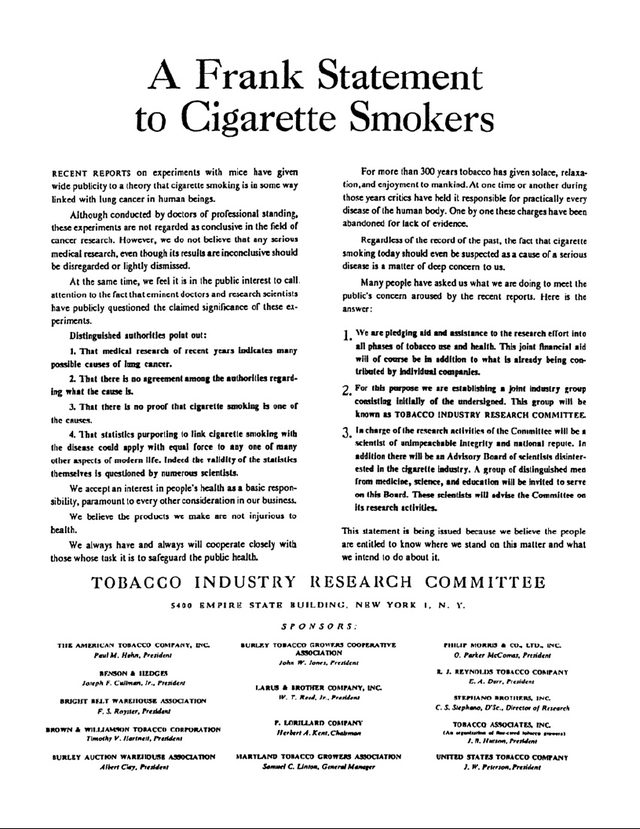
- The Frank Statement (1954, United States, tobacco industry). The companies answered new lung-cancer studies by citing only the doubters. In United States v. Philip Morris (D.D.C. 2006), Judge Gladys Kessler found it part of a long effort to maintain public doubt. See A Frank Statement to Cigarette Smokers (Allan M. Brandt, The Cigarette Century, 2007).
- Gulf of Tonkin and Iraq (1964 and 2003, United States, executive branch). The NSA historian Robert Hanyok concluded that the 4 August 1964 attack did not occur and that signals intelligence was presented so as to deny decision makers a complete picture (President Johnson's Gulf of Tonkin 'Midnight Address'). In 2003 Colin Powell showed the UN mobile weapons labs whose main source, "Curveball", had been doubted inside U.S. and German intelligence; the Senate Intelligence Committee (2004) faulted the intelligence community's handling of the source; its report examined the intelligence agencies, not how policymakers used their product (Mobile Production Facilities for Biological Agents (UN Security Council slide)).
- Unpublished antidepressant trials (2008 study, United States, pharmaceutical research). Comparing 74 FDA-registered trials of 12 antidepressants with the literature, Erick Turner and colleagues found about 94% of published trials positive against about 51% by the FDA's analysis, because negative trials were mostly unpublished or reported with a positive slant (Turner et al., New England Journal of Medicine, 2008).
- The Gyirong flood toll (2026, China, public security authorities). Official coverage centred on rescue effort and a toll of 43 dead on the Tibet side, while police punished higher counts as "rumours" and platforms deleted them. The higher counts are unverified; the tag rests on what was left visible to check the toll with. See The Gyirong flood and the official death toll (the Guardian, 8 September 2026).
How to spot it
- What is the denominator: the population, period and rate the count belongs to?
- What is the strongest opposing evidence, and is it mentioned at all?
- Who chose the comparison, time window and baseline, and would another reasonable choice reverse the picture?
- Are verified and unverified items mixed, and does the message say which is which?
- Is missing evidence merely absent here, or removed from public view (deleted posts, withheld data, unpublished trials)?
- Can the full set be checked: a trial registry, the full dataset, the original report?
Where it ends: edge cases and legitimate persuasion
- Openly partisan advocacy. A lawyer's brief or campaign advertisement presents one side's best case in a genre everyone recognises. It becomes card stacking when a one-sided selection is presented as neutral or complete.
- Summary is not stacking. Every short message omits. The test is materiality: would the omitted fact reverse or substantially weaken the conclusion? U.S. securities law draws a similar line in SEC Rule 10b-5, which forbids omitting a material fact needed to keep statements from misleading.
- Neighbours. Partial disclosure offered as full is Limited hangout; a disclosure that does not travel with the message is Disclosure theater; Bothsidesism stacks the other way, presenting lopsided evidence as an even split; Whataboutism answers an accusation with a selected counter-comparison.
- Falsified numbers. Once figures are altered rather than selected, the technique is plain falsehood.
- Honest selection states its selection rule, gives denominators and date ranges, links the full data and names the strongest counter-evidence. Clinical-trial pre-registration, required by the International Committee of Medical Journal Editors from 2005, builds this into an institution.
Sources
- Brandt, Allan M. The Cigarette Century. Basic Books, 2007.
- Committee on Alleged German Outrages (Bryce Committee). Report of the Committee on Alleged German Outrages. HMSO, 1915.
- Hanyok, Robert J. "Skunks, Bogies, Silent Hounds, and the Flying Fish: The Gulf of Tonkin Mystery, 2-4 August 1964." Cryptologic Quarterly, National Security Agency (declassified 2005).
- Horne, John, and Alan Kramer. German Atrocities 1914: A History of Denial. Yale University Press, 2001.
- Huff, Darrell. How to Lie with Statistics. W. W. Norton, 1954.
- Institute for Propaganda Analysis. "How to Detect Propaganda." Propaganda Analysis, 1937.
- Kahneman, Daniel. Thinking, Fast and Slow. Farrar, Straus and Giroux, 2011.
- Kahneman, Daniel, and Amos Tversky. "On the Psychology of Prediction." Psychological Review, 1973.
- Lee, Alfred McClung, and Elizabeth Briant Lee. The Fine Art of Propaganda. Harcourt, Brace, 1939.
- Levine, Timothy R. "Truth-Default Theory (TDT)." Journal of Language and Social Psychology, 2014.
- Merridale, Catherine. "The 1937 Census and the Limits of Stalinist Rule." The Historical Journal, 1996.
- Nickerson, Raymond S. "Confirmation Bias: A Ubiquitous Phenomenon in Many Guises." Review of General Psychology, 1998.
- Turner, Erick H., et al. "Selective Publication of Antidepressant Trials and Its Influence on Apparent Efficacy." New England Journal of Medicine, 2008.
- U.S. Senate Select Committee on Intelligence. Report on the U.S. Intelligence Community's Prewar Intelligence Assessments on Iraq. 2004.
- United States v. Philip Morris USA, Inc., 449 F. Supp. 2d 1 (D.D.C. 2006).
- The Guardian, reporting on the Clean Internet 2026 campaign and the Gyirong flood, 8 September 2026.
Case studies
- Managing the news: France's 'bourrage de crâne' and Austria-Hungary's War Press Office (1914-1918) — Managing the news: France's 'bourrage de crâne' and Austria-Hungary's War Press Office (1914-1918)
- Wellington House and the Bryce Report: atrocity evidence, confirmed and unconfirmed (1914-1915) — Wellington House and the Bryce Report: atrocity evidence, confirmed and unconfirmed (1914-1915)
- The German 'corpse factory': a false atrocity story and its long afterlife (1917-1925) — The German 'corpse factory': a false atrocity story and its long afterlife (1917-1925)
- The Justice Department's FARA release and public demonstrations — The Justice Department's FARA release and public demonstrations
- The Gyirong flood and the official death toll — The Gyirong flood and the official death toll
- Collectivisation, the 1932-33 famine and its denial: the kulak label, the silence and the foreign press — Collectivisation, the 1932-33 famine and its denial
- Angkar: language control in Democratic Kampuchea, 1975-1979, and the contests over its record — Angkar: language control in Democratic Kampuchea, 1975-1979
- Media war over Croatia and Bosnia, 1987-1995, and the denial of Srebrenica — Media war over Croatia and Bosnia, 1987-1995, and the denial of Srebrenica
- Anti-Rohingya propaganda in Myanmar, 2012-2018: the 'Bengali' label, the monks' sermons and the military's covert Facebook pages — Anti-Rohingya propaganda in Myanmar, 2012-2018
- German South West Africa, 1904-1908: the war on the Herero and Nama and the contest over its record — German South West Africa, 1904-1908: the war on the Herero and Nama
- The Office of War Information's Domestic Branch, 1942-43 — The Office of War Information's Domestic Branch, 1942-43
- The Nayirah testimony: a Kuwaiti government PR campaign at a House human rights caucus — The Nayirah testimony: a Kuwaiti government PR campaign at a House human rights caucus
- How the US and UK governments presented the case for war in Iraq, 2002-03 — How the US and UK governments presented the case for war in Iraq, 2002-03
- COINTELPRO: the FBI's covert media and information operations against U.S. groups, 1956-1971 — COINTELPRO: the FBI's covert media and information operations against U.S. groups, 1956-1971
- Taxpayer-funded government advertising in Canada and Australia, 1996-2019 — Taxpayer-funded government advertising in Canada and Australia, 1996-2019
- Ethyl: how leaded petrol was named, defended and kept on sale — Ethyl: how leaded petrol was named, defended and kept on sale
- The tobacco industry's smoking-and-health doubt campaign, 1953 to 1998 — The tobacco industry's smoking-and-health doubt campaign, 1953 to 1998
- The Sugar Research Foundation and the 1967 heart disease review — The Sugar Research Foundation and the 1967 heart disease review
- Fossil-fuel industry climate doubt campaigns, 1977 to the 2000s — Fossil-fuel industry climate doubt campaigns, 1977 to the 2000s
- OxyContin's launch marketing: a one-paragraph letter and a "less than one percent" message — OxyContin's launch marketing
- The Korean War germ-warfare charges: commissions, confessions and the 1953 recall — The Korean War germ-warfare allegations, 1952
- McCarthy's numbers: 205, 57, 81 and the move from 'card-carrying Communists' to 'security risks' (1950-54) — McCarthy's shifting numbers, 1950
- Lubang Buaya, 1965: the mutilation story the autopsies did not support — Indonesia 1965: the Lubang Buaya story
- Chieu Hoi and Radio Hanoi: both sides' propaganda aimed at the other side's soldiers in Vietnam — Chieu Hoi and Radio Hanoi: propaganda aimed at the other side's soldiers
- The Kenya Emergency, 1952-1960: 'rehabilitation', the Hola water cart, and the oath — The Kenya Emergency, 1952-1960: 'rehabilitation', the Hola water cart, and the oath
- 'Benevolent assimilation': the Philippine-American War and the propaganda on every side — 'Benevolent assimilation': the Philippine-American War and the propaganda on every side
- Algeria 1954-1962: 'events', psychological action, and the FLN's single voice — Algeria 1954-1962: 'events', psychological action, and the FLN's single voice
- Buy Empire, burn foreign cloth: the Empire Marketing Board and the swadeshi boycotts — Buy Empire, burn foreign cloth: the Empire Marketing Board and the swadeshi boycotts
- The Congo Free State press war: Leopold II's Press Bureau and the Congo Reform Association — The Congo Free State press war: Leopold II's Press Bureau and the Congo Reform Association
- The Tamil Tigers' martyr cult, and the state's 'humanitarian operation' — The Tamil Tigers' martyr cult, and the state's 'humanitarian operation'
- Soviet montage cinema as state film: Battleship Potemkin and October — Soviet montage cinema: Battleship Potemkin and October
- Film under Goebbels: Triumph des Willens (1935) and Der ewige Jude (1940) — Film under Goebbels: Triumph des Willens and Der ewige Jude
- Why We Fight: the U.S. Army's orientation films, 1942-1945 — Why We Fight: the U.S. Army's orientation films
- Britain's Ministry of Information films and London Can Take It! (1940-1942) — Britain's Ministry of Information films and London Can Take It!
- Reefer Madness and the 1930s marihuana campaign — Reefer Madness and the 1930s marihuana campaign
- Wartime radio voices: open and hidden broadcasts aimed at the enemy, 1939-1945 — Wartime radio voices, open and hidden
- State television across borders: from Der schwarze Kanal and ZDF-Magazin to RT, CGTN, Alhurra and Al Jazeera — State television across borders, from Der schwarze Kanal to RT and CGTN
- Kadesh and Behistun: kings carving their own record — Kadesh and Behistun: kings carving their own record
- Octavian, Antony and the Res Gestae: how Augustus wrote his own reign — Octavian, Antony and the Res Gestae: how Augustus wrote his own reign
- The Reformation print war: Luther, Cranach and the Catholic reply — The Reformation print war: Luther, Cranach and the Catholic reply
- The English Civil War pamphlet war, 1641-1649 — The English Civil War pamphlet war, 1641-1649
- Join or Die to the Boston Massacre: patriot and loyalist print, 1754-1783 — Join or Die to the Boston Massacre: patriot and loyalist print, 1754-1783
- Revolution, counter-revolution and Napoleon's bulletins, 1789-1815 — Revolution, counter-revolution and Napoleon's bulletins, 1789-1815
- Abolitionist and pro-slavery print, 1787-1860 — Abolitionist and pro-slavery print, 1787-1860
- Union and Confederate print, 1861-1865 — Union and Confederate print, 1861-1865
- Remember the Maine: the yellow press and Spain, 1895-1898 — Remember the Maine: the yellow press and Spain, 1895-1898
- India's Emergency: 'India is Indira' and the censored press — India's Emergency: 'India is Indira' and the censored press
- Xinjiang's 'vocational training centres': the government's messaging and its critics' — Xinjiang's 'vocational training centres': the government's messaging and its critics'
- Gwangju, May 1980: 'rioters', 'spies' and the censored press — Gwangju, May 1980: 'rioters', 'spies' and the censored press
- Pengkhianatan G30S/PKI: how Indonesia's New Order kept 1965 on screen — Pengkhianatan G30S/PKI: how Indonesia's New Order kept 1965 on screen
- The loudspeaker war: propaganda across the Taiwan Strait, 1949-1987 — The loudspeaker war: propaganda across the Taiwan Strait, 1949-1987
- The Kim leader cult, the anti-US month and the leaflets sent back — The Kim leader cult, the anti-US month and the leaflets sent back
- Operation Spectrum: Singapore's 'Marxist conspiracy' and its answers — Operation Spectrum: Singapore's 'Marxist conspiracy' and its answers
- Marcos's martial law: the 'New Society' and the online contest over its memory — Marcos's martial law: the 'New Society' and the online contest over its memory
- Screened, state-written and contested: East Asia's history-textbook disputes since 1955 — Screened, state-written and contested: East Asia's history-textbook disputes since 1955
- The Great Leap Forward's 'sputnik' harvests and the famine that followed — The Great Leap Forward's 'sputnik' harvests and the famine that followed
- Germany answers back: the Manifesto of the 93 and the Lusitania medal (1914-1916) — Germany answers back: the Manifesto of the 93 and the Lusitania medal (1914-1916)
- The Institute for Propaganda Analysis (1937-1942) — The Institute for Propaganda Analysis (1937-1942)
- Crime and victim attack ads in two U.S. presidential races: Horton and the furloughs (1988), James Byrd Jr. and hate-crimes law (2000) — Crime and victim attack ads in two U.S. presidential races: Horton and the furloughs (1988), James Byrd Jr. and hate-crimes law (2000)
- 2004: outside-group ads on Kerry's Navy record and Bush's Guard record — 2004: outside-group ads on Kerry's Navy record and Bush's Guard record
- Mood over argument: "Morning in America" (Reagan-Bush 1984) and "Hope" / "Yes We Can" (Obama 2008) — Mood over argument: "Morning in America" (Reagan-Bush 1984) and "Hope" / "Yes We Can" (Obama 2008)
- The steelworker ad and the welfare ads: two fact-checked attacks from the 2012 U.S. presidential race — The steelworker ad and the welfare ads: two fact-checked attacks from the 2012 U.S. presidential race
- British election posters and broadcasts, 1978 to 2005: Conservative and Labour attack campaigns — British election posters and broadcasts, 1978 to 2005: Conservative and Labour attack campaigns
- Brazil 2018 and 2022: WhatsApp blasts, removal orders against both campaigns, and the electoral court's new powers — Brazil 2018 and 2022: WhatsApp blasts, removal orders against both campaigns, and the electoral court's new powers
- The MMR scare: from a 1998 press conference to Vaxxed, and its 1802 ancestors — The MMR scare: from a 1998 press conference to Vaxxed, and its 1802 ancestors
- Just Say No and the fried egg: anti-drug campaigns, 1971-2016 — Just Say No and the fried egg: anti-drug campaigns, 1971-2016
- The satanic panic: ritual-abuse claims in the US and UK, 1980-1994 — The satanic panic: ritual-abuse claims in the US and UK, 1980-1994
- Follow the science, Plandemic: COVID-19 messaging from officials and contrarians, 2020-2022 — Follow the science, Plandemic: COVID-19 messaging from officials and contrarians, 2020-2022
- The Index of Prohibited Books (1559-1966) — The Index of Prohibited Books (1559-1966)
- Wartime censorship in the First World War: Britain, Germany, France and the United States — Wartime censorship in the First World War: Britain, Germany, France and the United States
- Glavlit and the retouched photographic record — Glavlit and the retouched photographic record
- China's Great Firewall and the June Fourth anniversary — China's Great Firewall and the June Fourth anniversary
- Apartheid South Africa's banned organisations, persons and publications — Apartheid South Africa's banned organisations, persons and publications
- Temperance, Prohibition and the wets: the dry campaigns and their opponents, 1874 to 1933 — Temperance, Prohibition and the wets: the dry campaigns and their opponents, 1874 to 1933
- Labor organizing and anti-union campaigns in the United States, 1910-1941 — Labor organizing and anti-union campaigns in the United States, 1910-1941
- The US abortion debate: persuasion campaigns on both sides since the 1960s — The US abortion debate: persuasion campaigns on both sides since the 1960s
- Black Lives Matter and Blue Lives Matter: two slogans, their campaigns, and a foreign operation that posed as both — Black Lives Matter and Blue Lives Matter: two slogans, their campaigns, and a foreign operation that posed as both
- Gun rights and gun control: persuasion on both sides of the U.S. gun debate — Gun rights and gun control: persuasion on both sides of the U.S. gun debate
- Perón cumple, Evita dignifica: Argentina's state media machine, and the decree that erased it — Perón cumple, Evita dignifica: Argentina's state media machine, and the decree that erased it
- The Reich Ministry of Public Enlightenment and Propaganda, 1933-1945 — The Reich Ministry of Public Enlightenment and Propaganda, 1933-1945
- Fascist Italy's propaganda machine: from the Duce's Press Office to the Ministry of Popular Culture — Fascist Italy's propaganda machine: from the Duce's Press Office to the Ministry of Popular Culture
- Imperial Japan's wartime propaganda at home: the Information Bureau, the neighbourhood associations and the war communiqués — Imperial Japan's wartime propaganda at home: the Information Bureau, the neighbourhood associations and the war communiqués
- Soviet wartime propaganda, 1939-1945: Sovinformburo, Agitprop and the Red Army press — Soviet wartime propaganda, 1939-1945: Sovinformburo, Agitprop and the Red Army press
- Britain's Ministry of Information and Political Warfare Executive: posters at home, black radio abroad — Britain's Ministry of Information and Political Warfare Executive: posters at home, black radio abroad
- The U.S. Office of War Information and the Writers' War Board: a 'strategy of truth' meets the advertising men — The U.S. Office of War Information and the Writers' War Board: a 'strategy of truth' meets the advertising men
- Chinese wartime propaganda, 1937-1945: Chongqing, Yan'an and Wang Jingwei's Nanjing — Chinese wartime propaganda, 1937-1945: Chongqing, Yan'an and Wang Jingwei's Nanjing
- Hitler über Deutschland: the 1932 campaigns that made the NSDAP a mass party — Hitler über Deutschland: the 1932 campaigns that made the NSDAP a mass party
- Before Triumph of the Will: staging scale for a fringe party at Nuremberg, 1923-1933 — Before Triumph of the Will: staging scale for a fringe party at Nuremberg, 1923-1933
- From a fire to a vote: the Reichstag Fire Decree and the Enabling Act, February-March 1933 — From a fire to a vote: the Reichstag Fire Decree and the Enabling Act, February-March 1933
- Bolshevik agitprop, 1917-1921: soviets, decrees, agit-trains and the ROSTA windows — Bolshevik agitprop, 1917-1921: soviets, decrees, agit-trains and the ROSTA windows
- 'Trotskyism or Leninism': the press campaign that removed Trotsky from Soviet leadership (1924-1929) — 'Trotskyism or Leninism': the press campaign that removed Trotsky from Soviet leadership (1924-1929)
- "Liquidate the kulaks as a class": the propaganda campaign for collectivization (1929-1933) — "Liquidate the kulaks as a class": the propaganda campaign for collectivization (1929-1933)
- The Moscow show trials: confession, spectacle and consent (1936-1938) — The Moscow show trials: confession, spectacle and consent (1936-1938)
- Divide the land, label the enemy: propaganda and discipline in the Jiangxi Soviet (1927-1934) — Divide the land, label the enemy: propaganda and discipline in the Jiangxi Soviet (1927-1934)
- Propaganda of the Chinese Civil War, 1945-1949: land reform, surrender leaflets and the fall of the mainland — Propaganda of the Chinese Civil War, 1945-1949: land reform, surrender leaflets and the fall of the mainland
- The People's Court: the Volksgerichtshof as a stage for verdicts, 1934-1945 — The People's Court: the Volksgerichtshof as a stage for verdicts, 1934-1945
- Manufactured unanimity: the Nazi single-list plebiscites, 1934-1938 — Manufactured unanimity: the Nazi single-list plebiscites, 1934-1938
- The German Labour Front and Strength Through Joy, 1933-1945 — The German Labour Front and Strength Through Joy, 1933-1945
- The Agitprop Department: the Communist Party's standing propaganda apparatus, 1920-1991 — The Agitprop Department: the Communist Party's standing propaganda apparatus, 1920-1991
- Pravda, Izvestia and TASS: the institutional structure of the Soviet press monopoly, 1912-1991 — Pravda, Izvestia and TASS: the institutional structure of the Soviet press monopoly, 1912-1991
- The Union of Soviet Writers and socialist realism, 1932-1969 — The Union of Soviet Writers and socialist realism, 1932-1969
- Selling the Gulag: the "re-forging" of the White Sea-Baltic Canal, 1930-1937 — Selling the Gulag: the 're-forging' of the White Sea-Baltic Canal, 1930-1937
- Zhongxuanbu: the Central Propaganda Department as the ruling party's standing ministry of message, 1949-2026 — Zhongxuanbu: the Central Propaganda Department as the ruling party's standing ministry of message, 1949-2026
- Xinhua News Agency: China's state press apparatus, 1931-present — Xinhua News Agency: China's state press apparatus, 1931-present
- The PLA's Political Commissar System: Dual Command, the General Political Department and PLA Daily — The PLA's Political Commissar System: dual command, the General Political Department and PLA Daily
- The Hundred Flowers and Anti-Rightist Campaigns: soliciting criticism, then purging it (1956-1959) — The Hundred Flowers and Anti-Rightist Campaigns: soliciting criticism, then purging it (1956-1959)
- The Hitler Youth: from a party wing to a legal duty, 1926-1945 — The Hitler Youth: from a party wing to a legal duty, 1926-1945
- The Bund Deutscher Mädel: raising Nazi Germany's girls for the Volk — The Bund Deutscher Mädel: raising Nazi Germany's girls for the Volk
- Nazi control of school curriculum and teachers, 1933-1938 — Nazi control of school curriculum and teachers, 1933-1938
- Two ladders to the top: the Napolas, the Adolf Hitler Schools, and the Reich's rival cadet pipelines (1933-1945) — Two ladders to the top: the Napolas, the Adolf Hitler Schools, and the Reich's rival cadet pipelines (1933-1945)
- Kinderlandverschickung: evacuating Germany's children into Hitler Youth camps, 1940-1945 — Kinderlandverschickung: evacuating Germany's children into Hitler Youth camps, 1940-1945
- The Komsomol: youth pipeline, mass mobilization and internal discipline, 1918-1991 — The Komsomol: youth pipeline, mass mobilization and internal discipline, 1918-1991
- Soviet control of school curriculum and textbooks — Soviet control of school curriculum and textbooks
- Red scarf to Party card: a century of the Communist Youth League of China — Red scarf to Party card: a century of the Communist Youth League of China
- The Volkssturm: staging a 'people's storm' out of Nazi Germany's last conscription, 1944-45 — The Volkssturm: staging a 'people's storm' out of Nazi Germany's last conscription, 1944-45
- The Nero Decree: Hitler's order to destroy Germany, and the myth built on defying it — The Nero Decree: Hitler's order to destroy Germany, and the myth built on defying it
- Wonder weapons: how the Reich sold the V-1, V-2 and Me 262 as war-winners, 1944-1945 — Wonder weapons: how the Reich sold the V-1, V-2 and Me 262 as war-winners, 1944-1945
- Werwolf: Nazi Germany's propaganda of a nationwide resistance that barely existed, 1944-1945 — Werwolf: Nazi Germany's propaganda of a nationwide resistance that barely existed, 1944-1945
- The Wehrmachtbericht's collapse: from 'Endsieg' to Dönitz's surrender broadcasts, 1944-1945 — The Wehrmachtbericht's collapse: from 'Endsieg' to Dönitz's surrender broadcasts, 1944-1945
- Glasnost: the controlled opening that outran the Soviet state (1985-1989) — Glasnost: the controlled opening that outran the Soviet state (1985-1989)
- From 'ill health' to Swan Lake: the GKChP's case for its own coup, 19-21 August 1991 — From 'ill health' to Swan Lake: the GKChP's case for its own coup, 19-21 August 1991
- The end of the USSR: Gorbachev's resignation and the flag over the Kremlin (December 1991) — The end of the USSR: Gorbachev's resignation and the flag over the Kremlin (December 1991)
- Swan Lake on loop: how Soviet television announced a coup by going silent (19-21 August 1991) — Swan Lake on loop: how Soviet television announced a coup by going silent (19-21 August 1991)
- The Gang of Four: arrest, denunciation and a trial that closed the Cultural Revolution's books (1976-1981) — The Gang of Four: arrest, denunciation and a trial that closed the Cultural Revolution's books (1976-1981)
- The 1981 Resolution: how the Chinese Communist Party engineered a single verdict on Mao — The 1981 Resolution: how the Chinese Communist Party engineered a single verdict on Mao
- Scar literature: China's state-permitted reckoning with the Cultural Revolution, 1977-1981 — Scar literature: China's state-permitted reckoning with the Cultural Revolution, 1977-1981
- History will absolve me: the 26th of July Movement and Batista's press, 1953–1959 — History will absolve me: the 26th of July Movement and Batista's press, 1953–1959
- ¡Venceremos!: Cuba's 1961 literacy campaign, the primer, and the year-end declaration — ¡Venceremos!: Cuba's 1961 literacy campaign, the primer, and the year-end declaration
- Órgano oficial del Comité Central: Cuba's standing media apparatus after 1959 — Órgano oficial del Comité Central: Cuba's standing media apparatus after 1959
- Pioneros por el comunismo: Cuba's youth ladder, the single textbook, and the reply that uses the same devices — Pioneros por el comunismo: Cuba's youth ladder, the single textbook, and the reply that uses the same devices
- Playa Girón and the Bay of Pigs: mercenaries in one telling, Cuban patriots in the other — Playa Girón and the Bay of Pigs: mercenaries in one telling, Cuban patriots in the other
- Cuba's crisis years: Mariel, the Special Period, the Malecón, and 11 July — Cuba's crisis years: Mariel, the Special Period, the Malecón, and 11 July
Then and now
- Then and now: making every citizen a lookout (US home front 1942, "If You See Something, Say Something" 2010s) — Making every citizen a lookout: US home front 1942 and "If You See Something, Say Something"