Henry Morgenthau Jr.
Illustration, not an archive object
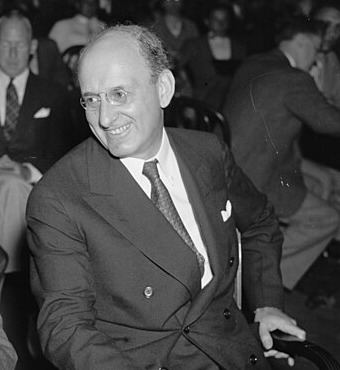

Secretary of the Treasury (1934-1945) · United States
On the regime page: Roosevelt administration
4 quotes, oldest first. Filter with other speakers.
“One of the greatest crimes in history, the slaughter of the Jewish people in Europe, is continuing unabated. This Government has for a long time maintained that its policy is to work out programs to save those Jews and other persecuted minorities of Europe who could be saved. You are probably not as familiar as I with the utter failure of certain officials in our State Department, who are charged with actually carrying out this policy, to take any effective action to prevent the extermination of the Jews in German-controlled Europe.”
Opening of the report Morgenthau presented to President Roosevelt at the White House on 16 January 1944. It was drafted by Treasury staff, chiefly Josiah E. DuBois Jr., and went to the President under Morgenthau's name; within days Roosevelt created the War Refugee Board.
Personal Report to the President (original title: Report to the Secretary on the Acquiescence of This Government in the Murder of the Jews), Morgenthau Diaries, Book 694, pp. 194-202, Franklin D. Roosevelt Library, Hyde Park, dated 16 January 1944, as reprinted in A Study of the Holocaust: Student Readings (ERIC ED419720) Source
Content note: Accusation of antisemitism against US officials The words are shown as they were said or written. Why
“Whether one views this failure as being deliberate on the part of those officials handling the matter, or merely due to their incompetence, is not too important from my point of view. However, there is a growing number of responsible people and organizations today who have ceased to view our failure as the product of simple incompetence on the part of those officials in the State Department charged with handling this problem. They see plain Anti-Semitism motivating the actions of these State Department officials and, rightly or wrongly, it will require little more in the way of proof for this suspicion to explode into a nasty scandal.”
From the same report to the President, which accused named State Department officials of obstructing rescue of Jews from Europe and set out two cases in evidence.
Personal Report to the President (original title: Report to the Secretary on the Acquiescence of This Government in the Murder of the Jews), Morgenthau Diaries, Book 694, pp. 194-202, Franklin D. Roosevelt Library, Hyde Park, dated 16 January 1944, as reprinted in A Study of the Holocaust: Student Readings (ERIC ED419720) Source
“Here lies the heart of German industrial power, the caldron of wars. This area should not only be stripped of all presently existing industries but so weakened and controlled that it can not in the foreseeable future become an industrial area.”
Treasury memorandum on the treatment of Germany after surrender, sent to Roosevelt and to Hull and carried to the Quebec Conference in September 1944. It proposed partitioning Germany and removing or destroying industry in the Ruhr.
Morgenthau to President Roosevelt, "Suggested Post-Surrender Program for Germany," 5 September 1944, section 3 (The Ruhr Area), Foreign Relations of the United States: Conference at Quebec, 1944, doc. 86, p. 102 Source
“The responsibility for sustaining the German economy and people rests with the German people with such facilities as may be available under the circumstances.”
Section 7 of the same Treasury program set the limits of military government responsibility for the German civilian economy after surrender. Roosevelt and Churchill initialled a related memorandum at Quebec in mid-September 1944.
Morgenthau to President Roosevelt, "Suggested Post-Surrender Program for Germany," 5 September 1944, section 7, Foreign Relations of the United States: Conference at Quebec, 1944, doc. 86, p. 104 Source