Newton D. Baker
Illustration, not an archive object
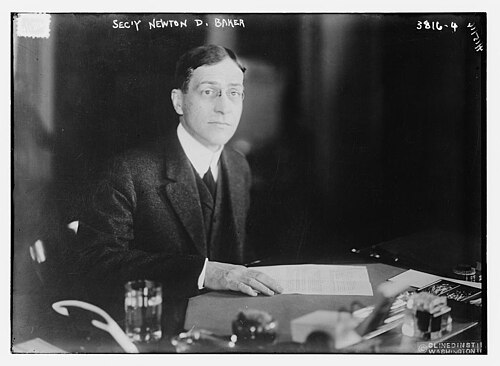

Secretary of War of the United States (1916-1921) · United States
On the regime page: Wilson administration
7 quotes, oldest first. Filter with other speakers.
“I can easily imagine a man whose affiliations, for instance, would be with a German ancestry and German traditions, making an indiscreet remark and arousing a very great deal of resentment, and following this a heady community impulse not only against him and his remark, but generalized against all persons who bore the same kind of name or the same sort of traditional affiliation. And I can easily imagine a community getting itself worked up into a pretty feverish state of opinion, and feeling that it ought to resent as disloyal what was perhaps only a thoughtless and unmeant indiscretion.”
Baker spoke about five weeks after the United States entered the war, to college presidents called to Washington. He asked them to discourage intolerance toward people of German descent.
"The Task of the Colleges", address to a gathering of college presidents, Washington, 5 May 1917, in Newton D. Baker, Frontiers of Freedom (New York: George H. Doran, 1918), p. 28 Source
“This is the time for physicians of public opinion to exercise a curative impulse. You gentlemen and the young men who are in your colleges, who go to their homes from your colleges and write to their homes from your colleges, making up thus a very large part of the direction of public opinion, you can exercise a curative influence by preaching the doctrine of tolerance, by exemplifying the fact that it is not necessary for a nation like the United States, which is fighting for the vindication of a great ideal, to discolor its purpose by hatreds or by the entertainment of any unworthy emotion.”
The passage follows his warning about community reactions to remarks by people of German descent, in the same address to college presidents.
"The Task of the Colleges", address to a gathering of college presidents, Washington, 5 May 1917, in Newton D. Baker, Frontiers of Freedom (New York: George H. Doran, 1918), pp. 28-29 Source
“Not to add a square inch to the territory of the United States; not to take from any man, woman, or child living in the world a single thing which belongs to him; not even for the glory of successful arms; but in order to reestablish those principles of national justice without which national continuance and life can not prevail, and to give to the stricken peoples of the world who have been fighting for the right, rest and respite to rehabilitate their almost destroyed civilization.”
Baker spoke on the evening of the first national registration under the Selective Service Act, describing the purpose of the war and the draft registration that took place that day.
"On the Evening of Registration Day", address to the Georgetown Citizens' Association, Washington, 5 June 1917, in Newton D. Baker, Frontiers of Freedom (New York: George H. Doran, 1918), p. 38 Source
“You and I are both too wise and we have had too much experience in this country to imagine that a broken accent means a broken mind, or that a non-American name, or the inability to speak readily our language means any lack of loyalty in the man or in his make-up.”
Baker addressed the International Association of Chiefs of Police eight months into the war. He had just asked them to search out and suppress disloyalty, and went on to ask them to discriminate between disloyal people and those with ties to the enemy countries by blood or tradition.
"Problems of the Melting Pot", address to the annual convention of police chiefs, Washington, 4 December 1917, in Newton D. Baker, Frontiers of Freedom (New York: George H. Doran, 1918), p. 168 Source
“But never let us hesitate a second when we find a man living here, eating of our bread and drinking of the milk of plenty, when we find that man disloyal! The man who strikes us in the back, who undertakes to sap our strength through fire or otherwise, let us see that he is rendered harmless to accomplish any such purpose against the Government and our people.”
The passage closes his appeal to police chiefs to apply "justice and fair dealing" and avoid "haste, ignorance and suspicion" while still acting against disloyal persons.
"Problems of the Melting Pot", address to the annual convention of police chiefs, Washington, 4 December 1917, in Newton D. Baker, Frontiers of Freedom (New York: George H. Doran, 1918), p. 169 Source
“The whole business of mobilizing the mind of the world so far as American participation in the war was concerned was in a sense the work of the Committee on Public Information.”
Baker spoke at a dinner for George Creel after the armistice. His remarks were printed, in Creel's book, as the Foreword.
Informal address at a dinner for George Creel, Washington, 29 November 1918, printed as the Foreword to George Creel, How We Advertised America (New York: Harper & Brothers, 1920), p. xiii Source
“We had an alternative to face when we went into this war. The instant reaction of habit and tradition was to establish strict censorship, to allow to ooze out just such information as a few select persons might deem to be helpful, and to suppress all of the things which these persons deemed hurtful.”
Baker contrasts the Committee on Public Information with a conventional press-censorship board, in remarks printed as the Foreword to Creel's history of the Committee.
Informal address at a dinner for George Creel, Washington, 29 November 1918, printed as the Foreword to George Creel, How We Advertised America (New York: Harper & Brothers, 1920), p. xiii Source