In one line: Adolf Hitler, Reich Chancellor from 1933 and Führer from 1934, killed himself in the Führerbunker in Berlin on 30 April 1945, a week before Germany's surrender, and the German radio announced on 1 May that he had "fallen" fighting Bolshevism.
The final days
Hitler moved into the Führerbunker, beneath the garden of the Old Reich Chancellery, on 16 January 1945. On 22 April, when an ordered counter-attack had not been carried out, he said for the first time that the war was lost and that he would stay in Berlin and shoot himself (Antony Beevor, Berlin: The Downfall 1945, 2002). On 28 April he heard on the BBC and Reuters that Heinrich Himmler had offered surrender to the Western Allies through the Swedish diplomat Folke Bernadotte. He ordered Himmler's arrest and had Himmler's liaison, Hermann Fegelein, shot (Ian Kershaw, Hitler: A Biography, 2008).
Shortly after midnight on 29 April he married Eva Braun in a civil ceremony. He then dictated a private will and a political testament to his secretary Traudl Junge, naming Admiral Karl Dönitz as Reich President and Joseph Goebbels as Chancellor. On 29 April he also learned how Mussolini's body had been treated in Milan (see How Benito Mussolini died). He had one of the cyanide capsules supplied for the bunker tested on his dog Blondi, which died.
The death
Nobody saw the shot fired. After a lunch on 30 April, at about 14:30, Hitler and Braun went into his study. The accounts that matter come from men who entered afterwards: his valet Heinz Linge, his adjutant Otto Günsche and Martin Bormann. They describe Hitler slumped on the sofa with blood at his right temple and a pistol beside him, and Braun beside him with no visible wound, smelling of bitter almonds, the sign of cyanide. Kershaw puts the time at about 15:30 to 15:50.

Content note: Content note: a primary document. The typed text contains Hitler's antisemitic statements, including a charge that Jews arranged a spectacle for enemy masses, and it is shown unaltered as the record of his stated reasons. This object is shown as it was published. Why
The evidence on the method comes from several sources that do not fully agree.
- The witnesses. Linge and Günsche, interrogated by Soviet officers from 1945 to 1955 (published as Henrik Eberle and Matthias Uhl, The Hitler Book, 2005), described a shot to the temple. Hitler Youth leader Artur Axmann later said it was in the mouth. The German court of 1952 to 1956 (below) accepted the temple.
- The Soviet autopsy. A Soviet report of 8 May 1945, published by Lev Bezymenski in 1968, named cyanide poisoning. Bezymenski later admitted that the 1968 account contained deliberate untruths about the manner of death.
- The remains. A skull fragment with an apparent exit wound was found in May 1946. In 2009 the University of Connecticut archaeologist Nick Bellantoni, in the History Channel programme Hitler's Escape, said the skull fragment with the bullet hole belonged to a woman under 40; bone samples were typed at the university's Center for Applied Genetics and Technology, which said its DNA result agreed with Bellantoni's anatomical assessment and had been done on very small fragments he brought from Moscow. Vasily Khristoforov, director of the FSB archives, rejected this, saying the researchers had never contacted the archive and asking what the DNA could have been compared with, and the Russian State Archive says Bellantoni's team was not given access to the skull. No peer-reviewed paper reported the test. In 2017 the French pathologist Philippe Charlier and colleagues examined the jaw, dental bridge and a skull fragment in Moscow. They reported that the teeth matched Hitler's 1944 X-rays and dental records and could not be fakes, found no gunpowder residue on the jaw, and noted bluish stains on the dentures that they said were compatible with cyanide (Charlier and others, European Journal of Internal Medicine 54, 2018, e10 to e12). The 2018 study examined teeth and bone, not DNA, and did not address the 2009 claim.
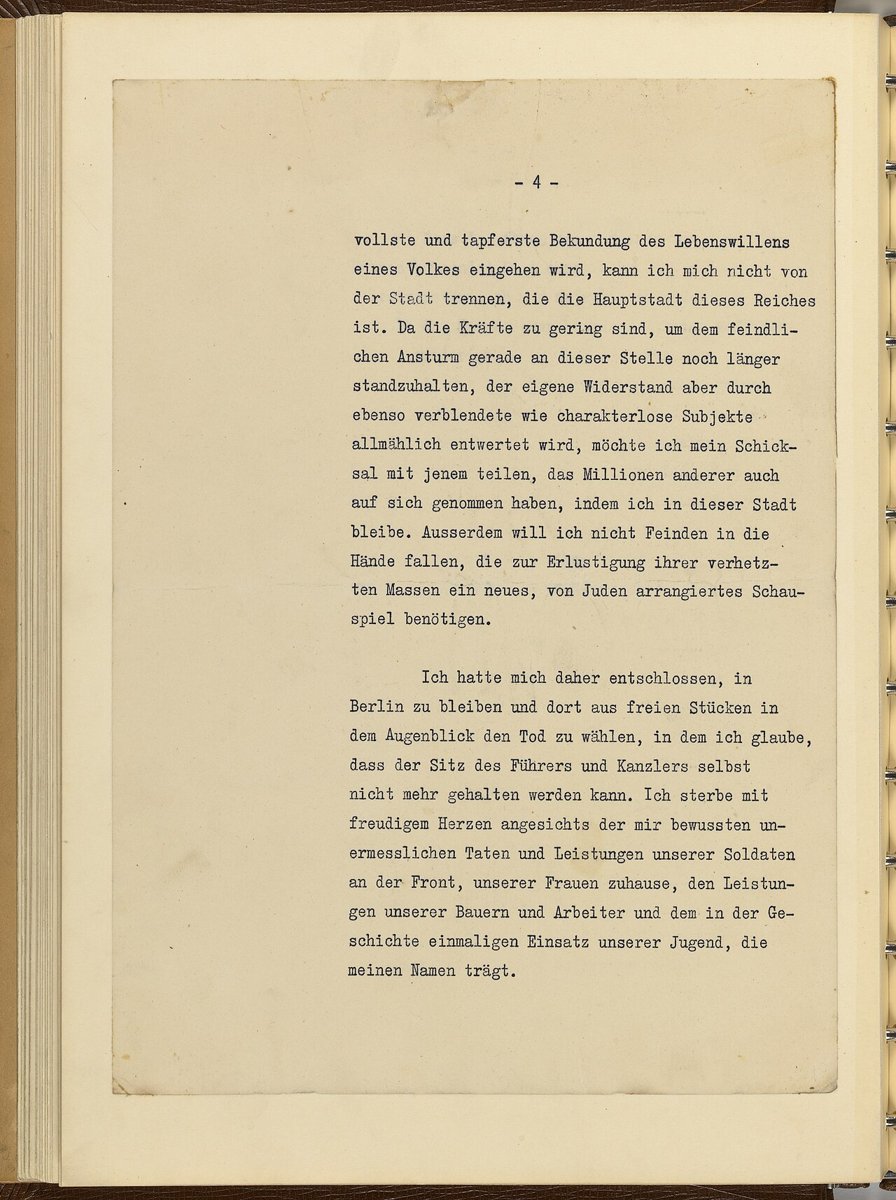
Hitler's own words are on record. His political testament, typed and signed in the early hours of 29 April, says: "Ausserdem will ich nicht Feinden in die Hände fallen, die zur Erlustigung ihrer verhetzten Massen ein neues, von Juden arrangiertes Schauspiel benötigen" ("Besides, I do not want to fall into the hands of enemies who need a new spectacle, arranged by Jews, for the amusement of their incited masses"). It also says he chose "aus freien Stücken" ("of my own free will") to die in Berlin.
What happened to the body
Linge, Günsche and others carried the two bodies up into the Chancellery garden, poured petrol over them and set them alight under shellfire, from about 16:00. Witnesses described charred remains that were later covered in a shell crater (Joachimsthaler, 1999).
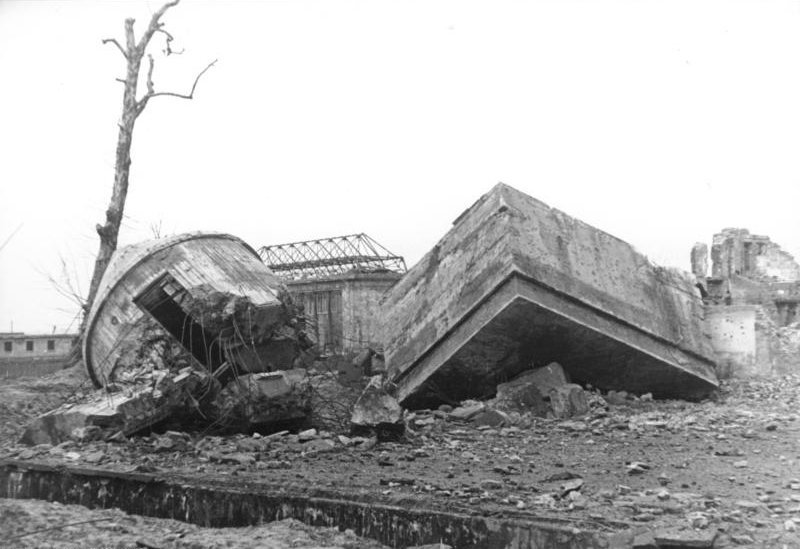

Soviet counter-intelligence found burned remains in the first days of May. Hitler's dental assistant Käthe Heusermann and technician Fritz Echtmann, who had worked for his dentist Hugo Blaschke, identified the jaw on 11 May 1945 from his records. The Soviet authorities moved the remains between several sites, among them Finow and a forest in Brandenburg, and from 1946 held them at a military compound at Magdeburg. When that compound was due to pass to East Germany, KGB chief Yuri Andropov authorised their destruction. On 4 April 1970 a KGB team cremated them and put the ashes into the Biederitz river, a tributary of the Elbe. The reason later given was to prevent a shrine. The jaw and a skull fragment remain in Moscow archives. Hitler has no grave.
How the death was announced and used
On the night of 1 May Reichssender Hamburg broadcast the news. The English text carried by the Stars and Stripes (Paris edition, 2 May 1945) reads: "It is reported from the Fuehrer's headquarters that our Fuehrer, Adolf Hitler, has fallen this afternoon at his command post in the Reich Chancellery, fighting to the last breath against Bolshevism and for his country." Dönitz then spoke, and the same page quotes him: "Hitler has fallen at his command post." and "At the end of this, his battle, and of his unswerving straight path of life, stands his death as a hero in the capital of the Reich." Neither said that Hitler had killed himself. Dönitz said Hitler had appointed him successor and framed the war as a fight against Bolshevism.
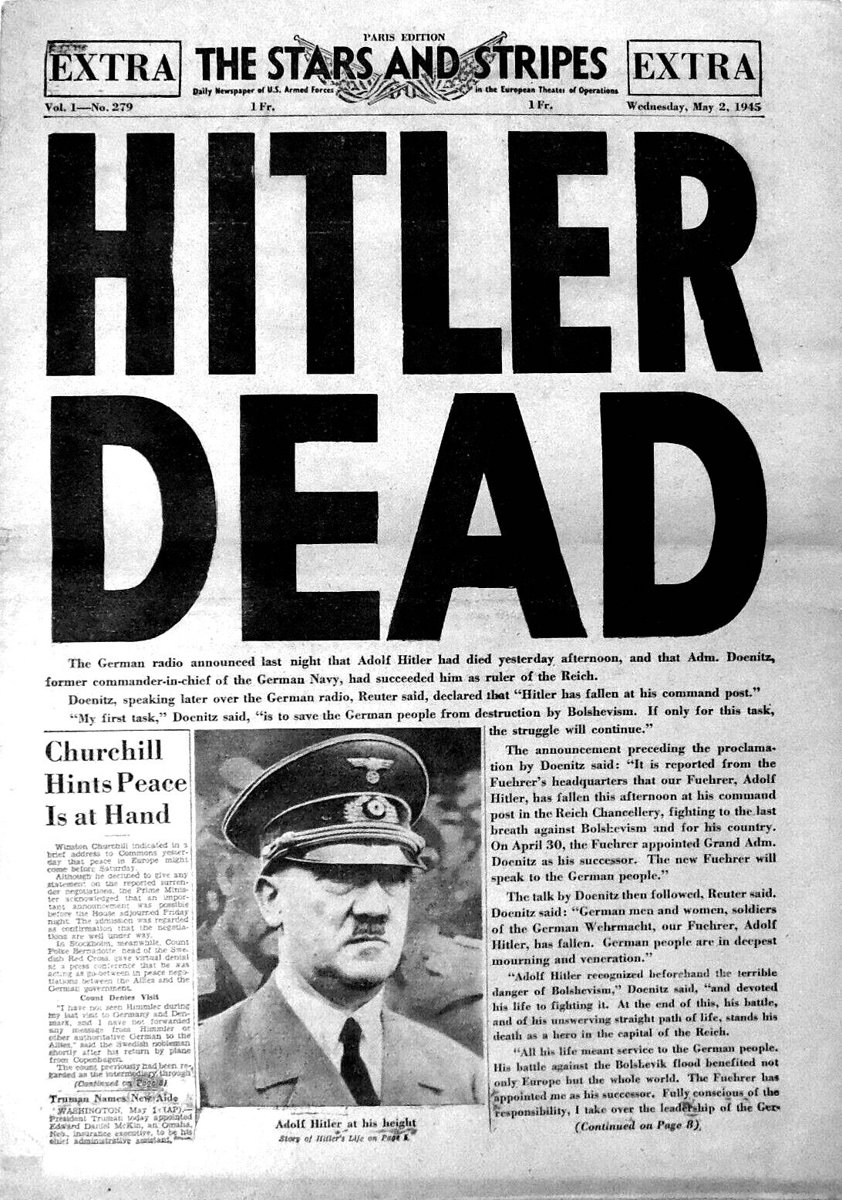

The Soviet side then used the uncertainty. At a press conference on 9 June 1945 Marshal Zhukov said no corpse had been found that could be Hitler's and that he could have flown out at the last moment. Michael Beschloss reports that Stalin told Truman at Potsdam in July 1945 that Hitler was probably in Spain or Argentina. Historians, among them Eberle and Uhl, treat this as deliberate disinformation, while the NKVD's "Operation Myth" produced a secret dossier for Stalin, the "Hitler Book", that recorded the aides' accounts of the suicide.
In the west, the British officer Hugh Trevor-Roper investigated from November 1945 and published The Last Days of Hitler in 1947, concluding that Hitler had killed himself. Claims that he survived, in South America or elsewhere, continued, and US agencies investigated and gave them no credence. A West German court at Berchtesgaden declared him dead in 1956.
Timeline
- 16 January 1945: Hitler moves into the Führerbunker.
- 22 April 1945: he says the war is lost.
- 28 April 1945: he learns of Himmler's approach to the Allies; Fegelein is shot.
- 29 April 1945: marriage to Eva Braun, will and testament; he learns of Mussolini's fate.
- 30 April 1945: suicide of Hitler and Braun at about 15:30; burning of the bodies.
- 1 May 1945: radio announcement of his death; Goebbels and his wife die.
- 2 May 1945: Soviet forces take the Chancellery.
- 8 May 1945: surrender; Soviet autopsy report.
- 11 May 1945: dental identification.
- 9 June 1945: Zhukov's press conference.
- 4 April 1970: the remains are destroyed.
Same-standard note
This page uses the same sections and definitions as every "How they died" page and marks disputed points with the sources on each side. Hitler died by his own hand, in a besieged capital, at the end of a war, and his body was burned rather than displayed or buried. This differs from leaders killed by others, such as Mussolini, from those who died of illness, and from those who were tried first, and no equivalence is implied.
Sources
- Hitler, political testament, 29 April 1945, typed copy, US National Archives RG 242 (Hitler Items, Box 2A, catalogue id 6883511).
- The Stars and Stripes, Paris edition, 2 May 1945, front page (hosted here).
- Ian Kershaw, Hitler: A Biography (2008) and Hitler, 1936 to 1945: Nemesis (2000); Antony Beevor, Berlin: The Downfall 1945 (2002); Hugh Trevor-Roper, The Last Days of Hitler (1947); Anton Joachimsthaler, The Last Days of Hitler (1999); Heinz Linge, With Hitler to the End (2009).
- Henrik Eberle and Matthias Uhl, The Hitler Book (2005); Michael Beschloss, The Conquerors (2002).
- P. Charlier, R. Weil, P. Rainsard, J. Poupon and J. C. Brisard, "The remains of Adolf Hitler: a biomedical analysis and definitive identification", European Journal of Internal Medicine 54 (2018), e10 to e12, doi:10.1016/j.ejim.2018.05.014.
- 2009 skull claim: UConn Center for Applied Genetics and Technology, "Hitler's Escape (2009)", https://genome.center.uconn.edu/hitlers-escape; ABC News, "DNA Test Sparks Controversy Over Hitler's Remains", 2009, https://abcnews.com/WN/hitler-skull-russian-secret-service-custody/story?id=9288287; Smithsonian Magazine on the 2018 study, https://www.smithsonianmag.com/smart-news/hitlers-teeth-confirm-he-died-1945-180969133/ (Charlier quoted via AFP). Dates are from Kershaw, Beevor and Joachimsthaler above.