In one line: Joseph Stalin, General Secretary of the Communist Party and Chairman of the Council of Ministers, had a stroke at his dacha at Kuntsevo on the night of 1 March 1953, was found after a delay that sources explain in different ways, died on 5 March, and was embalmed and placed beside Lenin until the Party congress of 1961 had his body moved to the Kremlin Wall.
The final days
Stalin was 74. In the weeks before his death the state press was carrying the "Doctors' Plot": on 13 January 1953 TASS announced the arrest of nine physicians accused of killing Soviet leaders by harmful treatment, and Vladimir Vinogradov, long one of Stalin's own doctors, was among those named. The last evening is known mostly from memoirs. According to Nikita Khrushchev (Khrushchev Remembers, 1970), Stalin dined at Kuntsevo on 28 February with Lavrentiy Beria, Georgy Malenkov, Khrushchev and Nikolai Bulganin, and the guests left in the early hours of 1 March, between about 4 and 6 a.m. in the retellings.
The death
Sources agree on the outline and differ on the details. On 1 March Stalin did not call for anything, and the guards of the Ministry of State Security (MGB) did not go in. According to Pyotr Lozgachev, a duty officer whose account was published in the 1990s, he entered at about 10:30 p.m. with documents and found Stalin on the floor of a small room, awake but unable to speak or move his right side. Other retellings credit the housekeeper and give 11 p.m.; this page does not settle which is right. The guards telephoned the security minister, Sergei Ignatiev, who passed the news to Malenkov and Beria. Both men arrived at Kuntsevo in the early hours of 2 March, around 3 a.m. in the accounts used here. In Lozgachev's testimony, as reported by Edvard Radzinsky and later writers, Beria told him not to panic because Stalin was sleeping, and left. Doctors were summoned in the morning and examined Stalin at about 7 a.m. on 2 March, about eight and a half hours after he was found.
The doctors found right-sided paralysis, loss of speech and blood pressure of about 190/110, and diagnosed a haemorrhage in the left hemisphere. Pravda of 4 March named the team, under the Health Minister, Andrei Tretyakov, including the therapist Pyotr Lukomsky and the neurologist Nikolai Konovalov. Treatment included oxygen, drugs and leeches, and leaders attended in shifts. Stalin's daughter Svetlana Alliluyeva, who was present, wrote in Twenty Letters to a Friend (1967) that "at what seemed like the very last moment he suddenly opened his eyes and cast a glance over everyone in the room", then "suddenly lifted his left hand as though he were pointing to something above and bringing down a curse on us all. The gesture was incomprehensible and full of menace, and no one could say to whom or at what it might be directed." The official time of death is 9:50 p.m. on 5 March.
Disputed points:
- The delay. Staff said they feared disturbing him, which Roy and Zhores Medvedev have doubted. Radzinsky blamed Beria for deliberate delay. Robert Service and Simon Sebag Montefiore describe a natural stroke followed by hesitation among men who had long obeyed his orders.
- Poisoning. Felix Chuev's Sto sorok besed s Molotovym (1991) records Molotov saying that Beria had told him he had removed Stalin and saved the others; Beria was executed in December 1953 and left no account. Abdurakhman Avtorkhanov argued in Zagadka smerti Stalina: Zagovor Beriya (Posev, Frankfurt, 1976) that Stalin died as the result of a conspiracy led by Beria; an article in Rodina (2023, cited below) says he had no documentary sources and relied on stories told by "old Bolsheviks". Jonathan Brent and Vladimir Naumov (Stalin's Last Crime, 2003) raised the possibility of the anticoagulant warfarin because stomach bleeding was reported in the autopsy, and Miguel Faria (2011, 2015) named Beria and possibly Khrushchev. A 2019 reappraisal concluded that hypertensive stroke explains the autopsy findings. No toxicology has been published, and the charges against Beria in 1953 did not include Stalin's death.
What happened to the body
The autopsy was reported on 7 March: a large haemorrhage in the left hemisphere. The body lay in the Hall of Columns of the House of Unions from 6 March. The funeral was on 9 March. The coffin was carried to Red Square, Malenkov, Beria and Molotov spoke, and the coffin was taken into the Mausoleum around noon. Crowds filled the streets of central Moscow for days, and people were crushed against walls and army trucks, above all around Trubnaya Square. No official count was published. Oleg Khlevniuk (Stalin: New Biography of a Dictator, 2017) reports that Khrushchev later estimated 109 dead; it is Khrushchev's estimate as reported by Khlevniuk, not an archival count. The notes attributed to Ivan Serov, who ran the order headquarters, record that the Sklifosovsky hospital reported 127 bodies picked up in Moscow in total (as quoted by Lenta.ru, 2023, which adds that the data on the dead remain classified). Other estimates run from dozens to several thousand. The U.S. Army attaché Martin Manhoff photographed the funeral; his photographs are linked, not hosted, because the archive states no rights position.
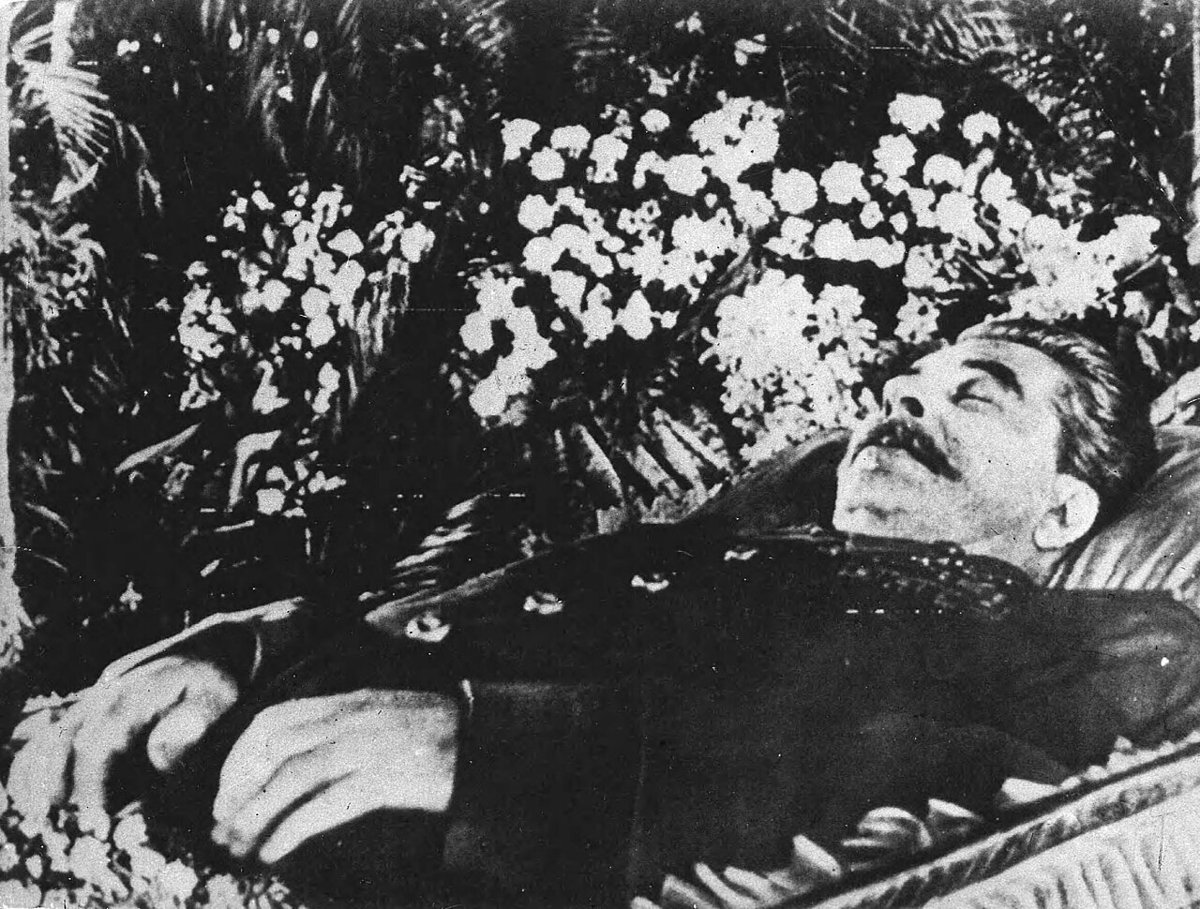

Content note: Photograph of Stalin's body in an open coffin. This object is shown as it was published. Why
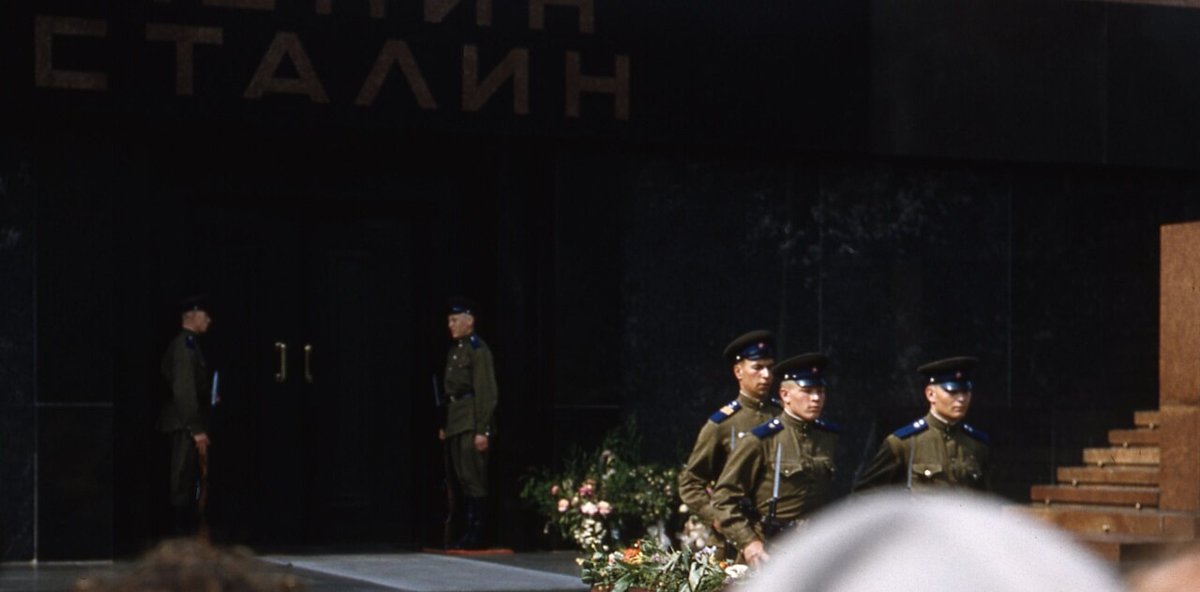

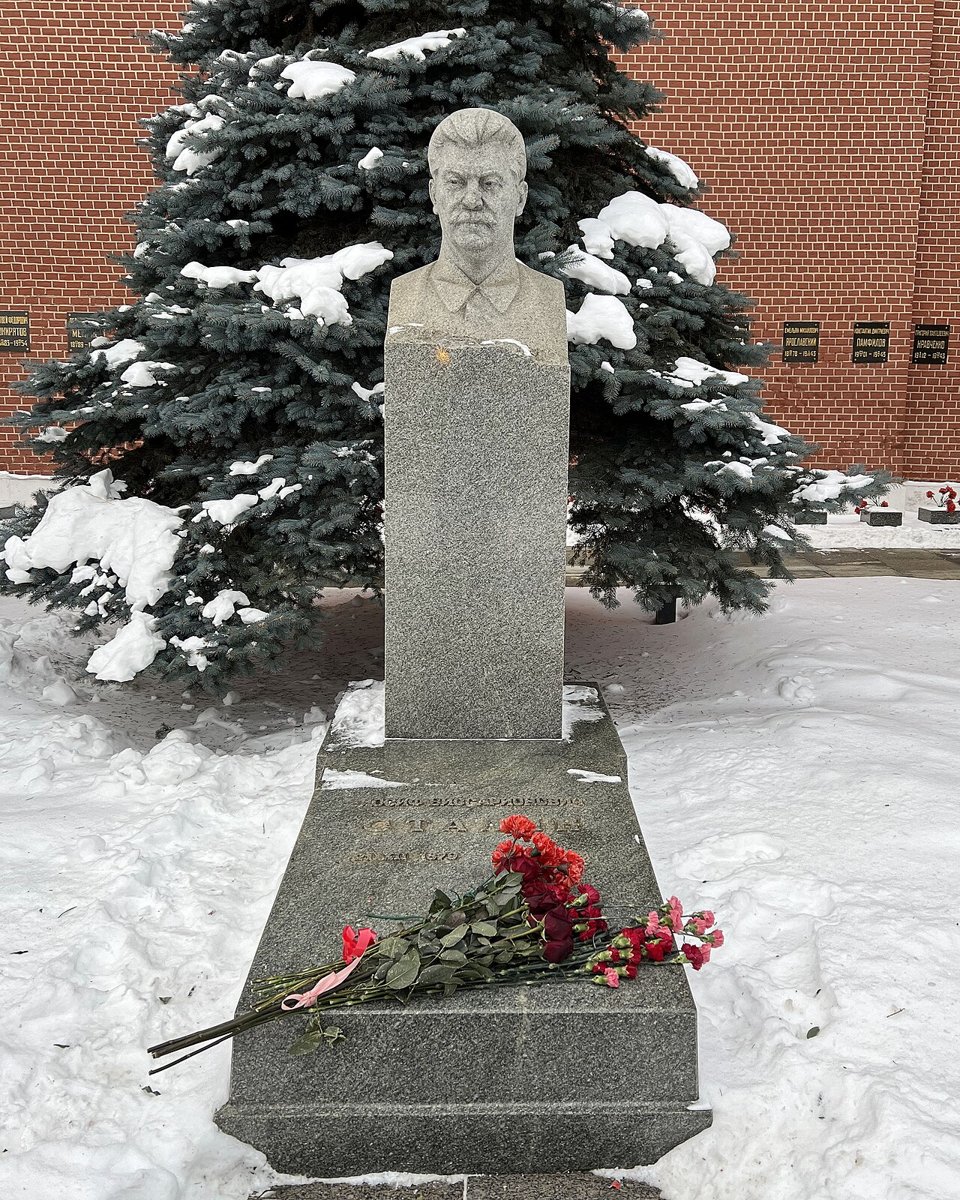
The body was embalmed, and the Mausoleum on Red Square carried both names from 1953, as a 1958 photograph shows. On 30 October 1961 the 22nd Party Congress resolved, in the widely quoted English translation, that "the further presence in the mausoleum of the sarcophagus with the coffin of J.V. Stalin shall be regarded as inexpedient" because of "the serious violations by Stalin of the Leninist behests, the abuses of power, the mass reprisals against honest Soviet people". According to Pravda, the body was removed on the night of 31 October and buried at the Kremlin Wall behind the Mausoleum.
How the death was announced and used
The first public notice was a government communiqué dated 3 March and printed in Pravda on 4 March. It said that "в ночь на 2-ое марта у товарища Сталина, когда он находился в Москве в своей квартире, произошло кровоизлияние в мозг" (translated here: in the night of 2 March, while he was in his Moscow apartment, Comrade Stalin suffered a cerebral haemorrhage). The sources above place him at the dacha at Kuntsevo; an article in Rodina (2023), which quotes the communiqué from Pravda of 4 March 1953, calls the wording a distortion of that fact while noting that the dacha then lay outside Moscow's city limits, and no document found explains the wording. The communiqué also announced medical bulletins and Stalin's temporary departure from leading state and Party work. The bulletin of 5 March gave blood pressure of 210/110 and an irregular pulse, and listed the treatments, leeches among them.
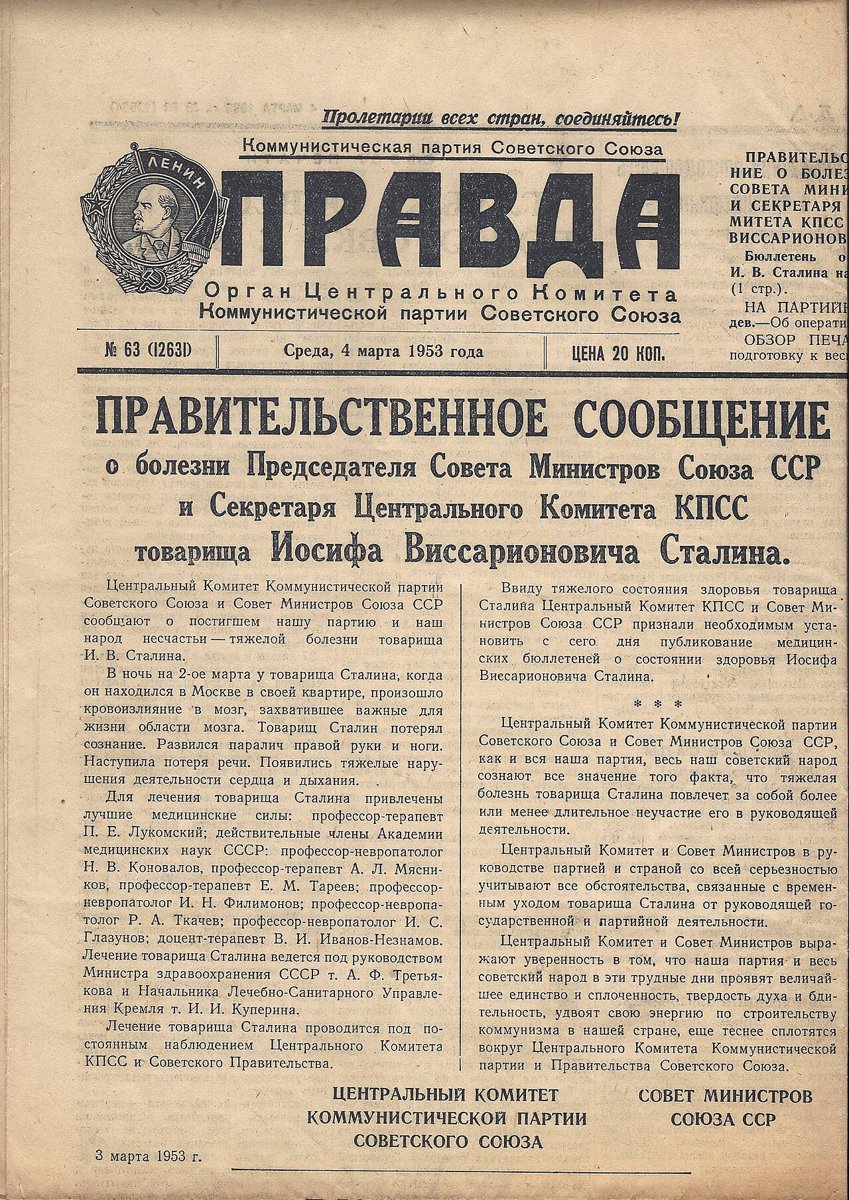

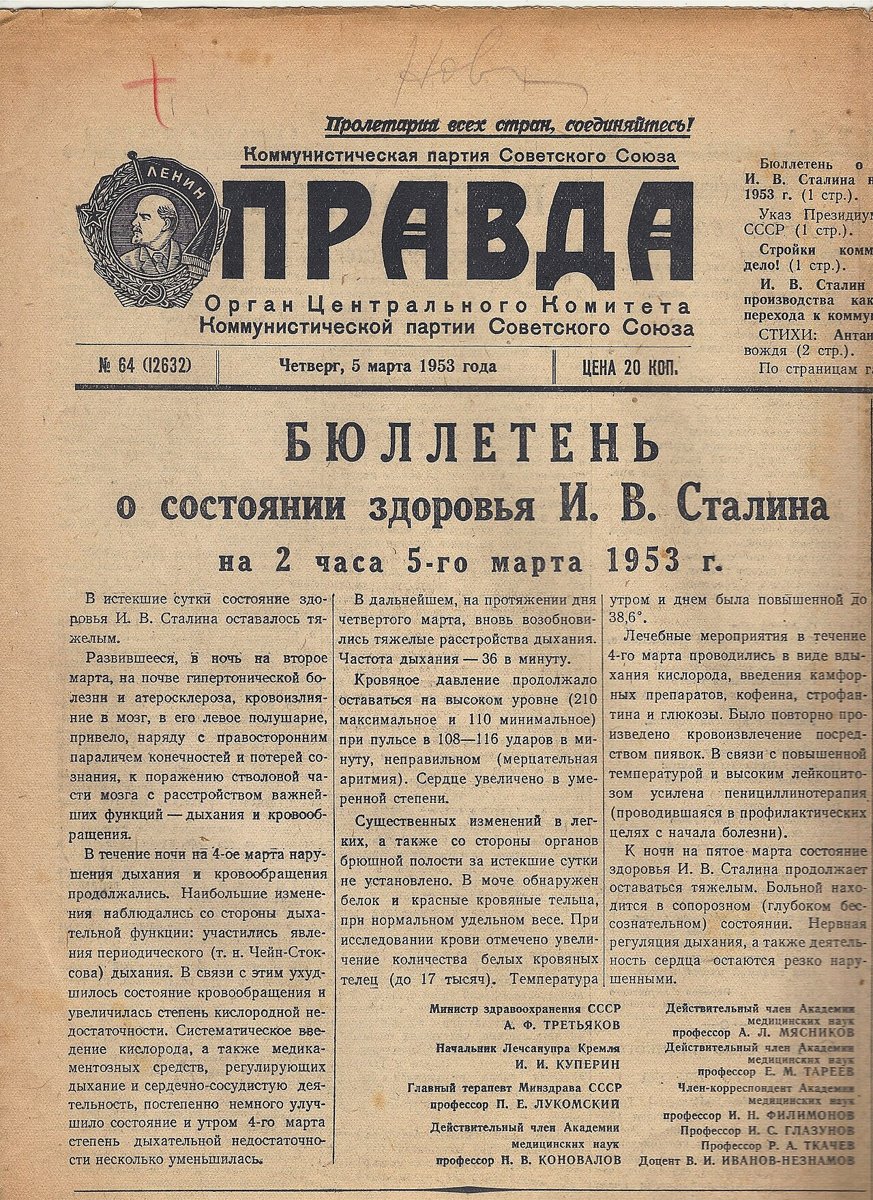

On 5 March, from 8 to 8:40 p.m., before the recorded death, a joint session of the Central Committee plenum, the Council of Ministers and the Presidium of the Supreme Soviet named Malenkov Chairman of the Council of Ministers, merged the security and interior ministries under Beria, and made Molotov Foreign Minister, according to the session's protocol. Moscow radio announced the death on the morning of 6 March. On 4 April the state announced that the Doctors' Plot arrests had been unlawful and released the doctors. Beria was arrested on 26 June.
On 25 February 1956 Khrushchev spoke to a closed session of the 20th Congress. In the marxists.org translation he began: "Comrades! In the Party Central Committee's report at the 20th Congress ... quite a lot has been said about the cult of the individual and about its harmful consequences." The text was read at Party meetings, published by the U.S. State Department in June 1956, and printed in the USSR in 1989.
Timeline
- 13 January 1953: TASS announces the arrest of nine doctors.
- 1 March, about 10:30 p.m.: Stalin is found on the floor.
- 2 March: Beria and Malenkov arrive in the early hours; doctors examine him about 7 a.m.
- 4 March: the communiqué is printed.
- 5 March: joint session, 8 to 8:40 p.m.; death at 9:50 p.m.
- 9 March: funeral and entombment beside Lenin.
- 4 April 1953: the doctors are released.
- 25 February 1956: Khrushchev's closed speech.
- 30 to 31 October 1961: the congress resolution; the body is moved.

Same-standard note
This page tells each death in the same order and treats claims of poisoning as claims, naming who made them, as it would for any leader. Stalin died in office, at a residence, of a stroke in the official record, after a delay. Other pages record deaths by shooting, in custody or in bed; Mao Zedong's body was also preserved, in different circumstances, and neither page implies an equivalence.
Sources
- Pravda, no. 63, 4 March 1953 (government communiqué) and no. 64, 5 March 1953 (medical bulletin); Pravda, 7 March 1953 (autopsy); protocol of the joint session of 5 March 1953 (constitutions.ru).
- N. S. Khrushchev, "On the Cult of Personality and Its Consequences", 25 February 1956 (marxists.org); resolution of the 22nd Congress, 30 October 1961, as quoted in contemporary press coverage.
- Edvard Radzinsky, Stalin (1996); Simon Sebag Montefiore, Stalin: The Court of the Red Tsar (2003); Robert Service, Stalin: A Biography (2004); Roy and Zhores Medvedev, The Unknown Stalin (2003); Joshua Rubenstein, The Last Days of Stalin (2016).
- Jonathan Brent and Vladimir Naumov, Stalin's Last Crime (2003); Felix Chuev, Sto sorok besed s Molotovym (1991); Abdurakhman Avtorkhanov, Zagadka smerti Stalina: Zagovor Beriya (Posev, 1976); Miguel A. Faria, "Stalin's mysterious death", Surgical Neurology International (2011), and "The death of Stalin: was it a natural death or poisoning?" (2015); "What did Joseph Stalin really die of? A reappraisal of his illness, death, and autopsy findings" (2019).
- Oleg Khlevniuk, Stalin: New Biography of a Dictator (Yale University Press, 2017), for Khrushchev's later estimate of the funeral dead.
- Svetlana Alliluyeva, Twenty Letters to a Friend (1967), letter on her father's death.
- Rodina, 4 March 2023, https://rodina-history.ru/2023/03/04/kak-ne-ubivali-stalina.html; Lenta.ru, "Tolpa napirala", 6 March 2023, https://lenta.ru/articles/2023/03/06/davka/, on the crush and the Serov notes.