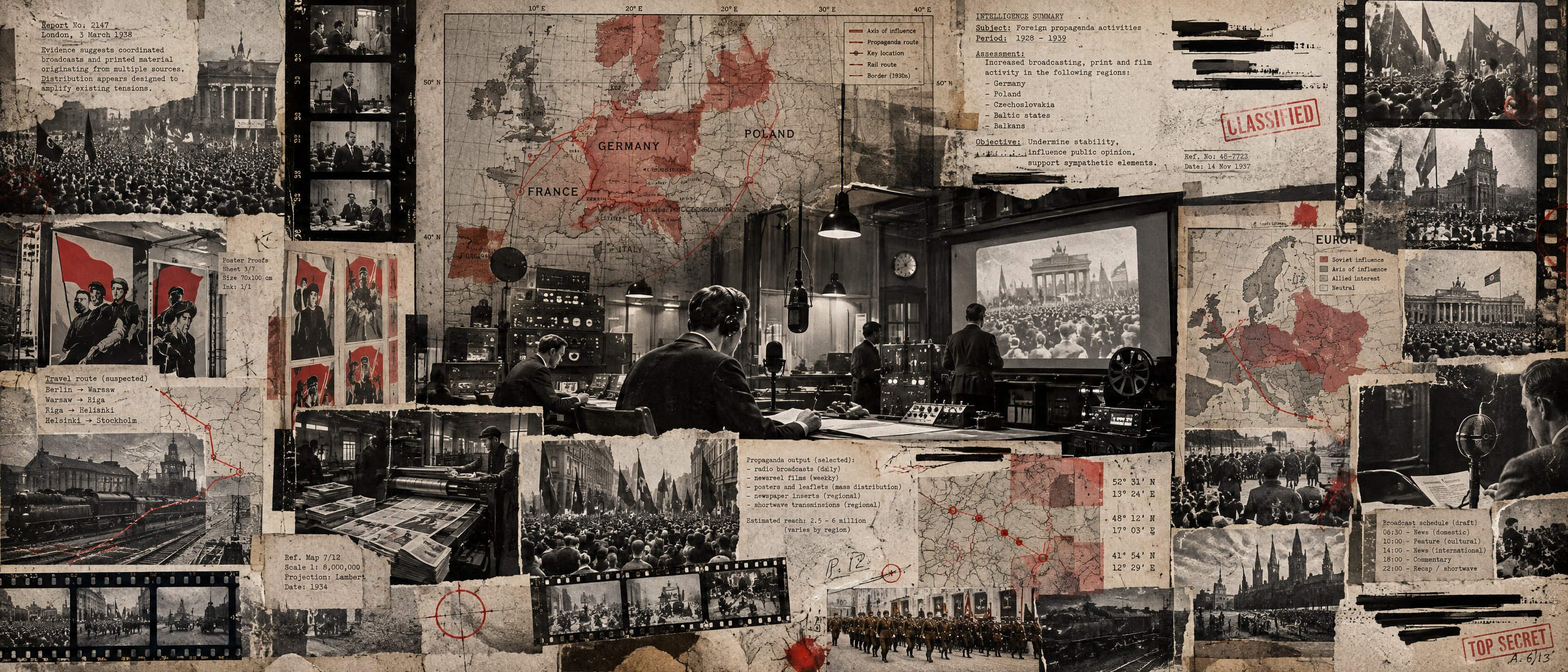
In one line: From 1922 to 1953 Joseph Stalin, as General Secretary of the Communist Party, led the Soviet Union through forced collectivisation and industrialisation, the famine of 1932 to 1933, the mass arrests and executions of 1937 and 1938, the war with Germany and postwar reconstruction, in a one-party state whose press, schools, film and literature were directed by the party's propaganda departments.
The leader and the people under the leader
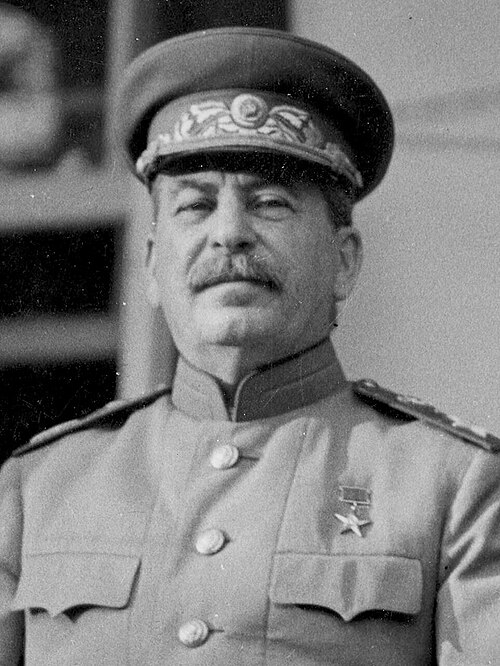
Photo: US government photographer (Franklin D. Roosevelt Library Public Domain Photographs), Public domain (PD-USGov) Joseph Stalin
General Secretary of the Central Committee; from 1941 also Chairman of the Council of People's Commissars · 1922 to 1953
Controlled party appointments through the Secretariat from 3 April 1922, became head of government on 6 May 1941 and Supreme Commander on 8 August 1941, and held these offices until his death on 5 March 1953.
In their words
“The press must grow day in and day out—it is our Party's sharpest and most powerful weapon.”
“Education is a weapon the effect of which is determined by the hands which wield it, by who is to be struck down.”
In the archive: 'Trotskyism or Leninism': the press campaign that removed Trotsky from Soviet leadership (1924-1929), The Lenin cult after 1924: an embalmed body, a mausoleum and a doctrine called "Leninism", "Liquidate the kulaks as a class": the propaganda campaign for collectivization (1929-1933)

Party leadership
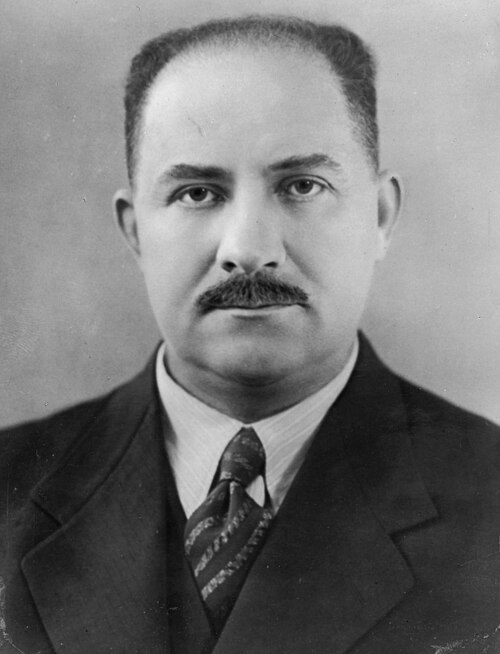
Photo: G. Weil (Grigory Vayl) for TASS, Public domain (PD-Russia; PD-1996) Lazar Kaganovich
Secretary of the Central Committee; People's Commissar of Railways · 1928 to 1939
Handled party personnel as a Central Committee secretary from 1928, led the Moscow party organization from 1930 to 1935, headed the railway commissariat from 1935 to 1937 and again from 1938 to 1942, and sat on the Politburo from 1930.
In the archive: Collectivisation, the 1932-33 famine and its denial: the kulak label, the silence and the foreign press
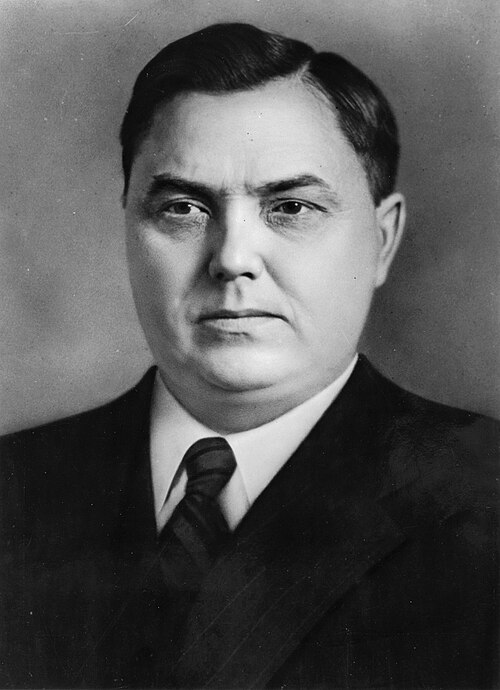
Photo: G. Weil (Grigory Vayl) for TASS, Public domain (PD-Russia; PD-1996) Georgy Malenkov
Secretary of the Central Committee; head of its cadres department · 1939 to 1953
Ran the Central Committee's personnel assignments from 1939, sat on the wartime State Defence Committee, delivered the Central Committee report to the 19th Party Congress in October 1952, and became Chairman of the Council of Ministers on 6 March 1953.
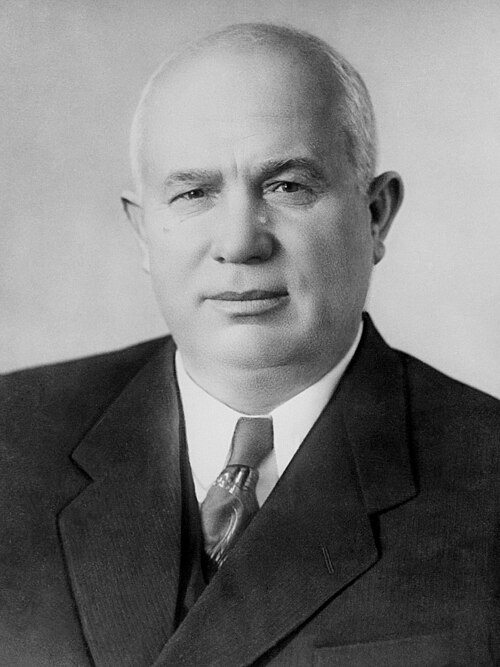
Photo: TASS, Public domain (PD-Russia; PD-US-not renewed) Nikita Khrushchev
First Secretary of the Communist Party of Ukraine; from 1949 Central Committee secretary and head of the Moscow party organization · 1938 to 1953
Led the Moscow party from 1935 to 1938 and the Ukrainian party from January 1938 to March 1947 and again from December 1947 to December 1949, then returned to Moscow as a Central Committee secretary; he denounced the "cult of personality" in a closed speech on 25 February 1956.
.jpg)

.jpg)
State and security
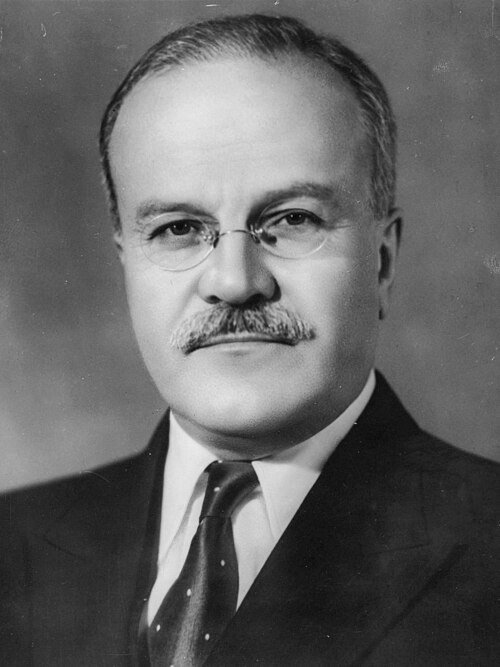
Photo: G. Weil (Grigory Vayl) for TASS, Public domain (PD-Russia; PD-1996) Vyacheslav Molotov
Chairman of the Council of People's Commissars; People's Commissar (from 1946 Minister) for Foreign Affairs · 1930 to 1949
Headed the government from 19 December 1930 until Stalin took the post in May 1941, was foreign commissar from 3 May 1939, signed the German-Soviet Non-Aggression Pact of 23 August 1939 and announced the German invasion by radio on 22 June 1941.
In the archive: Soviet wartime propaganda, 1939-1945: Sovinformburo, Agitprop and the Red Army press
No portrait with a verified licence found. Nearest: source, TASS photograph by Fyodor Kislov of 8 February 1940, tagged PD-Russia only; the photographer is named and no United States public-domain basis is recorded, so it was not used. Mikhail Kalinin
Chairman of the Central Executive Committee of the USSR; from 1938 Chairman of the Presidium of the Supreme Soviet · 1922 to 1946
Formal head of state, who signed laws and decrees for the country's central legislative body and presented state awards.
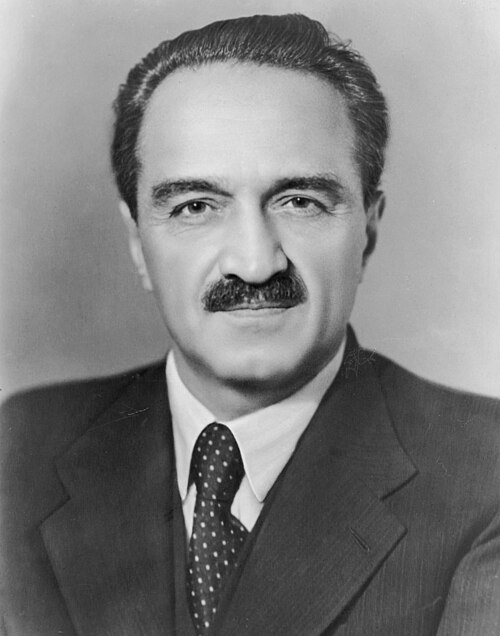
Photo: G. Weil (Grigory Vayl) for TASS, Public domain (PD-Russia; PD-1996) Anastas Mikoyan
Deputy Chairman of the Council of People's Commissars; People's Commissar for Foreign Trade · 1937 to 1953
Managed trade and food supply, was foreign trade commissar from 1938 to 1949, oversaw the receipt of Allied Lend-Lease deliveries in the war, and sat on the Politburo from 1935.
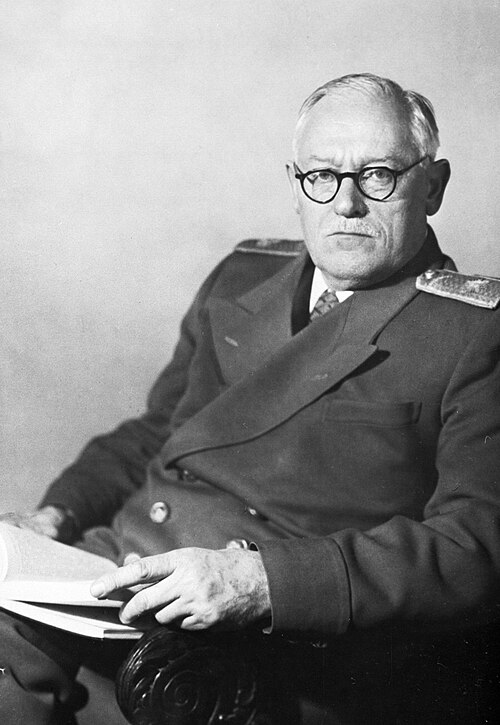
Photo: Grigory Vayl (G. Vail), RIA Novosti, CC BY-SA 3.0 Andrey Vyshinsky
Procurator of the USSR; from 1949 Minister of Foreign Affairs · 1935 to 1953
Headed the prosecution service from 1935 and was chief prosecutor at the Moscow show trials of 1936, 1937 and 1938; he became foreign minister on 4 March 1949 and held the post until Stalin's death.
In the archive: The Moscow show trials: confession, spectacle and consent (1936-1938)
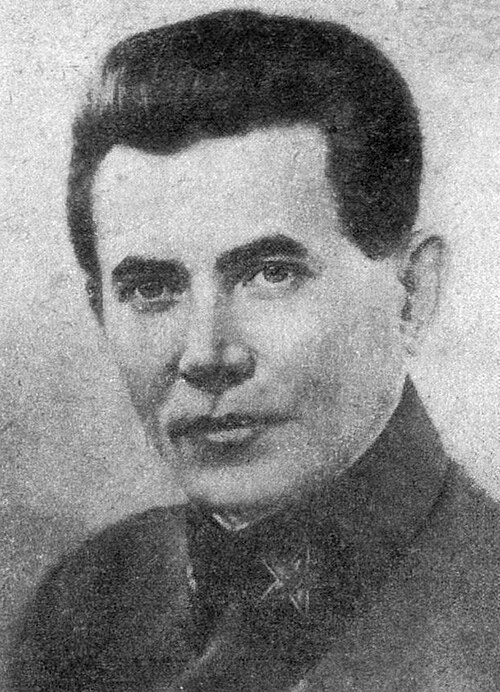
Photo: Unknown author (reproduced in the magazine Ogonyok, no. 3, 1938), Public domain (PD-Russia-1996) Nikolai Yezhov
People's Commissar for Internal Affairs (NKVD) · 1936 to 1938
Headed the NKVD from 26 September 1936 to 25 November 1938, the period of the Great Terror and of Order No. 00447; he was arrested in April 1939 and shot on 4 February 1940.
In the archive: The NKVD as its own propagandist: 'enemies of the people,' informants and the vigilant state (1934-1946), The Moscow show trials: confession, spectacle and consent (1936-1938), Glavlit and the retouched photographic record
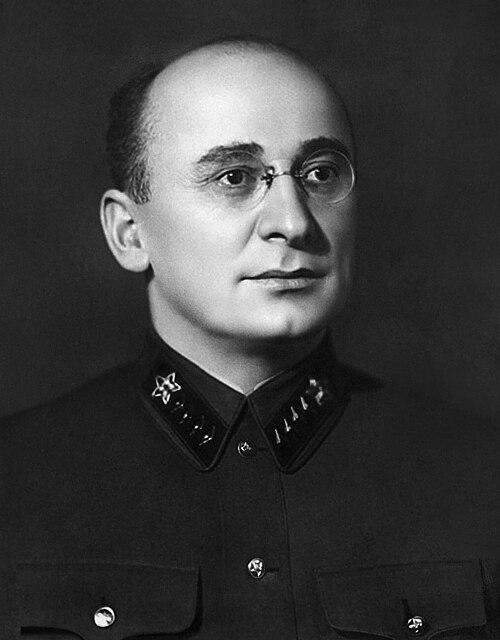
Photo: Unknown, presumed official, Public domain (PD-Russia) Lavrentiy Beria
People's Commissar for Internal Affairs (NKVD) · 1938 to 1945
Headed the NKVD, which ran the Gulag, the border troops and the wartime deportations, from November 1938 to December 1945; he later supervised the atomic-bomb programme, was arrested on 26 June 1953 and shot in December 1953.
In the archive: The NKVD as its own propagandist: 'enemies of the people,' informants and the vigilant state (1934-1946), Selling the Gulag: the "re-forging" of the White Sea-Baltic Canal, 1930-1937

.jpg)
.jpg)


Armed forces
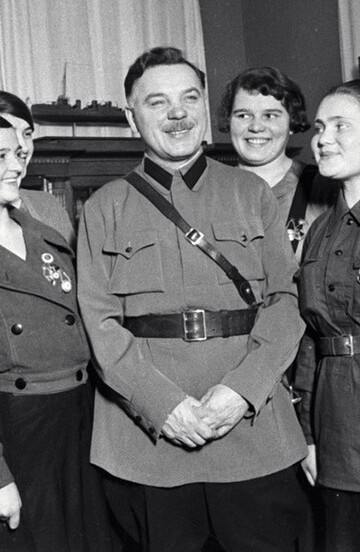
Photo: Ivan Shagin, RIA Novosti, CC BY-SA 3.0 Kliment Voroshilov
People's Commissar for Defence · 1925 to 1940
Headed the Red Army's commissariat from 1925, became one of the first five Marshals of the Soviet Union in 1935, and was replaced by Semyon Timoshenko on 7 May 1940 after the Winter War.
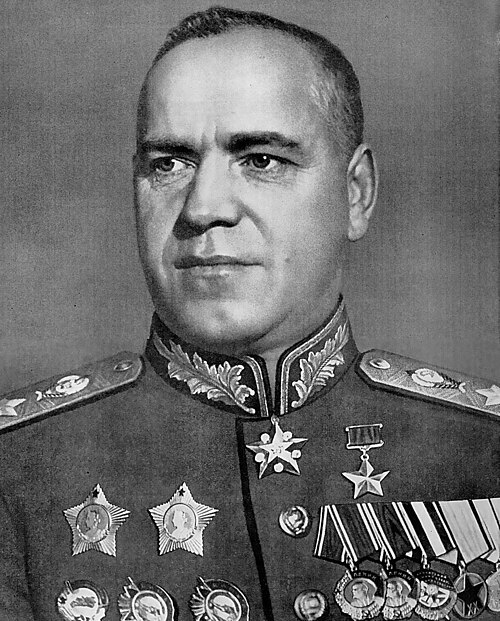
Photo: Grigory Vayl (G. Weil), published by Time Inc. in Life magazine, Public domain (PD-US-not renewed) Georgy Zhukov
Chief of the General Staff; from 1942 Deputy Supreme Commander · 1941 to 1945
Chief of the General Staff from January to July 1941, Deputy Supreme Commander from August 1942, and a commander or coordinator of fronts from Moscow to Berlin; he signed the German surrender in Berlin for the USSR on 8 May 1945.


Propaganda and culture
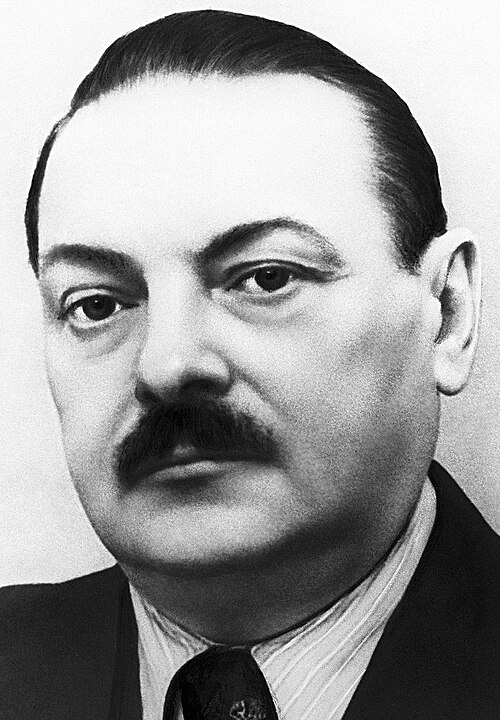
Photo: TASS, Public domain (PD-Russia; PD-US-not renewed) Andrei Zhdanov
Secretary of the Central Committee; head of the Leningrad party organization from 1934 · 1934 to 1948
Led the Leningrad party from December 1934, including through the siege, and from 1946 supervised the party's ideology and culture, directing the resolution of 14 August 1946 on the journals Zvezda and Leningrad; he died on 31 August 1948.
In their words
“In addition to this, the truthfulness and historical concreteness of the artistic portrayal should be combined with the ideological remolding and education of the toiling people in the spirit of socialism. This method in belles lettres and literary criticism is what we call the method of socialist realism.”
“We demand that our comrades, both practising writers and those in positions of literary leadership, should be guided by that without which the Soviet order cannot live, that is to say, by politics, so that our young people may be brought up not in the spirit of do-nothing and don't-care, but in an optimistic revolutionary spirit.”
In the archive: The Union of Soviet Writers and socialist realism, 1932-1969, The Agitprop Department: the Communist Party's standing propaganda apparatus, 1920-1991
No portrait with a verified licence found. Nearest: source, dated 1938 to 1945 and tagged only PD-RU-exempt (the exemption for official documents and symbols), which does not clearly cover a portrait photograph, so it was not used. Aleksandr Shcherbakov
Secretary of the Central Committee; head of the Soviet Information Bureau (Sovinformburo) · 1941 to 1945
Headed Sovinformburo from its founding on 24 June 1941 and the Red Army's Main Political Administration from June 1942, and led the Moscow party organization; he died on 10 May 1945.
In the archive: Soviet wartime propaganda, 1939-1945: Sovinformburo, Agitprop and the Red Army press
No public-domain or openly licensed portrait found on Wikimedia Commons; the English Wikipedia article carries no image. Georgy Aleksandrov
Head of the Central Committee's Propaganda and Agitation Department (Agitprop) · 1940 to 1947
Directed the party line for the press, lectures and the arts from 6 September 1940 and wrote the Pravda article of 14 April 1945, "Comrade Ehrenburg oversimplifies"; he was removed in 1947 after criticism of his history of Western philosophy.
In the archive: The Agitprop Department: the Communist Party's standing propaganda apparatus, 1920-1991, Soviet wartime propaganda, 1939-1945: Sovinformburo, Agitprop and the Red Army press
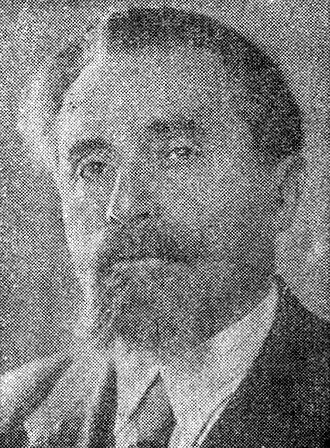
Photo: Unknown author, Public domain (PD-Russia-1996) Solomon Lozovsky
Deputy head, from 1945 head, of the Soviet Information Bureau; Deputy People's Commissar for Foreign Affairs · 1941 to 1948
Ran Sovinformburo's foreign-language output, initiated the Jewish Anti-Fascist Committee under it in 1942, was arrested in January 1949 and was shot on 12 August 1952 with twelve other committee defendants.
In the archive: Soviet wartime propaganda, 1939-1945: Sovinformburo, Agitprop and the Red Army press


Background and rise to power
The Bolsheviks took power in Petrograd on 7 November 1917 and won the civil war of 1918 to 1921 (Bolshevik agitprop). The Union of Soviet Socialist Republics was formed on 30 December 1922. Stalin, a Georgian-born Bolshevik, was elected General Secretary of the Central Committee on 3 April 1922, an office that gave him control over party appointments.
Lenin, disabled by strokes, dictated notes in December 1922 and January 1923, later called his "Letter to the Congress", in which he wrote that Stalin, "having become Secretary-General, has unlimited authority concentrated in his hands" (Lenin's Collected Works, English edition), added that "Stalin is too rude", and proposed his removal from the post. Lenin died on 21 January 1924. The notes were not published in the Soviet Union until 1956.
Stalin allied with Grigory Zinoviev and Lev Kamenev against Leon Trotsky, then with Nikolai Bukharin against them, then against Bukharin. Trotsky was expelled from the party in November 1927, exiled to Alma-Ata in January 1928 and deported from the USSR in February 1929 (the press campaign against Trotsky). Lenin's memory became a doctrine, "Leninism", of which Stalin was chief interpreter (the Lenin cult).
How power was organized
The 1936 Constitution, adopted on 5 December 1936, stated in Article 1: "The Union of Soviet Socialist Republics is a socialist state of workers and peasants." Article 126 named the Communist Party as "the vanguard of the working people in their struggle to strengthen and develop the socialist system" and "the leading core of all organizations of the working people, both public and state". At the first Supreme Soviet election, on 12 December 1937, there was one candidate for each seat.
Decisions were taken in the party's Politburo and issued as party and government decrees. Stalin's formal office was the party secretaryship until 6 May 1941, when he became Chairman of the Council of People's Commissars, the head of government, which Vyacheslav Molotov had chaired from 1930. He chaired the State Defence Committee from 30 June 1941 and was Supreme Commander from 8 August 1941. Mikhail Kalinin was the formal head of state.
Coercion ran through the political police: the OGPU, then from 1934 the NKVD under Genrikh Yagoda, Nikolai Yezhov (from September 1936) and Lavrentiy Beria (from November 1938), and after 1946 the MGB (the NKVD as propagandist). Sergei Kirov was shot dead on 1 December 1934. Public trials of former party leaders followed in 1936, 1937 and 1938, with Andrei Vyshinsky as prosecutor (the Moscow show trials). NKVD Order No. 00447 of 30 July 1937 set regional quotas for arrests and executions; NKVD statistics record about 1.58 million arrests and about 682,000 executions in 1937 and 1938 (Getty and Naumov).
Collectivisation began in earnest in December 1929 with the slogan likvidatsiya kulachestva kak klassa ("liquidation of the kulaks as a class"); historians estimate about 1.8 million people were deported to "special settlements" in 1930 and 1931 (Viola). Famine deaths in 1932 to 1933 across the USSR are estimated at about 5.5 to 6.5 million by Davies and Wheatcroft, and other historians give higher totals; demographic studies put direct losses at about 3.9 million in Ukraine (Rudnytskyi and others) and Cameron estimates about 1.5 million in Kazakhstan. Governments and historians disagree over whether the famine in Ukraine was a genocide (collectivisation; the famine and its denial). The Gulag held about 2.5 million prisoners in camps and colonies in the early 1950s; its records list about 1.05 million deaths in the camps from 1934 to 1953, a count that omits prisoners released shortly before death, and scholarly estimates of deaths in Gulag detention from 1930 to 1953 run from about 1.5 to 1.8 million (Zemskov; Applebaum). Whole peoples, among them Chechens, Kalmyks and Crimean Tatars, were deported in 1943 and 1944 (the Gulag's own publicity).
The USSR and Germany signed a non-aggression pact on 23 August 1939, and the Red Army entered eastern Poland on 17 September. The NKVD shot about 22,000 Polish prisoners in spring 1940 under a Politburo decision of 5 March 1940. Germany invaded on 22 June 1941; Soviet war dead are estimated at about 27 million. After 1945 the state ran campaigns against writers (1946) and against "rootless cosmopolitans" (1948 to 1953). Stalin died on 5 March 1953.
The propaganda apparatus
The Central Committee's Agitation and Propaganda Department (Agitprop) set the line: Georgy Aleksandrov headed it from 6 September 1940 under the supervision of Andrei Zhdanov, and from 1947 Mikhail Suslov oversaw it (Agitprop; doctrine page). Pravda (the party's paper), Izvestia (the government's) and the news agency TASS carried it, and the censorship office Glavlit, created in June 1922, vetted print and images (the press institutions; Glavlit and retouched photographs).
Culture had its own channels: the Union of Soviet Writers of 1934 under Maxim Gorky, with socialist realism as its method, and Zhdanov's resolution of 14 August 1946 on the journals Zvezda and Leningrad (the Union of Writers; Soviet montage cinema). Schools taught from single approved textbooks (school control); the Komsomol and Pioneers enrolled young people (Komsomol; Pioneers), and held up a boy said to have been killed for denouncing his father, Pavlik Morozov, as a model. Official language labelled targets "kulaks", "wreckers" and "enemies of the people", and called execution vysshaya mera nakazaniya ("highest measure of punishment"). Stalin's fiftieth birthday, on 21 December 1929, opened the press cult of the leader that Jeffrey Brooks traces in Thank You, Comrade Stalin!
In the war the Soviet Information Bureau (Sovinformburo), founded on 24 June 1941 and headed by Aleksandr Shcherbakov and from 1945 by Solomon Lozovsky, issued the daily communiqués. The line followed policy: after the pact of August 1939 Molotov told the Supreme Soviet on 31 October 1939 (English text in Soviet Peace Policy, 1940) that a war for "the destruction of Hitlerism" was "not only senseless but criminal", and after 22 June 1941 the enemy became the "German-fascist invader". On 15 April 1943 a Sovinformburo statement blamed Germany for the Katyn graves; a TASS statement of 13 April 1990 acknowledged NKVD responsibility (wartime propaganda; Mainila, 1939). From 1948 the state jammed foreign radio (radio jamming).
The archive's definitions fit most clearly: name-calling ("enemy of the people", "kulak"), scapegoating (shortages and famine blamed on kulaks and "wreckers"), fear appeal (the vigilance campaign against hidden enemies), identity fusion (party, people and leader as one), manufactured consensus (single-candidate elections, unanimous resolutions), euphemism ("liquidation", "highest measure of punishment") and card stacking (no mention of the famine in the press, retouched photographs, the Katyn denial).
Timeline
- 3 April 1922: Stalin is elected General Secretary.
- 27 December 1929: Stalin announces the liquidation of the kulaks as a class.
- 1932 to 1933: famine in Ukraine, Kazakhstan and other regions.
- 1 December 1934: Kirov is shot dead.
- 19 August 1936: the first Moscow show trial opens.
- 30 July 1937: NKVD Order No. 00447.
- 23 August 1939: the German-Soviet Non-Aggression Pact.
- 22 June 1941: Germany invades.
- 8 May 1945: Germany's surrender is signed in Berlin; Zhukov signs for the USSR.
- 14 August 1946: the resolution on Zvezda and Leningrad.
- 12 August 1952: thirteen defendants in the Jewish Anti-Fascist Committee case, Lozovsky among them, are executed.
- 5 March 1953: Stalin dies.
- 25 February 1956: Khrushchev's closed speech, "On the Cult of Personality and Its Consequences".
Same-standard note
This page uses the same structure and definitions as every other regime page: a technique is listed only where the archive's working definition and a documented example fit, the same technique ids are applied to every regime, and offices and dates are stated without judging the people who held them. The scale and purpose are set out as history, not as a ranking: a one-party state that carried out mass arrests, executions, deportations and forced labour against its own population, and whose policies were followed by famine. Other regime pages record other systems, each with its own scale, intent and context.
Sources
- Constitution of the USSR, 5 December 1936; NKVD Order No. 00447, 30 July 1937; Politburo decision of 5 March 1940, released by the Russian government in 1992; V. I. Lenin, "Letter to the Congress", Collected Works, vol. 36; N. S. Khrushchev, "On the Cult of Personality and Its Consequences", 25 February 1956.
- Robert Conquest, The Great Terror: A Reassessment (1990); Simon Sebag Montefiore, Stalin: The Court of the Red Tsar (2003); Robert Service, Stalin: A Biography (2004); Stephen Kotkin, Stalin: Paradoxes of Power (2014), Stalin: Waiting for Hitler (2017).
- R. W. Davies and Stephen G. Wheatcroft, The Years of Hunger (2004); Sarah Cameron, The Hungry Steppe (2018); Lynne Viola, The Unknown Gulag (2007); Anne Applebaum, Gulag: A History (2003).
- J. Arch Getty and Oleg Naumov, The Road to Terror (1999); V. N. Zemskov, "GULAG", Sotsiologicheskie issledovaniya (1991); Jeffrey Brooks, Thank You, Comrade Stalin! (2000).
In the archive
Collection objects (6)
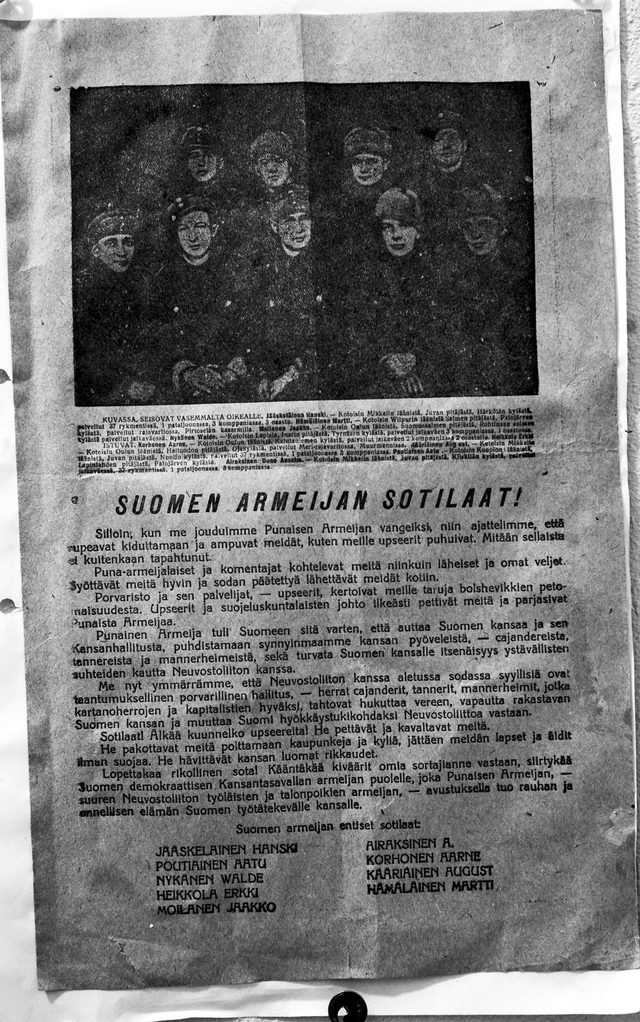 Suomen armeijan sotilaat! (Soldiers of the Finnish Army!): Soviet leaflet signed by named Finnish prisoners
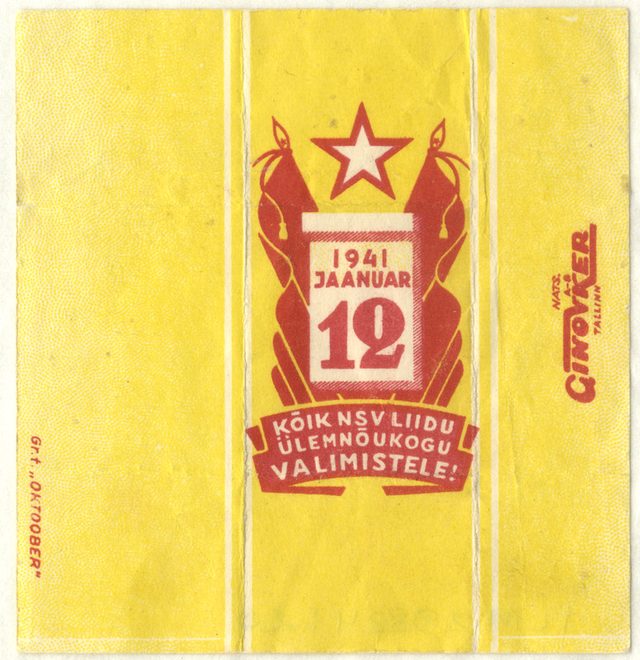 Kõik NSV Liidu Ülemnõukogu valimistele! (Everyone to the USSR Supreme Soviet Elections!): Tallinn sweet wrapper
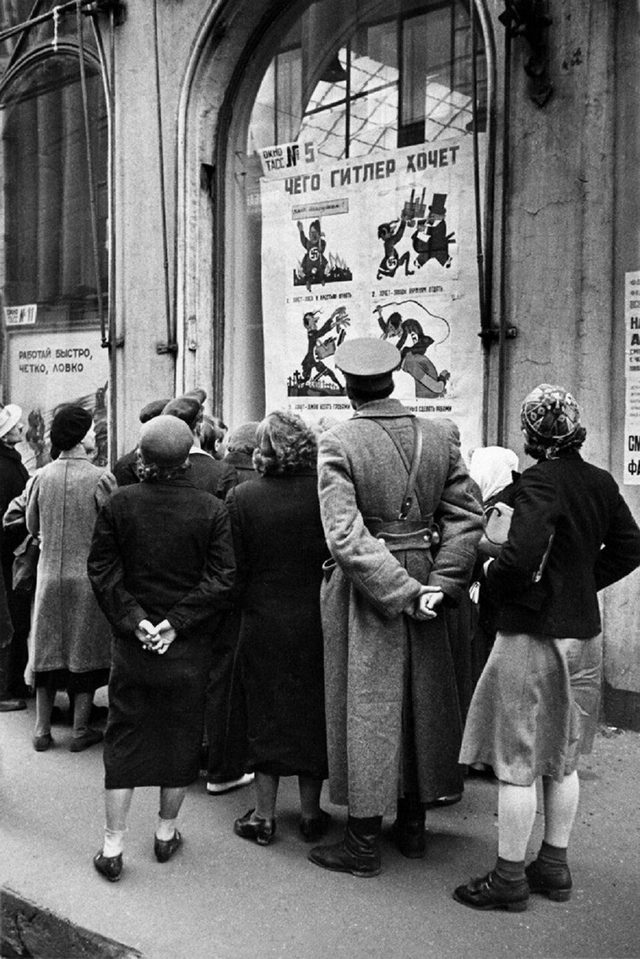 Muscovites at TASS Window No. 5, 'What Hitler Wants' (Chego Gitler khochet)Content note
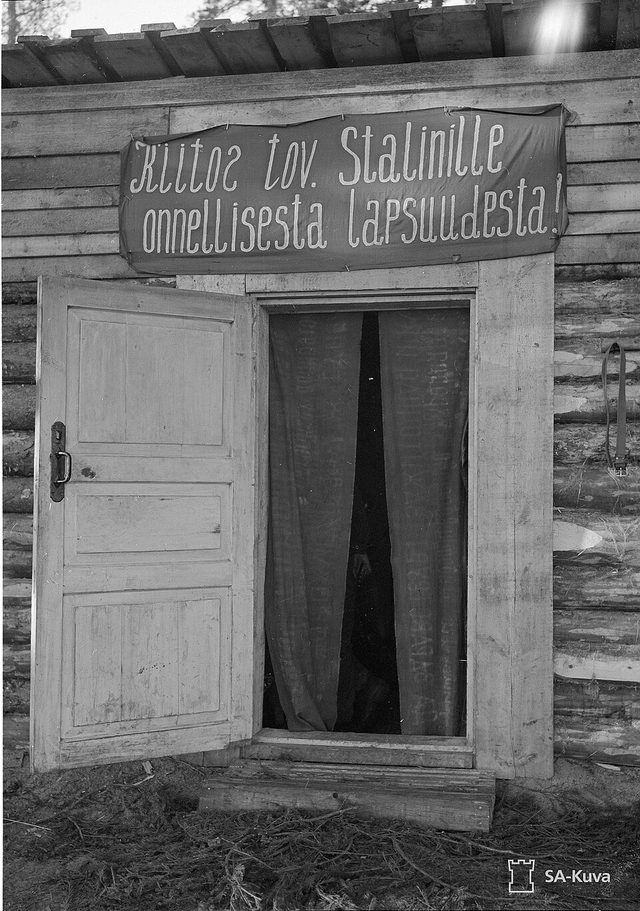 'Kiitos tov. Stalinille onnellisesta lapsuudesta!' (Thanks to Comrade Stalin for a happy childhood): banner over a hut door, Vidlitsa
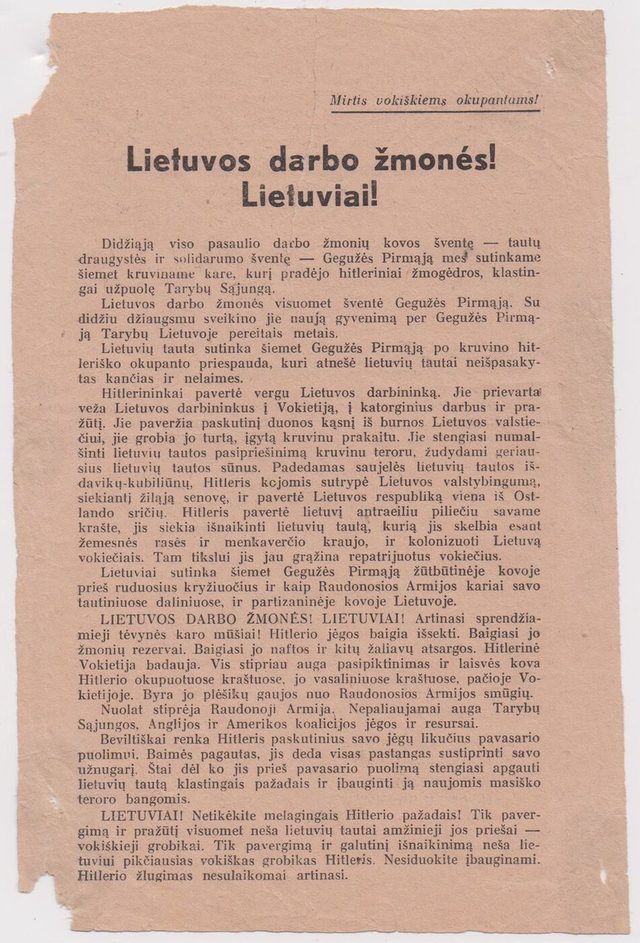 Lietuvos darbo žmonės! Lietuviai! (Working People of Lithuania! Lithuanians!): Soviet May Day leaflet for German-occupied Lithuania
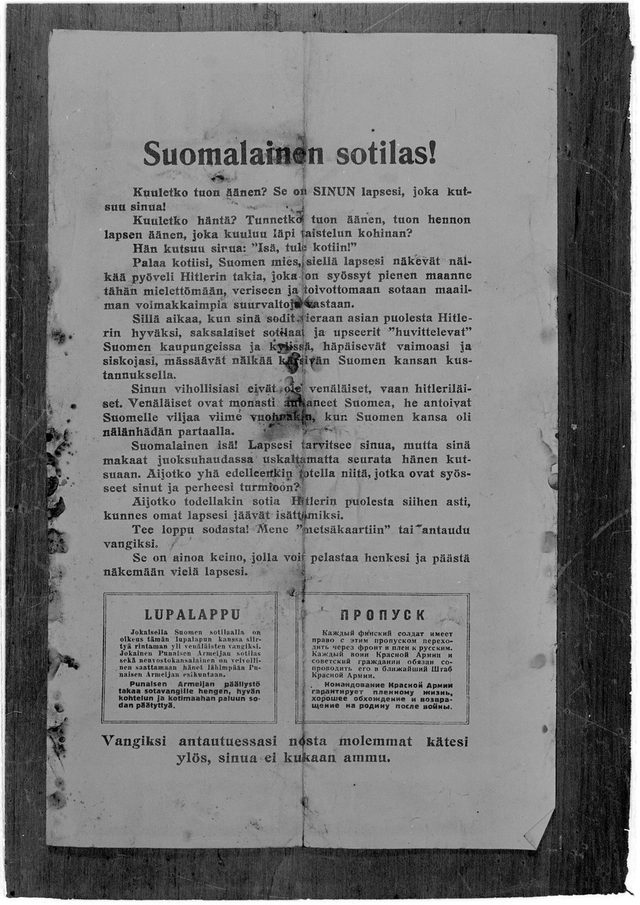 Suomalainen sotilas! (Finnish Soldier!): Soviet safe-conduct leaflet, Continuation War
Case studies
- 'Trotskyism or Leninism': the press campaign that removed Trotsky from Soviet leadership (1924-1929)
- The Lenin cult after 1924: an embalmed body, a mausoleum and a doctrine called "Leninism"
- "Liquidate the kulaks as a class": the propaganda campaign for collectivization (1929-1933)
- Collectivisation, the 1932-33 famine and its denial: the kulak label, the silence and the foreign press
- The Moscow show trials: confession, spectacle and consent (1936-1938)
- The NKVD as its own propagandist: 'enemies of the people,' informants and the vigilant state (1934-1946)
- Selling the Gulag: the "re-forging" of the White Sea-Baltic Canal, 1930-1937
- The Agitprop Department: the Communist Party's standing propaganda apparatus, 1920-1991
- Pravda, Izvestia and TASS: the institutional structure of the Soviet press monopoly, 1912-1991
- Glavlit and the retouched photographic record
- The Union of Soviet Writers and socialist realism, 1932-1969
- Soviet montage cinema as state film: Battleship Potemkin and October
- Soviet control of school curriculum and textbooks
- The Komsomol: youth pipeline, mass mobilization and internal discipline, 1918-1991
- The All-Union Pioneer Organization: scouting rebuilt as a communist pipeline, 1922-1991
- The Pavlik Morozov cult: a Soviet martyr built from a disputed murder
- Soviet wartime propaganda, 1939-1945: Sovinformburo, Agitprop and the Red Army press
- Cold War radio jamming (1948 to 1988)
- Bolshevik agitprop, 1917-1921: soviets, decrees, agit-trains and the ROSTA windows
Then and now
- Then and now: accusing the target of the attack you are about to launch (Mainila 1939, Ukraine 2022)
- Then and now: "and what about you?" (Soviet Union, Cold War; US, China and Russia, 2017–21)