In one line: Wilhelm II, German Emperor and King of Prussia from 1888 to 1918, died in exile at Huis Doorn on 4 June 1941 and was buried there on 9 June in the presence of Reich officials and Wehrmacht honour battalions, against the wishes in his 1933 testament.
The final days
The abdication came in two steps (see German Empire under Wilhelm II). On 9 November 1918, with the army in retreat and revolution in Berlin, the chancellor Max von Baden announced that the Emperor had decided to renounce the throne. Wilhelm's own retrospective account of 1922, reproduced by the German History in Documents and Images project, says the chancellor "on his own initiative, had summarily announced my abdication—which had not happened yet at all"; the project's introduction says the announcement was made without his consent. That is Wilhelm's version and the project's summary of it. We have not opened the text of the announcement itself. On 10 November Wilhelm travelled by road and then by train to the Dutch frontier at Eijsden and crossed into the Netherlands, where he stayed at Amerongen castle with Count Bentinck. On 28 November, at Amerongen, he signed a written statement of abdication as German Emperor and King of Prussia.
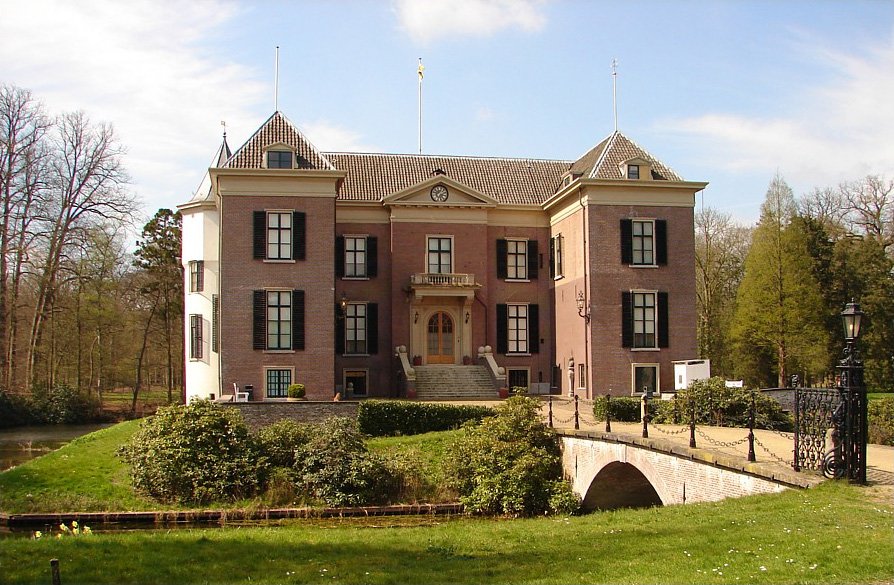

In January 1920 the Dutch government declined the Allied demand for his extradition for trial, saying it "cannot admit any other duty than that imposed upon it by the laws of the Kingdom and national tradition" and that "Holland has always been regarded as a refuge for the vanquished in international conflicts" (as quoted in Richards, Touro International Law Review, 2012). He bought the house at Doorn, near Utrecht, in 1919 and settled there on 15 May 1920. He lived there for twenty-one years with his household, wrote, felled trees in the park, and hoped for a restoration of the monarchy. On 25 December 1933 he signed a testament that set out his wishes for burial. Huis Doorn's own exhibition quotes its provisions: burial in the park at Doorn, and "een sobere uitvaart, zonder afgevaardigden uit Duitsland, zonder hakenkruisvlaggen en zonder kransen" (a plain funeral, without delegates from Germany, without swastika flags and without wreaths). The exhibition's wording is that he wished to be buried in the park at Doorn if the monarchy had not been restored at his death.
German troops invaded the Netherlands on 10 May 1940, and Doorn lay inside the occupied country from then on.
The death
Wilhelm II died at Huis Doorn on 4 June 1941, aged 82. A United Press report from Doorn dated 4 June 1941, as transcribed on a royal-history blog that attributes it to the New York Times, says he died at 11:30 a.m. after a relapse "super induced by a pulmonary embolism" during the night, and that he would be buried with full military honours at Doorn on Monday.
What happened to the body
The testament put the burial at Doorn, and the funeral was held there. Huis Doorn's exhibition names Arthur Seyss-Inquart as Hitler's personal representative at it.
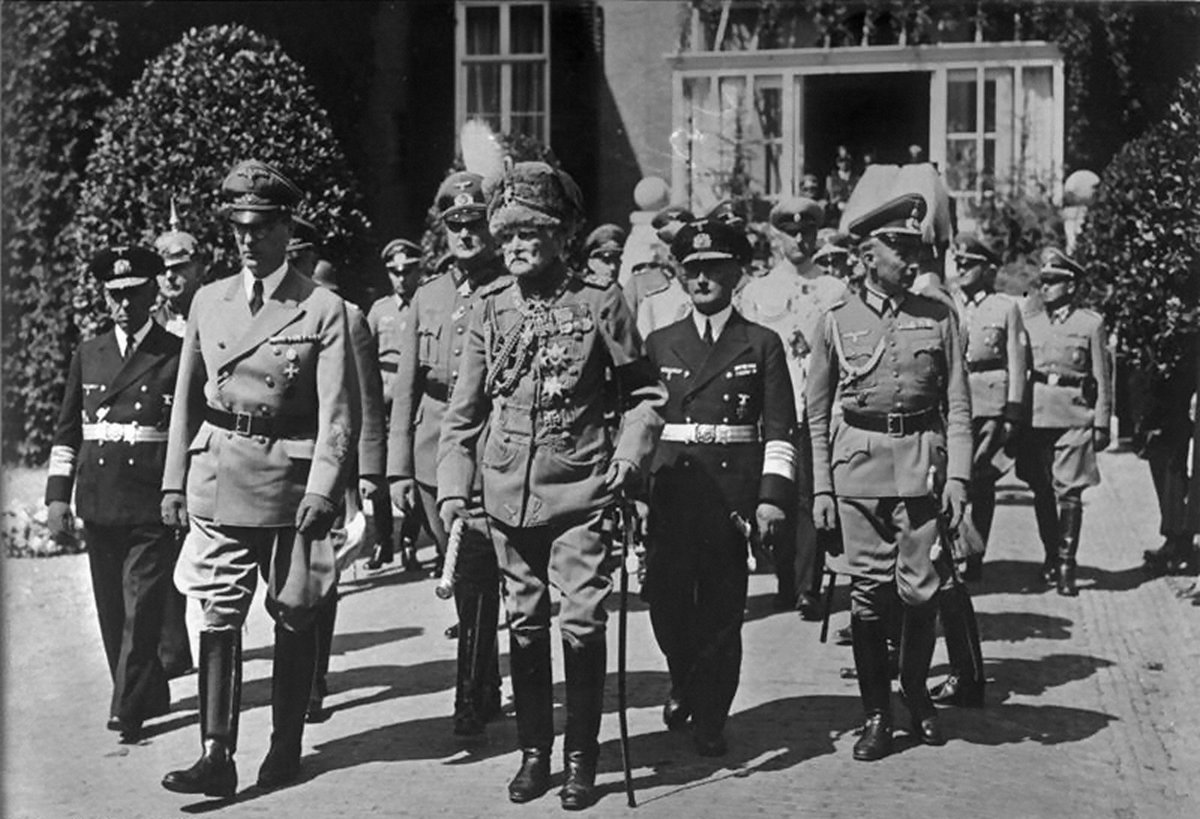


The funeral took place on 9 June 1941 in the park at Huis Doorn, five days after the death. The Bundesarchiv's press-agency caption for a photograph of the day names the Reich Minister and Reichskommissar for the occupied Netherlands, Arthur Seyss-Inquart, walking beside Field Marshal August von Mackensen, aged 91, in his old Hussar uniform. In the second row it names Admiral Wilhelm Canaris for the chief of the armed forces high command, General Friedrich Christiansen for Hermann Göring, Colonel General Curt Haase for the army's commander-in-chief and Admiral Hermann Densch for the navy's. Honour battalions of the three services of the Wehrmacht marched through the gatehouse and across the grounds, played chorales and fired salutes. The caption says a large mourning company and the people of Doorn attended. Other accounts put the number present at a few hundred.
The swastika. The testament asked for no German delegates, no swastika flags and no wreaths. The funeral had delegates from the Reich and military honours, and Huis Doorn's exhibition records ("Vele kransen met rouwlinten zijn voorzien van hakenkruizen, waaronder één van Adolf Hitler") that many wreaths had mourning ribbons bearing swastikas, one of them from Hitler; the SKBL article likewise says Hitler sent a wreath with a swastika. The sources we opened do not say whether swastika flags were displayed, and the one photograph hosted here shows uniformed mourners and no flag. How the family and household responded on the day is not recorded in the sources we have seen.
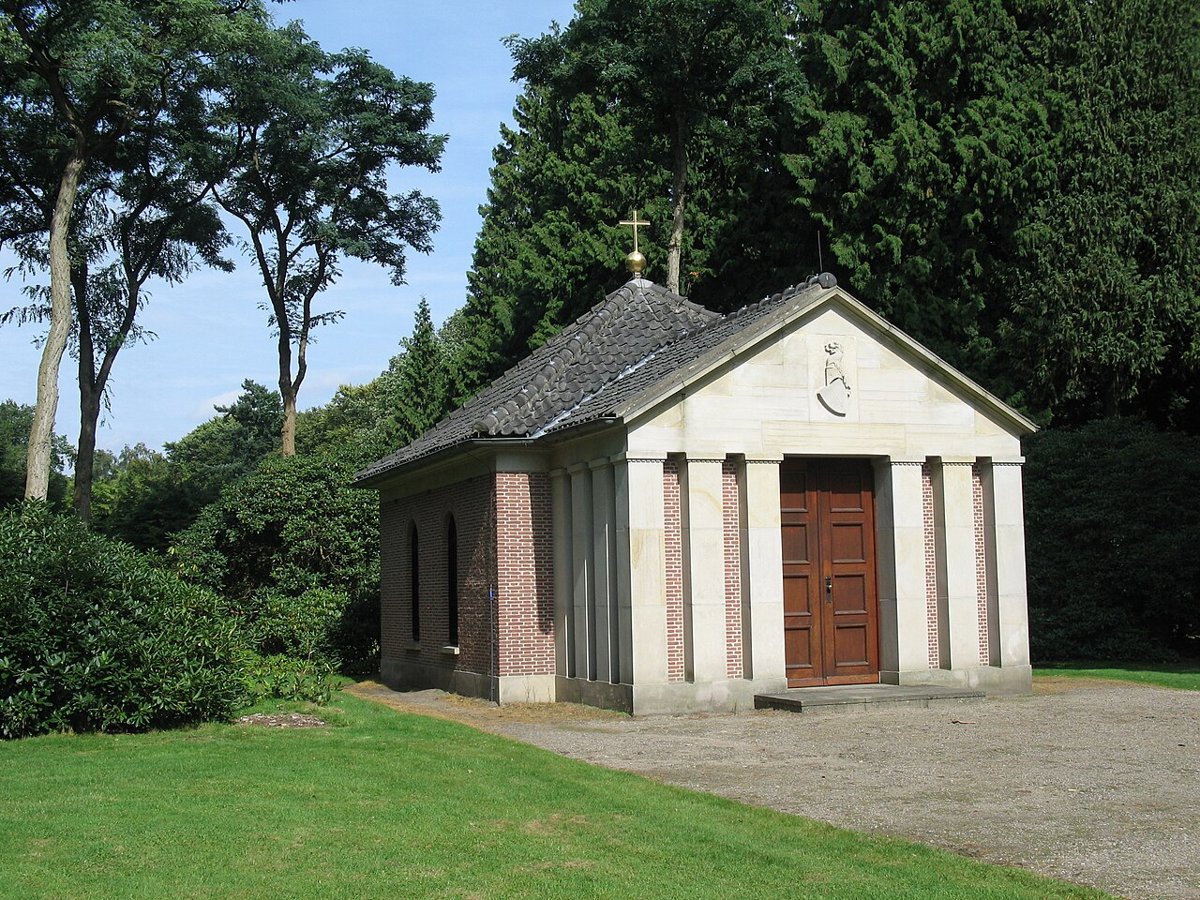
He was buried first in a chapel in the park. The architect Martin Kiessling, a Prussian official who had been dismissed in 1933, designed a mausoleum, a classical temple with twelve pilasters, with the Hohenzollern arms over the entrance. The coffin was moved into it on 4 June 1942, the first anniversary of the death. The building is still the Hohenzollern family's property, and the house became a museum in 1942, opened by the former Crown Prince. After the war the Dutch state took over the house as enemy property and refused the former Crown Prince's request to have it released. His second wife, Hermine, died in 1947 and was buried at Potsdam, not at Doorn. Wilhelm's body has remained at Doorn.
How the death was announced and used
The sources consulted do not preserve the text of the German or Dutch official announcements. What survives is the handling of the funeral. The Doorn funeral, with the Reichskommissar present and all three services represented, was photographed by the Scherl picture agency, and the Bundesarchiv's captions describe a burial "mit militärischen Ehren" (with military honours).
Timeline
- 9 November 1918: Max von Baden announces the abdication (Wilhelm says before he had agreed); a republic is proclaimed in Berlin.
- 10 November 1918: Wilhelm crosses into the Netherlands at Eijsden.
- 28 November 1918: signs the abdication statement at Amerongen.
- 15 May 1920: settles at Huis Doorn.
- 25 December 1933: signs the testament with his burial instructions.
- 10 May 1940: German forces invade the Netherlands.
- 4 June 1941: dies at Huis Doorn.
- 9 June 1941: buried in the park with Wehrmacht honours.
- 4 June 1942: coffin moved into the mausoleum.
Same-standard note
This page uses the same sections and definitions as every "How they died" page and says where the sources are secondary or silent. Wilhelm died of natural causes, in exile, in a country occupied by Germany since May 1940; the question that the record raises is what that government did with the death, and what the family did with his instructions. This differs from leaders who died in office or in custody, and no equivalence with any other page is implied.
Sources
- Huis Doorn, exhibition "De keizer en het Derde Rijk": "Uitvaart Wilhelm II", https://huisdoorn.anticipate.nl/dekeizerenhetderderijk/uitvaart-wilhelm-ii/ and "Haus Doorn im Zweiten Weltkrieg", https://huisdoorn.anticipate.nl/dekeizerenhetderderijk/haus-doorn-im-zweiten-weltkrieg/ (testament of 25 December 1933, funeral, wreaths).
- Bundesarchiv, Bild 183-L19106, Scherl and ADN press captions, 9 June 1941 (attendance at the funeral).
- Stichting Kasteel- en Buitenplaatsen Landgoederen (SKBL), "Een mausoleum als tijdelijk verblijf? De Duitse keizer in Doorn", https://www.skbl.nl/een-mausoleum-als-tijdelijk-verblijf-de-duitse-keizer-in-doorn/ (mausoleum, Kiessling, 4 June 1942, Hermine).
- United Press report from Doorn, 4 June 1941 (time and cause of death), as transcribed at https://royalmusingsblogspotcom.blogspot.com/2009/06/kaiser-wilhelm-ii-dead-at-82.html (the transcription, not the newspaper page, was opened).
- Jason Richards, Touro International Law Review 15(2), 2012, on the Dutch reply refusing extradition (https://www.tourolaw.edu/pdf/RichardsRJasonFinalArticle.pdf).
- GHDI, "Kaiser Wilhelm II on his Abdication (Retrospective Account, 1922)", https://germanhistorydocs.org/en/weimar-germany-1918-1933/kaiser-wilhelm-ii-on-his-abdication-retrospective-account-1922
- German History in Documents and Images, "Wilhelm II crosses the Dutch border", https://germanhistorydocs.org/en/wilhelmine-germany-and-the-first-world-war-1890-1918/ (10 November 1918).