In one line: the "three warfares" (public opinion warfare, psychological warfare and legal warfare) are a set of concepts written into the Chinese People's Liberation Army's Political Work Regulations in 2003, and they are a frequently cited frame in outside writing on how China's armed forces approach influence, though scholars disagree about how coherent a doctrine they form.
The source
- Primary text: 《中国人民解放军政治工作条例》 (Political Work Regulations of the Chinese People's Liberation Army), approved by the Central Committee of the Communist Party of China and the Central Military Commission and published in December 2003; revised in 2010. The three terms are 舆论战 (public opinion or media warfare), 心理战 (psychological warfare) and 法律战 (legal warfare), grouped as 三战 or 三种战法.
- Main outside sources: U.S. Department of Defense, Annual Report to Congress: Military and Security Developments Involving the People's Republic of China (annual; the 2011 edition defines the three warfares); Stefan Halper (director), China: The Three Warfares, report for Andrew Marshall, Director, Office of Net Assessment (May 2013), released through the Pentagon's FOIA reading room; Elsa B. Kania, "The PLA's Latest Strategic Thinking on the Three Warfares," China Brief 16, no. 13 (Jamestown Foundation, 22 August 2016); Sangkuk Lee, "China's 'Three Warfares': Origins, Applications, and Organizations," Journal of Strategic Studies 37, no. 2 (2014).
- Language: Chinese original; English quotations here are from English-language sources or are this archive's paraphrase.
- Rights on this archive: the PLA regulations are summarized. The DoD reports are U.S. government works (public domain). Halper, Kania, Lee and Mattis are in copyright and summarized with short quotations.
Context
The regulations are the PLA's rulebook for "political work," the Party's system of political officers, education and discipline inside the armed forces, a lineage that runs back to the Red Army (see the archive's pages on Maoist thought work). According to Chinese and outside accounts of the 2003 text, the regulations list among wartime political-work tasks to "conduct public opinion warfare, psychological warfare, and legal warfare" (开展舆论战、心理战、法律战), alongside work to disintegrate enemy forces and counter-psychological and counter-espionage work, and they require training in the three concepts. Summaries of Chinese and English sources report that the Central Military Commission issued implementing guidelines in 2005 that brought the concepts into PLA education and training.
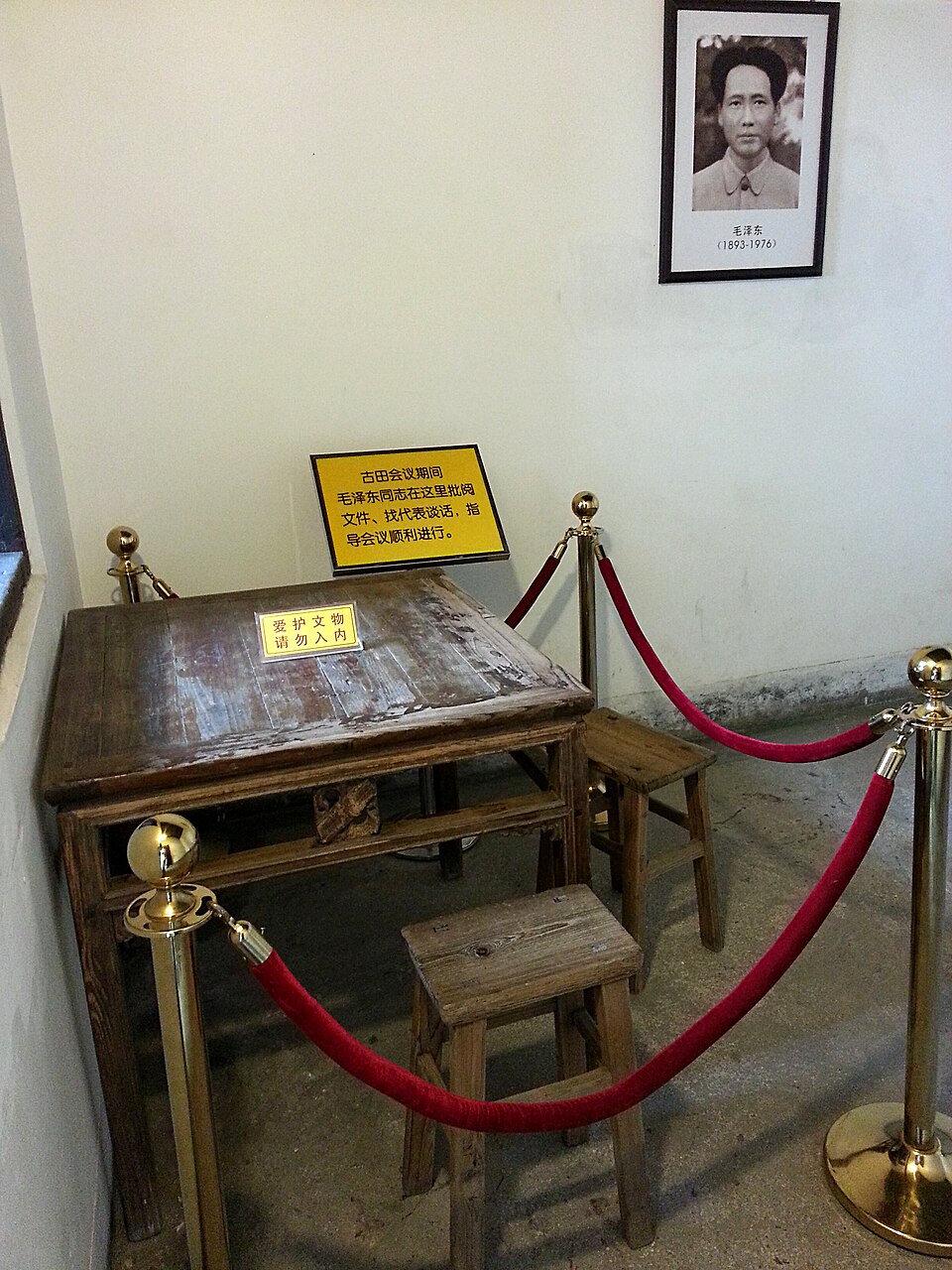
A wooden table and two stools preserved at the Gutian Congress site, Fujian, behind a rope barrier. A placard states that Mao Zedong reviewed documents, spoke with delegates and directed the proceedings of the Gutian Conference (1929) here. Photograph by Rolfmueller, 24 December 2012, CC BY-SA 3.0, via Wikimedia Commons.
Under the 2003 and 2010 regulations, responsibility sat with the General Political Department; after the 2015-16 military reforms it passed to the Central Military Commission's Political Work Department.
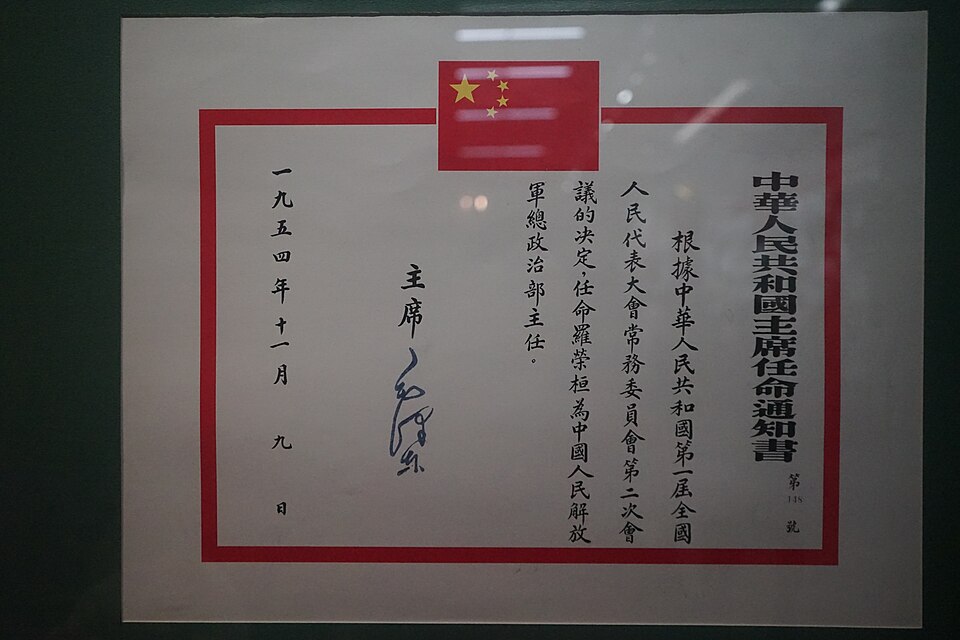
Appointment notice No. 148 of the Chairman of the People's Republic of China, 9 November 1954, naming Luo Ronghuan Director of the General Political Department of the People's Liberation Army, on display at the Military Museum of the Chinese People's Revolution, Beijing. Photograph by Huanokinhejo, 17 August 2017, CC BY-SA 4.0, via Wikimedia Commons.
What it says
Public opinion (media) warfare. The 2011 DoD report defines it as aimed at influencing domestic and international public opinion to build support for China's military actions and to dissuade an adversary from actions contrary to China's interests. Kania describes PLA writing on it as seeking to control the prevailing discourse and shape perceptions.
Psychological warfare. The DoD report describes it as seeking to undermine an enemy's ability to conduct combat operations through deterring, shocking and demoralizing enemy military personnel and supporting civilian populations.
Legal warfare. The DoD report describes it as using international and domestic law to claim the high ground or assert Chinese interests, and to constrain an adversary's operational freedom. Kania describes PLA texts treating law as a means to contest an adversary's legal arguments and justify one's own actions.
Integration with military operations. Kania, drawing on the Academy of Military Science's Science of Military Strategy (2013) and PLA National Defense University teaching materials, including an Introduction to Public Opinion Warfare, Psychological Warfare, and Legal Warfare (2014), reports that PLA writers treat the three as a force multiplier in peacetime political and diplomatic contests as well as in war.
Continuity with older ideas. Outside writers trace the concepts to classical Chinese strategy, in particular Sun Tzu's idea of winning without fighting, and the 2003 regulations place them beside the older political-work task of disintegrating enemy forces. How direct that lineage is remains a matter of interpretation.
How it worked in practice
Institutions. The concepts are assigned to the political-work system rather than to a single command. Outside accounts, summarized in the Chinese-language Wikipedia entry on 三种战法, describe shared roles for the former General Political Department's Liaison Department, the Ministry of Foreign Affairs and the United Front Work Department. Detailed budgets and staffing for three-warfares work are not public.
Documented applications as outside sources describe them. The Halper report, as quoted by the Washington Free Beacon (26 March 2014), called the three warfares "a dynamic three dimensional war-fighting process that constitutes war by other means" and "China's weapon of choice in the South China Sea." Kania and other authors point to the South China Sea as the main case: state media and diplomatic messaging on China's historic claims, the nine-dash line on official maps, and the legal campaign against the Philippines' 2013 arbitration case. When the tribunal ruled on 12 July 2016, China's Ministry of Foreign Affairs stated that the award "is null and void and has no binding force" and that China neither accepts nor recognizes it. Kania and Halper read this legal and media effort as legal warfare and public opinion warfare in action; the PRC government describes it as the defense of its sovereignty and maritime rights under international law and history.
Taiwan. Taiwan's Ministry of National Defense has published analyses applying the three warfares frame to cross-Strait messaging (for example "China's Three Warfares Strategy and Its Application toward Taiwan").
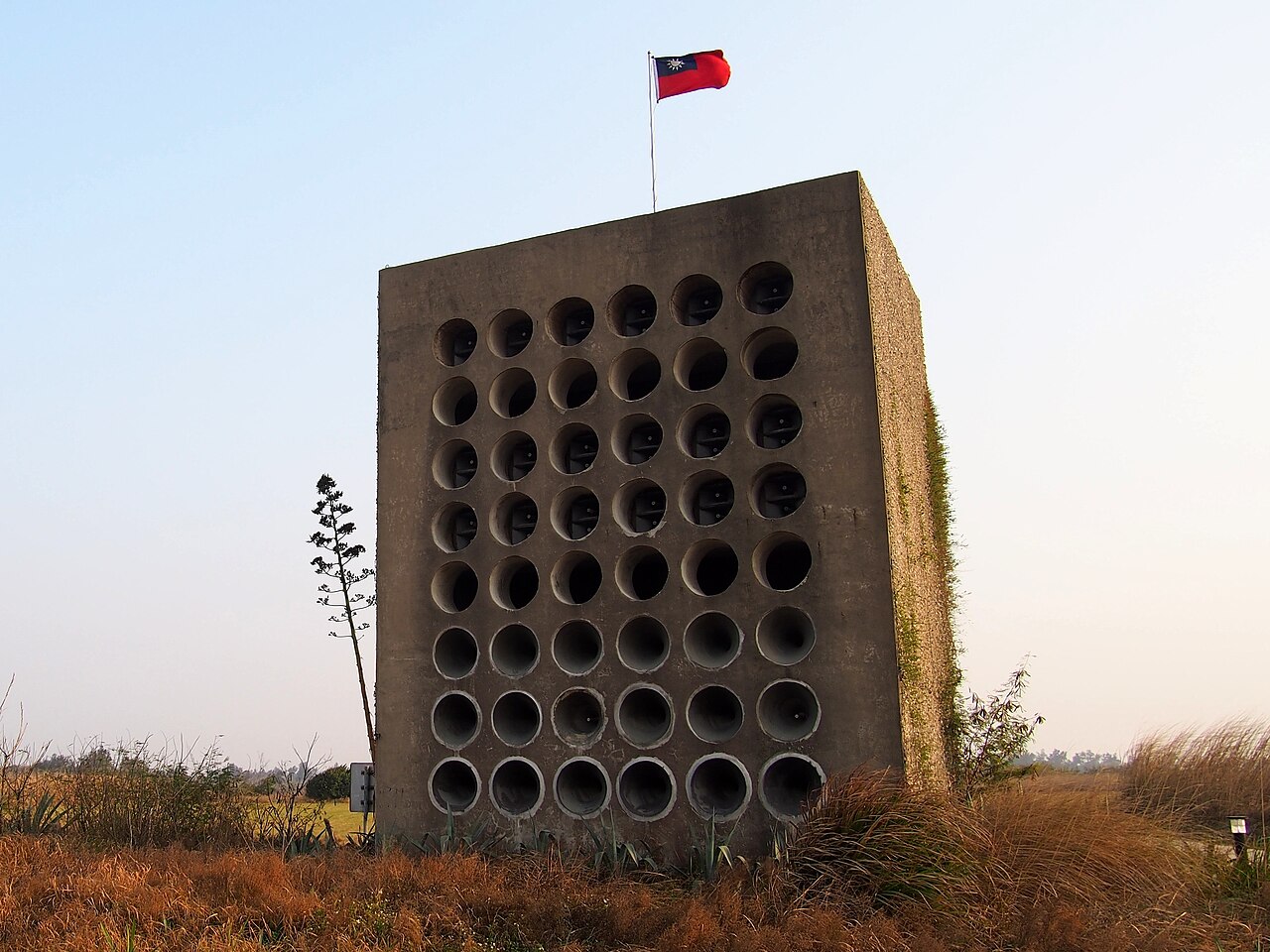
The Beishan broadcasting wall on Kinmen, built by the Republic of China army in 1967, with 48 loudspeaker openings facing Xiamen; an earlier cross-Strait messaging installation on the Taiwanese side. Photo by rheins, January 2015, via Panoramio and Wikimedia Commons, CC BY 3.0 (cropped version).
Techniques in this archive's taxonomy
- Fear appeal: the DoD definition of psychological warfare centers on deterring, shocking and demoralizing an adversary's forces and population, which matches the taxonomy's fear appeal where messages stage harm to shape behavior.
- Semantic hijacking: this taxonomy has no separate id for legal warfare. The closest is semantic hijacking: outside analyses describe legal warfare as contesting how legal terms (sovereignty, historic rights, the status of maritime features) are defined and applied. The match is partial and applies only where the dispute is over definitions; open legal argument in its own name is not propaganda under Doctrine (working definition).
Public opinion warfare as described is a general goal (shaping domestic and foreign opinion) rather than one move, so no single technique id is attached to it here.
Reception and criticism
- U.S. defense assessments (DoD annual reports) present the three warfares as a deliberate PLA concept. The Halper study for the Office of Net Assessment went further, describing it as a surrogate for armed conflict and warning, as the Free Beacon summarized it, that the U.S. government and military lacked effective tools to counter it.
- Kania (2016) treats it as a real, evolving concept in PLA writing and traces how the Academy of Military Science and National Defense University texts developed it.
- Peter Mattis ("China's 'Three Warfares' in Perspective," War on the Rocks, 30 January 2018) argues that treating the three warfares as the proxy for Beijing's influence operations is the wrong approach, because the Party centre, its propaganda system and the United Front do most of that work, and military writing is aimed at a PLA audience.
- Other critics (for example Pieter Zhao, The Strategy Bridge, 2023) argue that fitting Chinese actions into a set framework such as the three warfares can impose more coherence than the record shows and miss how actions connect to broader national strategy.
- PRC official position: the Chinese government does not publish an English exposition of the three warfares. Its Ministry of National Defense has rejected successive DoD China reports; in December 2024 spokesman Zhang Xiaogang said the report distorted China's defense policy and sensationalized a so-called Chinese military threat, and the ministry states that China pursues a defensive national defense policy.
Same-standard note
The three warfares describe a military's planned use of media, psychology and law against foreign audiences and adversaries. The same labels apply to the U.S. military's psychological operations (U.S. Army and Joint Staff, Psychological Operations doctrine (1987-2013)) and to Russia's concepts of information confrontation and reflexive control (Soviet and Russian military theory, Reflexive control and information confrontation (1960s-2016)). The differences are in form: U.S. doctrine is published in full manuals, while the PLA's is known mainly through short regulatory text, teaching materials and outside analysis, so claims about its reach carry more interpretation.
Sources
- 《中国人民解放军政治工作条例》 (Political Work Regulations of the PLA), December 2003; revised 2010. Excerpt: http://www.reformdata.org/2003/1205/4925.shtml
- U.S. Department of Defense, Annual Report to Congress: Military and Security Developments Involving the People's Republic of China 2011 (Office of the Secretary of Defense, 2011).
- Stefan Halper (dir.), China: The Three Warfares, prepared for Andy Marshall, Director, Office of Net Assessment, Office of the Secretary of Defense (May 2013). https://www.esd.whs.mil/Portals/54/Documents/FOID/Reading%20Room/Litigation_Release/Litigation%20Release%20-%20China-%20The%20Three%20Warfares%20%20201305.pdf
- Bill Gertz, "Warfare Three Ways," Washington Free Beacon, 26 March 2014. https://freebeacon.com/national-security/warfare-three-ways/
- Elsa B. Kania, "The PLA's Latest Strategic Thinking on the Three Warfares," China Brief 16, no. 13 (Jamestown Foundation, 22 August 2016). https://jamestown.org/the-plas-latest-strategic-thinking-on-the-three-warfares/
- Sangkuk Lee, "China's 'Three Warfares': Origins, Applications, and Organizations," Journal of Strategic Studies 37, no. 2 (2014). https://www.tandfonline.com/doi/abs/10.1080/01402390.2013.870071
- Peter Mattis, "China's 'Three Warfares' in Perspective," War on the Rocks, 30 January 2018. https://warontherocks.com/2018/01/chinas-three-warfares-perspective/
- Pieter Zhao, "Chinese Political Warfare: A Strategic Tautology? The Three Warfares and the Centrality of Political Warfare within Chinese Strategy," The Strategy Bridge, 28 August 2023. https://thestrategybridge.org/the-bridge/2023/8/28/chinese-political-warfare-a-strategic-tautology
- Ministry of Foreign Affairs of the People's Republic of China, "Statement ... on the Award of 12 July 2016 of the Arbitral Tribunal in the South China Sea Arbitration Established at the Request of the Republic of the Philippines," 12 July 2016. https://www.fmprc.gov.cn/nanhai/eng/snhwtlcwj_1/201607/t20160712_8527294.htm
- "China's defense ministry slams Pentagon report on China's military development as deceptive, hypocritical," Global Times, December 2024. https://www.globaltimes.cn/page/202412/1325516.shtml
- "Three warfares," Wikipedia (English) and "三种战法," Wikipedia (Chinese), consulted as pointers to the 2003 and 2005 texts. https://en.wikipedia.org/wiki/Three_warfares