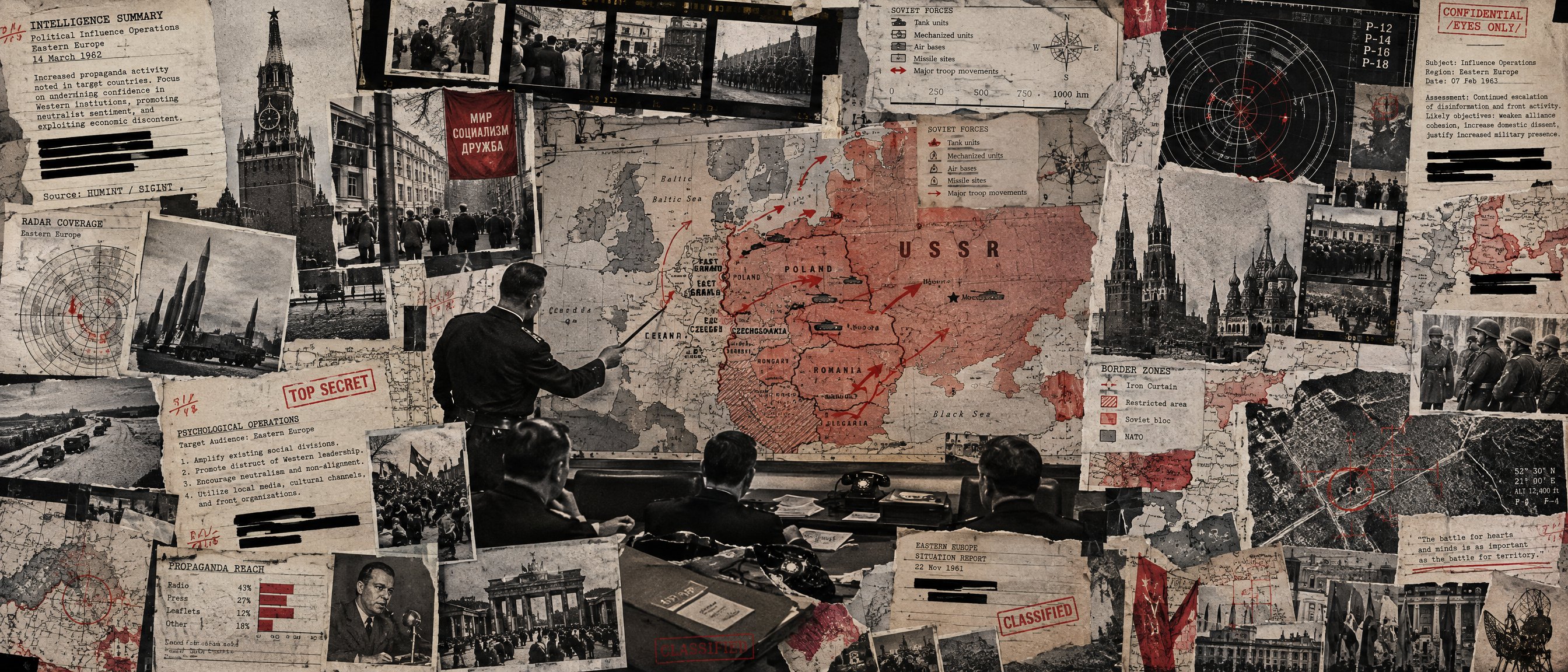
In one line: reflexive control is a Soviet-era theory, developed from the 1960s, of shaping an opponent's decisions by feeding them prepared information, and together with Russia's official doctrine of "information confrontation" it is central to how Russian and Western analysts discuss Russian information operations, alongside two outside labels, the "Gerasimov doctrine" and RAND's "firehose of falsehood."
The source
- Vladimir A. Lefebvre (1936-2020), Soviet mathematical psychologist who developed reflexive theory in Soviet military research from the 1960s; he left the USSR for the United States in 1974 and later worked at the University of California, Irvine.
- Timothy L. Thomas, "Russia's Reflexive Control Theory and the Military," Journal of Slavic Military Studies 17, no. 2 (2004): 237-256. The main English-language survey of the Soviet and Russian literature.
- Russian Federation, Information Security Doctrine (approved by President Vladimir Putin, 9 September 2000, No. Pr-1895) and its replacement, the Doctrine of Information Security of the Russian Federation (Presidential Decree No. 646, 5 December 2016).
- Valery Gerasimov, "Tsennost' nauki v predvidenii" ("The Value of Science Is in the Foresight"), Voenno-promyshlennyi kur'er (VPK), February 2013; English translation by Robert Coalson, Military Review (January-February 2016).
- Mark Galeotti, "The 'Gerasimov Doctrine' and Russian Non-Linear War," In Moscow's Shadows (blog), 6 July 2014; and "I'm Sorry for Creating the 'Gerasimov Doctrine'," Foreign Policy, 5 March 2018.
- Christopher Paul and Miriam Matthews, The Russian "Firehose of Falsehood" Propaganda Model: Why It Might Work and Options to Counter It (RAND Corporation, PE-198, 2016).
- Rights on this archive: Russian state documents are summarized from official English translations. Thomas, Galeotti and RAND are in copyright and summarized with short quotations.
Context
Reflexive control grew out of Soviet work in the 1960s on decision-making, game theory and cybernetics. Lefebvre, working in military-linked research, modeled how one side could represent the other side's reasoning and act on it. Thomas writes that the subject had been studied in the Soviet Union and Russia for nearly 40 years by 2004, with both military and civilian uses, and that it is close in meaning to the U.S. concept of perception management.
After 1991 the theme reappeared in official language as "information security" and "information confrontation" (informatsionnoe protivoborstvo), a term Russian doctrine uses for rivalry between states in the information sphere. The 2000 doctrine was issued in the first year of Putin's presidency; the 2016 doctrine replaced it after the 2014 crisis over Ukraine.
What it says
Reflexive control as defined by Thomas. Thomas describes reflexive control as "a means of conveying to a partner or an opponent specially prepared information to incline him to voluntarily make the predetermined decision desired by the initiator of the action." The target is meant to believe the decision is its own.
Modeling the opponent's reasoning. In Lefebvre's approach, the controlling side builds a model of how the opponent perceives the situation, including how the opponent perceives the controller, and chooses inputs that lead that model toward a chosen outcome.
A catalogue of methods in Soviet and Russian military writing. Thomas surveys Russian officers' writing, including Col. S. A. Komov's list of "intellectual" information-warfare methods. At the summary level the list includes distraction, overload with contradictory information, paralysis, exhaustion, deception, division of an opponent from its allies, pacification, intimidation through an appearance of superiority, provocation, suggestion and pressure that discredits a government before its population.
Information confrontation as state doctrine. The 2000 Information Security Doctrine groups threats into categories including threats to citizens' rights in spiritual life and information activity, threats to information support for state policy, and threats to Russia's information industry. The 2016 doctrine states that foreign media publish a growing volume of materials containing biased assessments of Russian state policy, that foreign intelligence services are expanding the use of informational-psychological influence aimed at destabilization, and it calls for developing the Armed Forces' "forces and means of information confrontation."
Non-military means in Gerasimov's 2013 article. Gerasimov, then newly appointed Chief of the General Staff, wrote that "the role of nonmilitary means of achieving political and strategic goals has grown, and, in many cases, they have exceeded the power of force of weapons in their effectiveness." He used the Arab Spring as an example and asked whether such turmoil might be typical of 21st-century war, stressing the integrated use of political, economic, informational and other non-military measures backed by military force.
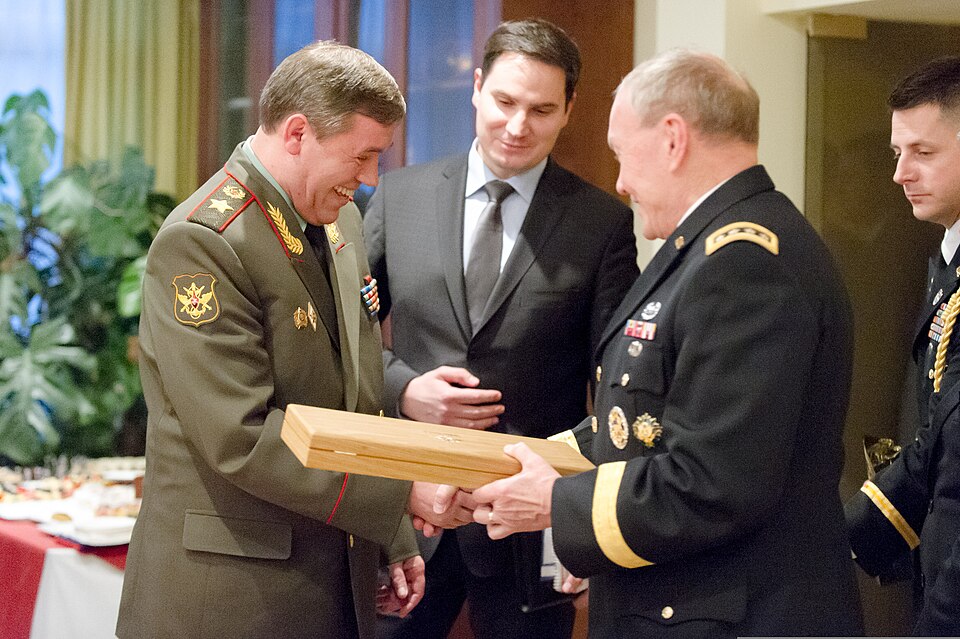
Russian Gen. Valery Gerasimov, Chief of the General Staff (left), presents a gift to U.S. Gen. Martin Dempsey, Chairman of the Joint Chiefs of Staff, during a meeting in Brussels, 21 January 2014. Photo by MC1 Daniel Hinton, U.S. Department of Defense, via Wikimedia Commons. Public domain.
How it worked in practice
Institutions. The 2000 and 2016 doctrines were drafted by the Security Council of the Russian Federation and assign tasks across federal agencies and the Armed Forces. Budgets for information confrontation units are not published.
The "Gerasimov doctrine" label. In July 2014, during the conflict in eastern Ukraine, Galeotti posted a translation of Gerasimov's article under the title "The 'Gerasimov Doctrine' and Russian Non-Linear War," while stating in the text that it was not a doctrine. The label spread through Western policy writing. In Foreign Policy in March 2018 Galeotti wrote that "to my immense chagrin, I created this term," argued that no such doctrine exists, and said that Gerasimov had been describing how Moscow saw Western actions, such as the "color revolutions," rather than setting out a Russian plan.
RAND's "firehose of falsehood" model. Paul and Matthews, examining Russian state messaging since the 2008 Georgia war and the 2014 Crimea annexation through outlets such as RT and Sputnik and online activity, describe four features: it is high-volume and multichannel; rapid, continuous and repetitive; it lacks a commitment to objective reality; and it lacks commitment to consistency. They use findings from psychology to explain why such a model "might work." It is an outside analytic model of observed output, not a Russian doctrinal text.
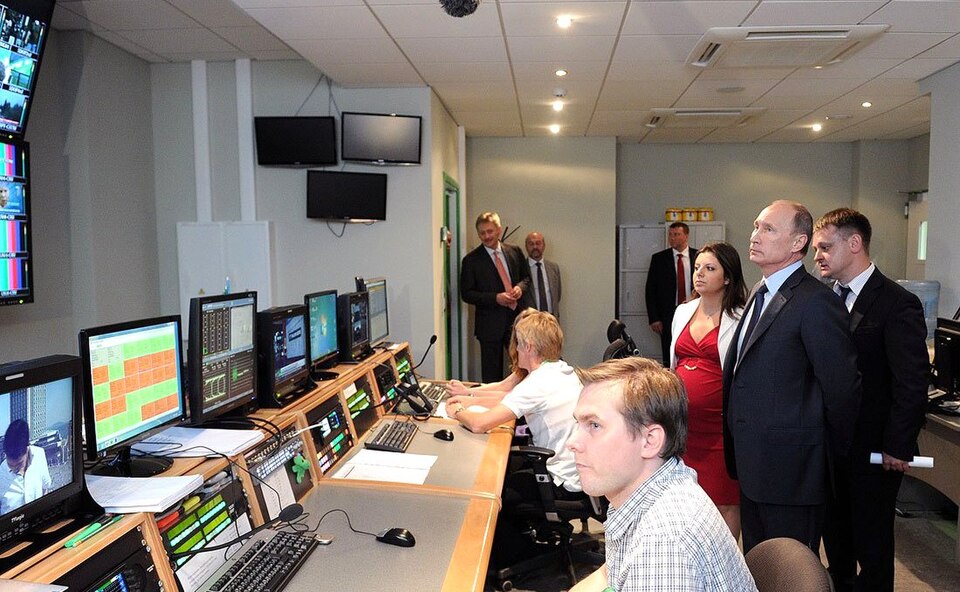
Vladimir Putin and RT editor-in-chief Margarita Simonyan in an RT control room during a visit to the new RT broadcasting centre, Moscow, 11 June 2013. Kremlin.ru, CC BY 4.0, via Wikimedia Commons.
Techniques in this archive's taxonomy
- Firehosing: the taxonomy's id comes directly from Paul and Matthews (2016); the model's four features are its definition. Komov's "overload" (supplying large volumes of contradictory information), as summarized by Thomas, describes a related move.
- Card stacking: Thomas's definition of reflexive control, "specially prepared information" chosen to incline the target to a predetermined decision, describes selecting and ordering information so it points one way.
- Fear appeal: Komov's "intimidation" (creating an appearance of overwhelming superiority) and "paralysis" (creating the illusion of threats to vital interests), as Thomas summarizes them, stage threat to shape the target's choices.
Reception and criticism
- Russian official position. The 2016 doctrine presents Russia's information measures as defensive: it names foreign media bias, foreign intelligence "informational-psychological" influence and discrimination against Russian media abroad as threats Russia must counter. Gerasimov's article discusses the Arab Spring and color revolutions as examples of the non-military methods he described.
- Thomas and other U.S. military analysts treat reflexive control as a long-running line of Soviet and Russian thought with practical military uses, while noting its parallel to Western perception management.
- Galeotti argues that the "Gerasimov doctrine" does not exist and that treating it as real leads to misunderstanding of the actual challenge Russia poses. Charles K. Bartles's "Getting Gerasimov Right," published in the same Military Review issue as the translation, offers a reading of the article in its Russian military context.
- RAND's authors frame their model, in the report's title, as an account of why the approach "might work," and pair it with options to counter it.
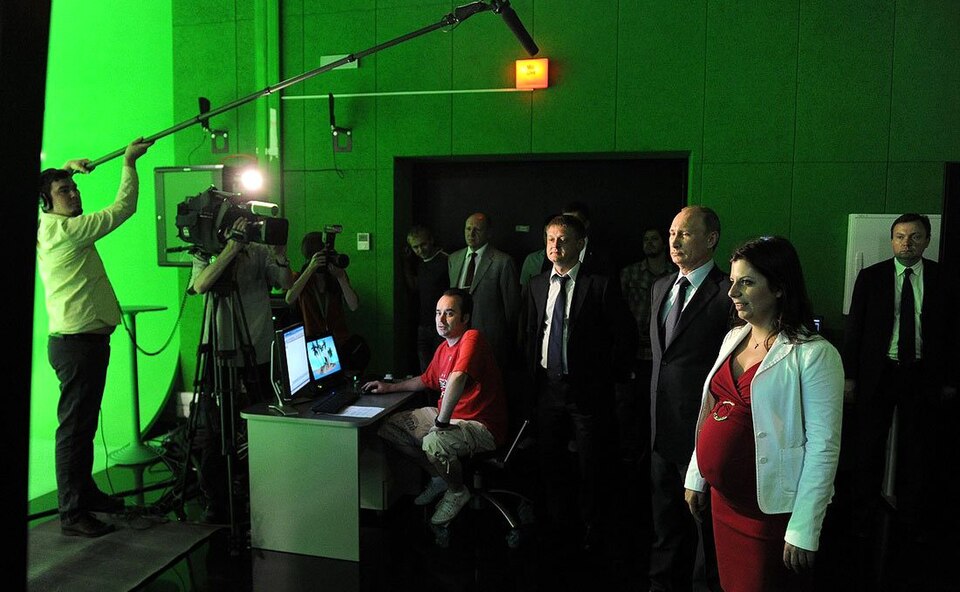
Vladimir Putin and Margarita Simonyan in a green-screen studio at the new RT broadcasting centre, Moscow, June 2013. Kremlin.ru, CC BY 4.0, via Wikimedia Commons.
Same-standard note
Thomas himself compares reflexive control to the U.S. concept of perception management, and U.S. psychological operations doctrine (U.S. Army and Joint Staff, Psychological Operations doctrine (1987-2013)) also begins from analyzing a target audience in order to change its behavior. China's "three warfares" (People's Liberation Army, the Three Warfares (2003)) likewise pair media, psychology and law. The same technique ids apply to all three; the differences lie in documentation (published U.S. manuals, short Chinese regulatory text, Russian doctrines plus a large officer literature) and in what each side says it is responding to.
Sources
- Timothy L. Thomas, "Russia's Reflexive Control Theory and the Military," Journal of Slavic Military Studies 17, no. 2 (2004): 237-256. https://www.tandfonline.com/doi/abs/10.1080/13518040490450529
- Vladimir A. Lefebvre, biographical summary, "Vladimir Lefebvre," Wikipedia. https://en.wikipedia.org/wiki/Vladimir_Lefebvre
- Information Security Doctrine of the Russian Federation, approved 9 September 2000, No. Pr-1895. https://www.itu.int/en/ITU-D/Cybersecurity/Documents/National_Strategies_Repository/Russia_2000.pdf
- Doctrine of Information Security of the Russian Federation, Presidential Decree No. 646, 5 December 2016 (Ministry of Foreign Affairs translation). https://www.mid.ru/en/foreign_policy/official_documents/-/asset_publisher/CptICkB6BZ29/content/id/2563163
- RFE/RL, "New Kremlin Information-Security Doctrine Calls For 'Managing' Internet In Russia," December 2016. https://www.rferl.org/a/russia-informaiton-security-internet-freedome-concerns/28159130.html
- Valery Gerasimov, "The Value of Science Is in the Foresight: New Challenges Demand Rethinking the Forms and Methods of Carrying out Combat Operations," Voenno-promyshlennyi kur'er, February 2013; trans. Robert Coalson, Military Review 96, no. 1 (January-February 2016). https://www.armyupress.army.mil/portals/7/military-review/archives/english/militaryreview_20160228_art008.pdf
- Charles K. Bartles, "Getting Gerasimov Right," Military Review 96, no. 1 (January-February 2016). https://www.armyupress.army.mil/Portals/7/military-review/Archives/English/MilitaryReview_20160228_art009.pdf
- Mark Galeotti, "The 'Gerasimov Doctrine' and Russian Non-Linear War," In Moscow's Shadows, 6 July 2014. https://inmoscowsshadows.wordpress.com/2014/07/06/the-gerasimov-doctrine-and-russian-non-linear-war/
- Mark Galeotti, "I'm Sorry for Creating the 'Gerasimov Doctrine'," Foreign Policy, 5 March 2018. https://foreignpolicy.com/2018/03/05/im-sorry-for-creating-the-gerasimov-doctrine/
- Christopher Paul and Miriam Matthews, The Russian "Firehose of Falsehood" Propaganda Model: Why It Might Work and Options to Counter It, PE-198 (Santa Monica: RAND Corporation, 2016). https://www.rand.org/pubs/perspectives/PE198.html