Content note. This case quotes racist death threats written in the name of the Ku Klux Klan. They are quoted as evidence of the method. The U.S. government, and later a KGB archive, attribute them to Soviet intelligence, not to the Klan.
In one line: in July 1984, Olympic committees in Africa and Asia received letters on Ku Klux Klan letterhead threatening to shoot or hang their athletes in Los Angeles; the U.S. Attorney General said the KGB wrote and mailed them, Moscow called that a myth, and a KGB archivist's notes later described the operation as a Soviet active measure.
What happened
- 1980. The United States leads a boycott of the Moscow Summer Olympics after the Soviet intervention in Afghanistan. The next Summer Games are awarded to Los Angeles, 28 July to 12 August 1984.
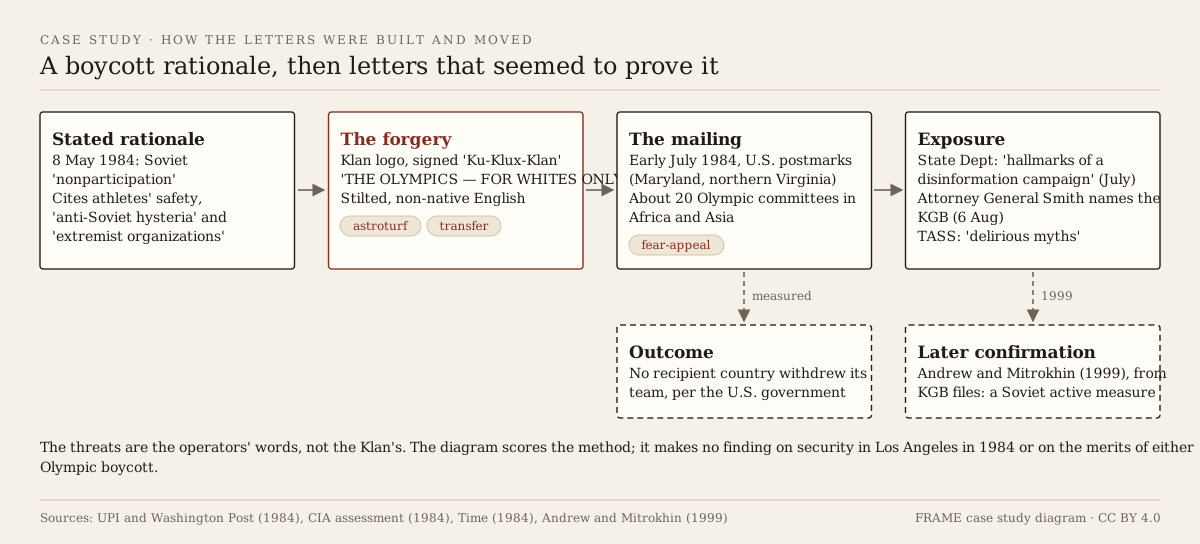
- 8 May 1984. The Soviet Union announces it will not send a team. It calls the decision "nonparticipation" rather than a boycott and says the United States cannot guarantee its athletes' safety. The government statement says: "Chauvinistic sentiments and anti-Soviet hysteria are being whipped up in this country," and accuses U.S. authorities of "connivance" with "extremist organizations" creating "unbearable conditions" for Soviet athletes. Allied states follow.
- Early July 1984. Olympic committees in Asia and Africa receive letters on paper bearing a Ku Klux Klan logo, signed "Ku-Klux-Klan". UPI reports on 5 July that the South Korean committee received one mailed from Maryland. A letter headed "THE OLYMPICS — FOR WHITES ONLY!" reads in part: "The blacks and yellows will not be permitted to defile America's stadiums," and "If your cubs dare to come to the Summer Olympics in America, they will be shot or hanged."
- About 10 July. State Department spokesman Alan Romberg says the letters "bear all the hallmarks of a disinformation campaign" and that their thrust "dovetails neatly with the Soviet justification for their withdrawal". The Washington Post names recipients in Zimbabwe, Sri Lanka, South Korea, Malaysia, Nigeria, Singapore and China.
- 1984, CIA assessment. A CIA paper titled Alleged KKK Death Threats to Third World Olympic Athletes: A Soviet Active Measure counts eleven national committees (Malaysia, South Korea, Sri Lanka, Zimbabwe, Senegal, Cameroon, Zambia, China, Singapore, Japan and Hong Kong). It describes letters "extremely racist and violent in tone" that describe lynchings and shootings, and judges them forgeries meant to support Moscow's claim that athletes' safety could not be guaranteed.
- 23 July. Time notes the stilted syntax, words such as "curs", and a hyphenated "Ku-Klux" letterhead that the real Klan rarely used. Secretary of State George Shultz: "It makes you wonder if it is a disinformation campaign."
- 6 August 1984, mid-Games. Attorney General William French Smith says the letters, sent to about 20 countries, "were not produced or sent by the Ku Klux Klan. They were instead manufactured and mailed by another organization devoted to terror: the KGB." He calls them "classic examples of Soviet forgery" found through linguistic and forensic analysis, and says the aim was to justify the boycott and win support from non-communist countries. He adds that none of the recipients "succumbed to the attempted intimidation". TASS calls the charge "delirious myths".
- 1999. Christopher Andrew and Vasili Mitrokhin, drawing on Mitrokhin's notes from KGB foreign-intelligence files, describe the letters as a KGB active measure in The Sword and the Shield, and write that Moscow met Smith's charge with feigned indignation (as quoted by NPR, 2017).
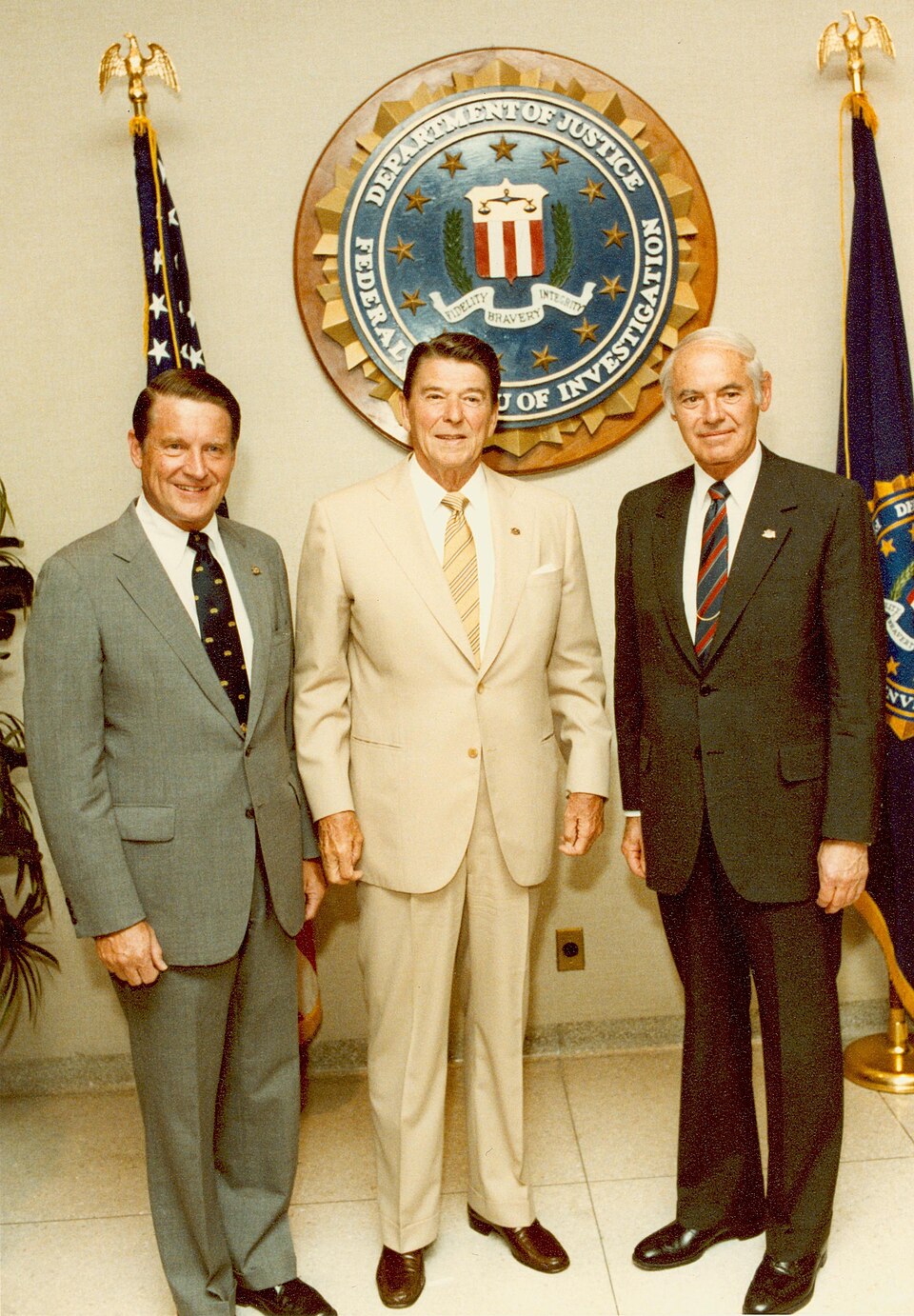
FBI Director William H. Webster, President Ronald Reagan and Attorney General William French Smith (right) at FBI Headquarters, 26 July 1983. FBI photo, public domain. Smith made the 1984 attribution; the image predates the case and is shown only to identify him.
How it works
- Astroturfing: a foreign intelligence service writes as an American group. The letters are built to look like an authentic domestic voice. The postmarks were from Prince George's County, Maryland, and northern Virginia (Washington Post), counties where, Sports Illustrated reports, Soviet nationals were allowed to live.
- Transfer: the Klan name and logo carry more than a century of racist violence in the United States. Pasting them onto a threat about the Olympics lends that stigma to the host city and country without any claim needing proof. The letters do not argue that Los Angeles is unsafe; the letterhead does.
- Fear appeal: threats of shooting and hanging go to the people who decide whether a team travels. The only "protection" on offer is to stay home, which is the Soviet position announced on 8 May. According to the U.S. government, none of the recipients withdrew.
Then and now
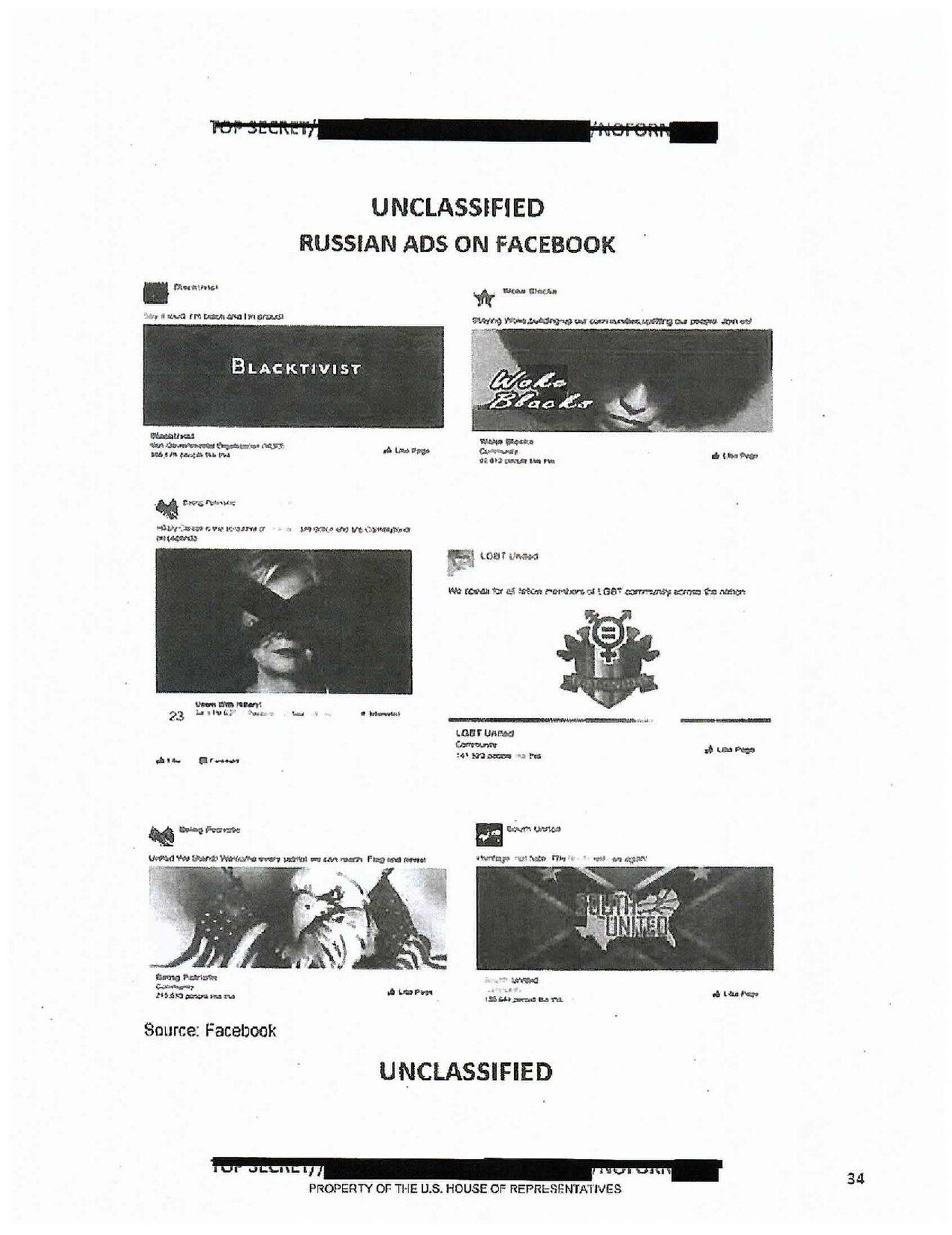
'Russian Ads on Facebook' (House Intelligence Committee exhibit), House Intelligence Committee, 2018. Public domain.
Thirty-two years later, the St Petersburg Internet Research Agency ran Facebook pages posing as American communities, including Black-identity pages, and a "Miners for Trump" rally campaign ('Miners for Trump' rally poster (Internet Research Agency)). In 2026 the Russia-aligned Matryoshka network pasted a CNN logo onto recut celebrity clips (Matryoshka's midterm clips: borrowed faces and a borrowed logo). The shared move is a Russian-linked operator speaking in an American voice about American divisions, often race.
The differences are as large as the likeness. The 1984 operation reached about 20 committees by post, used one hostile persona, and aimed at a narrow government decision: whether a team would travel. The IRA reached a mass audience with many sympathetic personas and made no single demand. Matryoshka borrows a trusted news brand rather than a hated group, and its measured reach was small. None of the three is shown to have changed the outcome it aimed at.
Positions on the record
- Soviet position. The Soviet Union said its team stayed home because of security risks and anti-Soviet agitation in the United States. HISTORY describes a California activist coalition that campaigned for Soviet-bloc athletes to defect. TASS rejected the forgery charge as "delirious myths".
- U.S. position. The State Department (July) and the Attorney General (August) said the letters were Soviet forgeries. The Active Measures Working Group, the interagency group set up in 1981 to counter Soviet disinformation, handled the public case; accounts of the group, including Schoen and Lamb (2012), say its report let U.S. agencies reassure the recipient governments. Sports Illustrated reports that an FBI source inside the KGB confirmed the Russian-speaking authorship.
- What is documented: the letter text, the recipients, the U.S. attribution, the CIA assessment, the Soviet denial, and the account in The Sword and the Shield, which rests on Mitrokhin's notes from KGB files, brought out through British intelligence, rather than on U.S. government sources.
- What is not shown: the forensic findings themselves, which were not published in the sources here; who physically mailed the letters; and the identity of the FBI source. This page makes no finding on the security conditions in Los Angeles in 1984 or on the merits of either boycott.
Same-method test
Western services used the same method. In early 1963, Britain's Information Research Department forged a statement in the name of the Soviet-aligned World Federation of Democratic Youth, calling Africans "primitive", uncivilised and morally weak, to turn African readers against the Eastern bloc; it also ran the "Loyal African Brothers" leaflets under a fake African movement (Guardian 2022; LoBue 2023; Cormac 2026). In the United States, the FBI's COINTELPRO sent forged letters and cartoons to the Black Panther Party and the US Organization, each made to look as if it came from the other group (Church Committee, 1976). A racist statement written in someone else's name to set one audience against another scores the same here whichever service writes it.
Soviet forgeries of U.S. documents are also on the record: CIA officials told the House Intelligence Committee in 1980 that the "Field Manual 30-31B" circulated since 1976 was a KGB forgery (some writers dispute this), and the State Department's Special Report No. 88 (October 1981) catalogued forged letters and documents.
How to spot it
- A threat that speaks for a domestic extremist group, sent abroad to officials rather than to the group's own audience, is aimed at the recipient's decision, not at the group's members.
- Check small marks of authenticity: the group's real name and styling, idiom, and where the letter was mailed.
- Ask whose stated position the letter happens to prove. Here the letters supplied evidence for a boycott rationale announced two months earlier.
Images
| Image | Source | Licence |
|---|---|---|
| Mechanism diagram (above) | Drawn for FRAME from the sources below (make_diagrams.py) |
CC BY 4.0, FRAME |
| Webster, Reagan and Smith at FBI Headquarters (1983) | Wikimedia Commons, FBI | Public domain (U.S. government work) |
| House Intelligence Committee IRA exhibit (2018) | FRAME gallery | Public domain (U.S. government work) |
| 1984 Olympics plaque, Los Angeles Memorial Coliseum (below) | Wikimedia Commons, Michael Barera | CC BY-SA 4.0 |

.jpg)
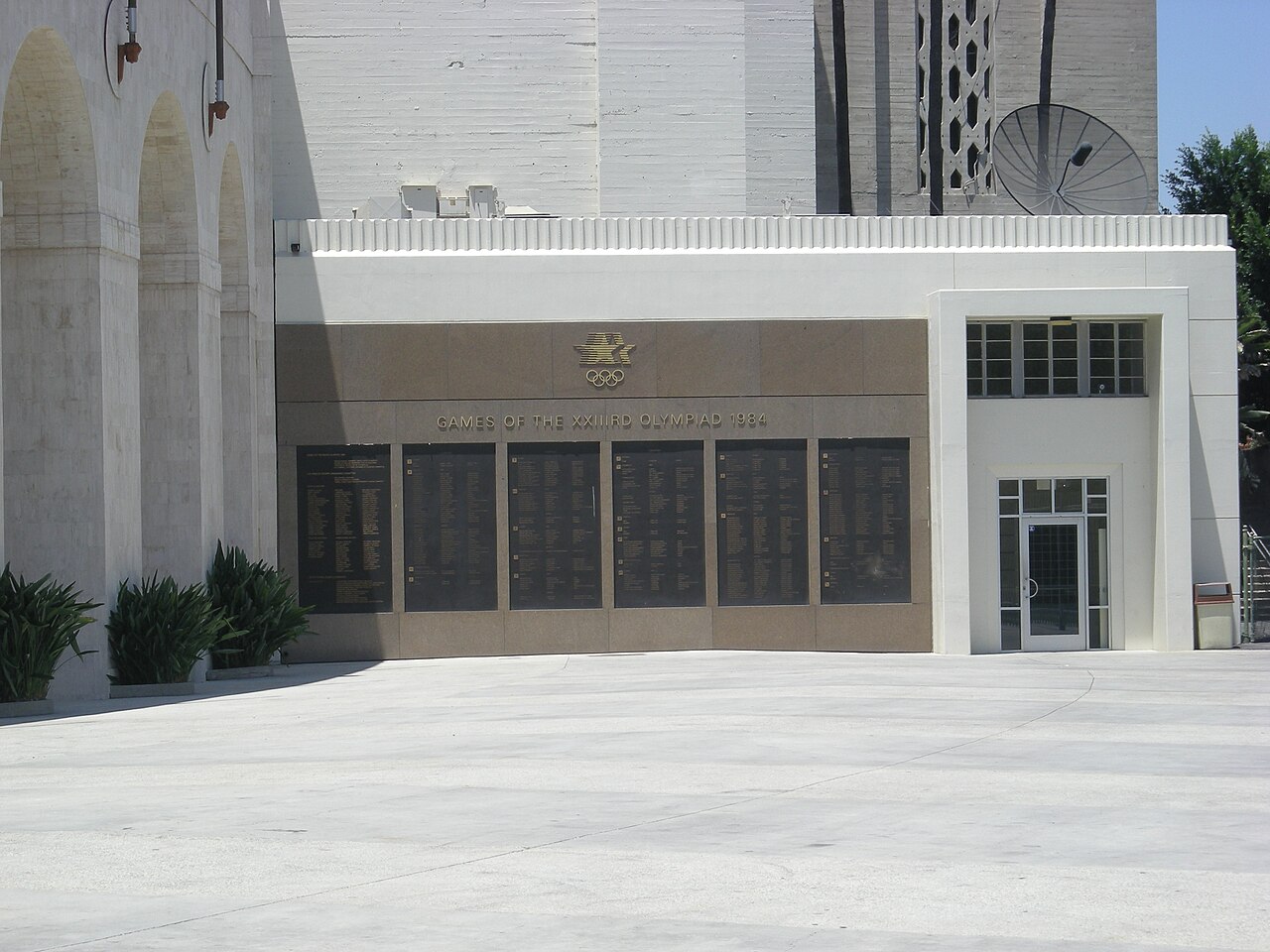
The 1984 Games plaque at the Los Angeles Memorial Coliseum, 2007. Photo: Michael Barera, CC BY-SA 4.0.
Image gaps
- The letters themselves. No openly licensed copy was found. The CIA assessment may reproduce one, but cia.gov could not be reached from the build environment. Possibly fillable from the CIA reading room.
- Smith's 6 August 1984 news conference. No public-domain photo found; wire photos are copyrighted.
- The 1984 Soviet statement and TASS reports. No openly licensed copy; Soviet press material with unclear U.S. copyright status is not used.
- State Department Special Report No. 88 (1981). Public domain, but govinfo.gov could not be reached. Fillable.
Sources
- UPI, 6 August 1984: "Smith says Soviet forged KKK letters to several nations"
- UPI, 11 July 1984: "U.S. says Soviets sent leaflets" (State Department statement)
- UPI, 5 July 1984: letter to the South Korean Olympic Committee
- Washington Post, 11 July 1984: "4 Nations Get Abusive Letters Threatening Olympic Athletes"
- Washington Post, 7 August 1984: "U.S. Ties 'Klan' Olympic Hate Mail to KGB" (CIA reading-room copy)
- CIA, 1984: "Alleged KKK Death Threats to Third World Olympic Athletes: A Soviet Active Measure"
- Time, 23 July 1984: "Olympics: Mysterious Hate Mail"
- Christian Science Monitor, 7 August 1984: News in Brief
- Sports Illustrated, 28 July 2020: "The Cold War, the Klan and the Olympics" (TASS "delirious myths"; FBI source inside the KGB)
- NPR, 30 October 2017: "Russians Targeted U.S. Racial Divisions Long Before 2016 And Black Lives Matter"
- HISTORY: "Soviets announce boycott of 1984 Olympics" (8 May 1984 statement) and "The California Activists Who Scared the Soviets Away From the 1984 Olympics"
- Christopher Andrew and Vasili Mitrokhin, The Sword and the Shield: The Mitrokhin Archive and the Secret History of the KGB (Basic Books, 1999).
- Fletcher Schoen and Christopher J. Lamb, Deception, Disinformation, and Strategic Communications: How One Interagency Group Made a Major Difference, INSS Strategic Perspectives 11 (NDU Press, 2012)
- U.S. Department of State, Soviet Active Measures: Forgery, Disinformation, Political Operations, Special Report No. 88 (October 1981)
- Thomas Rid, Active Measures: The Secret History of Disinformation and Political Warfare (Farrar, Straus and Giroux, 2020), on KGB forgery practice.
- Jason Burke, "Secret British 'black propaganda' campaign targeted cold war enemies", The Guardian, 14 May 2022.
- Adam LoBue, "'They must either be informed or they will be cominformed': Covert propaganda, political literacy, and cold war knowledge production in the Loyal African Brothers series", Journal of Global History 18:1 (2023), 68-87
- Rory Cormac, Fakers: A Top-Secret Tale of Phantoms and Forgeries on the Disinformation Front Line (Oxford University Press, 2026).
- U.S. Senate Select Committee (Church Committee), Final Report, Book III: "COINTELPRO" (1976)
- U.S. House of Representatives, Permanent Select Committee on Intelligence, Subcommittee on Oversight, Soviet Covert Action (The Forgery Offensive), hearings of 6 and 19 February 1980 (CIA testimony on Field Manual 30-31B).
- Daniele Ganser, NATO's Secret Armies: Operation Gladio and Terrorism in Western Europe (Frank Cass, 2005), for the view that Field Manual 30-31B may be genuine.