Content note. This case describes murals of masked gunmen, prison protests, hunger strikes and the commemoration of people who killed and were killed. Paramilitary slogans and terms are quoted short as evidence of the method, not as this archive's view of any cause.
In one line: in Northern Ireland's Troubles, republican and loyalist paramilitaries both turned gable walls, newspapers and the prisons into media channels, borrowing sacred and historical imagery and fighting over the words "volunteer" and "prisoner of war", while the British and Irish states answered with broadcasting bans, a "criminalisation" policy, covert army information work and, after 1998, public money to repaint the walls.
What happened
- Before 1969. Mural painting was mainly a unionist tradition from the early twentieth century, tied to the yearly celebration of the Battle of the Boyne (1690). Bill Rolston calls those murals state-friendly. Republican murals came later, at the height of the Troubles.
- 1 March 1976: "criminalisation". The British government ended Special Category Status for paramilitary prisoners convicted after that date. Republican prisoners answered with the blanket protest (refusing prison uniform) in 1976 and the "dirty protest" in 1978.
- 27 January 1979: one republican paper. An Phoblacht, the Dublin-based Sinn Féin paper, merged with the Belfast-based Republican News. The merged paper appeared under editor Danny Morrison, later Sinn Féin's director of publicity, with the stated aim of "a clear line of republican leadership".
- 1981: the hunger strike. Republican prisoners went on hunger strike for the return of political status. On 9 April 1981 the hunger striker Bobby Sands won the Fermanagh and South Tyrone by-election with 30,492 votes to 29,046 for the Ulster Unionist Harry West. He died on 5 May 1981. Rolston writes that 1981 brought "quite literally an explosion of murals" in nationalist and republican areas, which for the most part had not painted murals before.
- Late 1981: "armalite and ballot box". At the Sinn Féin Ard Fheis, Morrison asked whether anyone would object "if, with a ballot paper in one hand and an Armalite in this hand, we take power in Ireland". The phrase named a strategy of contesting elections while the IRA's campaign continued. Ed Moloney's history of the IRA traces how the Adams leadership used it to move toward electoral politics.
- From 1986: loyalist walls under paramilitary control. After the Anglo-Irish Agreement of November 1985, according to Rolston, no murals were painted in unionist areas from the summer of 1986 without the express agreement of paramilitary commanders. For about two decades most loyalist murals showed masked, armed men with UVF, UDA/UFF or Red Hand Commando insignia, advertising whichever group held the area.
- Loyalist print and commemoration. Loyalist groups ran magazines such as the UVF's Combat. Their murals tie the modern UVF, formed in 1966, to the original UVF of 1912 and to the 36th (Ulster) Division at the Somme in 1916. A 2002 mural in the Cregagh estate in east Belfast pairs the Somme with the slogan "For God and Ulster".
- Both sides' dead. Both movements painted memorials to their own members killed in the conflict: republicans to the ten 1981 hunger strikers and IRA volunteers, loyalists to UVF and UDA members.
- After 1998. Murals stayed. Republicans repainted many of their own walls toward political and international themes. Rolston writes that loyalists found this harder, and that the state stepped in to fund the "re-imaging" of murals to remove military iconography.
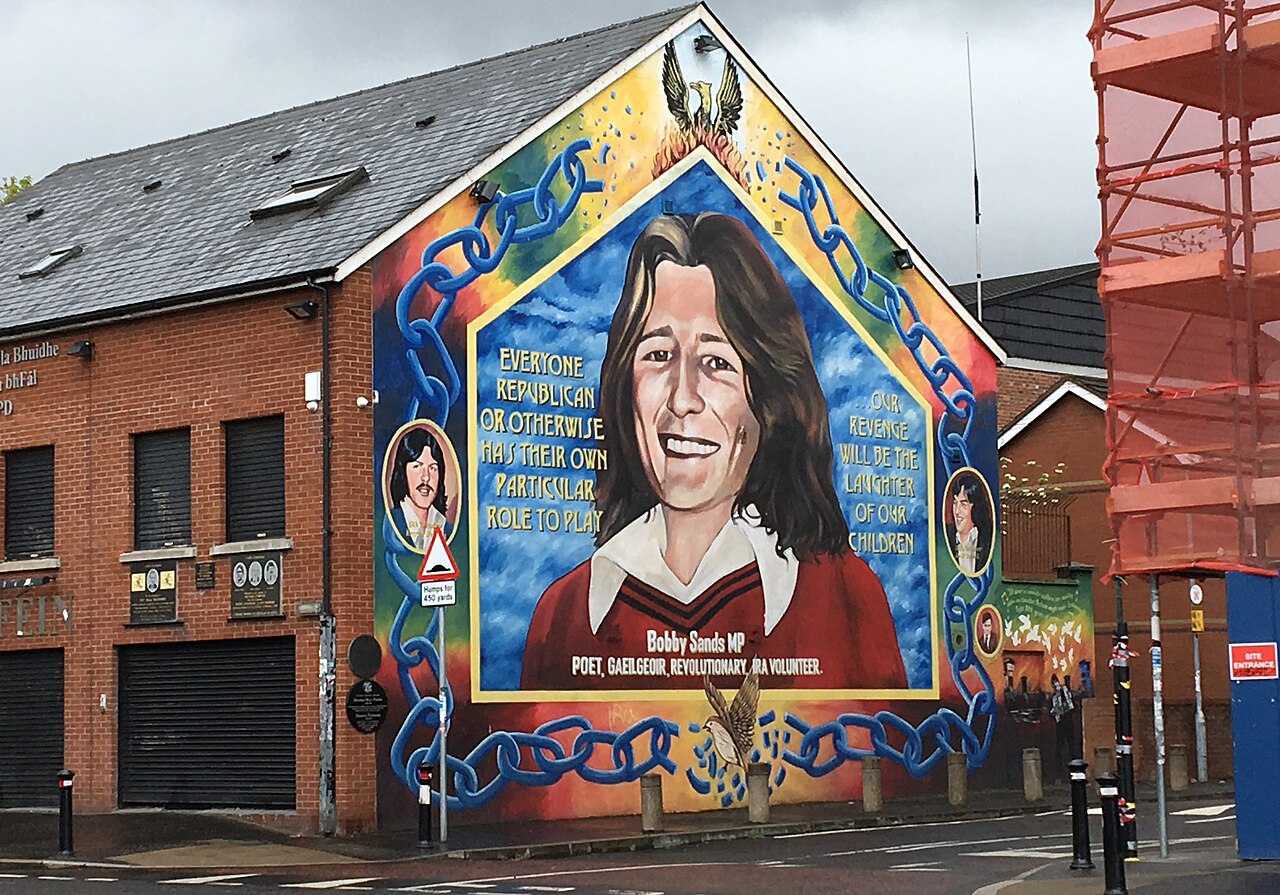
Republican: the Bobby Sands mural on the Falls Road, Belfast, 2019. Photo by Wikimedia user Tarafuku10, released under CC0.
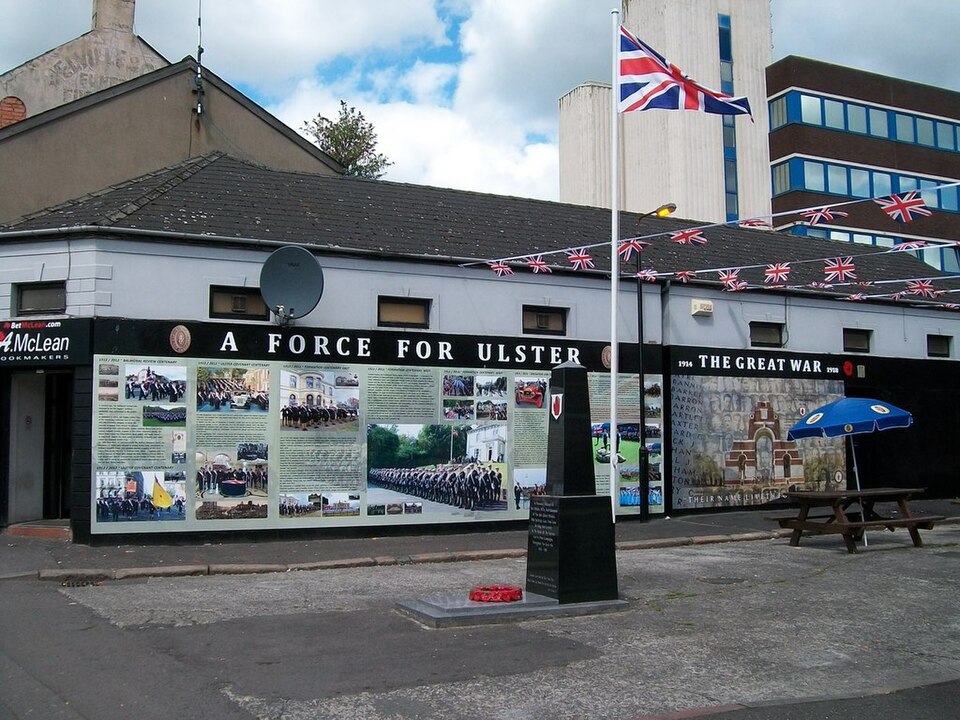
Loyalist: murals headed "A Force for Ulster" and "The Great War" beside a memorial, linking the 1913 UVF and the Somme with the modern organisation, Belfast, 2014. Photo by Eric Jones via Geograph, CC BY-SA 2.0.
How it works
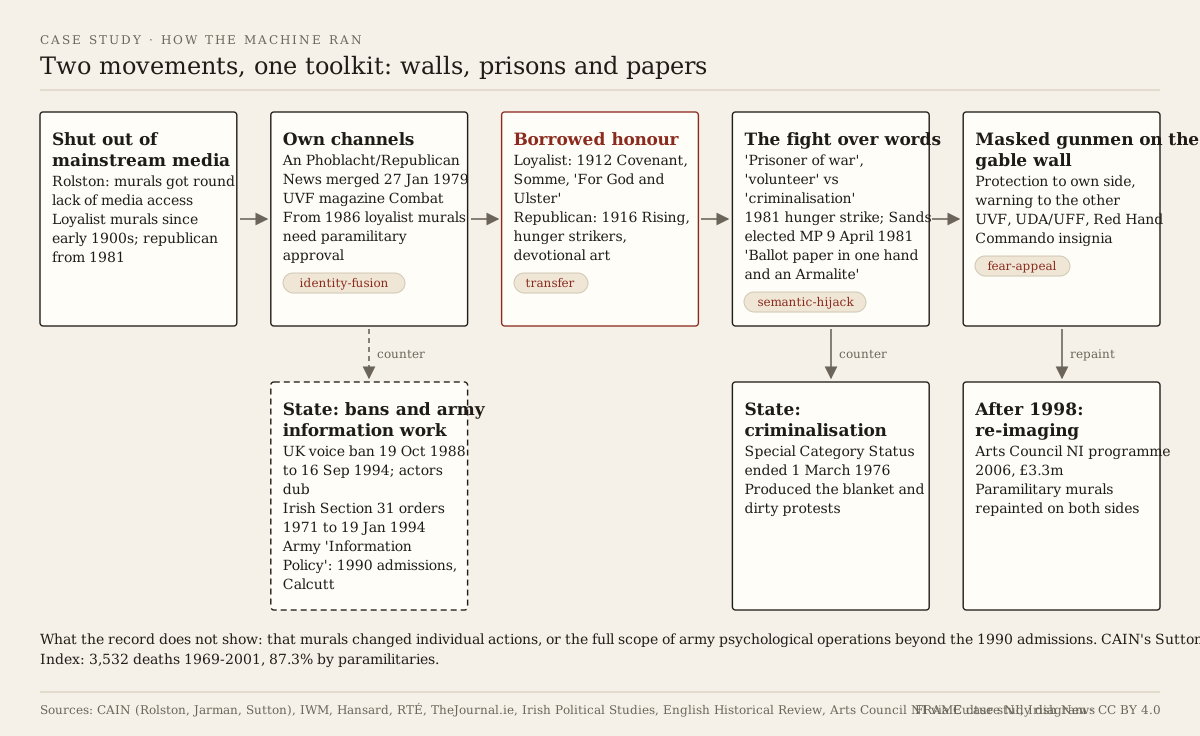
- Transfer: both sides borrowed the prestige of older, sacred or heroic material and pasted it onto a current armed group. Loyalist murals set the post-1966 UVF beside the 1912 Covenant signatories and the Somme dead, so that the honour given to 1916 carries over to the modern organisation. A student exhibition on the Cregagh mural describes it as an attempt to bridge the modern UVF to "the honour and sacrifice of the earlier UVF". Republican murals did the same with the 1916 Rising, Celtic myth and Catholic devotional imagery around the hunger strikers. The IWM notes a difference in emphasis: loyalist murals leaned on history and the Crown, republican ones on the present.
- Semantic hijacking: the fight over prison status was a fight over words. Republicans called prisoners "prisoners of war" and "political prisoners". The state's policy was named "criminalisation". Both sides called their members "volunteers", a word with civic and military prestige. Each label was stretched to cover a preferred set. The hunger strike forced the public to pick one vocabulary, and the Sands result was presented as a vote on it.
- Identity fusion: murals marked territory. Neil Jarman's work on "the symbolic construction of urban space" describes how murals tell residents and outsiders whose area they are in. When a paramilitary insignia stands for the street, questioning the group can read as disloyalty to the neighbourhood. Rolston's 1986 finding, that loyalist murals needed paramilitary approval, shows that in loyalist areas the channel itself was controlled by the armed groups.
- Fear appeal: the masked-gunman mural addresses two audiences at once. It tells its own community that the group protects them and tells the other community, and rival groups, that the area is armed. The student exhibition of loyalist murals from the mid-1980s describes the imagery as threatening and overtly military, tied to the cry of "No surrender".
- Audience and spread. Rolston writes that murals were a way for both movements to get round their lack of access to mainstream media. Murals reached residents, visiting journalists and later tourists; republican print reached supporters abroad; the prison protests reached world news without a friendly outlet.
How it was countered
- UK broadcasting ban, 19 October 1988 to 16 September 1994. Home Secretary Douglas Hurd barred broadcasters from carrying the direct voices of representatives of eleven organisations, including Sinn Féin, the IRA, the INLA, the UDA and the UVF. The words could still be reported. Broadcasters used actors to speak them, and Stephen Rea voiced Gerry Adams. The ban did not apply during election campaigns. It was lifted two weeks after the IRA's August 1994 ceasefire. Critics said it restricted reporting of an elected party.
- Section 31 in the Republic. Under Section 31 of the Broadcasting Authority Act, orders from 1971, strengthened in 1977, barred RTÉ from broadcasting interviews with members of organisations that pursued political aims by violent means. Michael D. Higgins, as minister, ended the orders on 19 January 1994, eight months before the IRA ceasefire.
- Criminalisation. Ending Special Category Status denied the "war" frame. It also produced the prison protests, which became a central theme of republican propaganda in the period; a 2022 Irish Political Studies study links those protests to prisoners' later support for electoral politics.
- The army's own information operations. Colin Wallace joined the British Army's press office at Thiepval Barracks, Lisburn, in 1968. He has said that from the early 1970s he also worked for an "Information Policy" unit that ran psychological operations, including unattributable, false stories aimed at both republican and loyalist paramilitaries. After years of official denials, ministers told Parliament in January 1990 that earlier statements about his role had been inaccurate because relevant papers had not been brought to their attention. The Calcutt inquiry that year recommended £30,000 compensation over his dismissal. Some of Wallace's wider claims, including about a project he called "Clockwork Orange", remain disputed. Separately, Rory Cormac's archival study in the English Historical Review documents unattributable propaganda in Northern Ireland by the Foreign Office's Information Research Department in the early 1970s.
- Re-imaging, from 2006. The Arts Council of Northern Ireland's Re-Imaging Communities programme launched in 2006 with £3.3 million, plus £500,000 added in 2008. It paid community groups on both sides to replace paramilitary murals, often with local history or cultural subjects. The Irish News has reported a UVF gunmen mural at Dee Street, east Belfast, being replaced with an image of Edward Carson. Rolston's 2012 study argues the state was now doing what it had long condemned: sponsoring political murals, with loyalist areas the main target.
- Did it work? The sources here do not credit any one counter-measure with ending the violence; the ceasefires and the 1998 Agreement came through negotiation. The UK voice ban was widely seen as ineffective because the words still aired. Rolston's 2012 study finds that re-imaging reduced masked-gunman murals, mostly in loyalist areas, but that paramilitary imagery did not disappear.
Then and now
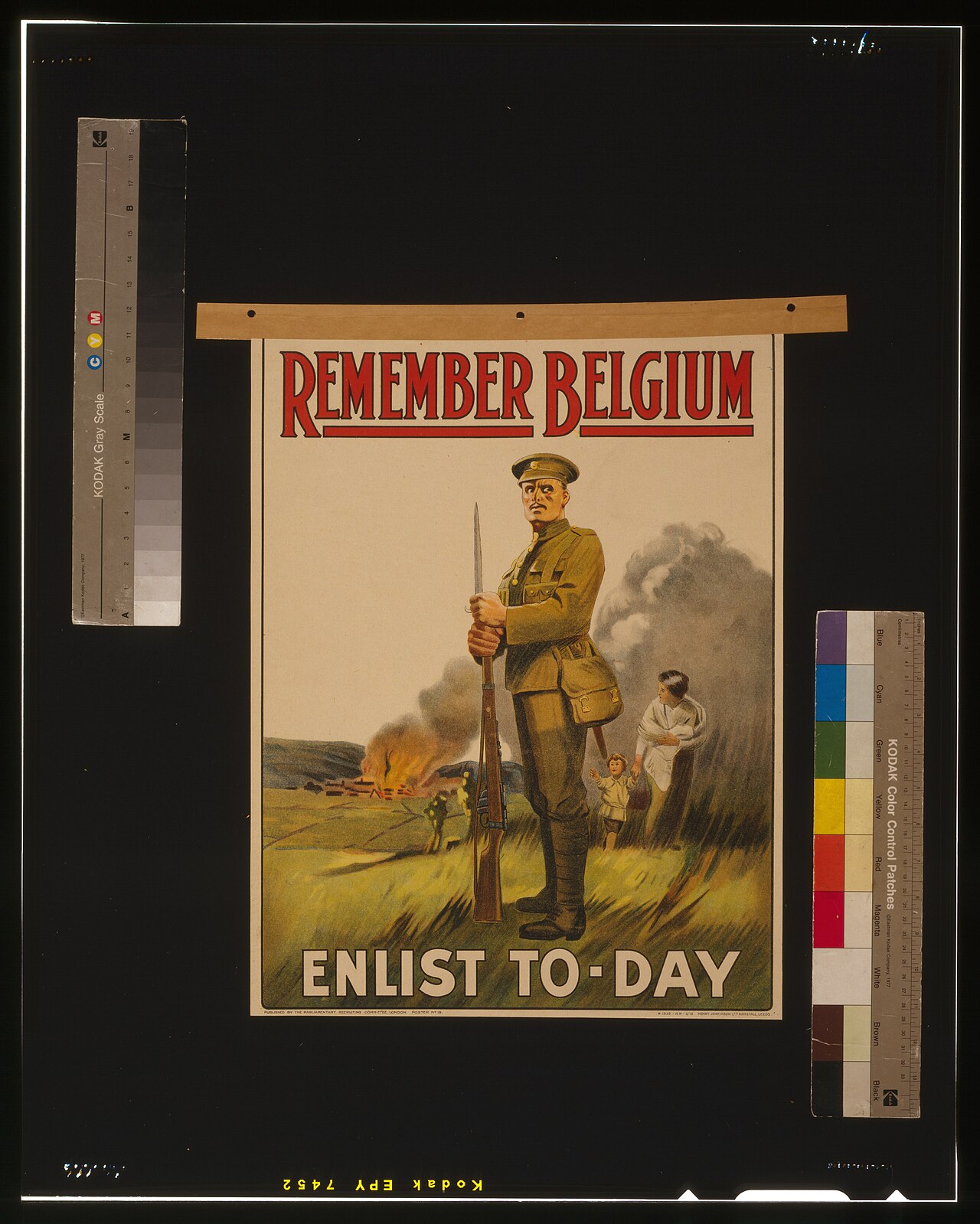
Remember Belgium — Enlist To-Day, Parliamentary Recruiting Committee (United Kingdom), 1915. Public domain.
This British recruiting poster was printed in the year that men of the original UVF were joining the 36th (Ulster) Division for the Western Front. It puts a lone soldier between the viewer and a fleeing woman and child, so that enlisting reads as the only honourable answer. Loyalist Somme murals borrow that same soldier-as-protector figure, and republican murals borrow the 1916 Rising in the same way. The differences are large. The poster was a government recruiting appeal in a declared war. The murals were painted, in loyalist areas from 1986 under paramilitary approval, to lend First World War or 1916 prestige to illegal armed groups formed decades later, in a conflict where most of the dead were civilians.
Positions on the record
- Republican position: the IRA was an army fighting British rule, its members were volunteers and its prisoners were prisoners of war. Morrison's "ballot paper in one hand and an Armalite in this hand" states the dual strategy in the movement's own words.
- Loyalist position: "For God and Ulster". The UVF and UDA presented themselves as defenders of the Union and of Protestant communities, heirs of the 1912 UVF and the Somme.
- What is documented: CAIN's Sutton Index lists 3,532 conflict deaths from 1969 to 2001. Republican and loyalist paramilitaries are recorded as responsible for 3,084 (87.3%), British and Irish state forces for 368 (10.4%), and 80 are unattributed. Republican groups account for roughly twice as many deaths as loyalist groups; most people killed by loyalist groups were civilians.
- Contested or not shown: how far murals changed anyone's actions, as opposed to marking territory; the full scope of army psychological operations beyond what ministers admitted in 1990; and the exact role of paramilitaries in bonfire and parade displays, which this page does not assess.
Same-method test
The page applies the same four technique ids to both movements, and the finding holds for both: republican and loyalist propaganda used the same devices, on the same kind of wall, often streets apart. It would hold equally for a movement of a different ideology. The West German far-left Red Army Faction (see Red Army Faction: communiqués, hunger strikes and the 'isolation torture' campaign) also framed its prisoners as political prisoners, used hunger strikes, and turned the 1974 hunger-strike death of Holger Meins into a campaign image. The state side is scored the same way: a "criminalisation" label and unattributable army stories are framing too. The differences in the record are not in method but in scale and targets, as the Sutton figures show.
How to spot it
- Ask what an old image is doing on a new wall. A Somme soldier or a 1916 rebel beside a modern insignia is borrowing honour for a group that did not exist then.
- Notice when a word like "volunteer", "prisoner of war" or "criminal" settles a legal and moral question before any facts are given.
- Ask who controls the wall, the paper or the press office. A mural approved by an armed group, or a story from an unattributed "army source", tells you about its sponsor.
- Check death tolls and responsibility in a neutral index such as CAIN's before accepting any side's account of who is defending whom.
Images
| Image | Source | Licence |
|---|---|---|
| Mechanism diagram (above) | Drawn for FRAME from the sources below (make_diagrams_extremist.py) |
CC BY 4.0, FRAME |
| Bobby Sands mural, Falls Road (2019) | Wikimedia Commons | CC0, Tarafuku10 |
| UVF and Somme murals, Belfast (2014) | Wikimedia Commons | CC BY-SA 2.0, Eric Jones |
| Remember Belgium, Enlist To-Day (1915) | FRAME gallery, from Wikimedia Commons (Library of Congress) | Public domain |


Image gaps
- A re-imaged mural, before and after. Street photographs of a replaced wall on each side would show the counter-measure. This gap can be filled.
- Pages of An Phoblacht/Republican News or loyalist magazines such as Combat. Not included: copyrighted movement media. Cited, not hosted.
- Broadcast footage with dubbed voices. Not included: broadcaster copyright.
Sources
- CAIN, Ulster University: Bill Rolston, Drawing Support: Murals in the North of Ireland
- Bill Rolston: The history of murals in the North of Ireland
- Bill Rolston, International Journal of Cultural Studies, 2012: Re-imaging: Mural painting and the state in Northern Ireland
- CAIN, Ulster University: Neil Jarman, Painting Landscapes: the place of murals in the symbolic construction of urban space
- Imperial War Museums: How murals illustrate Northern Ireland's political landscape
- CAIN, Ulster University: Sutton Index of Deaths, summary tables
- Irish Left Archive: An Phoblacht, publication record
- Ed Moloney, A Secret History of the IRA (2002), Internet Archive record
- Euronews, 21 March 2017: Martin McGuinness, the Armalite to the ballot box
- Irish Political Studies, 2022: Irish republican prisoners and strategic reorientation, c.1976-1998
- TheJournal.ie, January 2018: the UK broadcasting ban 30 years on
- RTÉ Brainstorm, 19 January 2024: A short history of Ireland's Section 31 broadcasting ban
- Hansard, 30 January 1990: Mr Colin Wallace (written answers) and Hansard, 31 October 1990: Mr Colin Wallace
- Rory Cormac, English Historical Review: The Information Research Department, unattributable propaganda and Northern Ireland
- Culture Northern Ireland: Re-imaging Communities
- The Irish News: East Belfast UVF gunmen mural replaced with image of Edward Carson
- The Troubles (Omeka exhibition): 36th Ulster Division Battle of the Somme mural and Unionist/Loyalist murals