Also called Tribal gatekeeping, Loyalty test
Collapse checking the claim into betraying the tribe, so method-critique feels like treason.
The tell
'People like us don't ask that' or 'that's what they would say.'
Not this
Shared identity offered as context, not as a gag on evidence.
History and effect
Related to the social-psychology construct of identity fusion (Swann et al.) and to Jacques Ellul's account of integration propaganda, which recruits belonging rather than arguing point by point.
It makes scrutiny of the claim feel like disloyalty, so the audience polices itself instead of the message.
Lineage: Swann et al.; Ellul integration propaganda
How it works
The move has three parts. First, a group identity is joined to a claim, a leader or a policy: the nation is the leader, the movement is its current line. Second, positions are reduced to two, inside and outside, leaving no place for a member who shares the identity but doubts the claim. Third, the outside position gets a label ("enemy of the people", "un-American", "anti-national", "traitor") that turns a question about evidence into a question about the questioner's allegiance. By the frame's logic, anyone asking for evidence has already chosen a side.
The sequence usually runs from the top down and then sideways. A leader, party organ or dominant outlet states the fusion, and members enforce it on each other; Irving Janis (1972) called members who shield a leader from unwelcome information "self-appointed mindguards". One-party states formalised this as denunciation; in democracies it appears more often in press campaigns, loyalty boards, campaign rhetoric and social-media pile-ons. The penalties differ enormously, from career damage to labour camp or execution, and that difference in scale is part of the record.
Variants include the purity test, which narrows the in-group by demanding assent to ever more specific positions, and the proxy version, which recasts criticism of a leader as an attack on the people the leader is said to embody.
Why it works
Social identity theory (Tajfel and Turner 1979) holds that people draw part of their self-esteem from their groups and are motivated to see them favourably. Research on identity fusion (Swann, Gómez, Seyle, Morales and Huici 2009; Swann, Jetten, Gómez, Whitehouse and Bastian 2012) describes a stronger state in which the boundary between personal self and group becomes porous, so a threat to the group is felt as a threat to the self; strongly fused participants more readily endorsed extreme pro-group action, including fighting and dying for the group. The technique borrows the name because it invites the audience to feel scrutiny of a group claim as an attack on themselves. In Jacques Ellul's (1962) terms it is integration propaganda, which seeks conformity with shared beliefs, rather than agitation against an enemy: it need not persuade anyone of the claim, only make doubt feel like leaving the group.
Dan Kahan and colleagues' work on identity-protective cognition (Kahan, Braman, Gastil, Slovic and Mertz 2007; Kahan et al. 2012) found that people weigh evidence on politically charged questions in ways that protect their standing in their groups, and that greater numeracy did not reduce this. Once a factual claim is tied to membership, accepting contrary evidence carries a social cost. Elisabeth Noelle-Neumann's spiral of silence (1974) adds that people who think they are in the minority tend to fall silent. Robert Jay Lifton (1961) described the "thought-terminating cliché", a loaded phrase that ends a line of inquiry; loyalty labels often do that job.
Examples across eras and sides
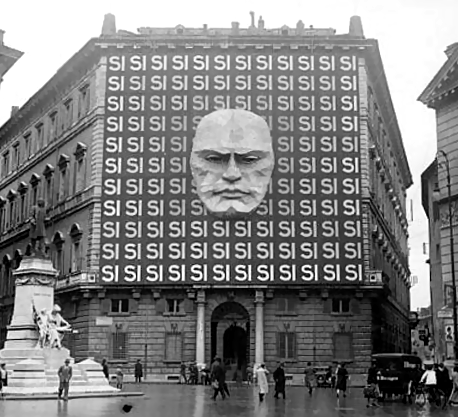
- "One people, one leader, one Yes" (1933, Germany, NSDAP government). For the single-list election and referendum of 12 November 1933, a banner on Berlin's Voßstraße read "Ein Volk, ein Führer, ein Ja". Nation, leader and the required answer become one thing, so a No vote reads as leaving the people. See Ein Volk, ein Führer, ein Ja (One People, One Leader, One Yes) (Bundesarchiv, Bild 183-K0930-502).
- "Enemy of the people" (1930s, Soviet Union, Communist Party under Stalin). The label, used by the Bolsheviks from 1917, became a standard charge of the purges of 1936 to 1938. In his closed speech to the 20th Party Congress on 25 February 1956, Nikita Khrushchev said Stalin's use of the concept made it unnecessary to prove the ideological errors of those accused and allowed repression of anyone who disagreed (Khrushchev, "On the Cult of Personality and Its Consequences", 1956; Robert Conquest, The Great Terror, 1968).
- Loyalty tests and "un-American" (1947 to 1954, United States, Truman administration and Congress). Democratic President Harry Truman's Executive Order 9835 (1947) set up loyalty reviews of federal employees, and the House Un-American Activities Committee and Republican Senator Joseph McCarthy treated past associations as proof of disloyalty. Republican Senator Margaret Chase Smith's "Declaration of Conscience" (1 June 1950) objected that Americans were losing livelihoods for exercising the right to criticise. Penalties were dismissal, blacklisting, prison terms for contempt of Congress, and, under the Smith Act, prison sentences for leaders of the Communist Party USA upheld in Dennis v. United States (1951) (Ellen Schrecker, Many Are the Crimes, 1998).
- Cultural Revolution (1966 to 1976, China, Chinese Communist Party under Mao Zedong). Labels such as "capitalist roader" and "revisionist" placed people outside the people, questioning a directive could itself be read as class-enemy thinking, and struggle sessions required colleagues and relatives to denounce the accused. The Party's own 1981 resolution on its history called the period responsible for the most severe setback and heaviest losses since 1949 (Roderick MacFarquhar and Michael Schoenhals, Mao's Last Revolution, 2006).
- "With us, or with the terrorists" (2001, United States, Bush administration). In his address to Congress on 20 September 2001, President George W. Bush told other nations: "Either you are with us, or you are with the terrorists." On 6 December 2001 Attorney General John Ashcroft told the Senate Judiciary Committee that to those who "scare peace-loving people with phantoms of lost liberty", his message was "your tactics only aid terrorists". (White House transcript, 20 September 2001; Senate Judiciary Committee hearing, 6 December 2001).
- "Anti-national" (2016 onward, India, BJP figures and allied media). After a February 2016 event at Jawaharlal Nehru University in Delhi, student union president Kanhaiya Kumar was arrested on a sedition charge, and ministers, party figures and several television anchors described protesting students and other critics as "anti-national". Christophe Jaffrelot describes how the label recast opposition to Hindu nationalist policy as disloyalty to India (Jaffrelot, Modi's India, 2021).
- "Enemies of the people" (2016 and 2017, United Kingdom and United States, a newspaper and a president). On 4 November 2016 the Daily Mail ran photographs of the three High Court judges who had ruled that Parliament must authorise notice of withdrawal from the EU under the headline "Enemies of the people". On 17 February 2017 President Donald Trump wrote on Twitter that named news organisations were "the enemy of the American People". In both, a court and named news organisations were placed outside "the people", so disagreement with a ruling or a report became a question of allegiance (R (Miller) v Secretary of State for Exiting the European Union [2016] EWHC 2768 (Admin); Trump on Twitter, 17 February 2017).
- "You ain't black" and "a special place in hell" (2016 and 2020, United States, Democratic campaigns). At a New Hampshire rally for Hillary Clinton on 6 February 2016, former Secretary of State Madeleine Albright told the audience that "there's a special place in hell for women who don't help each other", in a primary contest where polls showed many young women backing Bernie Sanders; she later wrote that she had used the line in the wrong context and did not mean that women must support a candidate because of gender. On 22 May 2020 Joe Biden told the radio host Charlamagne tha God that "if you have a problem figuring out whether you're for me or Trump, then you ain't black", and apologised the same day. In both, membership of a group (women, Black Americans) is tied to a vote, so choosing otherwise reads as leaving the group (Madeleine Albright, "My Undiplomatic Moment", The New York Times, 12 February 2016; The Breakfast Club, 22 May 2020).
- The Alaj portal (2026, Iran, Fars and IRIB amplifying unnamed operators). Iranian state media promoted a platform for citizens to submit the identities of Iranians abroad it called "anti-homeland currents, separatists, and promoters of sanctions and military attack". Framed as protecting the people, questions about the portal sound like questions about the asker's loyalty. See Alaj: the portal Iranian state media promoted for reporting 'traitors abroad' (Fars News Agency, 14 September 2026; IranWire, 16 September 2026).
How to spot it
- Does the message tell you who you are before it tells you what happened?
- Is there a place for someone who shares the identity but doubts this claim, or are the only options loyal and traitor?
- Is a question about evidence answered with a question about motive or allegiance ("whose side are you on?", "that's what they would say")?
- Does the label ("enemy of the people", "un-American", "anti-national", "traitor", "sellout") come with a specific charge and evidence, or does it stand in for them?
- Are checking institutions (courts, auditors, reporters, scientists) described as outside the group?
- Are members asked to report, shun or expose other members rather than to answer them?
- Swap the sides: would you accept the same label, aimed at your own group's critics, as an argument?
Where it ends: edge cases and legitimate persuasion
- Appeals to shared identity are not this technique in themselves. A leader who says "we are in this together" in a crisis, or a union asking members to hold a picket line, appeals to solidarity while the claims stay open to checking. It becomes identity fusion when the identity is used to shut down examination of a factual claim.
- A specific, evidenced accusation of disloyalty, such as a court finding of espionage, is different. Treason is a defined crime; the technique uses the word in place of the evidence.
- Groups may set terms of membership: a party may expel a member who campaigns for a rival, and a religious body may define its creed. The line is crossed when membership is used to police what members may ask about facts, and crossed much further when the state punishes that speech.
- Neighbours: Name-calling supplies the label; Scapegoating turns the fused group against an out-group; Bandwagon and Plain folks invite belonging without punishing doubt; Manufactured consensus makes the in-group's view look unanimous.
- The research construct and the technique differ. Swann's identity fusion is a measured psychological state, and being strongly fused with a group does not show manipulation; this page uses the name for messages that exploit that state.
Sources
- Conquest, Robert. The Great Terror: Stalin's Purge of the Thirties. Macmillan, 1968.
- Ellul, Jacques. Propaganda: The Formation of Men's Attitudes. Knopf, 1965 (French original Propagandes, 1962).
- Jaffrelot, Christophe. Modi's India: Hindu Nationalism and the Rise of Ethnic Democracy. Princeton University Press, 2021.
- Janis, Irving L. Victims of Groupthink. Houghton Mifflin, 1972.
- Kahan, Dan M., Donald Braman, John Gastil, Paul Slovic and C. K. Mertz. "Culture and Identity-Protective Cognition: Explaining the White-Male Effect in Risk Perception." Journal of Empirical Legal Studies 4(3), 2007.
- Kahan, Dan M., Ellen Peters, Maggie Wittlin, Paul Slovic, Lisa Larrimore Ouellette, Donald Braman and Gregory Mandel. "The Polarizing Impact of Science Literacy and Numeracy on Perceived Climate Change Risks." Nature Climate Change 2, 2012.
- Khrushchev, Nikita. "On the Cult of Personality and Its Consequences." Closed speech to the 20th Congress of the CPSU, 25 February 1956.
- Lifton, Robert Jay. Thought Reform and the Psychology of Totalism: A Study of "Brainwashing" in China. Norton, 1961.
- MacFarquhar, Roderick, and Michael Schoenhals. Mao's Last Revolution. Belknap Press of Harvard University Press, 2006.
- Noelle-Neumann, Elisabeth. "The Spiral of Silence: A Theory of Public Opinion." Journal of Communication 24(2), 1974.
- Schrecker, Ellen. Many Are the Crimes: McCarthyism in America. Little, Brown, 1998.
- Swann, William B., Jr., Ángel Gómez, D. Conor Seyle, J. Francisco Morales and Carmen Huici. "Identity Fusion: The Interplay of Personal and Social Identities in Extreme Group Behavior." Journal of Personality and Social Psychology 96(5), 2009.
- Swann, William B., Jr., Jolanda Jetten, Ángel Gómez, Harvey Whitehouse and Brock Bastian. "When Group Membership Gets Personal: A Theory of Identity Fusion." Psychological Review 119(3), 2012.
- Tajfel, Henri, and John C. Turner. "An Integrative Theory of Intergroup Conflict." In W. G. Austin and S. Worchel (eds.), The Social Psychology of Intergroup Relations. Brooks/Cole, 1979.
- Primary records: Bush, address to a joint session of Congress, 20 September 2001 (White House transcript); Senate Judiciary Committee hearing with Attorney General John Ashcroft, 6 December 2001; Executive Order 9835, 21 March 1947; Smith, "Declaration of Conscience", Senate floor, 1 June 1950; R (Miller) v Secretary of State for Exiting the European Union [2016] EWHC 2768 (Admin); Daily Mail front page, 4 November 2016; Donald Trump, Twitter post, 17 February 2017; Chinese Communist Party Central Committee, Resolution on Certain Questions in the History of Our Party since the Founding of the People's Republic of China, 1981; Bundesarchiv, Bild 183-K0930-502 (see Ein Volk, ein Führer, ein Ja (One People, One Leader, One Yes)); Fars News Agency, 14 September 2026, and IranWire, 16 September 2026 (see Alaj: the portal Iranian state media promoted for reporting 'traitors abroad').
Case studies
- Alaj: the portal Iranian state media promoted for reporting 'traitors abroad' — Alaj: the portal Iranian state media promoted for reporting 'traitors abroad'
- Kangura, Radio Rwanda and RTLM: Hutu Power propaganda before and during the genocide against the Tutsi, 1990-1994 — Kangura, Radio Rwanda and RTLM: Hutu Power propaganda, 1990-1994
- Angkar: language control in Democratic Kampuchea, 1975-1979, and the contests over its record — Angkar: language control in Democratic Kampuchea, 1975-1979
- Media war over Croatia and Bosnia, 1987-1995, and the denial of Srebrenica — Media war over Croatia and Bosnia, 1987-1995, and the denial of Srebrenica
- McCarthy's numbers: 205, 57, 81 and the move from 'card-carrying Communists' to 'security risks' (1950-54) — McCarthy's shifting numbers, 1950
- Big-character posters: how the opening labels of China's Cultural Revolution did the work of charges (1966-68) — Big-character posters and the labels of the Cultural Revolution
- The Kenya Emergency, 1952-1960: 'rehabilitation', the Hola water cart, and the oath — The Kenya Emergency, 1952-1960: 'rehabilitation', the Hola water cart, and the oath
- Algeria 1954-1962: 'events', psychological action, and the FLN's single voice — Algeria 1954-1962: 'events', psychological action, and the FLN's single voice
- Buy Empire, burn foreign cloth: the Empire Marketing Board and the swadeshi boycotts — Buy Empire, burn foreign cloth: the Empire Marketing Board and the swadeshi boycotts
- The Islamic State's media machine: Dabiq, Rumiyah, Amaq and the 'virtual caliphate' — The Islamic State's media machine: Dabiq, Rumiyah, Amaq and the 'virtual caliphate'
- Shining Path: the Gonzalo cult, the 'people's war' and the state's reply — Shining Path: the Gonzalo cult, the 'people's war' and the state's reply
- Walls, prisons and airwaves: republican and loyalist paramilitary propaganda in Northern Ireland — Walls, prisons and airwaves: republican and loyalist paramilitary propaganda in Northern Ireland
- The Tamil Tigers' martyr cult, and the state's 'humanitarian operation' — The Tamil Tigers' martyr cult, and the state's 'humanitarian operation'
- Film under Goebbels: Triumph des Willens (1935) and Der ewige Jude (1940) — Film under Goebbels: Triumph des Willens and Der ewige Jude
- India's Emergency: 'India is Indira' and the censored press — India's Emergency: 'India is Indira' and the censored press
- The loudspeaker war: propaganda across the Taiwan Strait, 1949-1987 — The loudspeaker war: propaganda across the Taiwan Strait, 1949-1987
- The Kim leader cult, the anti-US month and the leaflets sent back — The Kim leader cult, the anti-US month and the leaflets sent back
- Screened, state-written and contested: East Asia's history-textbook disputes since 1955 — Screened, state-written and contested: East Asia's history-textbook disputes since 1955
- The Great Leap Forward's 'sputnik' harvests and the famine that followed — The Great Leap Forward's 'sputnik' harvests and the famine that followed
- Holy war on three sides: the Ottoman jihad call, Germany's Islam policy and Britain's Arab Revolt messaging (1914-1918) — Holy war on three sides: the Ottoman jihad call, Germany's Islam policy and Britain's Arab Revolt messaging (1914-1918)
- The 1800 election: "Jefferson and no God" and "squints at monarchy" — The 1800 election: "Jefferson and no God" and "squints at monarchy"
- The satanic panic: ritual-abuse claims in the US and UK, 1980-1994 — The satanic panic: ritual-abuse claims in the US and UK, 1980-1994
- Gun rights and gun control: persuasion on both sides of the U.S. gun debate — Gun rights and gun control: persuasion on both sides of the U.S. gun debate
- The civil rights movement and the Citizens' Councils: boycotts and marches, 'outside agitator' labels, state money and economic pressure — The civil rights movement and the Citizens' Councils: boycotts and marches, 'outside agitator' labels, state money and economic pressure
- Mobutu's authenticité: how Zaire's party-state wrote one man into the nation — Mobutu's authenticité: how Zaire's party-state wrote one man into the nation
- South Africa's information war: the apartheid state's secret projects and the ANC's Radio Freedom — South Africa's information war: the apartheid state's secret projects and the ANC's Radio Freedom
- Perón cumple, Evita dignifica: Argentina's state media machine, and the decree that erased it — Perón cumple, Evita dignifica: Argentina's state media machine, and the decree that erased it
- The Reich Ministry of Public Enlightenment and Propaganda, 1933-1945 — The Reich Ministry of Public Enlightenment and Propaganda, 1933-1945
- Fascist Italy's propaganda machine: from the Duce's Press Office to the Ministry of Popular Culture — Fascist Italy's propaganda machine: from the Duce's Press Office to the Ministry of Popular Culture
- Imperial Japan's wartime propaganda at home: the Information Bureau, the neighbourhood associations and the war communiqués — Imperial Japan's wartime propaganda at home: the Information Bureau, the neighbourhood associations and the war communiqués
- Soviet wartime propaganda, 1939-1945: Sovinformburo, Agitprop and the Red Army press — Soviet wartime propaganda, 1939-1945: Sovinformburo, Agitprop and the Red Army press
- Chinese wartime propaganda, 1937-1945: Chongqing, Yan'an and Wang Jingwei's Nanjing — Chinese wartime propaganda, 1937-1945: Chongqing, Yan'an and Wang Jingwei's Nanjing
- Before the state: the NSDAP's propaganda in its fringe years, 1920-1923 — Before the state: the NSDAP's propaganda in its fringe years, 1920-1923
- Hitler über Deutschland: the 1932 campaigns that made the NSDAP a mass party — Hitler über Deutschland: the 1932 campaigns that made the NSDAP a mass party
- The SA in the street: uniforms, a martyr and staged disorder as proof only the NSDAP could 'restore order' (1921-1933) — The SA in the street: uniforms, a martyr and staged disorder as proof only the NSDAP could 'restore order' (1921-1933)
- Before Triumph of the Will: staging scale for a fringe party at Nuremberg, 1923-1933 — Before Triumph of the Will: staging scale for a fringe party at Nuremberg, 1923-1933
- From a fire to a vote: the Reichstag Fire Decree and the Enabling Act, February-March 1933 — From a fire to a vote: the Reichstag Fire Decree and the Enabling Act, February-March 1933
- The Lenin cult after 1924: an embalmed body, a mausoleum and a doctrine called "Leninism" — The Lenin cult after 1924: an embalmed body, a mausoleum and a doctrine called "Leninism"
- 'Trotskyism or Leninism': the press campaign that removed Trotsky from Soviet leadership (1924-1929) — 'Trotskyism or Leninism': the press campaign that removed Trotsky from Soviet leadership (1924-1929)
- "Liquidate the kulaks as a class": the propaganda campaign for collectivization (1929-1933) — "Liquidate the kulaks as a class": the propaganda campaign for collectivization (1929-1933)
- Divide the land, label the enemy: propaganda and discipline in the Jiangxi Soviet (1927-1934) — Divide the land, label the enemy: propaganda and discipline in the Jiangxi Soviet (1927-1934)
- The Yan'an Rectification Movement: doctrine, self-criticism and the Rescue Campaign (1942-1945) — The Yan'an Rectification Movement: doctrine, self-criticism and the Rescue Campaign (1942-1945)
- Land reform and the struggle session: how the CCP's class labels decided who kept their land, 1946-1952 — Land reform and the struggle session: how the CCP's class labels decided who kept their land, 1946-1952
- The Mao cult before the state: 'Mao Zedong Thought' and 'The East Is Red', 1943-1949 — The Mao cult before the state: 'Mao Zedong Thought' and 'The East Is Red', 1943-1949
- The Gestapo's Denunciation Apparatus: Policing by Public Tip-Off, 1933-1945 — The Gestapo's denunciation apparatus: policing by public tip-off, 1933-1945
- The People's Court: the Volksgerichtshof as a stage for verdicts, 1934-1945 — The People's Court: the Volksgerichtshof as a stage for verdicts, 1934-1945
- The SS as its own propaganda institution: Das Schwarze Korps, the Ahnenerbe and the order myth, 1931-1945 — The SS as its own propaganda institution: Das Schwarze Korps, the Ahnenerbe and the order myth, 1931-1945
- Manufactured unanimity: the Nazi single-list plebiscites, 1934-1938 — Manufactured unanimity: the Nazi single-list plebiscites, 1934-1938
- The German Labour Front and Strength Through Joy, 1933-1945 — The German Labour Front and Strength Through Joy, 1933-1945
- The Agitprop Department: the Communist Party's standing propaganda apparatus, 1920-1991 — The Agitprop Department: the Communist Party's standing propaganda apparatus, 1920-1991
- The NKVD as its own propagandist: 'enemies of the people,' informants and the vigilant state (1934-1946) — The NKVD as its own propagandist: 'enemies of the people,' informants and the vigilant state (1934-1946)
- Pravda, Izvestia and TASS: the institutional structure of the Soviet press monopoly, 1912-1991 — Pravda, Izvestia and TASS: the institutional structure of the Soviet press monopoly, 1912-1991
- The Union of Soviet Writers and socialist realism, 1932-1969 — The Union of Soviet Writers and socialist realism, 1932-1969
- The danwei: how the work unit became China's basic unit of political control, 1951-2003 — The danwei: how the work unit became China's basic unit of political control, 1951-2003
- The PLA's Political Commissar System: Dual Command, the General Political Department and PLA Daily — The PLA's Political Commissar System: dual command, the General Political Department and PLA Daily
- The Hundred Flowers and Anti-Rightist Campaigns: soliciting criticism, then purging it (1956-1959) — The Hundred Flowers and Anti-Rightist Campaigns: soliciting criticism, then purging it (1956-1959)
- The Hitler Youth: from a party wing to a legal duty, 1926-1945 — The Hitler Youth: from a party wing to a legal duty, 1926-1945
- The Bund Deutscher Mädel: raising Nazi Germany's girls for the Volk — The Bund Deutscher Mädel: raising Nazi Germany's girls for the Volk
- Nazi control of school curriculum and teachers, 1933-1938 — Nazi control of school curriculum and teachers, 1933-1938
- Two ladders to the top: the Napolas, the Adolf Hitler Schools, and the Reich's rival cadet pipelines (1933-1945) — Two ladders to the top: the Napolas, the Adolf Hitler Schools, and the Reich's rival cadet pipelines (1933-1945)
- Kinderlandverschickung: evacuating Germany's children into Hitler Youth camps, 1940-1945 — Kinderlandverschickung: evacuating Germany's children into Hitler Youth camps, 1940-1945
- The All-Union Pioneer Organization: scouting rebuilt as a communist pipeline, 1922-1991 — The All-Union Pioneer Organization: scouting rebuilt as a communist pipeline, 1922-1991
- The Komsomol: youth pipeline, mass mobilization and internal discipline, 1918-1991 — The Komsomol: youth pipeline, mass mobilization and internal discipline, 1918-1991
- Soviet control of school curriculum and textbooks — Soviet control of school curriculum and textbooks
- The Little Octobrists (Oktyabryata): a red star badge for seven-year-olds — The Little Octobrists (Oktyabryata): a red star badge for seven-year-olds
- The Pavlik Morozov cult: a Soviet martyr built from a disputed murder — The Pavlik Morozov cult: a Soviet martyr built from a disputed murder
- A corner of the flag on a six-year-old: the Young Pioneers of China — A corner of the flag on a six-year-old: the Young Pioneers of China
- Red scarf to Party card: a century of the Communist Youth League of China — Red scarf to Party card: a century of the Communist Youth League of China
- Class struggle in the classroom: nationalizing China's school curriculum and textbooks, 1949-1977 — Class struggle in the classroom: nationalizing China's school curriculum and textbooks, 1949-1977
- The Red Guards: how Mao turned millions of students into a political weapon, 1966-68 — The Red Guards: how Mao turned millions of students into a political weapon, 1966-68
- The Nero Decree: Hitler's order to destroy Germany, and the myth built on defying it — The Nero Decree: Hitler's order to destroy Germany, and the myth built on defying it
- History will absolve me: the 26th of July Movement and Batista's press, 1953–1959 — History will absolve me: the 26th of July Movement and Batista's press, 1953–1959
- ¡Venceremos!: Cuba's 1961 literacy campaign, the primer, and the year-end declaration — ¡Venceremos!: Cuba's 1961 literacy campaign, the primer, and the year-end declaration
- A committee on every block: Cuba's Committees for the Defense of the Revolution — A committee on every block: Cuba's Committees for the Defense of the Revolution
- Pioneros por el comunismo: Cuba's youth ladder, the single textbook, and the reply that uses the same devices — Pioneros por el comunismo: Cuba's youth ladder, the single textbook, and the reply that uses the same devices
- Cuba's crisis years: Mariel, the Special Period, the Malecón, and 11 July — Cuba's crisis years: Mariel, the Special Period, the Malecón, and 11 July