Content note: Japanese wartime leaflet with a suggestive scene and a skull-faced soldier, shown as issued. This object is shown as it was published. Why
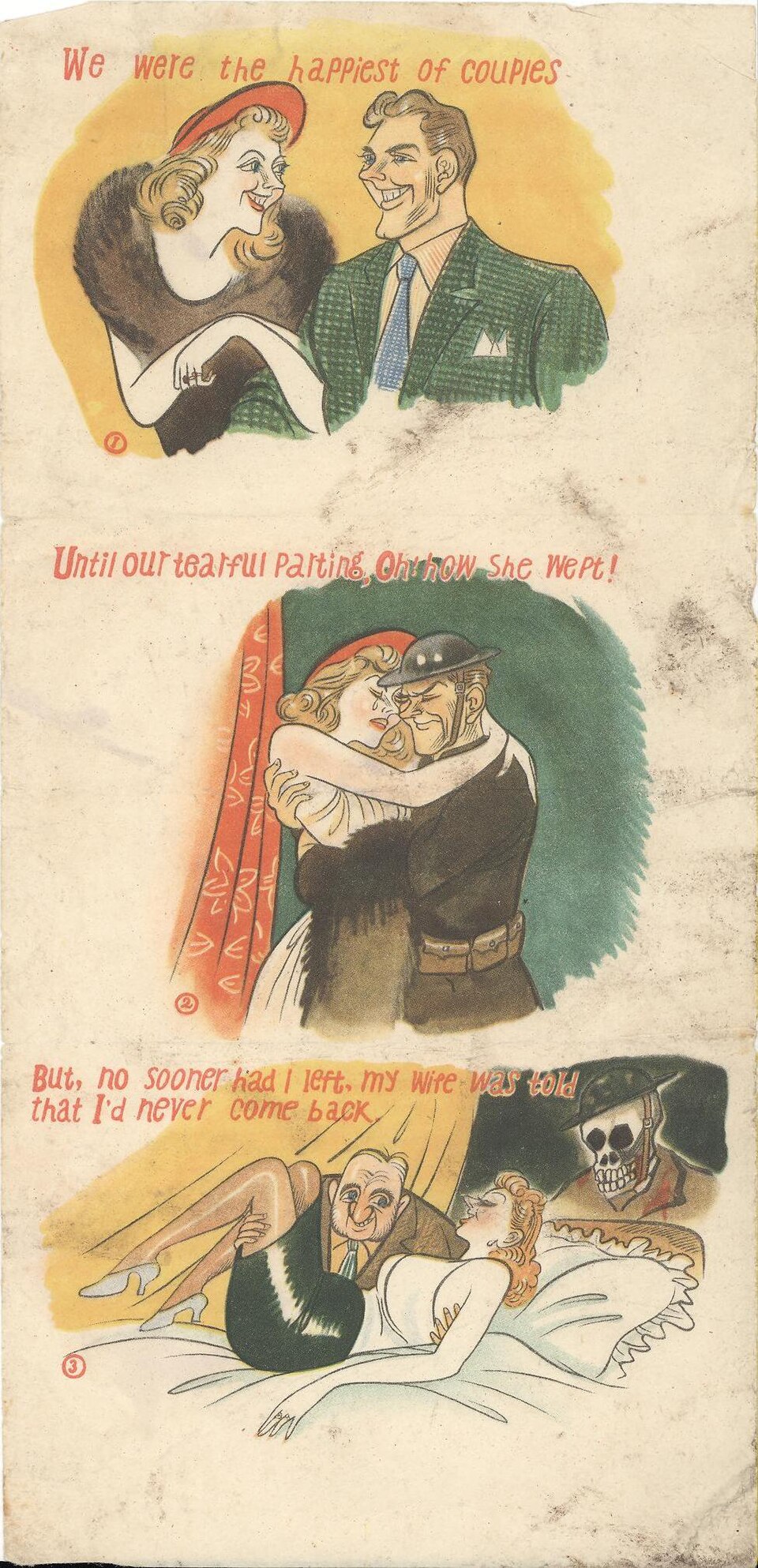
Japanese leaflet in English, "We were the happiest of couples" (Pacific, c. 1942)
Three-panel colour cartoon leaflet in a soldier's voice. 1: a smiling couple, 'We were the happiest of couples'. 2: a helmeted soldier embracing a weeping woman, 'Until our tearful parting, Oh! how she wept!'. 3: the woman in bed with an older man while a skeleton in a helmet looks on, 'But, no sooner had I left, my wife was told that I'd never come back'. The tell: it plays on a soldier's fear that death makes him instantly replaceable at home; no source or issuer is given.
Propaganda techniques used in this leaflet
- Date
- 1942
- Period
- Second World War
- Made by
- Empire of Japan (Japanese military psychological-warfare leaflet; no issuer named on the leaflet)
Full record
Region, Country, Medium, Issuer type, Regime, Leader, Audience, Purpose, Theme, Event, Source, Rights
- Region
- East Asia
- Country
- Empire of Japan
- Medium
- Leaflet
- Issuer type
- Military
- Regime
- Showa Japan
- Leader
- Hideki Tojo
- Audience
- Enemy forces
- Purpose
- Persuade or win support
- Theme
- War and the military
- Event
- World War II
- Leader
- Hideki Tōjō
- Source
- Unidentified Source blurred: contractors, cutouts, buried disclosure
- Source
- Wikimedia Commons, retrieved October 11, 2026
- Rights
- Openly licensed (CC BY 2.0, per Wikimedia Commons; Marine Corps Archives and Special Collections)
Japanese propaganda, circa 1942, Propaganda Collection (COLL/3541), Marine Corps Archives and Special Collections, Quantico, via Flickr and Wikimedia Commons, CC BY 2.0
Text on the object
Original (English) · read from the image, not independently checked
We were the happiest of couples

Until our tearful parting, Oh! how she wept!

But, no sooner had I left, my wife was told that I'd never come back
Read from the 960 px rendering; the hand lettering is clear. The three panels are numbered 1 to 3 in red circles on the leaflet.
.jpg)