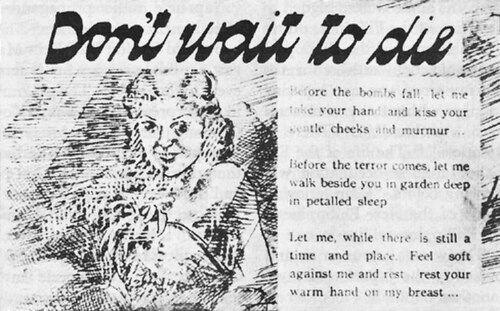
Japanese leaflet in English, "Don't wait to die" (Philippines, 1942)
English-language leaflet with a hand-lettered headline, 'Don't wait to die', beside a pencil-style drawing of a smiling woman with waved hair, and a text in the first person that begins 'Before the bombs fall' and 'Before the terror comes'. The headline and the two 'before' lines stage imminent death from bombing (fear appeal), and the text offers one remedy, intimacy with the speaker while 'there is still a time and place'; no alternative is discussed.
- Date
- 1942
- Period
- Second World War
- Made by
- Empire of Japan (Japanese military psychological-warfare leaflet, Battle of the Philippines; no issuer named on the leaflet)
- Region
- East Asia
- Country
- Empire of Japan
- Medium
- Leaflet
- Issuer type
- Military
- Regime
- Showa Japan
- Leader
- Hideki Tojo
- Audience
- Enemy forces
- Purpose
- Mobilize or secure compliance
- Theme
- War and the military
- Event
- World War II
- Techniques
- Fear appeal
- Regime
- Empire of Japan, 1937 to 1945
- Leader
- Hideki Tōjō
- Source
- Unidentified Source blurred: contractors, cutouts, buried disclosure
- Source
- Wikimedia Commons (source cited there: U.S. Army Center of Military History, The Fall of the Philippines, ch. XXI), retrieved September 29, 2026
- Rights
- Public domain (Commons tags PD-Japan-oldphoto, PD-1996; anonymous Japanese wartime leaflet, 1942)
Japanese wartime propaganda leaflet, Battle of the Philippines, 1942; via Wikimedia Commons
Text on the object
Don't wait to die

Before the bombs fall, let me
take your hand and kiss your
gentle cheeks and murmur ...

Before the terror comes, let me
walk beside you in garden deep
in petalled sleep

Let me, while there is still a
time and place.  Feel soft
against me and rest . . rest your
warm hand on my breast ...
Read from a 500 px rendering of the 488 px original; the small halftone text is faint in places but legible, and the line breaks follow the printed lines. The headline has no visible end punctuation in the image (the Commons caption adds an exclamation mark).