
Ernest Bevin
Illustration, not an archive object
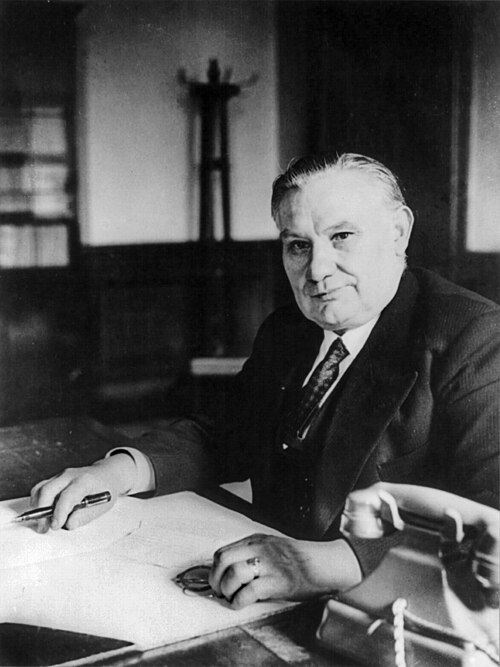

Minister of Labour and National Service · United Kingdom
On the regime page: Churchill wartime government
6 quotes, oldest first. Filter with other speakers.
“I would like to say that, after all, I regard a married woman as playing just as great a part as a citizen as if she were in any other avocation. We have had a system which has never paid her for her services, I admit, but, on the other hand, as a trade union official, I argued for years when I had to calculate wages and payments in industry that industry has had the services not only of men but of women, who kept the men fit to work, a service for which they had never been paid in the whole of their lives. I say that quite advisedly, but it does not mean that the State must not recognise the important work as a citizen that the wife is doing. I cannot, however, deal with that in this Bill. I yield to none, not even the most extreme feminists, with regard to the work I have done for women in this country through the trade union effort, in lifting them out of the sordid sweated industries on to a better basis; it is work on which I look back with pride. That was at a time when we did not get very much assistance. Therefore, I am sure there will be no dispute about the fact that we do not propose to enrol married women or women with children of their own.”
Speaking on the second reading of the National Service Bill, which provided for the call-up of women. Bevin was Minister of Labour and National Service.
House of Commons, 9 December 1941, HC Deb vol. 376, c1419 Source
“My object has been to devise a scheme that will be recognised as fair and which would not place the duty upon the officials of my Department of selecting according to merit or suitability. I therefore propose to resort to the most impartial method of all, that of the ballot. A draw will be made from time to time of one or more of the figures from 0 to 9 and those men whose National Service Registration Certificate numbers happen to end with the figure or figures thus drawn by ballot will be transferred to coalmining.”
Bevin's statement announcing the ballot under which some conscripts were directed to coalmining (the "Bevin Boys") instead of the armed forces.
House of Commons, 2 December 1943, HC Deb vol. 395, c521 Source
“Yes, I am entitled to direct anybody anywhere, including the right hon. Member.”
Bevin's reply to Sir Hugh O'Neill MP, who asked whether the coalmining scheme needed fresh legislation. Bevin withdrew the application of the remark to Members of Parliament a moment later, after a point of order.
House of Commons, 2 December 1943, HC Deb vol. 395, c523 Source
“There are thousands of cases in which conscientious objectors, although they have refused to take up arms, have shown as much courage as anyone else in Civil Defence and in other walks of life.”
Reply to Sir John Mellor MP, who had asked whether conscientious objectors would be directed to coalmining.
House of Commons, oral answers, 9 December 1943, HC Deb vol. 395, c1108 Source
“Making catch phrases is an easier job than directing 24,000,000 people in a war of this character. It was said in the opening speech that I worked up the Press, that I got hold of all the editors, and that I put everything in such a form that I could create the atmosphere for this Regulation. I do not know whether it is Parliamentary, Mr. Speaker, to say so, but that is a lie.”
Replying to a debate, opened by Aneurin Bevan MP, on a motion to annul the Order in Council adding Regulation 1AA to the Defence (General) Regulations. Bevin was answering the charge that he had stirred up a press campaign against strikers.
House of Commons, 28 April 1944, HC Deb vol. 399, c1120 Source
“Alter study, I came to the conclusion, that, if I trusted it, relied upon it, the trade unions and the employers through their industrial relations machinery, might make a better job of it than if we introduced totalitarian methods. I accordingly advised the Cabinet at that time that my policy would be based upon the utilisation of all this great joint relation machinery that had operated during these years. On the whole, I think, that decision has been justified.”
In the same speech, Bevin read to the House from his shorthand note of his luncheon address of 5 April 1944, on how he had chosen between a system of military-style control and reliance on joint industrial relations machinery.
House of Commons, 28 April 1944, HC Deb vol. 399, c1122 Source