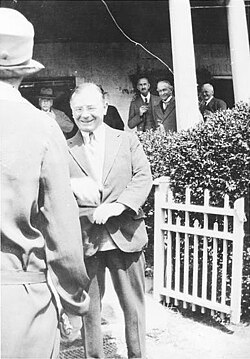
Leo Amery
Illustration, not an archive object

Secretary of State for India and Burma (1940 to 1945) · United Kingdom
On the regime page: Churchill wartime government
7 quotes, oldest first. Filter with other speakers.
“Somehow or other we must get into the Government men who can match our enemies in fighting spirit, in daring, in resolution and in thirst for victory.”
Amery, a Conservative backbencher, spoke on the first day of the Norway debate, after the Allied failure in Norway. He had been out of office since 1929. Three days later Chamberlain resigned, and Amery became Secretary of State for India and Burma in Churchill's government on 13 May 1940.
Speech in the Norway debate ("Conduct of the War"), House of Commons, 7 May 1940 (HC Deb vol. 360, c. 1150) Source
“You have sat too long here for any good you have been doing. Depart, I say, and let us have done with you. In the name of God, go.”
Amery, a Conservative backbencher, spoke on the first day of the Norway debate, after the Allied failure in Norway. He had been out of office since 1929. Three days later Chamberlain resigned, and Amery became Secretary of State for India and Burma in Churchill's government on 13 May 1940. The words are Cromwell's, which Amery introduced as words that he thought applicable to the present situation, and which he described as said to the Long Parliament.
Speech in the Norway debate ("Conduct of the War"), House of Commons, 7 May 1940 (HC Deb vol. 360, c. 1150) Source
Content note: Refusal to disclose where a detained leader is held. The words are shown as they were said or written. Why
“I have received no such representations. Mr. Nehru is permitted to correspond with his family on family matters. I am not prepared to disclose his present whereabouts.”
After the Indian National Congress passed the Quit India resolution on 8 August 1942, the Government of India arrested its leaders. A Member asked about communication with the prisoners and where Jawaharlal Nehru was held.
Oral answer on Congress prisoners, House of Commons, 1 October 1942 (HC Deb vol. 383, c. 906) Source
Content note: Official statement on machine-gunning of crowds from the air. The words are shown as they were said or written. Why
“Mobs were machine-gunned from the air on 15th, 16th, 21st and 22nd August and 6th September. Information regarding casualties is not available, but they are believed to be slight and on two out of the five occasions were probably nil. One Blenheim aircraft crashed in Bihar on 18th August. One member of the crew was killed in the crash; the remaining two were murdered. A second Blenheim with a crew of three on reconnaissance duty over Bihar on 30th August failed to return and so far there has been no trace of the aircraft or crew. Reports so far available show that the total number of persons killed during the disturbances was 846 and the number wounded 2,024. Of these 60 were Government servants (including military and police) killed and 648 wounded. So far as is known no European British subject (apart from the small number of military and Air Force casualties) was killed in the disturbances, though a considerable number mostly officials, received injuries. In Madras one domiciled European, an Assistant Salt Inspector, was murdered.”
A Member asked on which dates Indian crowds were machine-gunned from the air and how many were killed, after the disturbances that followed the arrest of Congress leaders in August 1942.
Oral answer on disturbances in India, House of Commons, 8 October 1942 (HC Deb vol. 383, c. 1342) Source
Content note: Defence of machine-gunning crowds from the air. The words are shown as they were said or written. Why
“There are conditions of violence and danger to life when that may be the only method.”
Shinwell had asked whether it was not possible to deal with mobs without machine-gunning, and whether this was in conformity with British practice.
Supplementary answer on disturbances in India, House of Commons, 8 October 1942 (HC Deb vol. 383, c. 1342) Source
“The most important development in the Indian food situation in the last few weeks is that the main rice crop, which is just coming to harvest, is reported to be excellent, particularly in Bengal. Military assistance in Bengal is getting into its stride, and the outlying centres, as well as Calcutta, are now receiving adequate supplies, though distribution from those centres to the more remote villages still presents a problem. Plans for rationing in urban areas are proceeding and should be in operation in Calcutta by the middle of this month. Deaths in Calcutta for the fortnight ending 28th October totalled 3,132. I cannot give figures for Bengal as a whole. It is reported that 2,233,000 people are being fed daily from free food kitchens.”
A Member asked for the latest figures on deaths from famine in Bengal and the extent of cholera.
Oral answer on the Indian food situation, House of Commons, 2 December 1943 (HC Deb vol. 395, c. 513) Source
Content note: Official figures on famine and cholera deaths. The words are shown as they were said or written. Why
“As I informed the hon. Member on 2nd December, figures of famine deaths for the whole of Bengal are not available. Figures for Calcutta for the period 16th August to 11th December, 1943, are as follows:—Admissions to hospital of starving persons 16,285. Deaths among such admissions 6,156. In addition, during the period 1st August to 11th December, the number of bodies disposed of by police or non-official relief organisations in Calcutta was 9,216, but this total may include some deaths not due to starvation. The total number of deaths from cholera in the whole of the Bengal Presidency between 27th June and 13th November was 77,938.”
A Member asked whether Bengal had published figures for deaths from starvation and cholera over the previous six months. Amery gave figures supplied through the Government of India.
Oral answer on starvation and disease in Bengal, House of Commons, 16 December 1943 (HC Deb vol. 395, c. 1665) Source
Often attributed, not verified
These words circulate under Leo Amery’s name but could not be traced to a source. They are listed so readers can check them, not as Leo Amery’s words.
“I didn't see much difference between his outlook and Hitler's, which annoyed him no little.”
The sentence is widely reported with a secondary citation, but the diary volume was not available to read, so the exact wording, date and page could not be confirmed against the edition.
“on the subject of India, Winston is not quite sane”
Reported in secondary sources without a page the author could check; the Barnes and Nicholson edition was not available to read.