F. E. Smith
Illustration, not an archive object
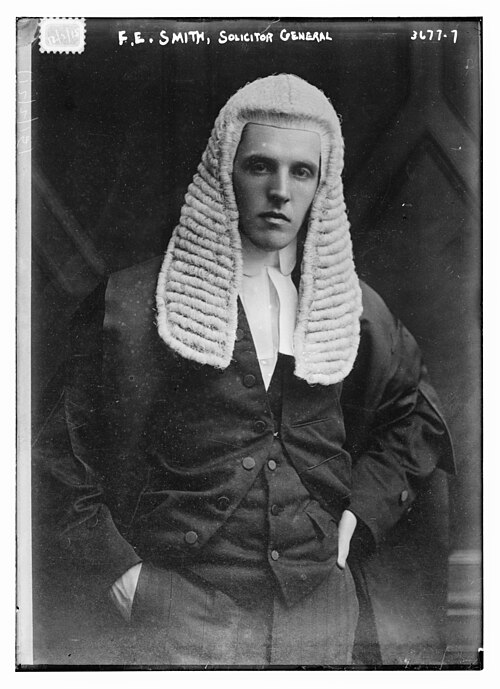

Director of the Press Bureau (August to September 1914); Solicitor General and Attorney General from 1915; later Lord Birkenhead · United Kingdom
On the regime page: Asquith government
4 quotes, oldest first. Filter with other speakers.
“This Bill will leave behind it the memory of unforgetable wrong. It will revive antagonisms happily declining. It will give satisfaction to none except those who say: "How these Christians love one another." The Government will be well advised, even at the eleventh hour, to withdraw a Bill which has shocked the conscience of every Christian community in Europe.”
Smith, then an opposition front-bencher, moved an amendment against the second reading of the Liberal Government's Bill to disestablish and disendow the Church of England in Wales. The closing sentence was widely quoted and mocked at the time.
F. E. Smith, speech moving the rejection of the Established Church (Wales) Bill, House of Commons, 13 May 1912, Hansard, HC Deb vol. 38, col. 820 Source
“No one will suppose, for instance, that we are to manufacture incidents. It is suggested we should have the assistance of journalists, but it is no part of our functions to manufacture news. We are not in competition with the news agencies.”
Smith answered Members' criticism, after the Times's publication of the previous day, that the Press Bureau supplied too little news to the press in the first weeks of the war.
F. E. Smith, Director of the Press Bureau, speech in the House of Commons, 31 August 1914, Hansard, HC Deb vol. 66, col. 490 Source
“I can only add that the principle on which we have gone in asking the Press to be silent has been to ask them to exclude material which was excluded by the decisions of Lord Kitchener and the War Office upon lines of general policy.”
In the same debate Smith described how the Bureau decided what newspapers were asked not to print, saying the Bureau followed the War Office's and Lord Kitchener's decisions on general policy.
F. E. Smith, Director of the Press Bureau, speech in the House of Commons, 31 August 1914, Hansard, HC Deb vol. 66, col. 493 Source
“We are sometimes told that the Government is weak. It may be weak—I do not know—but I tell my right hon. Friend this, that it is the intention of the Government and, I believe, with the approval of the great majority of the House and of the majority of this country, to see that, whereas the meetings of the Cabinet are intended to be secret, whereas we are all agreed that they ought to be secret, whereas they are protected by the oath which a Privy Councillor takes, that at least no newspaper shall publish the tittle-tattle, the inaccurate accounts which purport to be given day by day of what takes place in the Cabinet to be retailed, to the prejudice of this country, in neutral and foreign countries.”
Sir Henry Dalziel, a newspaper proprietor, moved a motion on the Defence of the Realm regulation restricting the publication of Cabinet proceedings. Smith replied for the Government.
Sir F. E. Smith, Attorney General, speech in the House of Commons on the Defence of the Realm Act regulation on the publication of Cabinet proceedings, 8 May 1916, Hansard, HC Deb vol. 82, col. 429 Source