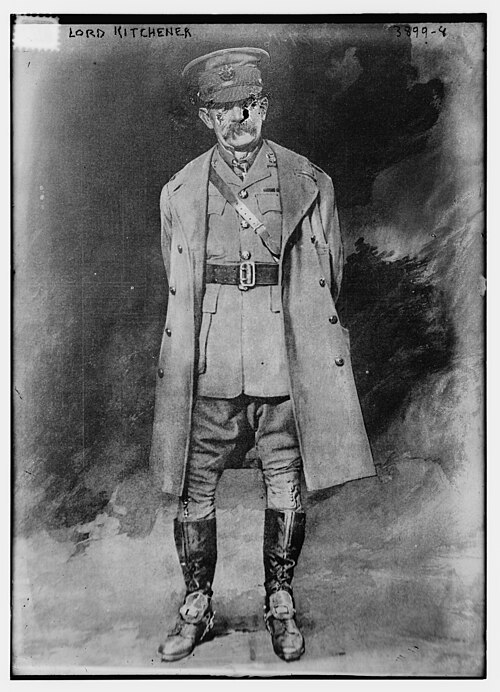
Herbert Kitchener
Illustration, not an archive object

Secretary of State for War · United Kingdom
On the regime page: Asquith government
6 quotes, oldest first. Filter with other speakers.
Content note: Concerns the internment of civilians. The words are shown as they were said or written. Why
“The women and children brought in should be divided in two categories, viz.: 1st. Refugees, and the families of Neutrals, non-combatants, and surrendered Burghers. 2nd. Those whose husbands, fathers and sons are on Commando. The preference in accommodation, etc. should of course be given to the first class.”
Kitchener, then commander-in-chief in South Africa, set out the policy of bringing Boer women and children into camps during the guerrilla phase of the war. The source also quotes the memorandum as calling this "the most effective method of limiting the endurance of the guerrillas".
Memorandum by Lord Kitchener to general officers, South Africa, 21 December 1900, as quoted in South African History Online, "Women and children in white concentration camps during the Anglo-Boer War, 1900-1902" Source
“You are ordered abroad as a soldier of the King to help our French comrades against the invasion of a common enemy. You have to perform a task which will need your courage, your energy, your patience. Remember that the honour of the British Army depends on your individual conduct. It will be your duty not only to set an example of discipline and perfect steadyness under fire but also to maintain the most friendly relations with those whom you are helping in this struggle. The operations in which you are engaged will, for the most part, take place in a friendly country, and you can do your own country no better service than in showing yourself in France and Belgium in the true character of a British soldier. Be invariably courteous, considerate and kind. Never do anything likely to injure or destroy property, and always look upon looting as a disgraceful act. You are sure to meet a welcome and to be trusted; your conduct must justify that welcome and that trust. Your duty cannot be done unless your health is sound. So keep constantly on your guard against any excesses. In this new experience you may find temptations both in wine and women. You must entirely resist both temptations, and, while treating all women with perfect courtesy, you should avoid any intimacy. Do your duty bravely. Fear God. Honour the King.”
A confidential printed message issued to each soldier of the British Expeditionary Force on embarkation for France, by the Secretary of State for War.
"An address by Field-Marshal Kitchener to the British Troops", leaflet for the Active Service Pay Book of the British Expeditionary Force, August 1914 Source
“Noble Lords on both sides of the House doubtless know that while associating myself in the fullest degree for the prosecution of the war with my colleagues in His Majesty's Government, my position on this Bench does not in any way imply that I belong to any political Party, for, as a soldier, I have no politics.”
Kitchener's first speech to the Lords, three weeks after he joined the Cabinet as a serving field marshal without a party.
Statement by the Secretary of State for War, House of Lords, 25 August 1914, HL Deb vol. 17, c. 501 Source
“The terms of my service are the same as those under which some of the finest portions of our manhood, now so willingly stepping forward to join the Colours, are engaging—that is to say, for the war, or, if it lasts longer than three years, then for three years. It has been asked why the latter limit has been fixed. It is because should this disastrous war be prolonged—and no one can foretell with any certainty its duration—then after three years' war there will be others fresh and fully prepared to take our places and see this matter through.”
Kitchener explained the enlistment terms for the new volunteers, "for the war, or, if it lasts longer than three years, then for three years", and why the three-year limit had been set.
Statement by the Secretary of State for War, House of Lords, 25 August 1914, HL Deb vol. 17, cc. 501-502 Source
“I have no complaint whatever to make about the response to my appeals for men — and I may mention that the progress in military training of those who have already enlisted is most remarkable ; the country may well be proud of them — but I shall want more men, and still more, until the enemy is crushed.”
Kitchener was replying to the toast to the Imperial Forces of the Crown at the Lord Mayor's banquet, three months after the war began and while the volunteer armies were being raised.
Speech by the Secretary of State for War at the Lord Mayor's Guildhall Banquet, 9 November 1914, in Great Speeches of the War (London: Hazell, Watson & Viney, 1915), pp. 59-61 Source
“There has been undoubtedly considerable delay in producing the material which we at an early stage in the war foresaw would be required. This delay is due mainly to the unprecedented and almost unlimited calls that have been made on the resources of the manufacturers of this country. Strenuous efforts have been taken by all concerned to reduce as far as possible this delay in production, and I am glad to say that already a very considerable improvement in the output has been the result of the energy and good work of all concerned.”
Made during the shell shortage controversy, a week after The Times published Colonel Repington's criticism of ammunition supply. The coalition government and a Ministry of Munitions followed within weeks.
Statement by the Secretary of State for War, House of Lords, 18 May 1915, HL Deb vol. 18, c. 1019 Source
Often attributed, not verified
These words circulate under Herbert Kitchener’s name but could not be traced to a source. They are listed so readers can check them, not as Herbert Kitchener’s words.
“Your country needs you.”
The 1914 poster (Alfred Leete's "Lord Kitchener Wants You", later "Your Country Needs You") carries his image and a caption; it is not a recorded speech or statement by Kitchener. The caption was an advertising slogan, not his own words.