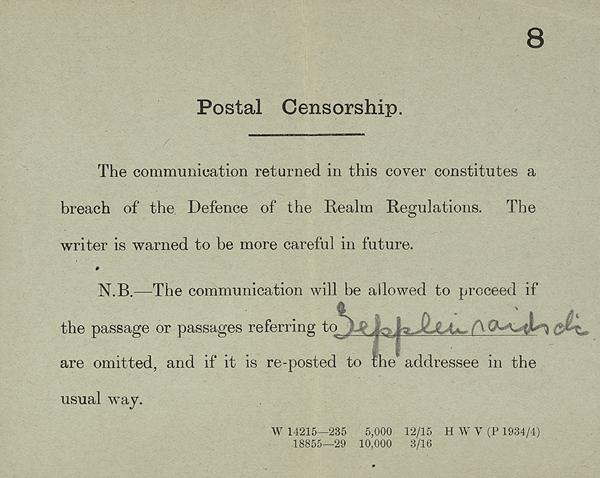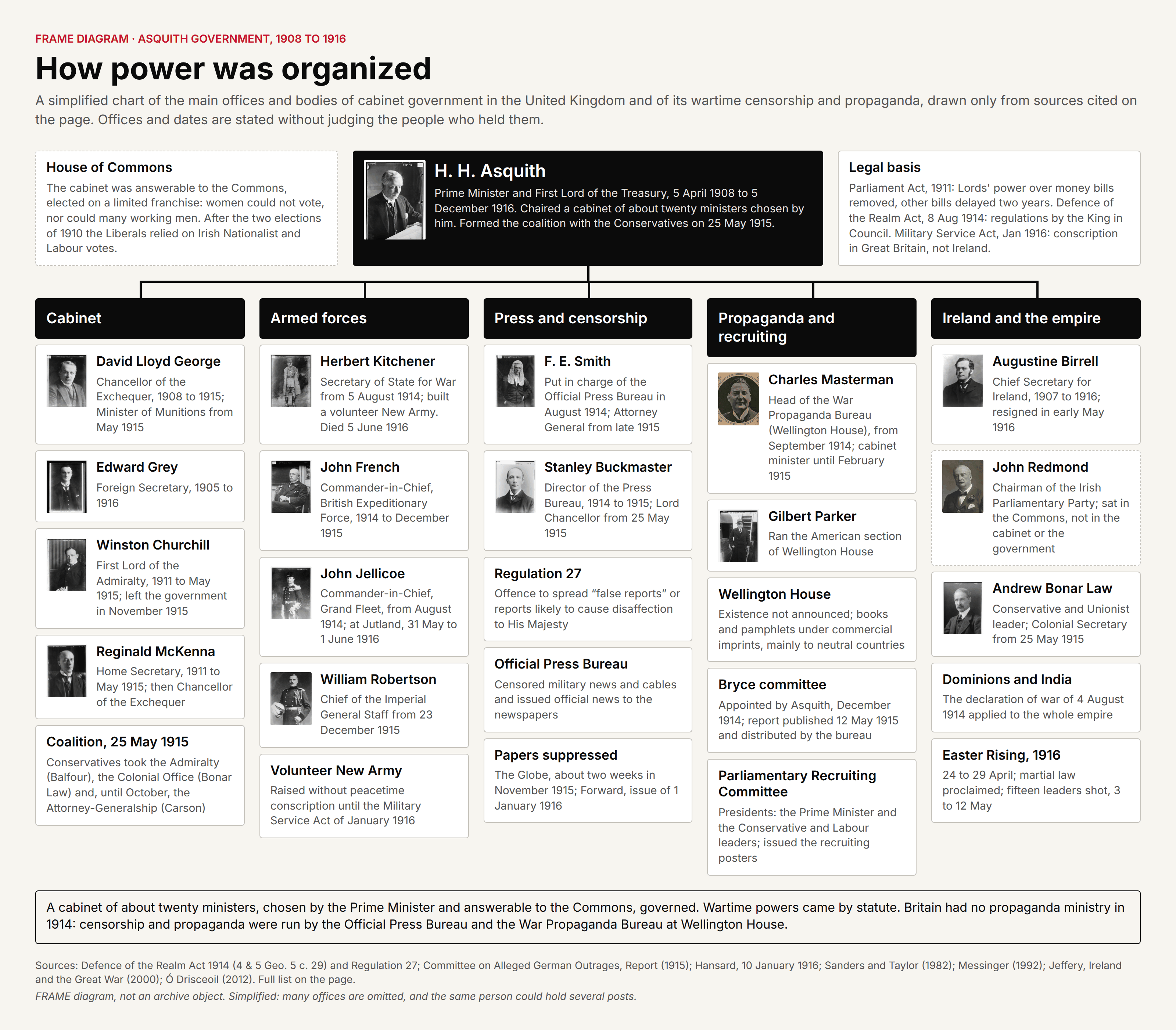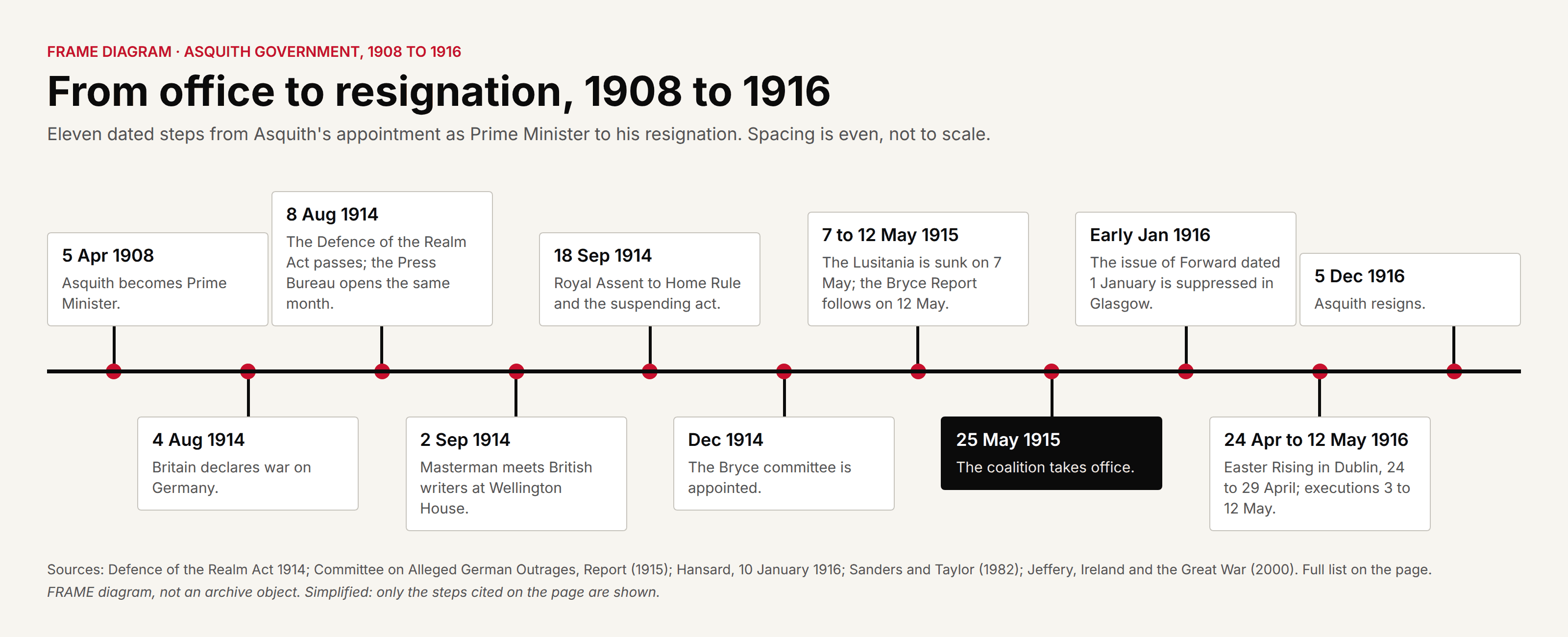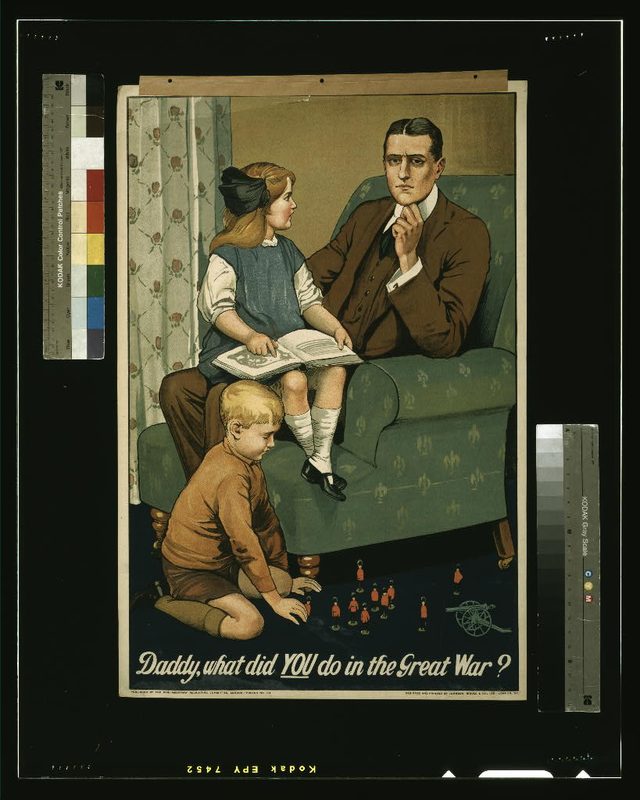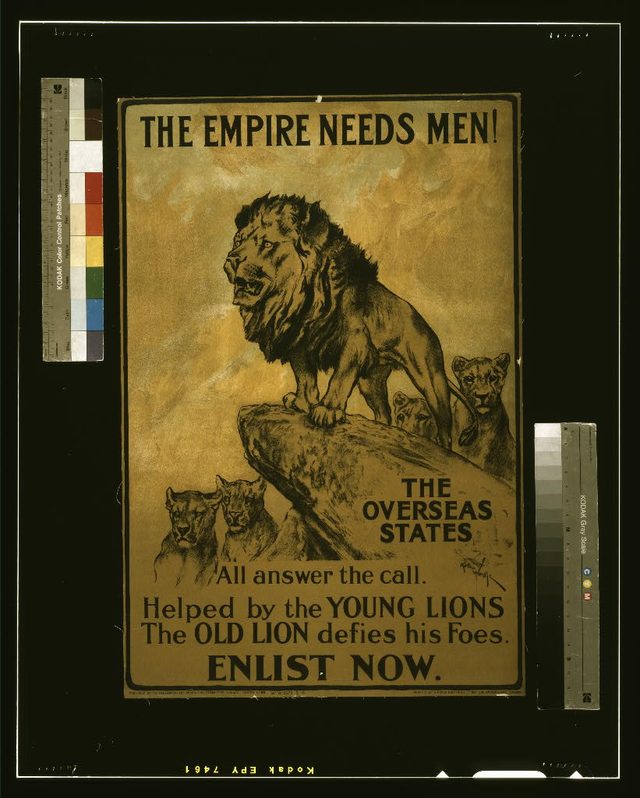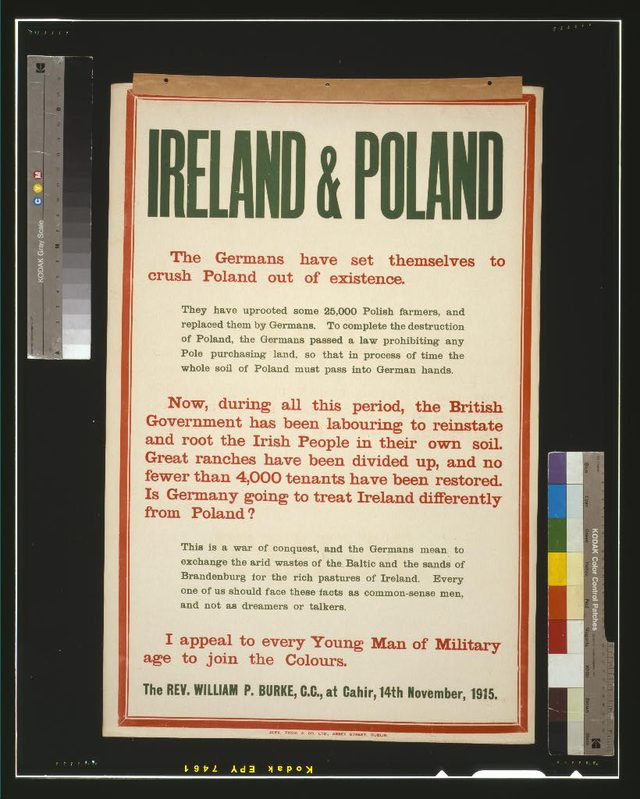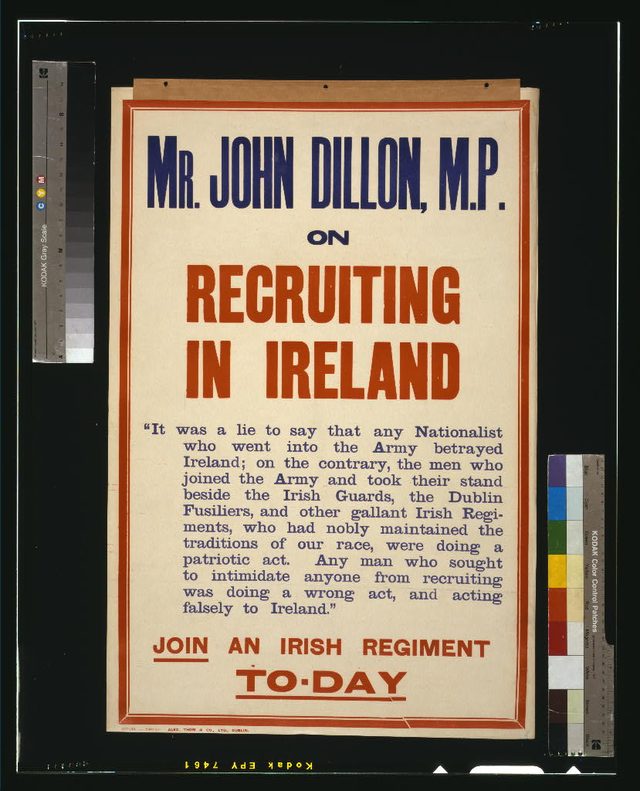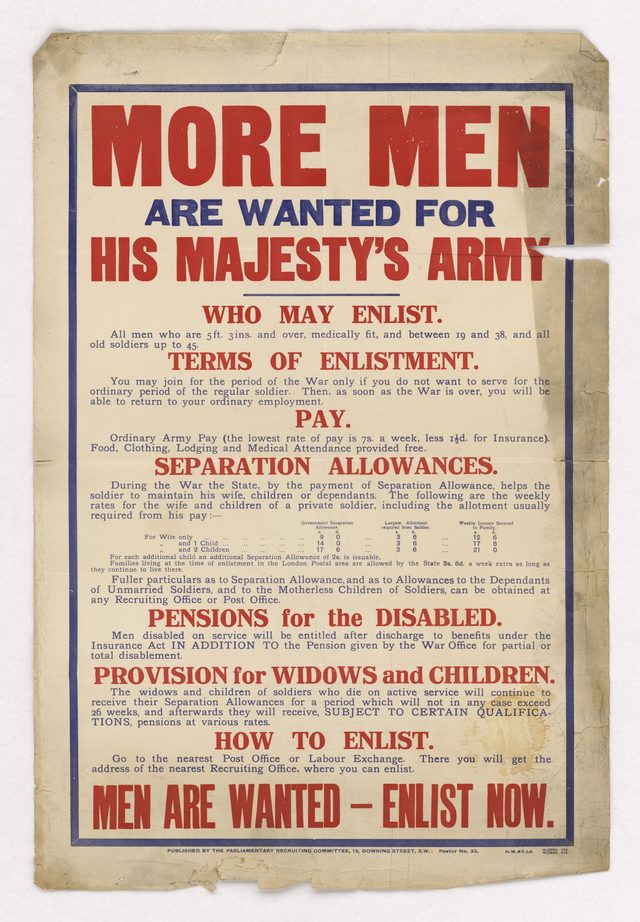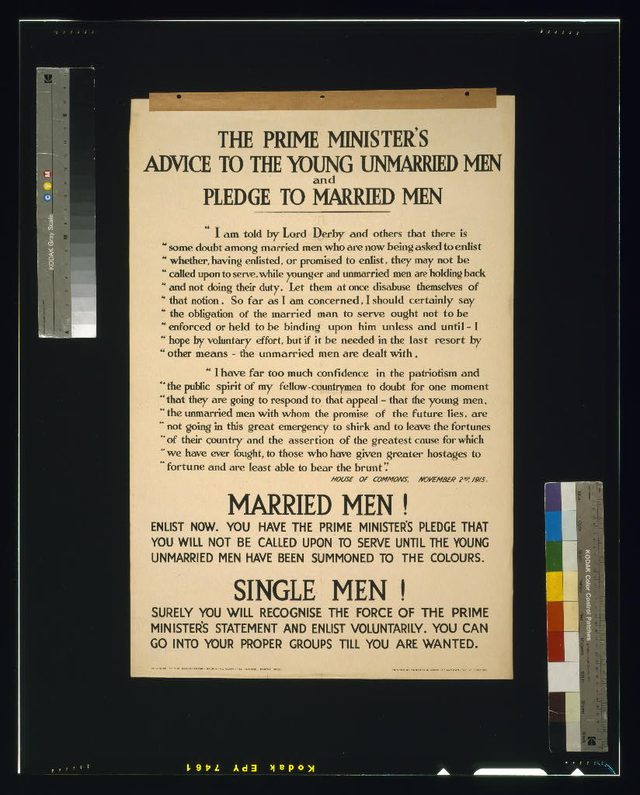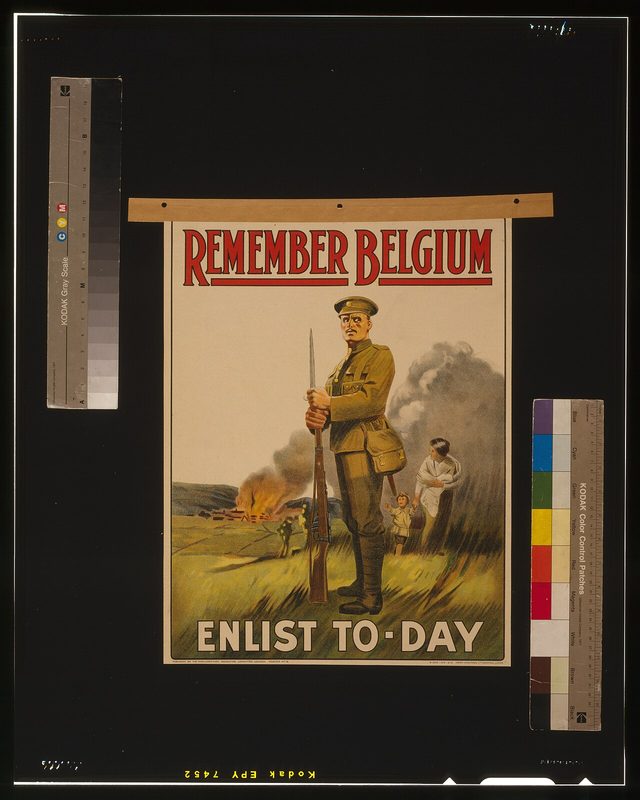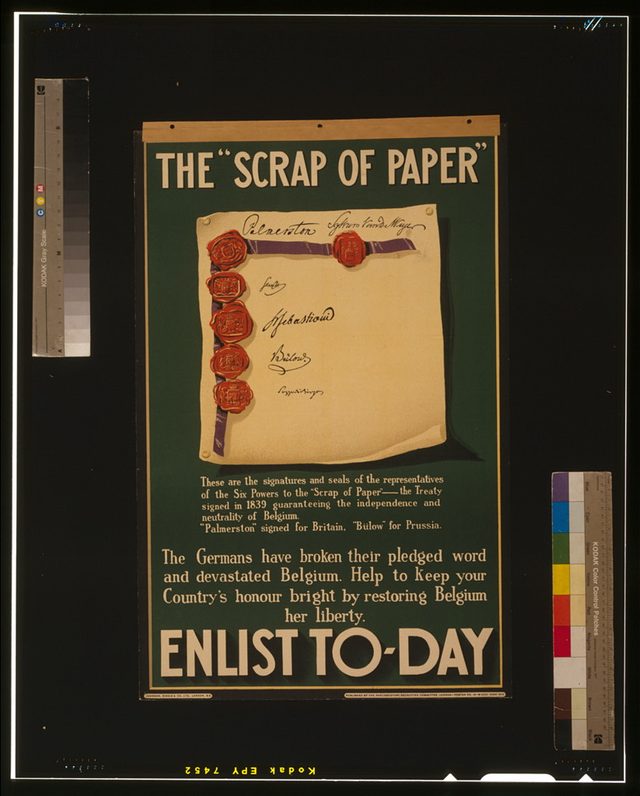
In one line: From 5 April 1908 to 5 December 1916 the Liberal Herbert Henry Asquith led the United Kingdom's cabinet government, which passed the Parliament Act of 1911 and a third Home Rule Bill for Ireland, took Britain into the First World War on 4 August 1914, put the press and post under wartime regulation, ran recruiting and propaganda partly in the open and partly in secret, and governed in coalition from May 1915.
The leader and the people under the leader
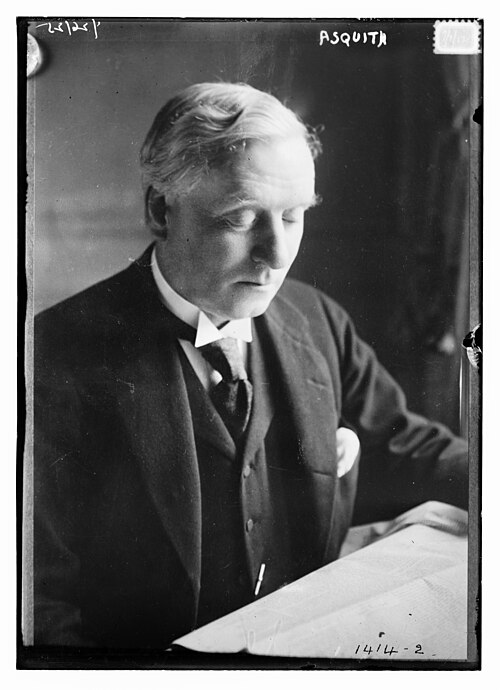
Photo: Bain News Service, Public domain (PD-Bain; no known restrictions, Library of Congress) H. H. Asquith
Prime Minister and First Lord of the Treasury · 1908 to 1916
H. H. Asquith: Read more
Chaired the cabinet from 5 April 1908, led the government that entered the war on 4 August 1914, appointed the Bryce committee in December 1914, formed the coalition of 25 May 1915 and resigned on 5 December 1916.
In their words
“we are fighting to vindicate the principle which, in these days when force, material force, sometimes seems to be the dominant influence and factor in the development of mankind, we are fighting to vindicate the principle that small nationalities are not to be crushed, in defiance of international good faith, by the arbitrary will of a strong and overmastering Power.”
“The ends of the Allies are well known; they have been frequently and precisely stated. They are not selfish ends, they are not vindictive ends, but they require that there shall be adequate reparation for the past and adequate security for the future.”
“The hon. Member must wait and see.”
“I oppose this, as I should oppose more logical and more courageous measures which started from the same point, on the broad and simple grounds that in my opinion, as a student of history and of our own public life, experience shows that the natural distinction of sex, which admittedly differentiates the functions of men and women in many departments of human activity, ought to continue to be recognised, as it always has been recognised, in the sphere of Parliamentary representation.”
“As has been repeatedly stated, this country is not under any obligation not public and known to Parliament which compels it to take part in any war. In other words, if war arises between European Powers there are no unpublished agreements which will restrict or hamper the freedom of the Government or of Parliament to decide whether or not Great Britain should participate in a war.”
All 15 quotes from H. H. Asquith, and 2 often attributed but not verified
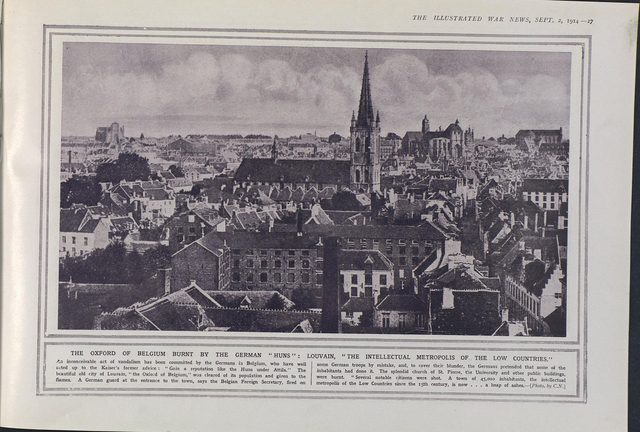
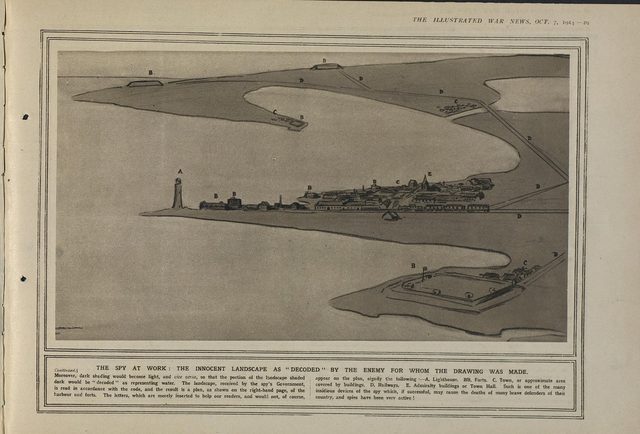
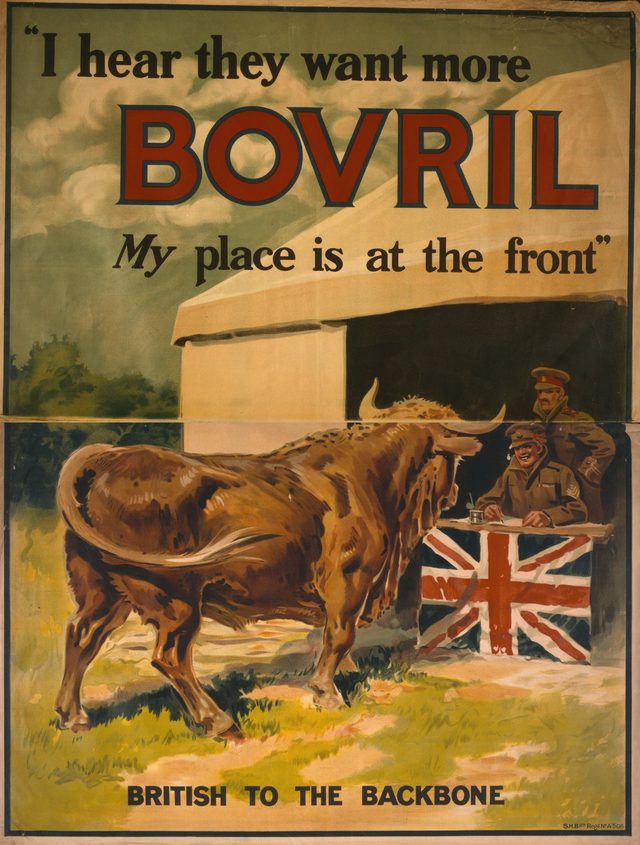
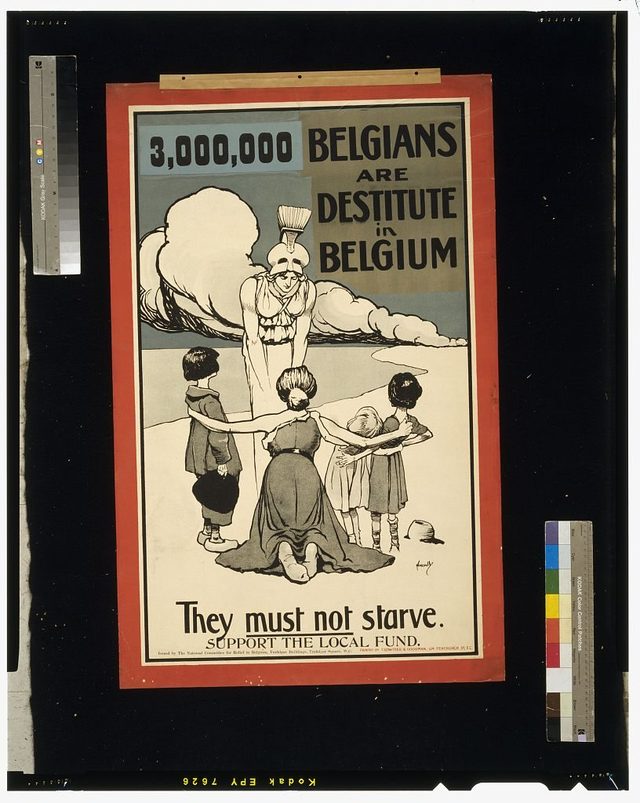
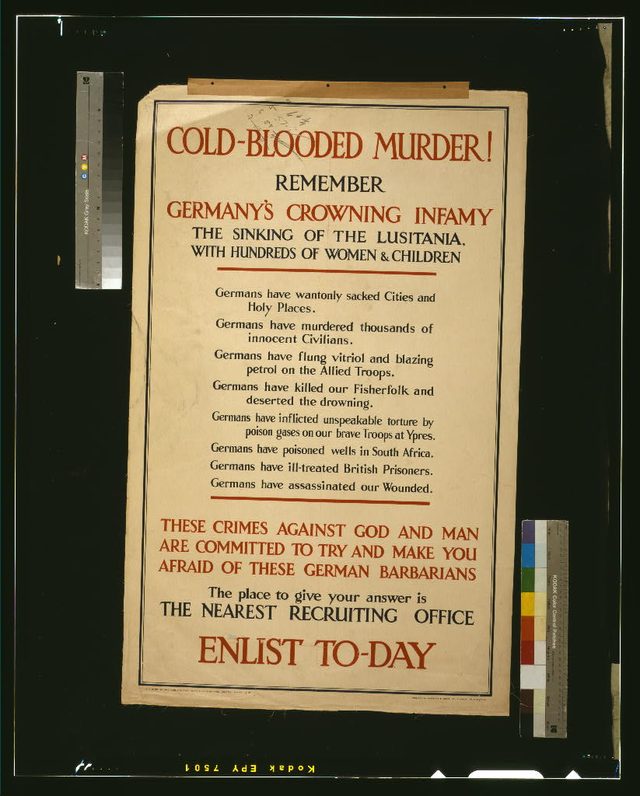
In the archive: Wellington House and the Bryce Report: atrocity evidence, confirmed and unconfirmed (1914-1915)
Cabinet
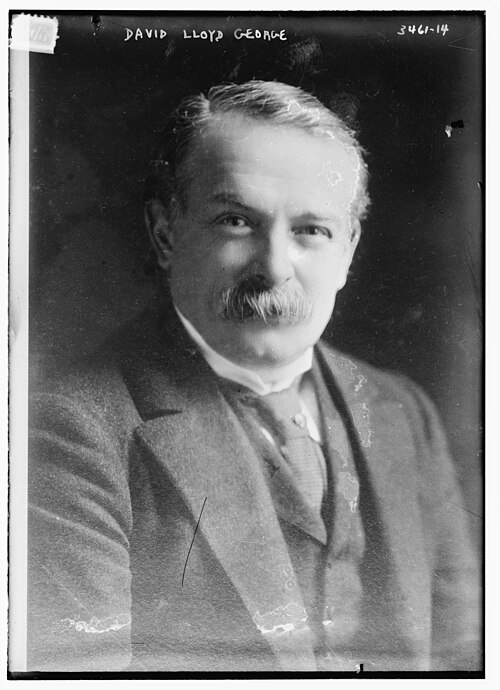
Photo: Bain News Service, Public domain (PD-Bain; no known restrictions, Library of Congress) David Lloyd George
Chancellor of the Exchequer; from May 1915 Minister of Munitions · 1908 to 1915
David Lloyd George: Read more
Chancellor from 1908 and author of the 1909 budget; ran the new Ministry of Munitions from May 1915, became Secretary of State for War in July 1916, and succeeded Asquith as Prime Minister on 7 December 1916.
In their words
“This, Mr. Emmott, is a War Budget. It is for raising money to wage implacable warfare against poverty and squalidness. I cannot help hoping and believing that before this generation has passed away we shall have advanced a great step towards that good time when poverty and wretchedness and human degradation which always follow in its camp will be as remote to the people of this country as the wolves which once infested its forests.”
“Because a fully-equipped duke costs as much to keep up as two "Dreadnoughts," and they are just as great a terror, and they last longer.”
“The question will be asked whether five hundred men, ordinary men chosen accidentally from among the unemployed, should override the judgment — the deliberate judgment — of millions of people who are engaged in the industry which makes the wealth of the country.”
All 17 quotes from David Lloyd George, and 5 often attributed but not verified
In the archive: Wartime censorship in the First World War: Britain, Germany, France and the United States
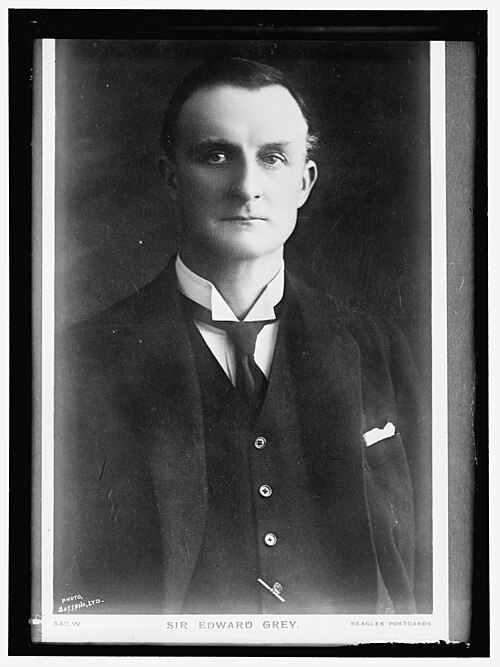
Photo: Harris & Ewing, Public domain (PD-Harris-Ewing; no known restrictions, Library of Congress) Edward Grey
Foreign Secretary · 1905 to 1916
Edward Grey: Read more
Headed the Foreign Office from December 1905 to December 1916; told the House of Commons on 3 August 1914 the case for war after the German invasion of Belgium; created Viscount Grey of Fallodon in July 1916.
In their words
“I agree that, if either Government had grave reason to expect an unprovoked attack by a third Power, or something that threatened the general peace, it should immediately discuss with the other whether both Governments should act together to prevent aggression and to preserve peace, and, if so, what measures they would be prepared to take in common.”
“We have great and vital interests in the independence—and integrity is the least part—of Belgium.”
“If, in a crisis like this, we run away from those obligations of honour and interest as regards the Belgian Treaty, I doubt whether, whatever material force we might have at the end, it would be of very much value in face of the respect that we should have lost.”
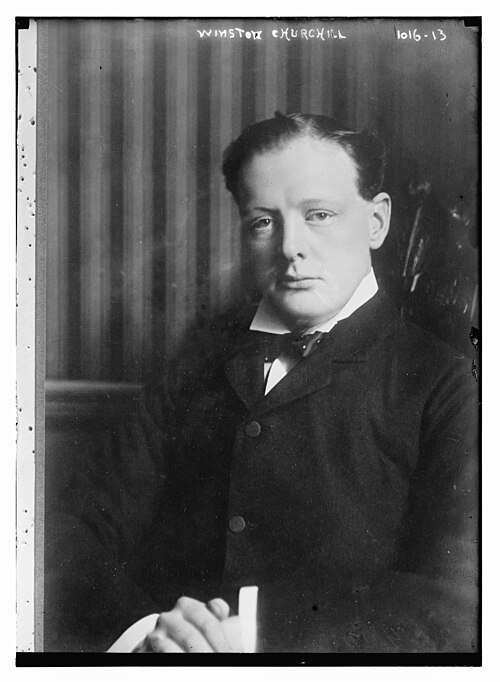
Photo: Bain News Service, Public domain (PD-Bain; no known restrictions, Library of Congress) Winston Churchill
First Lord of the Admiralty · 1911 to 1915
Winston Churchill: Read more
Headed the Admiralty from October 1911, and the naval side of the Dardanelles campaign of 1915 was planned under him; left the Admiralty in May 1915 and the government in November 1915, then served with the army in France.
In their words
“We will endeavour as far as we can to advance the principle of equal rights of civilised men irrespective of colour. We will encourage as far as may be in our power a careful, patient discrimination between different classes of coloured men. We will not—at least I will pledge myself—hesitate to speak out when necessary if any plain case of cruelty or exploitation of the native for the sordid profit of the white man can be proved.”
“The unnatural and increasingly rapid growth of the Feeble-Minded and Insane classes, coupled as it is with a steady restriction among all the thrifty, energetic and superior stocks, constitutes a national and race danger which it is impossible to exaggerate. I am convinced that the multiplication of the Feeble-Minded, which is proceeding now at an artificial rate, unchecked by any of the old restraints of nature, and actually fostered by civilised conditions, is a terrible danger to the race.”
“The British Navy is to us a necessity and, from some points of view, the German Navy is to them more in the nature of a luxury. Our naval power involves British existence. It is existence to us; it is expansion to them.”
All 27 quotes from Winston Churchill, and 5 often attributed but not verified
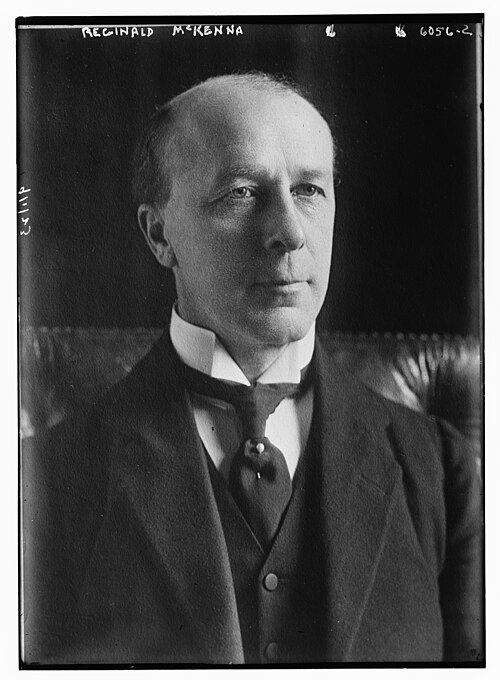
Photo: Bain News Service, Public domain (PD-Bain; no known restrictions, Library of Congress) Reginald McKenna
Chancellor of the Exchequer (from May 1915); earlier Home Secretary · 1915 to 1916
Reginald McKenna: Read more
Home Secretary from October 1911 to May 1915, the office whose September 1914 minute set up the collection of evidence on German conduct later used by the Bryce committee; Chancellor of the Exchequer from 25 May 1915 until December 1916.
In their words
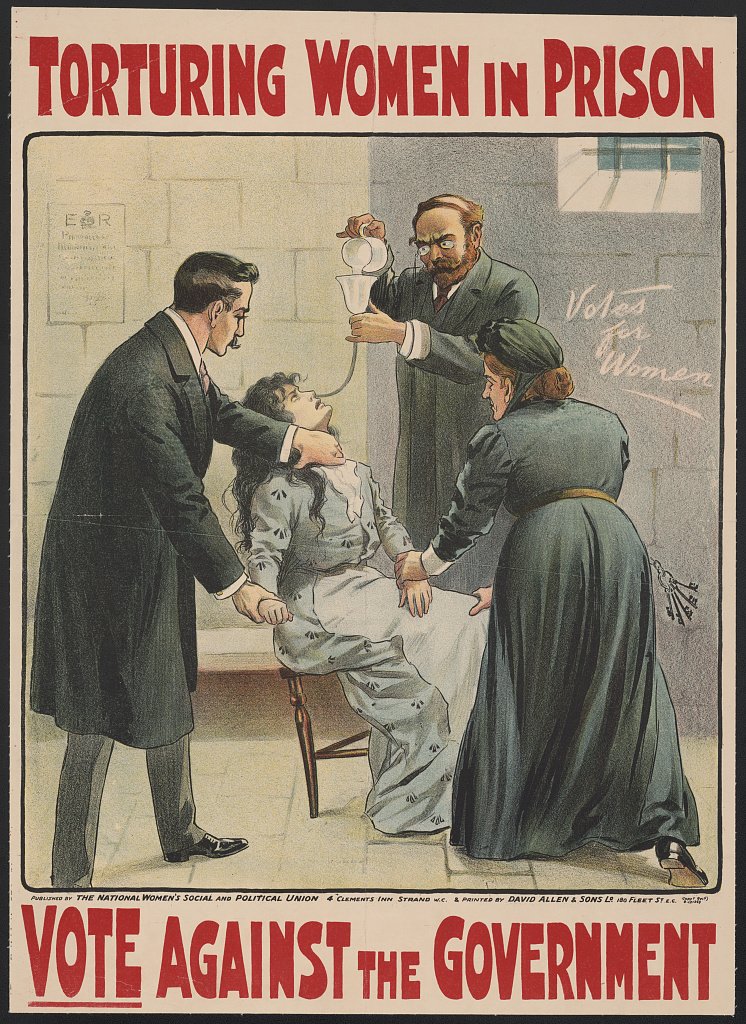
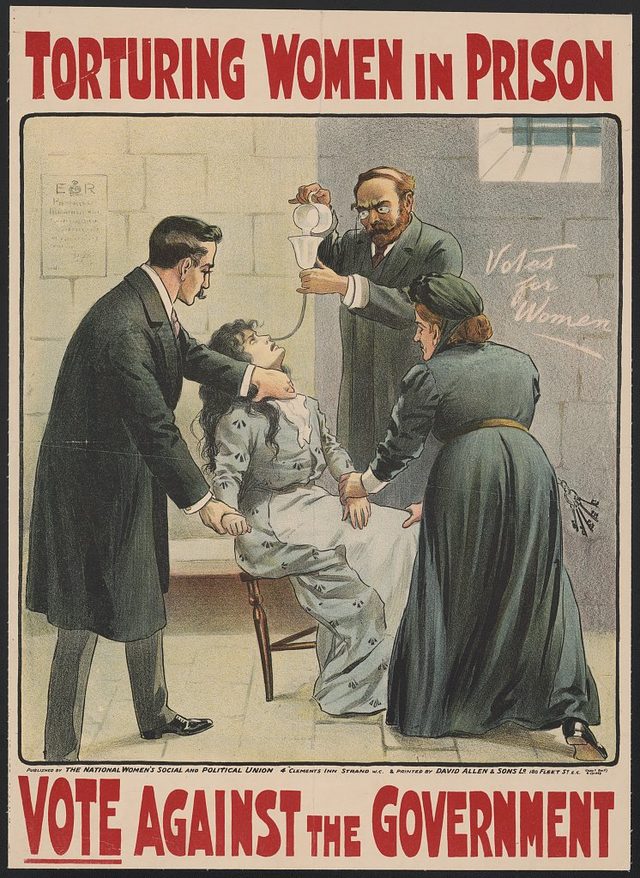
“I mention this perhaps only by the way in order to warn hon. Members against attaching too much credence to the accounts which are being given as to the terrible tortures which are endured in prison under the system of forcible feeding. Those prisoners have declared war on society, and part of their campaign is to carry on war against the Government, be they Liberal or Conservative, not this or that Government, but against all Governments which are responsible to a House of Commons elected by men. It is part of their propaganda to enrage public opinion against the officers of the law, and in executing their purpose they seem to be as neglectful of accuracy of statement as they are disregardful of civil order in their acts.”
“But it is undeniably true that forcible feeding, whether for those who suffer it or those who administer it, is a most objectionable practice, and means ought to be sought to enable those who are responsible for the administration of the law to take up some alternative methods which would not and could not have the same objections raised against them.”
“It has fallen to my lot to introduce a third Budget, in which I must ask the House to assent to additional and unprecedented burdens, which, heavy as they are, I feel confident, if the taxes are approved, will be accepted by the country.”
Armed forces
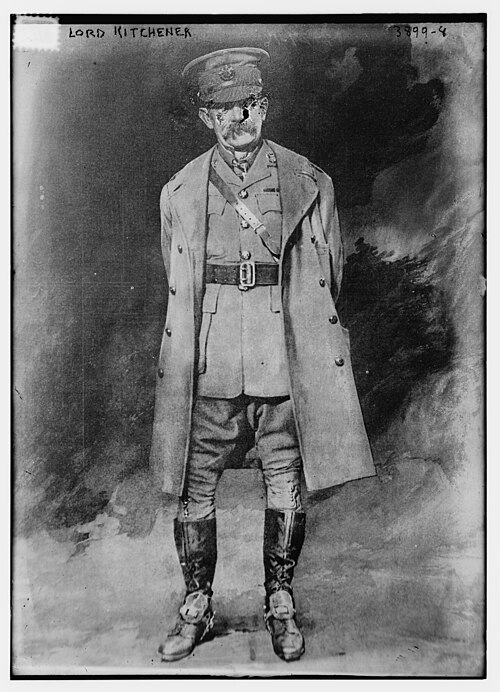
Photo: Bain News Service, Public domain (PD-Bain; no known restrictions, Library of Congress) Herbert Kitchener
Secretary of State for War · 1914 to 1916
Herbert Kitchener: Read more
Field marshal appointed on 5 August 1914 to raise a volunteer New Army; the subject of the false report that led to the suppression of *The Globe* in November 1915; died on 5 June 1916 when HMS *Hampshire* struck a mine off Orkney.
In their words
“The women and children brought in should be divided in two categories, viz.: 1st. Refugees, and the families of Neutrals, non-combatants, and surrendered Burghers. 2nd. Those whose husbands, fathers and sons are on Commando. The preference in accommodation, etc. should of course be given to the first class.”
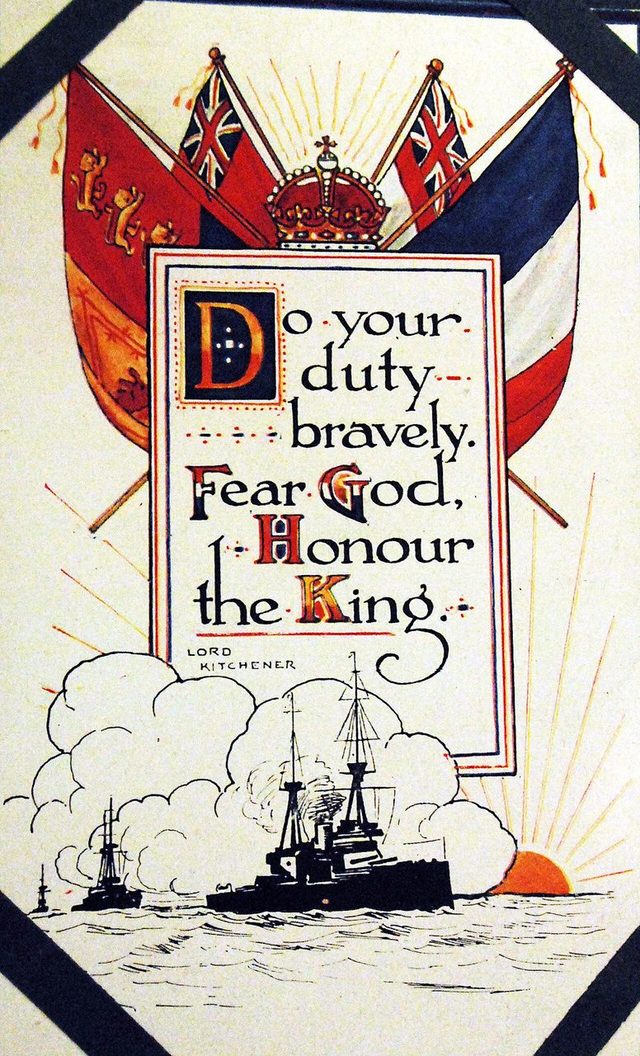
“You are ordered abroad as a soldier of the King to help our French comrades against the invasion of a common enemy. You have to perform a task which will need your courage, your energy, your patience. Remember that the honour of the British Army depends on your individual conduct. It will be your duty not only to set an example of discipline and perfect steadyness under fire but also to maintain the most friendly relations with those whom you are helping in this struggle. The operations in which you are engaged will, for the most part, take place in a friendly country, and you can do your own country no better service than in showing yourself in France and Belgium in the true character of a British soldier. Be invariably courteous, considerate and kind. Never do anything likely to injure or destroy property, and always look upon looting as a disgraceful act. You are sure to meet a welcome and to be trusted; your conduct must justify that welcome and that trust. Your duty cannot be done unless your health is sound. So keep constantly on your guard against any excesses. In this new experience you may find temptations both in wine and women. You must entirely resist both temptations, and, while treating all women with perfect courtesy, you should avoid any intimacy. Do your duty bravely. Fear God. Honour the King.”
“Noble Lords on both sides of the House doubtless know that while associating myself in the fullest degree for the prosecution of the war with my colleagues in His Majesty's Government, my position on this Bench does not in any way imply that I belong to any political Party, for, as a soldier, I have no politics.”
All 6 quotes from Herbert Kitchener, and 1 often attributed but not verified
In the archive: Wartime censorship in the First World War: Britain, Germany, France and the United States
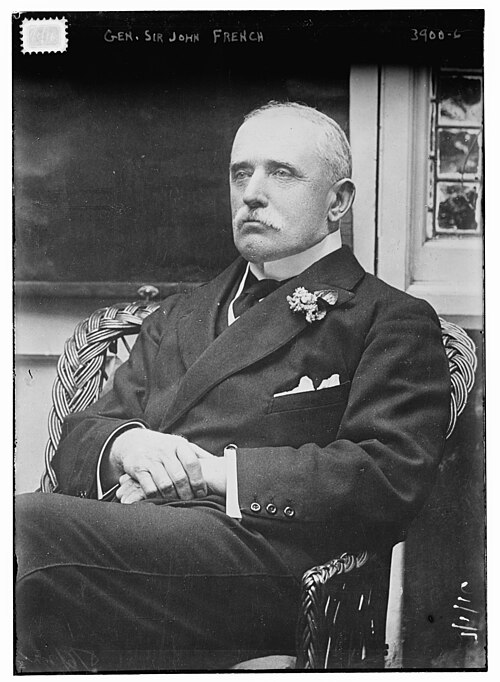
Photo: Bain News Service, Public domain (PD-Bain; no known restrictions, Library of Congress) John French
Commander-in-Chief, British Expeditionary Force · 1914 to 1915
John French: Read more
Commanded the British Expeditionary Force in France from August 1914 until Douglas Haig replaced him in December 1915, then commanded the forces in Britain.
In their words
“It is a rough war, but the problem it sets is a comparatively simple one — munitions, more munitions, always more munitions; this is the essential question, the governing condition of all progress, of every leap forward.”
“I said that the command of the British Forces in France had been entrusted to me by His Majesty's Government; that I alone was responsible to them for whatever happened, and that on French soil my authority as regards the British Army must be supreme until I was legally superseded by the same authority which had put that responsibility upon me.”
“I therefore determined on taking the most drastic measures to destroy the apathy of a Government which had brought the Empire to the brink of disaster.”
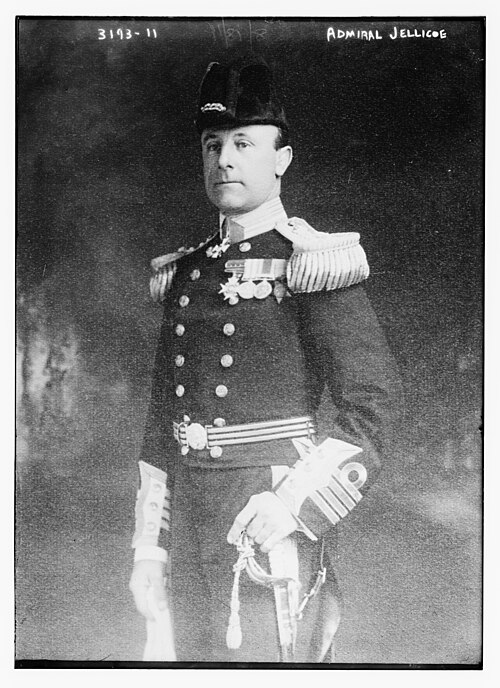
Photo: Bain News Service, Public domain (PD-Bain; no known restrictions, Library of Congress) John Jellicoe
Commander-in-Chief, Grand Fleet · 1914 to 1916
John Jellicoe: Read more
Took command of the Grand Fleet in August 1914, asked that the loss of HMS *Audacious* in October 1914 be kept secret, commanded at Jutland on 31 May and 1 June 1916, and became First Sea Lord in December 1916.
In their words
“Weather conditions of a highly unfavourable nature robbed the Fleet of that complete victory which I know was expected by all ranks, which is necessary for the safety of the Empire and which will yet be ours.”
“Our losses were heavy and we miss many most gallant comrades, but, although it is very difficult to obtain accurate information as to the enemy losses, I have no doubt that we shall find that they are certainly not less than our own.”
“I wired to the Admiralty suggesting that the loss of the Audacious should be kept secret for as long as possible, so that the enemy should not learn of it, as the fact would afford him encouragement at a time when the military situation was extremely critical for the Allies, and also because, as a general policy, it was desirable to conceal from the enemy any serious losses of which he could otherwise have no immediate knowledge.”
In the archive: Wartime censorship in the First World War: Britain, Germany, France and the United States
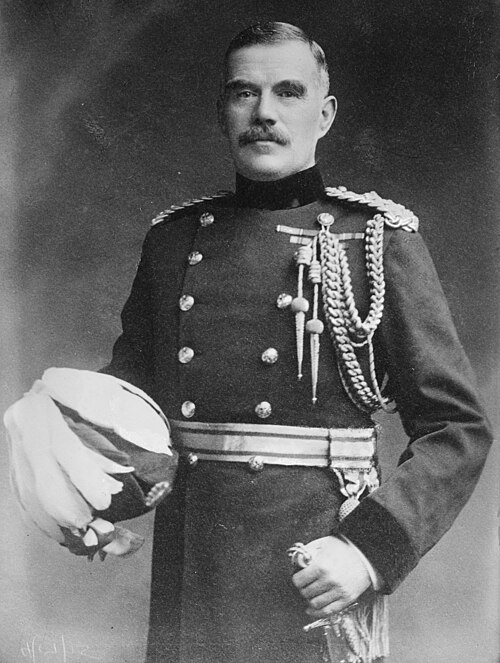
Photo: Bain News Service, Public domain (PD-Bain; no known restrictions, Library of Congress) William Robertson
Chief of the Imperial General Staff · 1915 to 1918
William Robertson: Read more
Chief of the General Staff to the British Expeditionary Force in 1915, became Chief of the Imperial General Staff on 23 December 1915 and held the post until February 1918, under Asquith's coalition and then Lloyd George's.
In their words
“Not being able to go back on the Prime Minister's pledge to call up the single men before the married, certain Ministers are trying to render compulsion useless by making out that although we may have power to take the men we cannot pay for them, and that they cannot be spared from their trades and at the same time admit of keeping up the necessary exports and so provide the money we need with which to subsidize our Allies.”
“The arguments I advanced were that we need every man we can get, and that it is for the Government to say how many they can pay for and how many they can find. The idea of some of the politicians is to abolish some if not all of the second line Territorial divisions now at home, thirteen in number, which are preparing to go out later. But I do not think this will be done.”
“If I have to depend almost entirely upon Press communiqués my opinion is not much more valuable than that of anyone else.”
War propaganda and censorship
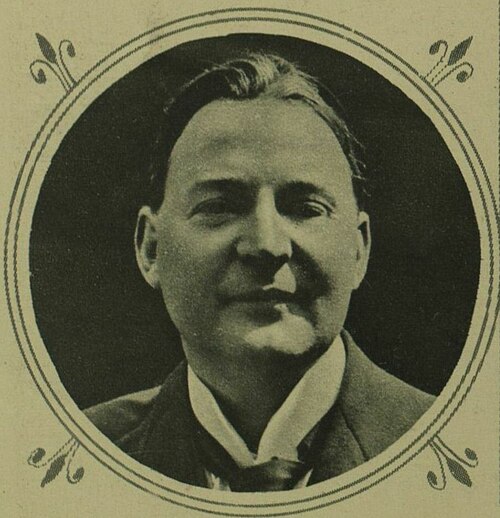
Photo: Unknown (photographer not credited by the Illustrated London News), Public domain (PD-UK-unknown, PD-US) Charles Masterman
Head of the War Propaganda Bureau (Wellington House); Chancellor of the Duchy of Lancaster 1914 to 1915 · 1914 to 1917
Charles Masterman: Read more
Ran the bureau at Wellington House from September 1914, met leading writers there on 2 September 1914 and kept its work unannounced; sat in the cabinet as Chancellor of the Duchy of Lancaster from February 1914 to February 1915.
In their words
“Imagine, for example, the twentieth century interpreted to the twenty-fifth by its popular newspapers: to-day, more certainly than its popular drama, the abstract and chronicle of the time.”
“Having attained so dolorous a consummation, perhaps the best that can be hoped for him is the advent of that friendly bullet which will terminate his inglorious life. Were this accomplished, the next day his own newspapers, the high priests of his religion, will rejoice over his death, and shamelessly gird at him for being what he is — the faithfullest of worshippers at their shrine.”
“I think that attitude explains more than anything else the combination of truculence and contempt which runs through all the German communications, and caused those who received them in London from day to day and hour to hour, to think that God must have made them quite blind.”
In the archive: Wellington House and the Bryce Report: atrocity evidence, confirmed and unconfirmed (1914-1915)
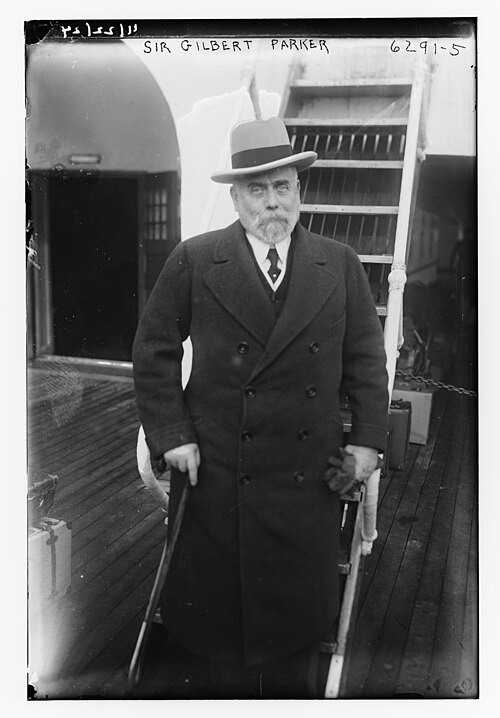
Photo: Bain News Service, Public domain (PD-Bain; no known restrictions, Library of Congress) Gilbert Parker
Head of the American section, War Propaganda Bureau · 1914 to 1917
Gilbert Parker: Read more
Canadian-born novelist and Member of Parliament chosen on 2 September 1914 to run Wellington House's work in the United States, where his mailings to opinion leaders carried his own name and not the bureau's; active until 1917.
In their words
“We advertised and stimulated many people to write articles. We utilised the friendly services and assistance of confidential friends; we had reports from important Americans constantly, and established association by personal correspondence with influential and eminent people of every profession in the United States, beginning with the university and college presidents, professors, and scientific men, and running through all the ranges of population.”
“Practically since the day war broke out between England and the Central Powers I became responsible for American publicity. I need hardly say that the scope of my department was very extensive, and its activities widely ranged. Among the activities was a weekly report to the British Cabinet on the state of American opinion, and constant touch with the permanent correspondents of American newspapers in England.”
“We asked our friends and correspondents to arrange for speeches, debates and lectures by American citizens, but we did not encourage Britishers to go to America and preach the doctrine of entrance into the war.”
In the archive: Wellington House and the Bryce Report: atrocity evidence, confirmed and unconfirmed (1914-1915)
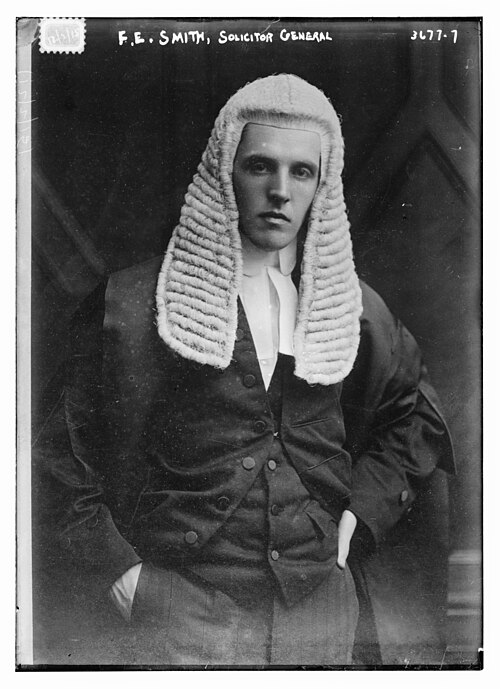
Photo: Bain News Service, Public domain (PD-Bain; no known restrictions, Library of Congress) F. E. Smith
Attorney General; earlier Director of the Press Bureau · 1915 to 1919
F. E. Smith: Read more
Put in charge of the Press Bureau and its newspaper censorship on the outbreak of war in August 1914; Solicitor General from May 1915 and Attorney General from late 1915, in which office he led the Crown's prosecution of Roger Casement in 1916.
In their words
“No one will suppose, for instance, that we are to manufacture incidents. It is suggested we should have the assistance of journalists, but it is no part of our functions to manufacture news. We are not in competition with the news agencies.”
“I can only add that the principle on which we have gone in asking the Press to be silent has been to ask them to exclude material which was excluded by the decisions of Lord Kitchener and the War Office upon lines of general policy.”
“This Bill will leave behind it the memory of unforgetable wrong. It will revive antagonisms happily declining. It will give satisfaction to none except those who say: "How these Christians love one another." The Government will be well advised, even at the eleventh hour, to withdraw a Bill which has shocked the conscience of every Christian community in Europe.”
“We are sometimes told that the Government is weak. It may be weak—I do not know—but I tell my right hon. Friend this, that it is the intention of the Government and, I believe, with the approval of the great majority of the House and of the majority of this country, to see that, whereas the meetings of the Cabinet are intended to be secret, whereas we are all agreed that they ought to be secret, whereas they are protected by the oath which a Privy Councillor takes, that at least no newspaper shall publish the tittle-tattle, the inaccurate accounts which purport to be given day by day of what takes place in the Cabinet to be retailed, to the prejudice of this country, in neutral and foreign countries.”
In the archive: Wartime censorship in the First World War: Britain, Germany, France and the United States
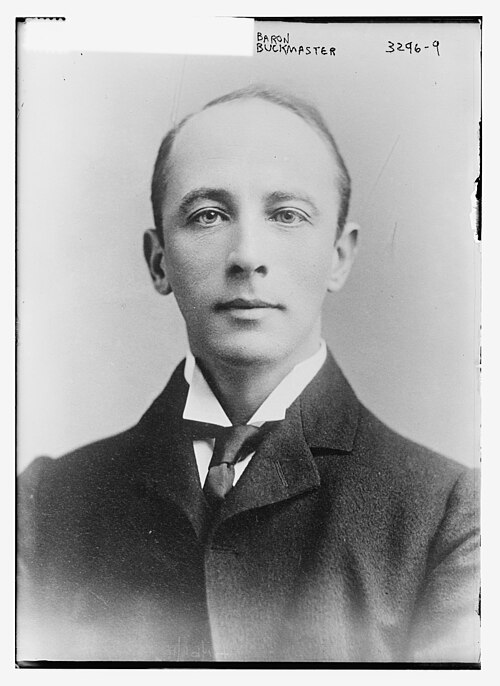
Photo: Bain News Service, Public domain (PD-Bain; no known restrictions, Library of Congress) Stanley Buckmaster
Lord Chancellor; earlier Director of the Press Bureau · 1915 to 1916
Stanley Buckmaster: Read more
Solicitor General from 1913 and Director of the Press Bureau in 1914 and 1915; became Lord Chancellor on 25 May 1915 and resigned with Asquith in December 1916.
In their words
“It has always been my view that the real rule by which this office which I now hold should be guided is the consideration as to whether the matter that it is proposed for publication should be allowed to see the light tested by whether its publication could afford any assistance to the enemy, whether it could unduly depress our people, whether it could disclose movements and operations of our troops, or of our Fleet, or by any other means whatever, directly or indirectly, imperil the national safety.”
“Therefore criticism of the Government, or of Members of the Government, is not that which I have ever stopped, except where such criticism is of such a character as that it might destroy public confidence in the Government which at this moment is charged with the conduct of the War, or might in any way weaken the confidence of the people in the administration of affairs, or otherwise cause distress or disturbance amongst people in thinking their affairs were in a really serious state.”
“May I point out that we have had news sent into us from every corner of the Kingdom, exact in detail, agreeing in particulars of time and place, recording the complete destruction of our Fleet and the annihilation of a number of our capital vessels. If we had acted on the suggestion of the hon. Member opposite, we should have published that news to the world, every word of which was a lie.”
In the archive: Wartime censorship in the First World War: Britain, Germany, France and the United States
Empire and Ireland
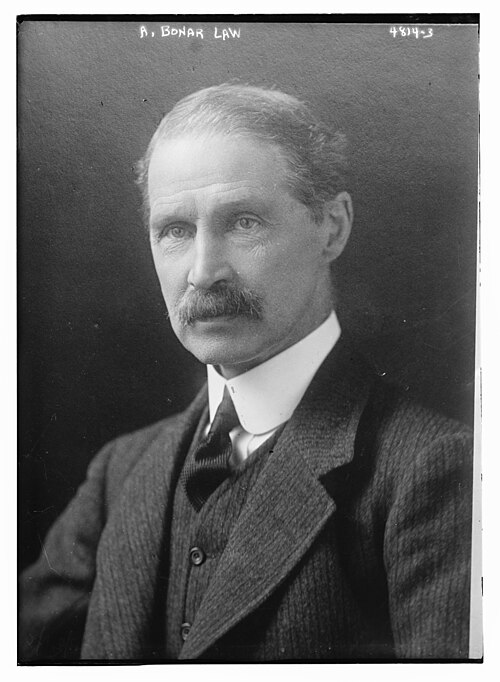
Photo: Bain News Service, Public domain (PD-Bain; no known restrictions, Library of Congress) Andrew Bonar Law
Secretary of State for the Colonies; Leader of the Conservative and Unionist Party · 1915 to 1916
Andrew Bonar Law: Read more
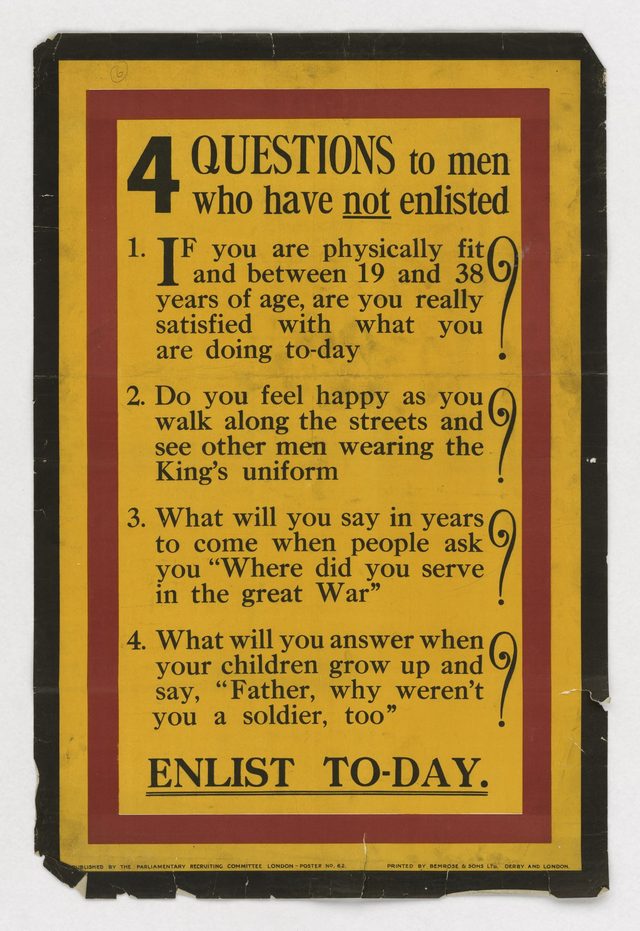
Led the Unionist opposition from 1911 and, in the coalition, ran the Colonial Office from 25 May 1915; with Asquith and the Labour leader Arthur Henderson he was a president of the Parliamentary Recruiting Committee.
In their words
“If the attempt be made under present conditions to force Home Rule on Ulster I can imagine no length of resistance to which Ulster will go in which I shall not be ready to support them.”
“The right hon. Gentleman has made a statement which, in view of the gravity of the situation as we all know, and as he best of all knows, seems to me one of the most amazing instances of paltering with the House of Commons and the country which we have ever had. The position is far more serious than the statement would lead us to suppose. A new danger has arisen, a danger which, I think, anyone might have foreseen, but which has apparently come upon the Government as a bolt from the blue, the danger, that is—and I shall show that I am not exaggerating—that our Army should be destroyed before our eyes.”
“In these circumstances, in view of the facts which I have pointed out, in view of the fact that the First Lord has said that this was a treasonable conspiracy, and that the troops were only moved immediately after he had made that statement, in view of the belief which was held by the officer commanding the forces that they were at once to put down Ulster, I think it will be very difficult for the Prime Minister to convince the House—I accept his own good faith completely—his own good faith—I think it will be very difficult for the Prime Minister to convince the House or the country that, with or without his knowledge—in my belief without his knowledge—some of his colleagues, acting for the Government, did not make this movement of troops as part of a concerted plan either to provoke or to intimidate the people of Ulster.”
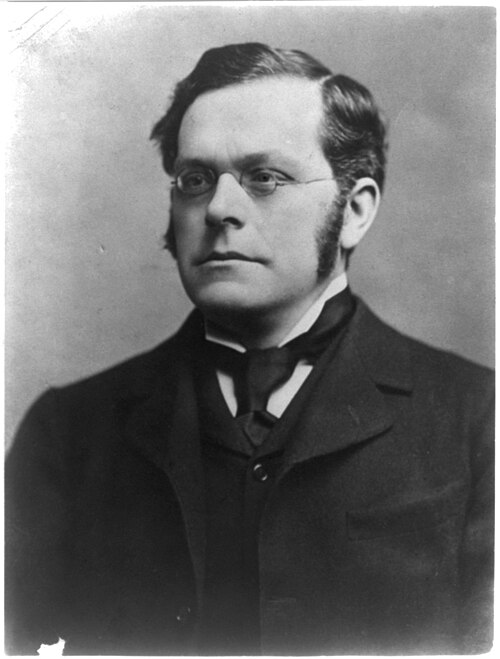
Photo: Bain News Service, Public domain (PD-Bain; no known restrictions, Library of Congress) Augustine Birrell
Chief Secretary for Ireland · 1907 to 1916
Augustine Birrell: Read more
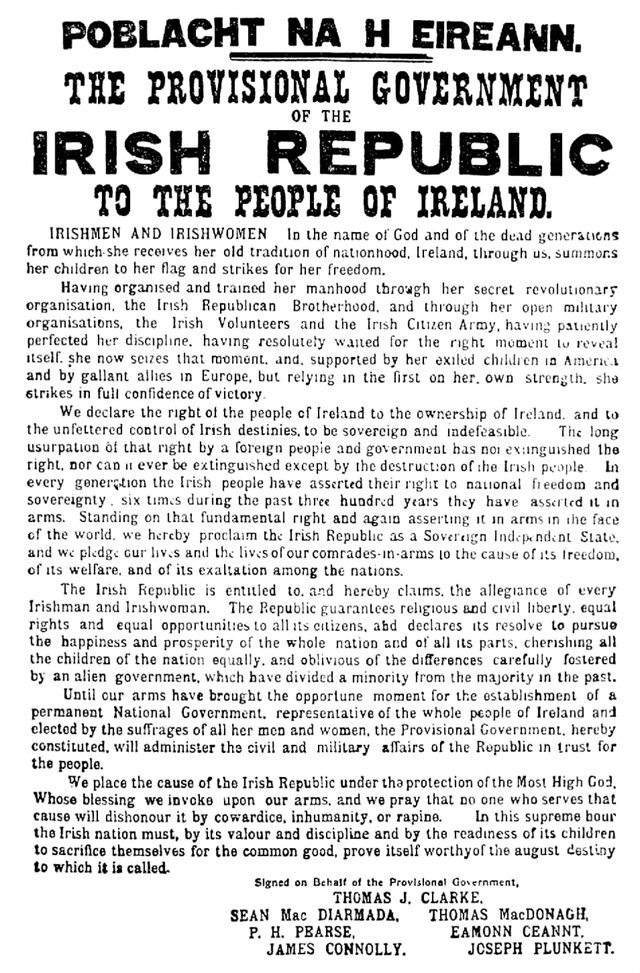
Ran the Irish administration at Dublin Castle and answered for it in the cabinet and the Commons; resigned in early May 1916 after the Easter Rising.
In their words
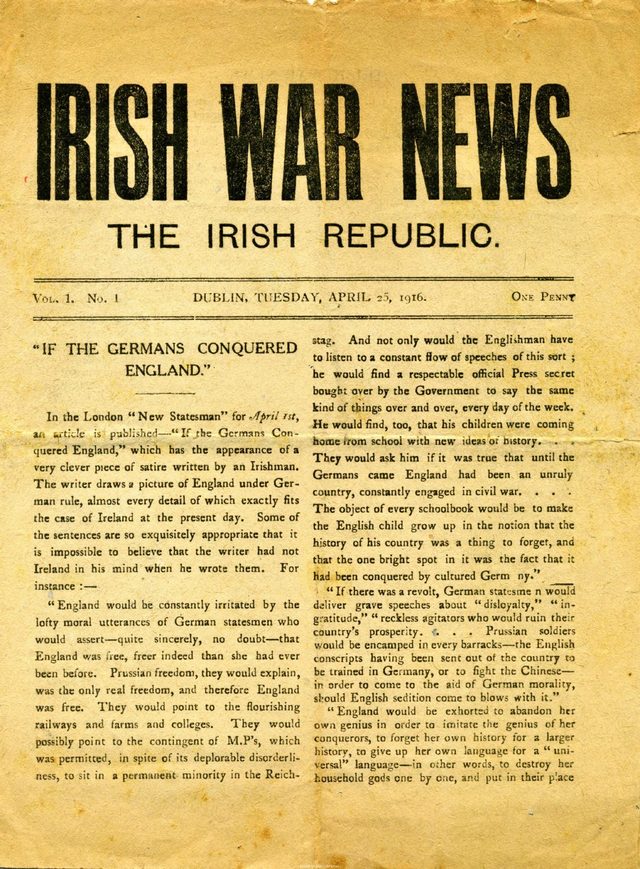
“We are at this moment considering what immediate steps should be taken to secure the suppression of documents and statements of this character. Although I do not myself regard them as a danger I am sure they are an insult to the sentiment of the vast majority of the Irish people.”
“I have no reason whatever to believe that these papers have poisoned anybody's mind except the minds of the people who have written the articles.”
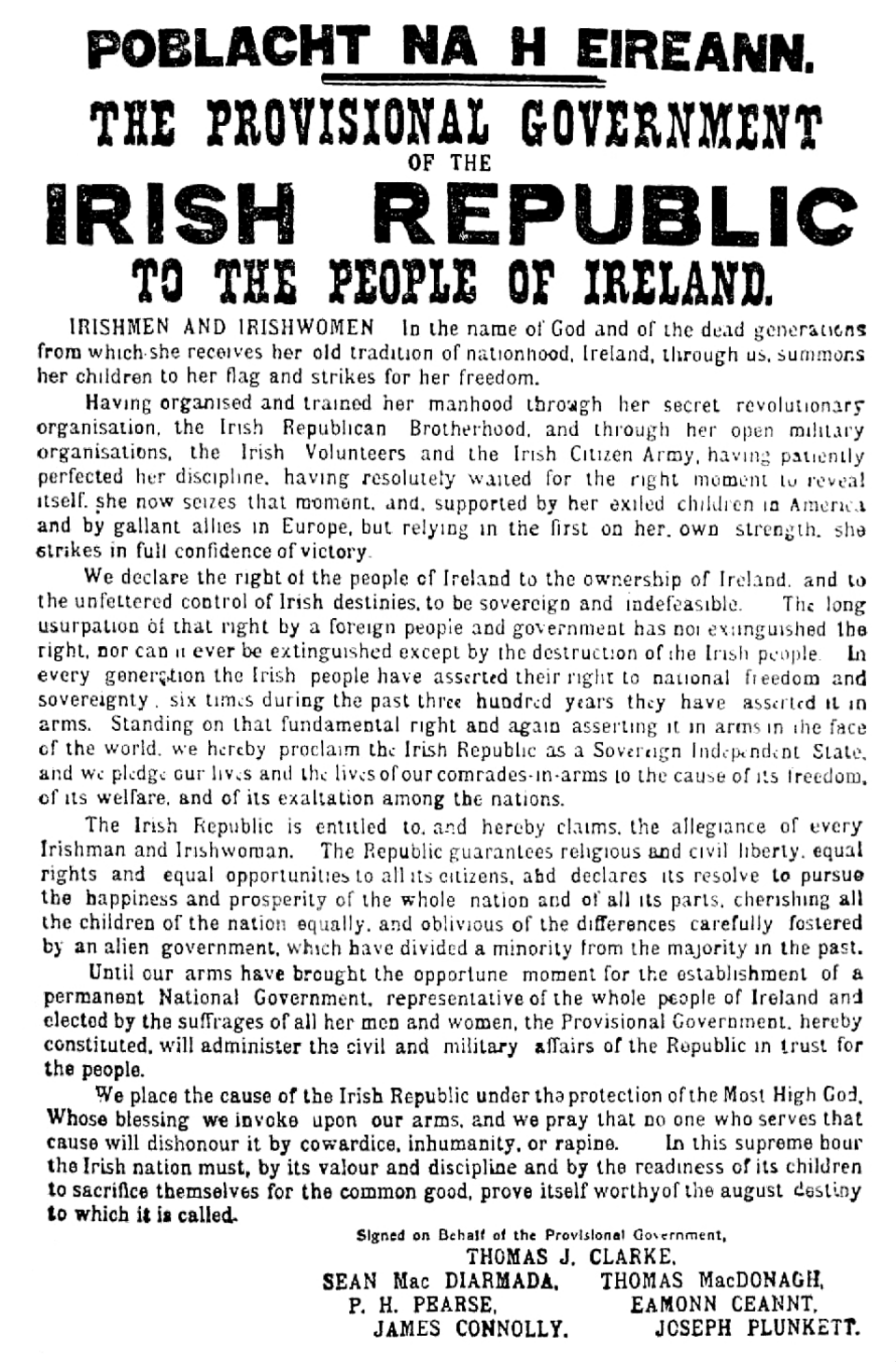
“I therefore, speaking for myself alone, say sorrowfully that I made an untrue estimate of this Sinn Fein movement—not indeed of its character or of the probable numbers of persons engaged in it or belonging to the association, nor of the localities where it is most to be found, nor of its frequent and obvious disloyalty, nor indeed of some of the dangers resulting from it. All this I knew and was able, if not fully, at all events with no great measures of incompleteness to appreciate, but not the possibility of a disturbance of the kind that has occurred in Dublin, of the mode of the warfare, if such an expression can be used in regard to it, which has been pursued—it was not street fighting, for there was no street fighting but of house and roof occupation—and of the desperate folly displayed by the leaders and by their dupes, which has resulted in the deaths of officers and soldiers who never enlisted for such purposes as these, and whose hopes, therefore, although their duty none the less has been well performed, were disappointed, and also in the deaths of equally brave inspectors, sergeants, and constables of the Royal Irish Constabulary.”
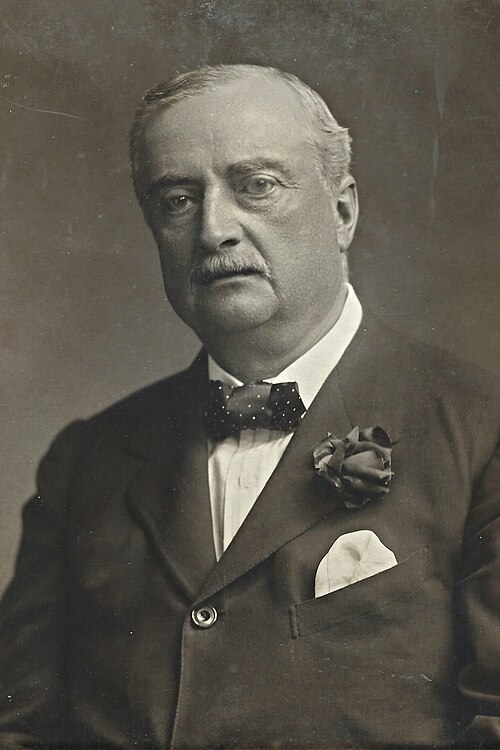
Photo: Russell & Sons, London, Public domain (PD-1923, PD-US-expired) John Redmond
Chairman of the Irish Parliamentary Party · 1900 to 1918
John Redmond: Read more
Led the Irish Nationalist members in the Commons, on whose votes the government relied after 1910 and whose Home Rule Bill became law in 1914; offered the Irish Volunteers for home defence on 3 August 1914 and declined a coalition post in May 1915. Not a member of the government.
In their words
“I say to the Government that they may to-morrow withdraw every one of their troops from Ireland. I say that the coast of Ireland will be defended from foreign invasion by her armed sons, and for this purpose armed Nationalist Catholics in the South will be only too glad to join arms with the armed Protestant Ulstermen in the North.”
“I certainly do not regard this settlement of the difficulty as a party triumph for my Friends or myself, and I shall certainly not represent it as a party triumph either in this House or in Ireland. It is nothing of the kind. It inflicts a severe disadvantage upon us.”
“Wicklow Volunteers, in spite of the peaceful happiness and beauty of the scene in which we stand, remember this country at this moment is in a state of war, and your duty is twofold. The duty of the manhood of Ireland is twofold. Its duty is at all costs to defend the shores of Ireland from foreign invasion. It is a duty more than that of taking care that Irish valour proves itself on the field of war as it has always proved itself in the past.”