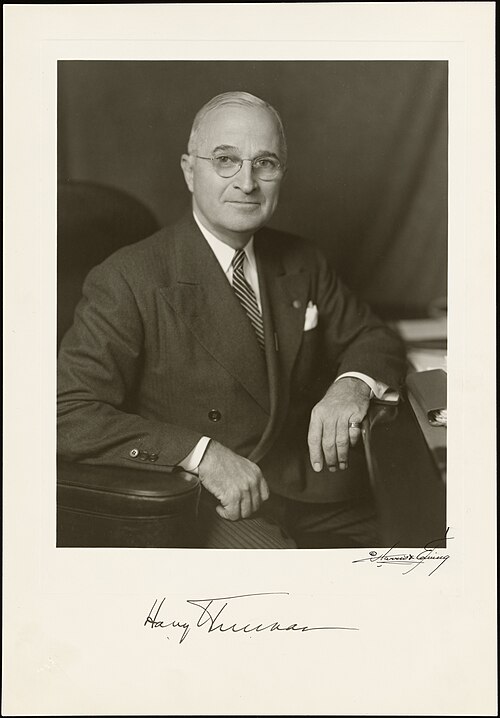
Harry S. Truman
Illustration, not an archive object

Vice President of the United States · United States
On the regime page: Roosevelt administration
12 quotes, oldest first. Filter with other speakers.
Content note: Suggests letting Germany and the Soviet Union kill as many of each other as possible. The words are shown as they were said or written. Why
“If we see that Germany is winning we ought to help Russia and if Russia is winning we ought to help Germany, and that way let them kill as many as possible, although I don't want to see Hitler victorious under any circumstances.”
Said as a Missouri senator two days after Germany invaded the Soviet Union, and before the United States entered the war. The remark was later cited in discussions of whether the United States should have aided either side.
Senator Harry S. Truman, remark on the German invasion of the Soviet Union, reported in the New York Times, 24 June 1941, p. 7, and quoted in Time, "National Affairs: Anniversary Remembrance" Source
“Our demand has been, and it remains--Unconditional Surrender! We will not traffic with the breakers of the peace on the terms of the peace. The responsibility for making of the peace--and it is a very grave responsibility--must rest with the defenders of the peace. We are not unconscious of the dictates of humanity. We do not wish to see unnecessary or unjustified suffering. But the laws of God and of man have been violated and the guilty must not go unpunished. Nothing shall shake our determination to punish the war criminals even though we must pursue them to the ends of the earth.”
His first address to Congress, four days after he took the oath as President on the death of Franklin Roosevelt, whose Vice President he had been since 20 January 1945.
Address Before a Joint Session of the Congress, 16 April 1945, text in the American Presidency Project (UC Santa Barbara) Source
Content note: Threat of overwhelming air attack after the first atomic bombing. The words are shown as they were said or written. Why
“If they do not now accept our terms they may expect a rain of ruin from the air, the like of which has never been seen on this earth.”
Issued after the atomic bombing of Hiroshima, while the President was returning from the Potsdam Conference aboard the U.S.S. Augusta. It refers to the Potsdam ultimatum of 26 July, which the Japanese leaders had rejected.
Statement by the President Announcing the Use of the A-Bomb at Hiroshima, 6 August 1945, text in the American Presidency Project (UC Santa Barbara) Source
“Collapse of free institutions and loss of independence would be disastrous not only for them but for the world.”
Delivered in person to a joint session of Congress on 12 March 1947, asking for $400,000,000 in aid to Greece and Turkey. Warns of the effect on Greece and Turkey and their neighbours if aid is not given.
Special Message to the Congress on Greece and Turkey: The Truman Doctrine, 12 March 1947, text in the American Presidency Project (UC Santa Barbara) Source
“I believe that we must assist free peoples to work out their own destinies in their own way. I believe that our help should be primarily through economic and financial aid which is essential to economic stability and orderly political processes.”
Delivered in person to a joint session of Congress on 12 March 1947, asking for $400,000,000 in aid to Greece and Turkey. Follows the sentence stating the policy of supporting free peoples.
Special Message to the Congress on Greece and Turkey: The Truman Doctrine, 12 March 1947, text in the American Presidency Project (UC Santa Barbara) Source
“Should we fail to aid Greece and Turkey in this fateful hour, the effect will be far reaching to the West as well as to the East.”
Delivered in person to a joint session of Congress on 12 March 1947, asking for $400,000,000 in aid to Greece and Turkey. Names Greece and Turkey as the immediate case.
Special Message to the Congress on Greece and Turkey: The Truman Doctrine, 12 March 1947, text in the American Presidency Project (UC Santa Barbara) Source
“assistance is imperative if Greece is to survive as a free nation.”
Delivered in person to a joint session of Congress on 12 March 1947, asking for $400,000,000 in aid to Greece and Turkey. Part of the sentence on the Greek government's appeal and the reports of the American Ambassador.
Special Message to the Congress on Greece and Turkey: The Truman Doctrine, 12 March 1947, text in the American Presidency Project (UC Santa Barbara) Source
“If we falter in our leadership, we may endanger the peace of the world--and we shall surely endanger the welfare of this Nation.”
Delivered in person to a joint session of Congress on 12 March 1947, asking for $400,000,000 in aid to Greece and Turkey. Near the close of the address.
Special Message to the Congress on Greece and Turkey: The Truman Doctrine, 12 March 1947, text in the American Presidency Project (UC Santa Barbara) Source
Content note: Describes totalitarian regimes as growing in "evil soil". The words are shown as they were said or written. Why
“The seeds of totalitarian regimes are nurtured by misery and want. They spread and grow in the evil soil of poverty and strife. They reach their full growth when the hope of a people for a better life has died.”
Delivered in person to a joint session of Congress on 12 March 1947, asking for $400,000,000 in aid to Greece and Turkey. Links totalitarian regimes to poverty and says the hope of a better life must be kept alive.
Special Message to the Congress on Greece and Turkey: The Truman Doctrine, 12 March 1947, text in the American Presidency Project (UC Santa Barbara) Source
“The world is not static, and the status quo is not sacred. But we cannot allow changes in the status quo in violation of the Charter of the United Nations by such methods as coercion, or by such subterfuges as political infiltration.”
Delivered in person to a joint session of Congress on 12 March 1947, asking for $400,000,000 in aid to Greece and Turkey. Distinguishes change he accepts from change by coercion or infiltration, which he says violates the UN Charter.
Special Message to the Congress on Greece and Turkey: The Truman Doctrine, 12 March 1947, text in the American Presidency Project (UC Santa Barbara) Source
“I believe that it must be the policy of the United States to support free peoples who are resisting attempted subjugation by armed minorities or by outside pressures.”
Delivered in person to a joint session of Congress on 12 March 1947, asking for $400,000,000 in aid to Greece and Turkey. The operative statement of the policy later called the Truman Doctrine.
Special Message to the Congress on Greece and Turkey: The Truman Doctrine, 12 March 1947, text in the American Presidency Project (UC Santa Barbara) Source
“totalitarian regimes imposed upon free peoples, by direct or indirect aggression, undermine the foundations of international peace and hence the security of the United States.”
Delivered in person to a joint session of Congress on 12 March 1947, asking for $400,000,000 in aid to Greece and Turkey. Ties totalitarian regimes imposed by aggression to US security.
Special Message to the Congress on Greece and Turkey: The Truman Doctrine, 12 March 1947, text in the American Presidency Project (UC Santa Barbara) Source
Often attributed, not verified
These words circulate under Harry S. Truman’s name but could not be traced to a source. They are listed so readers can check them, not as Harry S. Truman’s words.
“Boys, if you ever pray, pray for me now. I don't know if you fellows ever had a load of hay fall on you, but when they told me yesterday what had happened, I felt like the moon, the stars, and all the planets had fallen on me.”
A web search summary attributes the wording to Robert J. Donovan, Conflict and Crisis (1977), p. 17, and to Time (1968), but this checker did not see the book, the magazine or a Truman Library text with the words. The Truman Library oral history of Carleton Kent (trumanlibrary.gov/library/oral-histories/kentc) has the reporter saying 'the sun and the moon and the stars all landed on Mr. Truman all at once', which is not Truman's own sentence. Not published as his words until the Donovan page is seen.