Lavrentiy Beria
Illustration, not an archive object
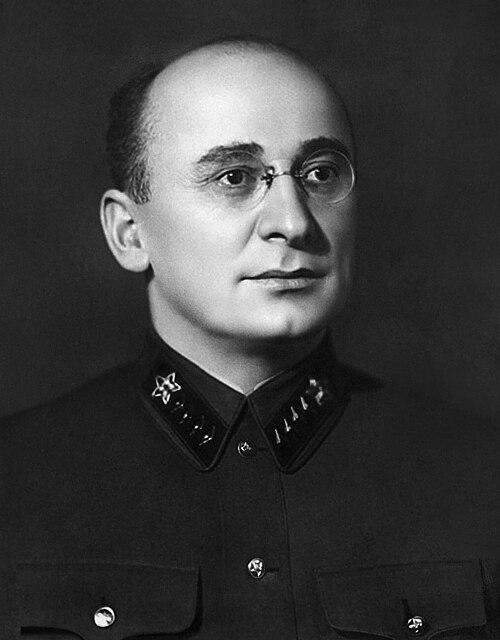

People's Commissar of Internal Affairs (NKVD), 1938-1945; Deputy Chairman of the Council of Ministers; Minister of Internal Affairs, 1953 · Soviet Union
On the regime page: Soviet Union under Stalin
4 quotes, oldest first. Filter with other speakers.
Content note: Introduces a proposal to shoot some 25,000 prisoners. The words are shown as they were said or written. Why
“In view of the fact that all are hardened and uncompromising enemies of Soviet authority, the USSR NKVD considers it necessary:”
Original (Russian)
Исходя из того, что все они являются закоренелыми, неисправимыми врагами советской власти, НКВД СССР считает необходимым:
English: Tadeusz Piotrowski, in Poland's Holocaust (McFarland, 1998); translator of the document not credited
Beria proposed that the NKVD try the cases of Polish prisoners of war in three camps and of prisoners in western Ukraine and Belarus; the Politburo, signing below, approved it the same day. The executions that followed in spring 1940 include those at Katyn.
Note of the People's Commissar of Internal Affairs L. Beria to the Politburo, 5 March 1940 (Politburo decision P13/144 of the same date), English in Tadeusz Piotrowski, Poland's Holocaust (Jefferson, NC: McFarland, 1998), p. 269 Source
Content note: Proposal to shoot prisoners of war and prisoners without trial. The words are shown as they were said or written. Why
“(1) To instruct the USSR NKVD that it should try them before special tribunals: (a) the cases of the 14,700 former Polish officers, government officials, land owners, police officers, intelligence officers, gendarmes, settlers in the border regions and prison guards being held in prisoner-of-war camps; (b) together with the cases of 11,000 members of various counter-revolutionary organizations of spies and saboteurs, former land owners, factory owners, former Polish officers, government officials, and escapees who have been arrested and are being held in the western provinces of the Ukraine and Belarus and apply to them the supreme penalty: shooting.”
Original (Russian)
Предложить НКВД СССР: 1) дела о находящихся в лагерях для военнопленных 14 700 человек бывших польских офицеров, чиновников, помещиков, полицейских, разведчиков, жандармов, осадников и тюремщиков, 2) а также дела об арестованных и находящихся в тюрьмах западных областей Украины и Белоруссии в количестве 11 000 человек членов различных к[онтр]р[еволюционных] шпионских и диверсионных организаций, бывших помещиков, фабрикантов, бывших польских офицеров, чиновников и перебежчиков — — рассмотреть в особом порядке, с применением к ним высшей меры наказания — расстрела.
English: Tadeusz Piotrowski, in Poland's Holocaust (McFarland, 1998); translator of the document not credited
Beria proposed that the NKVD try the cases of Polish prisoners of war in three camps and of prisoners in western Ukraine and Belarus; the Politburo, signing below, approved it the same day. The executions that followed in spring 1940 include those at Katyn.
Note of the People's Commissar of Internal Affairs L. Beria to the Politburo, 5 March 1940 (Politburo decision P13/144 of the same date), English in Tadeusz Piotrowski, Poland's Holocaust (Jefferson, NC: McFarland, 1998), p. 269 Source
“But what the imperialists need is not agreement. They are scared of agreements with the Soviet Union, because they might upset their aggressive plans, render unnecessary the arms drive which is the source of billions in superprofits. The imperialists need war. They need it for the robbery and enslavement of nations. And the American monopolists need it most of all, as a source of colossal superprofits.”
English: Foreign Languages Publishing House, Moscow, 1951; translator not credited. Original-language text not found.
Beria, a Deputy Chairman of the Council of Ministers, spoke at the annual meeting for the anniversary of the October Revolution, during the Korean War. The passage follows a section on Soviet proposals for agreement with the Western powers.
Speech at a celebration meeting of the Moscow Soviet, 6 November 1951, in L. P. Beria, The 34th Anniversary of the Great October Socialist Revolution (Moscow: Foreign Languages Publishing House, 1951), pp. 28-29 Source
“On the other hand there is the United States of America, heading the camp of imperialism, which acts as a centre of attraction for the aggressive and reactionary forces all over the world that are working to precipitate another world war with the idea of robbing and enslaving other nations.”
English: Foreign Languages Publishing House, Moscow, 1951; translator not credited. Original-language text not found.
Beria's description of the post-war world as two camps, the second part of a sentence that first describes the Soviet Union as heading the camp of socialism and democracy.
Speech at a celebration meeting of the Moscow Soviet, 6 November 1951, in L. P. Beria, The 34th Anniversary of the Great October Socialist Revolution (Moscow: Foreign Languages Publishing House, 1951), early section on the international situation Source
Often attributed, not verified
These words circulate under Lavrentiy Beria’s name but could not be traced to a source. They are listed so readers can check them, not as Lavrentiy Beria’s words.
“Show me the man and I will show you the case (the crime).”
Not found in any text consulted: the 5 March 1940 note, the 1950 and 1951 FLPH pamphlets by Beria, or the Jansen and Petrov biography of Yezhov. It is widely repeated without a source.