Winston Churchill
Illustration, not an archive object
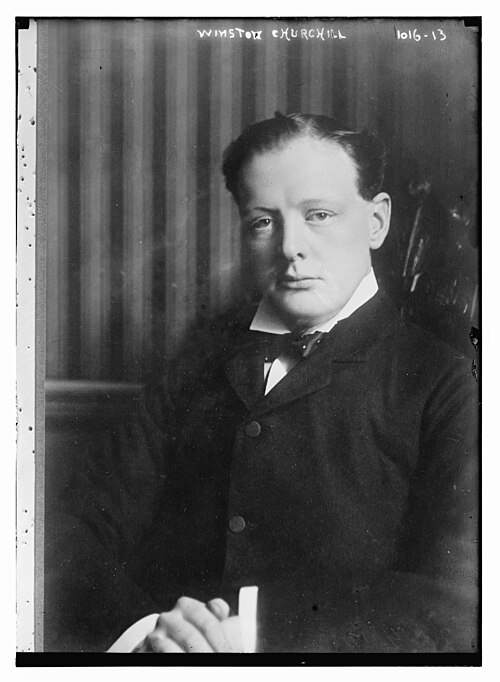

Prime Minister of the United Kingdom 1940 to 1945 · United Kingdom
On the regime page: Churchill wartime government, Asquith government
27 quotes, oldest first. Filter with other speakers.
“We will endeavour as far as we can to advance the principle of equal rights of civilised men irrespective of colour. We will encourage as far as may be in our power a careful, patient discrimination between different classes of coloured men. We will not—at least I will pledge myself—hesitate to speak out when necessary if any plain case of cruelty or exploitation of the native for the sordid profit of the white man can be proved.”
Churchill, then Under-Secretary of State for the Colonies, replied for the new Liberal government in a Commons debate on the treatment of Africans in South Africa after the Boer War.
Speech on South African Native Races, House of Commons, 28 February 1906, Hansard, HC Deb vol. 152, cc. 1243-1244 Source
Content note: Eugenic argument about people with mental disabilities. The words are shown as they were said or written. Why
“The unnatural and increasingly rapid growth of the Feeble-Minded and Insane classes, coupled as it is with a steady restriction among all the thrifty, energetic and superior stocks, constitutes a national and race danger which it is impossible to exaggerate. I am convinced that the multiplication of the Feeble-Minded, which is proceeding now at an artificial rate, unchecked by any of the old restraints of nature, and actually fostered by civilised conditions, is a terrible danger to the race.”
Written by Churchill as Home Secretary in Asquith's Liberal government, in the period when a Royal Commission's 1908 report on the feeble-minded was awaiting legislation (the Mental Deficiency Act followed in 1913). The letter argued for confinement, and in time sterilisation, of people then classed as feeble-minded.
Letter from Winston S. Churchill, Home Secretary, to Prime Minister H. H. Asquith, December 1910 (Asquith papers, MS 12, folios 224-8), quoted in Martin Gilbert, 'Churchill and Eugenics', International Churchill Society, 31 May 2009 Source
Content note: Advocates gas against 'uncivilised tribes'; colonial racial language. The words are shown as they were said or written. Why
“I do not understand this squeamishness about the use of gas. We have definitely adopted the position at the Peace Conference of arguing in favour of the retention of gas as a permanent method of warfare. It is sheer affectation to lacerate a man with the poisonous fragment of a bursting shell and to boggle at making his eyes water by means of lachrymatory gas. I am strongly in favour of using poisoned gas against uncivilised tribes. The moral effect should be so good that the loss of life should be reduced to a minimum. It is not necessary to use only the most deadly gasses: gasses can be used which cause great inconvenience and would spread a lively terror and yet would leave no serious permanent effects on most of those affected.”
Internal War Office minute written months after the Armistice, on the possible use of gas in colonial operations. The text distinguishes lachrymatory (tear) gas from the most deadly gases.
Departmental minute by Winston S. Churchill, Secretary of State for War, War Office, 12 May 1919 (Churchill papers 16/16), printed in Martin Gilbert, Winston S. Churchill, Companion Volume IV, Part 1 (London: Heinemann, 1977) Source
Content note: Antisemitic conspiracy claim about Jews and revolution. The words are shown as they were said or written. Why
“This movement among the Jews is not new. From the days of Spartacus-Weishaupt to those of Karl Marx, and down to Trotsky (Russia), Bela Kun (Hungary), Rosa Luxembourg (Germany), and Emma Goldman (United States), this world-wide conspiracy for the overthrow of civilisation and for the reconstitution of society on the basis of arrested development, of envious malevolence, and impossible equality, has been steadily growing. It played, as a modern writer, Mrs. Webster, has so ably shown, a definitely recognisable part in the tragedy of the French Revolution. It has been the mainspring of every subversive movement during the Nineteenth Century; and now at last this band of extraordinary personalities from the underworld of the great cities of Europe and America have gripped the Russian people by the hair of their heads and have become practically the undisputed masters of that enormous empire.”
Newspaper article written while Churchill was Secretary of State for War and Air, during the British debate over intervention in the Russian civil war. The article also contrasts these Jews with 'National Russian Jews' and with Zionism, which it presents as a rival and constructive movement, and it condemns pogroms against Russian Jews.
Winston S. Churchill, 'Zionism versus Bolshevism: A Struggle for the Soul of the Jewish People', Illustrated Sunday Herald, 8 February 1920, p. 5 Source
“That is an episode which appears to me to be without precedent or parallel in the modern history of the British Empire. It is an event of an entirely different order from any of those tragical occurrences which take place when troops are brought into collision with the civil population. It is an extraordinary event, a monstrous event, an event which stands in singular and sinister isolation.”
Churchill, Secretary of State for War, spoke for the government in the Commons debate on the Army Council's handling of Brigadier-General Reginald Dyer, who ordered troops to fire on a crowd at Jallianwala Bagh, Amritsar, on 13 April 1919.
Speech on the Army Council and General Dyer, House of Commons, 8 July 1920, Hansard, HC Deb vol. 131, c. 1725 Source
“Frightfulness is not a remedy known to the British pharmacopœia.”
From the same debate, in reply to an interjection about violence on the other side, after he had defined 'frightfulness' as great slaughter inflicted on a crowd to terrorise a district.
Speech on the Army Council and General Dyer, House of Commons, 8 July 1920, Hansard, HC Deb vol. 131, c. 1728 Source
Content note: Praises Italian Fascism's struggle against communism. The words are shown as they were said or written. Why
“If I had been an Italian, I am sure I should have been whole-heartedly with you from the start to finish in your triumphant struggle against the bestial appetites and passions of Leninism.”
Said to Italian journalists in Rome after two short meetings with Mussolini, while Churchill was Chancellor of the Exchequer, and at a time of negotiation over Italy's war debt. The statement is about Italy; he added that Britain was protected from such a choice.
Press statement, 'Anglo-Italian Relations', Rome, 20 January 1927, reprinted in Winston S. Churchill: His Complete Speeches 1897-1963, vol. IV: 1922-1928, ed. Robert Rhodes James (1974), p. 4126, as cited by the International Churchill Society Source
Content note: Demeaning remark about Gandhi's dress and status. The words are shown as they were said or written. Why
“It is alarming … to see Mr Gandhi, a seditious Middle Temple lawyer, now posing as a fakir of a type well-known in the East, striding half-naked up the steps of the Vice-regal Palace while he is still organising and conducting a campaign of civil disobedience.”
Made weeks after Churchill resigned from the Conservative shadow cabinet over the party's India policy, in response to Gandhi's talks with the Viceroy, Lord Irwin, following Gandhi's release from prison.
Speech to the West Essex Unionist Association, 23 February 1931, as quoted by the International Churchill Society ('India', The Life of Churchill) Source
The ellipsis is the International Churchill Society's, not ours. Circulated versions differ: others read 'alarming and also nauseating to see Mr Gandhi, a seditious Middle Temple lawyer of the type well-known in the East, now posing as a fakir, striding half-naked...'. The exact wording of the original report is not confirmed here; the venue 'Epping' is not confirmed either and should be treated as unverified.
Content note: Racial hierarchy applied to Indigenous peoples. The words are shown as they were said or written. Why
“I do not admit that the dog in the manger has the final right to the manger, even though he may have lain there for a very long time. I do not admit that right. I do not admit, for instance, that a great wrong has been done to the Red Indians of America, or the black people of Australia. I do not admit that a wrong has been done to those people by the fact that a stronger race, a higher-grade race, or, at any rate, a more worldly-wise race, to put it that way, has come in and taken their place. I do not admit it. I do not think the Red Indians had any right to say, The American Continent belongs to us and we are not going to have any of these European settlers coming in here. They had not the right, nor had they the power.”
Given in private evidence to the royal commission on Palestine, when Churchill was a backbench MP, in answer to questions about Arab claims to the land and the effect of continued Jewish immigration. The transcript stayed confidential until Martin Gilbert published it.
Testimony of Winston S. Churchill before the Palestine Royal Commission (Peel Commission), 12 March 1937, in Martin Gilbert, ed., The Churchill Documents, vol. 13, The Coming of War 1936-1939 (Hillsdale College Press, 2009), p. 616 Source
“I will, therefore, begin by saying the most unpopular and most unwelcome thing. I will begin by saying what everybody would like to ignore or forget but which must nevertheless be stated, namely, that we have sustained a total and unmitigated defeat, and that France has suffered even more than we have.”
Churchill, then a Conservative backbencher, spoke on the third day of the Commons debate on the Munich Agreement signed on 30 September 1938. Neville Chamberlain's government was defending the settlement.
Speech in the House of Commons debate on the Munich Agreement (Policy of His Majesty's Government), 5 October 1938, Hansard, HC Deb vol. 339, c. 360 Source
“I would say to the House, as I said to those who have joined this Government: "I have nothing to offer but blood, toil, tears and sweat." We have before us an ordeal of the most grievous kind.”
Churchill's first statement to the Commons as Prime Minister, three days after the German invasion of the Low Countries and France began, seeking a vote of confidence in his coalition government.
Statement on the formation of the new Government, House of Commons, 13 May 1940, Hansard, HC Deb vol. 360, c. 1502 Source
“You ask, what is our policy? I will say: It is to wage war, by sea, land and air, with all our might and with all the strength that God can give us; to wage war against a monstrous tyranny never surpassed in the dark, lamentable catalogue of human crime. That is our policy.”
From the same first statement as Prime Minister; this passage defines the government's policy for the House before the confidence vote.
Statement on the formation of the new Government, House of Commons, 13 May 1940, Hansard, HC Deb vol. 360, c. 1502 Source
“You ask, what is our aim? I can answer in one word: It is victory, victory at all costs, victory in spite of all terror, victory, however long and hard the road may be; for without victory, there is no survival.”
Churchill's first statement to the Commons as Prime Minister, immediately after the policy sentence in churchill-1940-05-13-our-policy-war.
Statement on the formation of the new Government, House of Commons, 13 May 1940, Hansard, HC Deb vol. 360, c. 1502 Source
“We shall go on to the end. We shall fight in France, we shall fight on the seas and oceans, we shall fight with growing confidence and growing strength in the air, we shall defend our island, whatever the cost may be. We shall fight on the beaches, we shall fight on the landing grounds, we shall fight in the fields and in the streets, we shall fight in the hills; we shall never surrender, and even if, which I do not for a moment believe, this island or a large part of it were subjugated and starving, then our Empire beyond the seas, armed and guarded by the British Fleet, would carry on the struggle, until, in God's good time, the new world, with all its power and might, steps forth to the rescue and the liberation of the old.”
Delivered to the Commons at the close of the Dunkirk evacuation, in a statement that also warned against treating the evacuation as a victory.
Statement on the war situation, House of Commons, 4 June 1940, Hansard, HC Deb vol. 361, c. 796 Source
“Upon this battle depends the survival of Christian civilisation. Upon it depends our own British life and the long continuity of our institutions and our Empire. The whole fury and might of the enemy must very soon be turned on us. Hitler knows that he will have to break us in this island or lose the war. If we can stand up to him all Europe may be free, and the life of the world may move forward into broad, sunlit uplands; but if we fail then the whole world, including the United States, and all that we have known and cared for, will sink into the abyss of a new dark age made more sinister, and perhaps more prolonged, by the lights of a perverted science. Let us therefore brace ourselves to our duty and so bear ourselves that if the British Commonwealth and Empire lasts for a thousand years men will still say, "This was their finest hour."”
Delivered to the Commons the day after the French government asked Germany for armistice terms.
Statement on the war situation, House of Commons, 18 June 1940, Hansard, HC Deb vol. 361, cc. 60-61 Source
“I need hardly say that the French ships were fought, albeit in this unnatural cause, with the characteristic courage of the French Navy, and every allowance must be made for Admiral Gensoul and his officers who felt themselves obliged to obey the orders they received from their Government and could not look behind that Government to see the German dictation. I fear the loss of life among the French and in the harbour must have been heavy, as we were compelled to use a severe measure of force and several immense explosions were heard.”
Report to the Commons the day after the Royal Navy attacked French warships at Mers-el-Kebir (Oran), following the French armistice with Germany.
Statement on the French Fleet, House of Commons, 4 July 1940, Hansard, HC Deb vol. 362, c. 1049 Source
“Never in the field of human conflict was so much owed by so many to so few.”
Spoken to the Commons during the Battle of Britain, in a review of the war that praised the Royal Air Force fighter and bomber crews.
Statement on the war situation, House of Commons, 20 August 1940, Hansard, HC Deb vol. 364, c. 1167 Source
“The British Broadcasting Corporation give, I believe, considerable latitude to expressions of opinion which are not injurious to the war effort, and I should be very sorry to think that Ministers were in any way to be held responsible for all statements by the B.B.C.”
Reply to a question asking whether ministers were responsible for the BBC's output. The answer that followed in the same exchange said the Minister of Information had effective control in matters of high consequence.
Oral answer by the Prime Minister on the BBC charter, House of Commons, 21 January 1941, Hansard, HC Deb vol. 368, cc. 25-26 Source
Content note: Dehumanising language about German soldiers ('Hun', 'crawling locusts'). The words are shown as they were said or written. Why
“No one has been a more consistent opponent of Communism than I have for the last twenty-five years. I will unsay no words that I've spoken about it. But all this fades away before the spectacle which is now unfolding. The past, with its crimes, its follies and its tragedies, flashes away. I see the Russian soldiers standing on the threshold of their native land, guarding the fields which their fathers have tilled from time immemorial. I see them guarding their homes; their mothers and wives pray, ah yes, for there are times when all pray for the safety of their loved ones, for the return of the breadwinner, of the champion, of their protectors. I see the 10,000 villages of Russia, where the means of existence was wrung so hardly from the soil, but where there are still primordial human joys, where maidens laugh and children play I see advancing upon all this, in hideous onslaught, the Nazi war machine, with its clanking, heel-clicking, dandified Prussian officers, its crafty expert agents, fresh from the cowing and tying down of a dozen countries. I see also the dull, drilled, docile brutish masses of the Hun soldiery, plodding on like a swarm of crawling locusts.”
Broadcast on the evening of the German attack on the USSR, announcing that Britain would give Russia all the help it could. Churchill had been a prominent opponent of Bolshevism since 1917.
Broadcast on the German invasion of the Soviet Union, BBC, 22 June 1941, transcript published by America's National Churchill Museum Source
“The aggressor is surprised, startled, staggered. For the first time in his experience mass murder has become unprofitable. He retaliates by the most frightful cruelties. As his armies advance, whole districts are being exterminated. Scores of thousands, literally scores of thousands of executions in cold blood are being perpetrated by the German police troops upon the Russian patriots who defend their native soil. Since the Mongol invasions of Europe in the sixteenth century there has never been methodical, merciless butchery on such a scale or approaching such a scale. And this is but the beginning. Famine and pestilence have yet to follow in the bloody ruts of Hitler's tanks. We are in the presence of a crime without a name.”
Broadcast after the Atlantic Conference, describing the German invasion of the Soviet Union, which had begun two months earlier. It is the passage in which Churchill refers to mass executions behind the German lines.
Broadcast to the world on his meeting with President Roosevelt (the Atlantic Charter), London, 24 August 1941, transcript at the Pearl Harbor History Associates archive (ibiblio.org) Source
Content note: Hostile remark about Indians and their religion, as reported by a colleague. The words are shown as they were said or written. Why
“I hate Indians. They are a beastly people with a beastly religion.”
Recorded by Amery, Churchill's Secretary of State for India, during wartime discussions about Indian self-government and the Congress party. The words are Amery's note of what Churchill said, not a text signed by Churchill.
Remark by Churchill recorded in the diary of Leo Amery, Secretary of State for India, 9 September 1942, in The Empire at Bay: The Leo Amery Diaries 1929-1945, ed. John Barnes and David Nicholson (London: Hutchinson, 1988), as quoted by the Hillsdale College Churchill Project Source
“'In war-time,' I said, 'truth is so precious that she should always be attended by a bodyguard of lies.'”
Churchill's own later account of a meeting of the Allied leaders and staffs at Tehran, in a discussion of cover and deception plans for the 1944 invasion of France. He records that Stalin and his colleagues appreciated the remark when translated.
Winston S. Churchill, The Second World War, vol. 5, Closing the Ring (London: Cassell, 1952), ch. 21, 'Teheran: The Crux', p. 337, recording his remark to Stalin at Tehran on 30 November 1943 Source
Content note: Endorses mass expulsion of a population. The words are shown as they were said or written. Why
“For expulsion is the method which, so far as we have been able to see, will be the most satisfactory and lasting. There will be no mixture of populations to cause endless trouble, as has been the case in Alsace-Lorraine. A clean sweep will be made. I am not alarmed by the prospect of the disentanglement of populations, nor even by these large transferences, which are more possible in modern conditions than they ever were before.”
Report to the Commons on Soviet proposals for Poland's postwar frontiers, in a passage about moving Polish populations from the east and expelling Germans from territory to be acquired by Poland in the west and north.
Statement on Poland, House of Commons, 15 December 1944, Hansard, HC Deb vol. 406, c. 1484 Source
Content note: Refers to bombing of cities to increase terror; civilian bombing. The words are shown as they were said or written. Why
“It seems to me that the moment has come when the question of bombing of German cities simply for the sake of increasing the terror, though under other pretexts, should be reviewed. Otherwise we shall come into control of an utterly ruined land. We shall not, for instance, be able to get housing materials out of Germany for our own needs because some temporary provision would have to be made for the Germans themselves. The destruction of Dresden remains a serious query against the conduct of Allied bombing. I am of the opinion that military objectives must henceforward be more strictly studied in our own interests rather than that of the enemy. The Foreign Secretary has spoken to me on this subject, and I feel the need for more precise concentration upon military objectives, such as oil and communications behind the immediate battle-zone, rather than on mere acts of terror and wanton destruction, however impressive.”
Written six weeks after the bombing of Dresden, after Churchill had been shown accounts of the raid. He later agreed to withdraw this minute and have the Chief of the Air Staff redraft it in different terms.
Minute by the Prime Minister to the Chiefs of Staff Committee and the Chief of the Air Staff, 28 March 1945, printed in Martin Gilbert, Winston S. Churchill, vol. VII, Road to Victory 1941-1945 (London: Heinemann, 1986), p. 1257 Source
“From Stettin in the Baltic to Trieste in the Adriatic, an iron curtain has descended across the Continent. Behind that line lie all the capitals of the ancient states of Central and Eastern Europe. Warsaw, Berlin, Prague, Vienna, Budapest, Belgrade, Bucharest and Sofia, all these famous cities and the populations around them lie in what I must call the Soviet sphere, and all are subject in one form or another, not only to Soviet influence but to a very high and, in many cases, increasing measure of control from Moscow.”
Delivered after Churchill had left office as Prime Minister (he was Leader of the Opposition), with President Truman present on the platform. The speech addressed postwar relations with the Soviet Union and the Anglo-American partnership.
'The Sinews of Peace' address at Westminster College, Fulton, Missouri, 5 March 1946, text published by the International Churchill Society Source
“For my part, I consider that it will be found much better by all parties to leave the past to history, especially as I propose to write that history myself.”
Said as Leader of the Opposition in the Commons debate on foreign affairs, in reply to the Foreign Secretary, when Churchill was writing his war memoirs.
Speech in the Foreign Affairs debate, House of Commons, 23 January 1948, Hansard, HC Deb vol. 446, c. 557 Source
Often attributed, not verified
These words circulate under Winston Churchill’s name but could not be traced to a source. They are listed so readers can check them, not as Winston Churchill’s words.
“History will be kind to me for I intend to write it.”
Hansard, HC Deb 23 January 1948 vol. 446 c. 557, has: 'leave the past to history, especially as I propose to write that history myself.' The popular form does not appear in his published words; it is a paraphrase of the 1948 remark.
“The best argument against democracy is a five-minute conversation with the average voter.”
No source in his speeches, books or papers; the International Churchill Society and the Hillsdale Churchill Project list it as a misattribution, and no instance appears before the mid-1990s.
“Success is not final, failure is not fatal: it is the courage to continue that counts.”
The International Churchill Society and the Hillsdale Churchill Project found no trace in the Churchill corpus; a similar line appears in a 1938 advertisement.
“Strangle Bolshevism in its cradle.”
The Hillsdale Churchill Project could not find the phrase in his 1919-20 speeches; he did say in the Commons on 26 January 1949 that 'the strangling of Bolshevism at its birth would have been an untold blessing to the human race', and in Washington on 28 June 1954 'we might have strangled Bolshevism in its cradle'. His 19 February 1919 Mansion House speech contains 'the foul baboonery of Bolshevism' (not 'strangle').
“One may dislike Hitler's system and yet admire his patriotic achievement. If our country were defeated I hope we should find a champion as indomitable [...]”
Reported in secondary sources (the Hillsdale and ICS pages on the Hitler essays discuss it), but the essay text itself was not reached in this check, so no quotation is published. Not asserted to be false.