Liu Shaoqi
Illustration, not an archive object
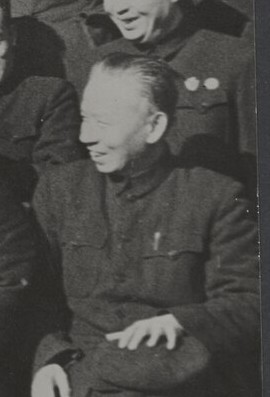
Chairman of the People's Republic; Vice-Chairman of the CCP · China
On the regime page: People's Republic of China under Mao Zedong
5 quotes, oldest first. Filter with other speakers.
“Our entire Party press must propagate Mao Zedong Thought in a systematic way. The propaganda departments of the Party should edit Comrade Mao Zedong's important works into popular reading matter suited to the level of the average Party member.”
English: Foreign Languages Press, Beijing (Selected Works of Liu Shaoqi, vol. 1, 1984). Original-language text not found.
Report to the Seventh National Congress of the Communist Party on the revised Party constitution, which wrote Mao Zedong Thought into the constitution as the Party's guide.
"On the Party" (report on the revision of the Party constitution, Seventh National Congress, 14 May 1945), in Selected Works of Liu Shaoqi, vol. 1 (Beijing: Foreign Languages Press, 1984) Source
“This is due to the fact that the masses, especially the peasantry, accept things only on the strength of their own personal experience instead of on the strength of our general propaganda and slogans.”
English: Foreign Languages Press, Beijing (Selected Works of Liu Shaoqi, vol. 1, 1984). Original-language text not found.
From the part of the report on how Party members should lead the masses, arguing that general calls must be combined with specific guidance in practical work.
"On the Party" (report on the revision of the Party constitution, Seventh National Congress, 14 May 1945), in Selected Works of Liu Shaoqi, vol. 1 (Beijing: Foreign Languages Press, 1984) Source
“Some foreign commentators find it strange that while we safeguard the people's democratic freedoms and rights, we also suppress all counter-revolutionary activities and punish traitors and counter-revolutionaries. Of course, anyone who expects our Constitution to ensure freedom for the activities of traitors and counter-revolutionaries is bound to be disappointed. As for the foreign imperialists and their hangers-on, who would like to enslave us, our Constitution and laws will never give them the slightest loophole. Is it not precisely because we have deprived the traitors and counter-revolutionaries of their freedom that the people have genuine freedom?”
English: Foreign Languages Press, Beijing (Selected Works of Liu Shaoqi, vol. 2, 1991; authorised translation of the 1985 Chinese edition). Original-language text not found.
Report to the first session of the First National People's Congress on the draft constitution, answering foreign comments on the draft's provisions on freedoms and on counter-revolutionary activity.
Report on the Draft Constitution of the People's Republic of China, 15 September 1954, in Selected Works of Liu Shaoqi, vol. 2 (Beijing: Foreign Languages Press, 1991), pp. 153-154 Source
“Now the question arises: were the problems of the past few years caused more by natural disasters or by the mistakes we made in our work? Peasants in Hunan said, "It is thirty per cent natural disaster and seventy per cent man-made calamity." I have posed this question to cadres from several provincial Party committees.”
English: Foreign Languages Press, Beijing (Selected Works of Liu Shaoqi, vol. 2, 1991; authorised translation of the 1985 Chinese edition). Original-language text not found.
Talk on the economic crisis that followed the Great Leap Forward and the people's communes, in which Liu reports what peasants in Hunan told him during an investigation there. The same remark recurs in his speech of 27 January 1962.
Cause of the Present Economic Difficulties and Methods for Overcoming Them, 31 May 1961, in Selected Works of Liu Shaoqi, vol. 2 (Beijing: Foreign Languages Press, 1991), p. 315 Source
“Last year when I returned to Hunan, I visited an area suffering enormous difficulties. I asked the peasants, "What is the cause of your current troubles? Have you suffered from natural disasters?" They replied, "Yes, we have suffered natural disasters, but only to a certain extent, perhaps 30 per cent, while the remaining 70 per cent of production failures should be attributed to man-made disasters."”
English: Foreign Languages Press, Beijing (Selected Works of Liu Shaoqi, vol. 2, 1991; authorised translation of the 1985 Chinese edition). Original-language text not found.
Speech at the conference of about 7,000 cadres held after the Great Leap Forward, delivered in addition to the written report of the same date. Liu describes asking peasants in Hunan about the cause of the failure of production.
Speech at an Enlarged Working Conference of the Central Committee of the Party, 27 January 1962, in Selected Works of Liu Shaoqi, vol. 2 (Beijing: Foreign Languages Press, 1991), p. 398 Source
Often attributed, not verified
These words circulate under Liu Shaoqi’s name but could not be traced to a source. They are listed so readers can check them, not as Liu Shaoqi’s words.
“Three parts natural disaster, seven parts man-made calamity (三分天灾,七分人祸) as Liu Shaoqi's own formula.”
In the speech (Selected Works of Liu Shaoqi vol. 2, p. 398) Liu attributes the 30/70 split to what peasants in Hunan told him; he then says disasters were the main cause in some places but not in most, and that in most parts of the country mistakes were the major cause. The split is reported speech, not Liu's own stated figure. Both statements are published above.