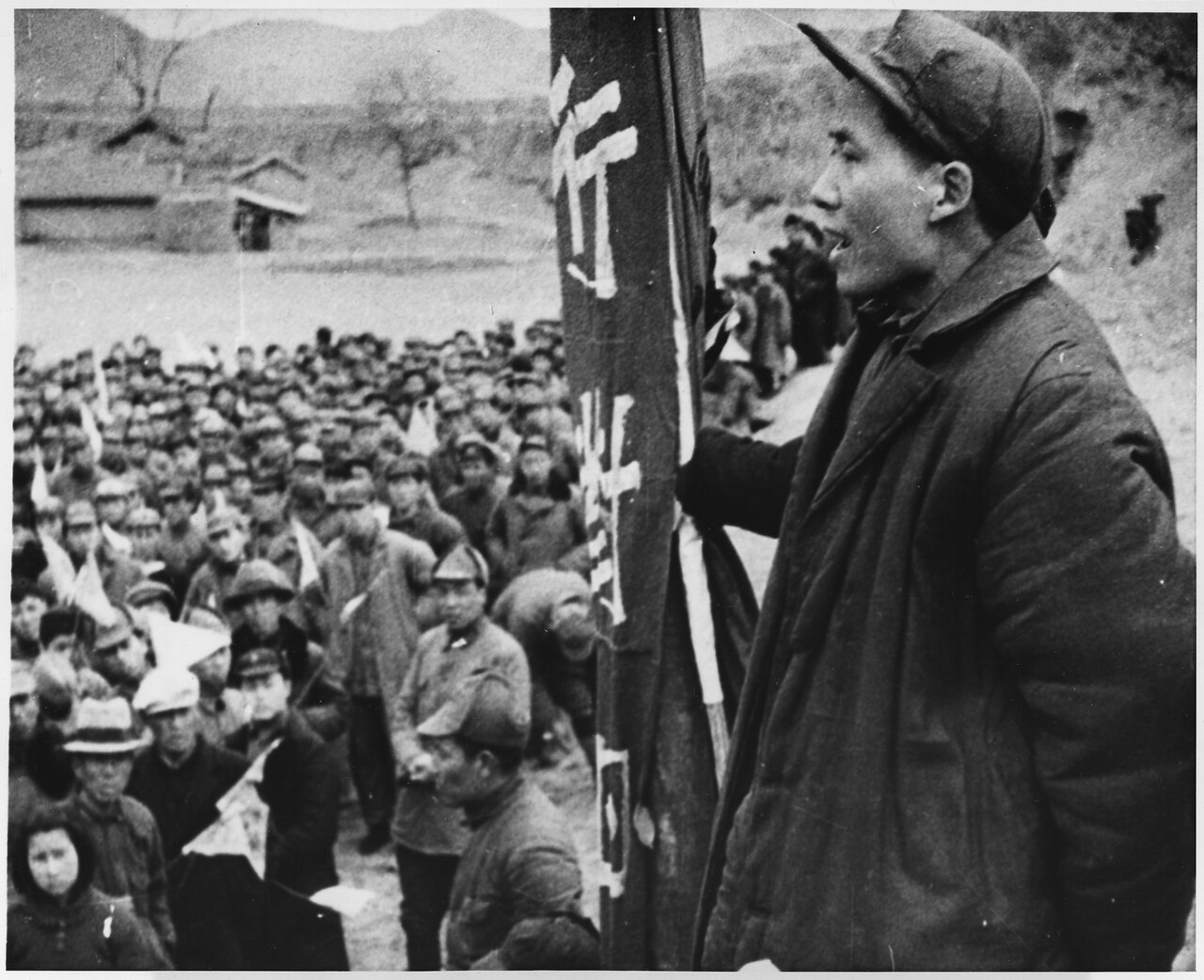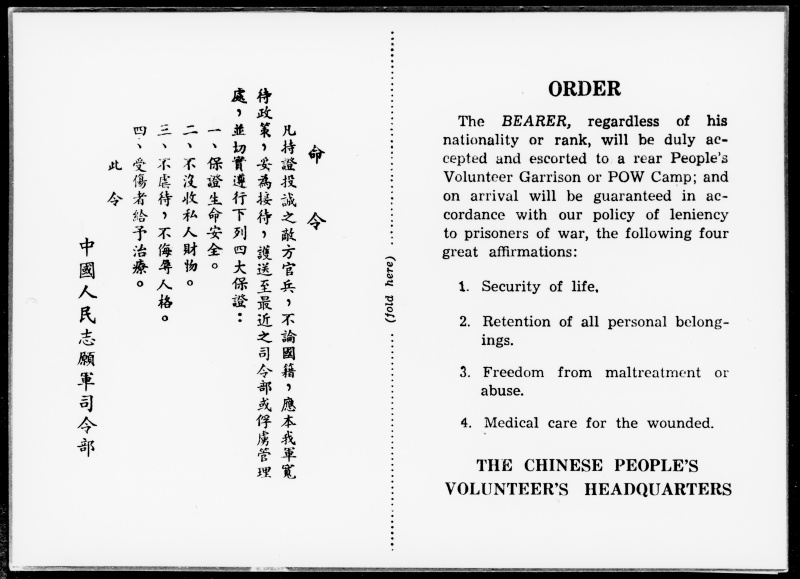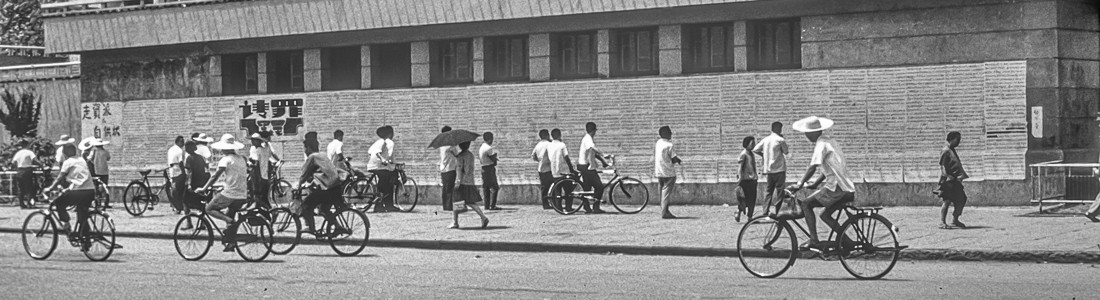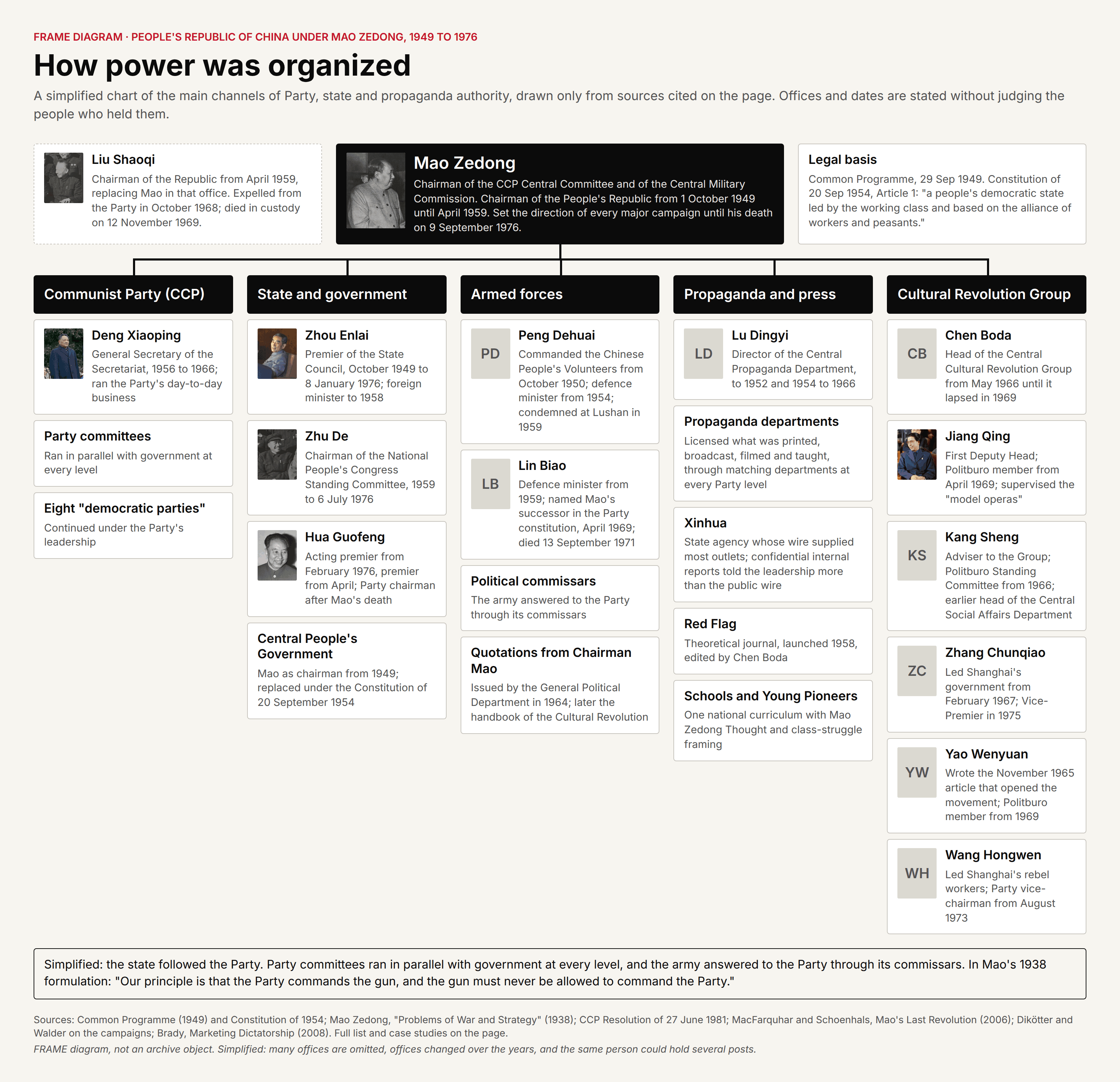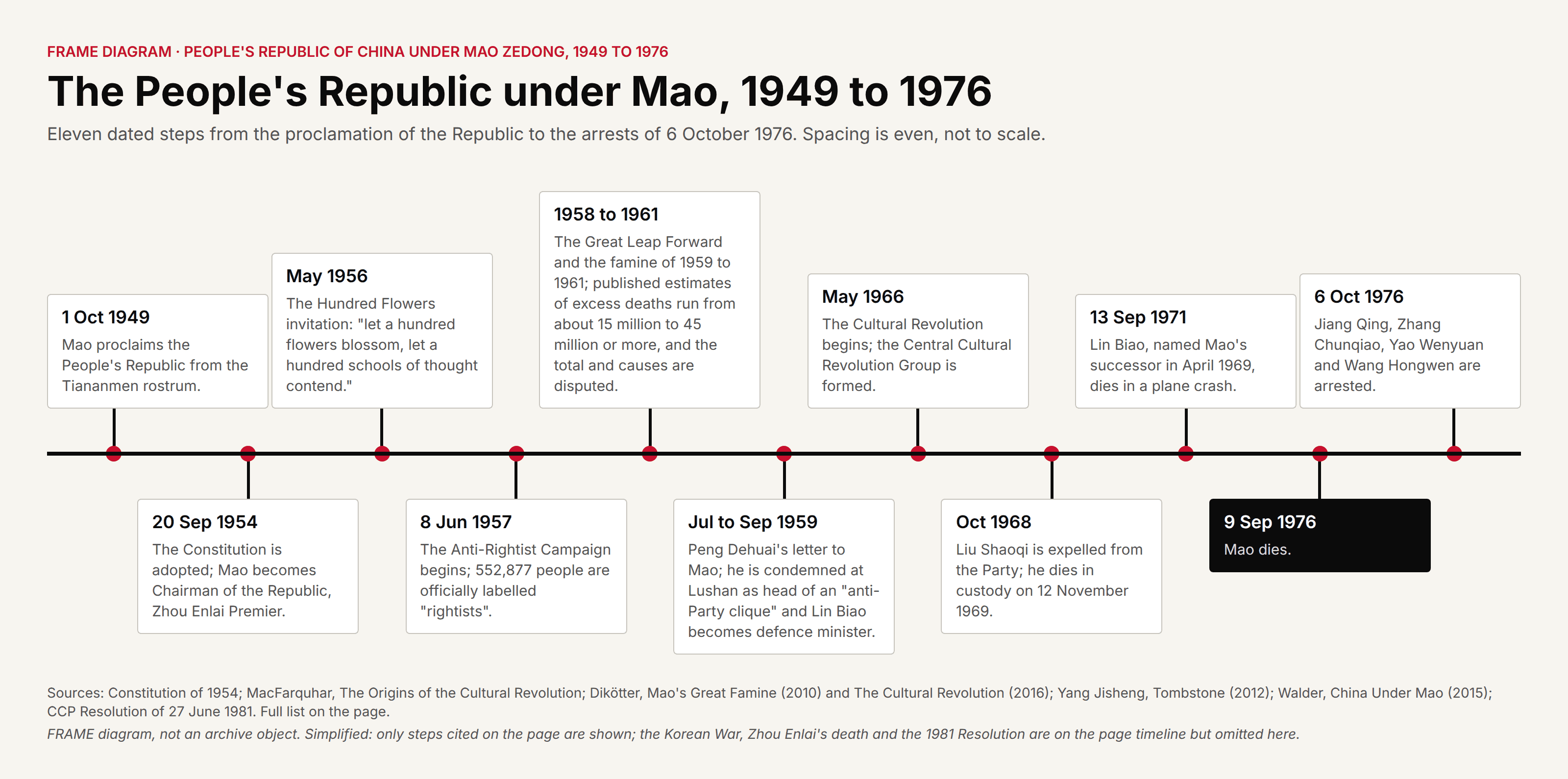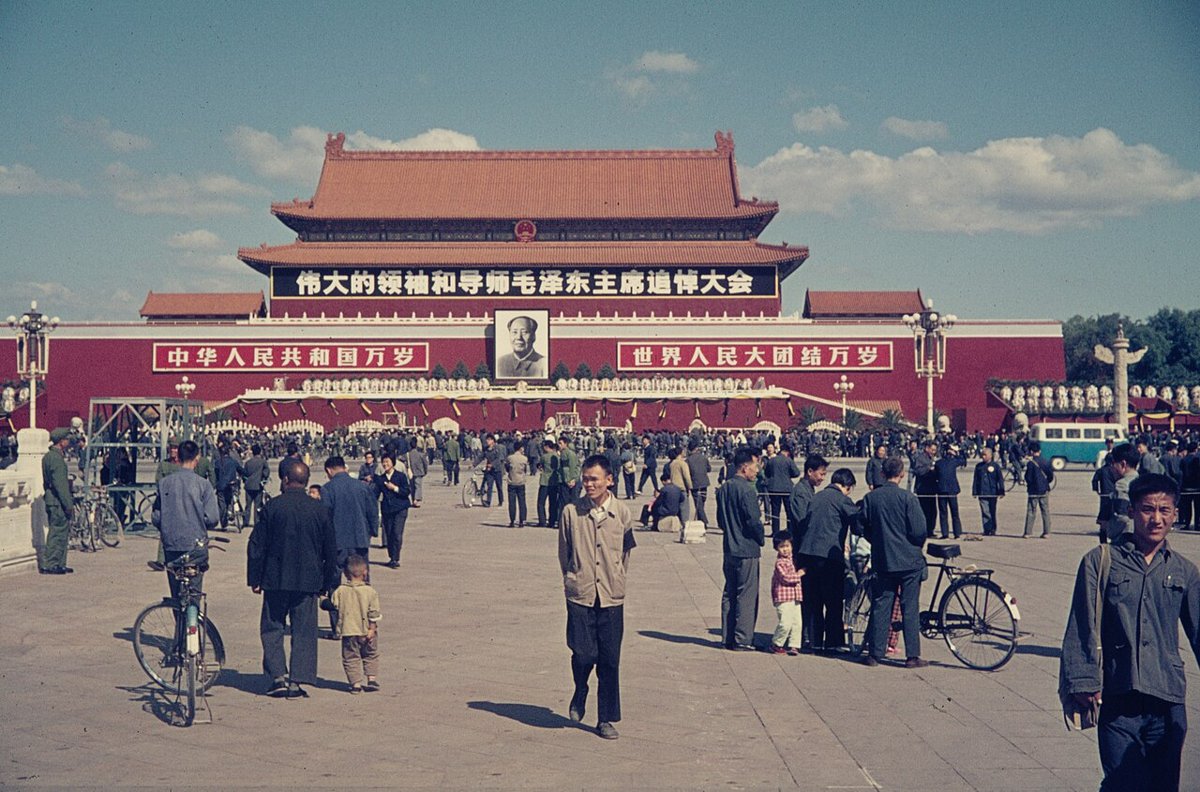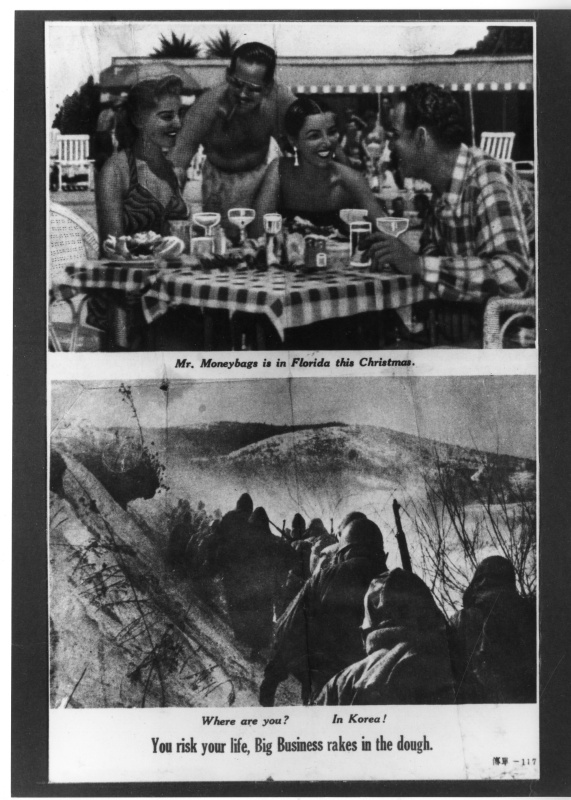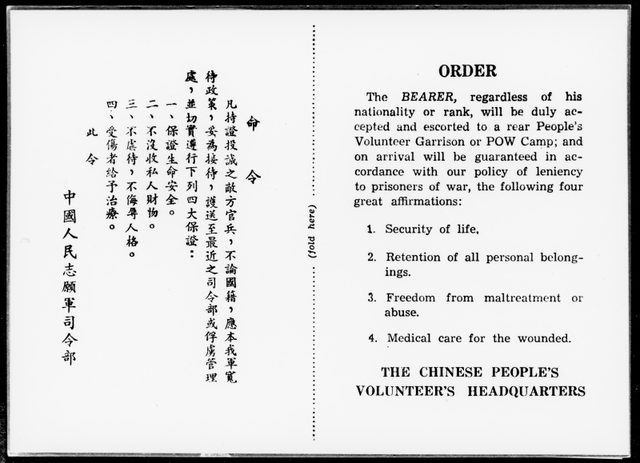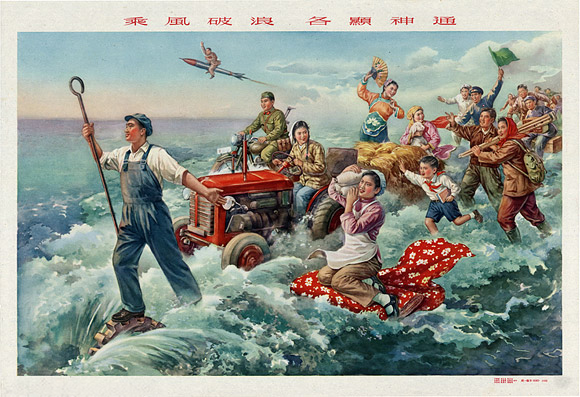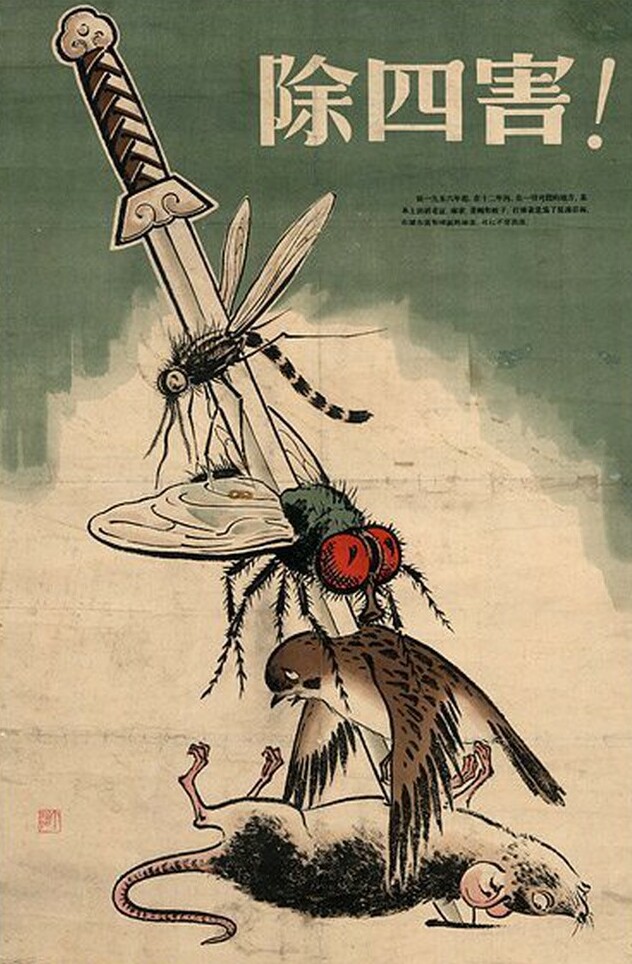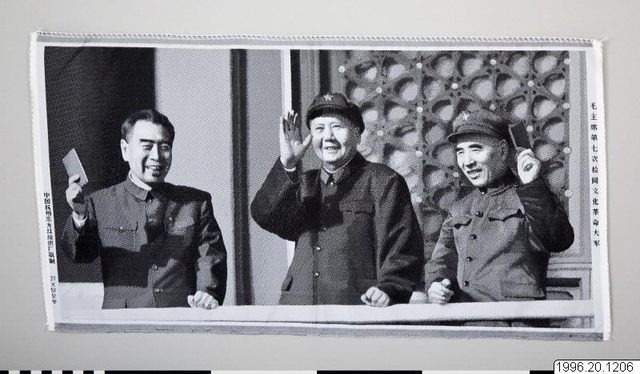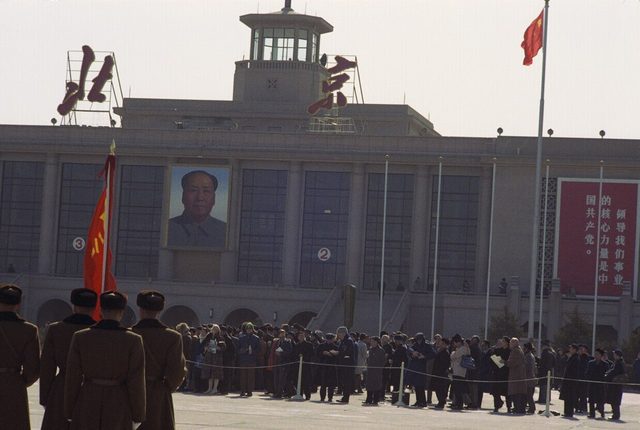
In one line: From 1 October 1949 to Mao Zedong's death on 9 September 1976 the Chinese Communist Party (CCP) governed the People's Republic of China under Chairman Mao, with the Party leading every other body of the state, and in those years carried out land reform, intervention in the Korean War, collectivisation, the Great Leap Forward and the famine that followed, a series of campaigns against named classes of people, and the Cultural Revolution.
The leader and the people under the leader
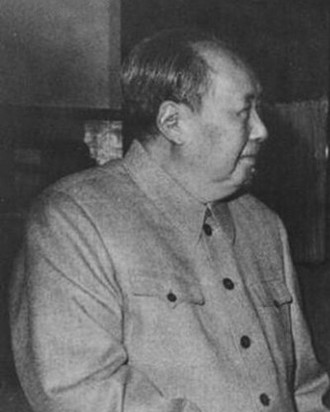
Photo: White House Photo Office (President Nixon), U.S. National Archives, Public domain (PD-USGov) Mao Zedong
Chairman of the CCP Central Committee and of the Central Military Commission; Chairman of the People's Republic until April 1959 · 1949 to 1976
Mao Zedong: Read more
Led the Party from 1943 and the state from 1 October 1949; held the state chairmanship until April 1959 and, as Party chairman and head of the Central Military Commission, set the direction of every major campaign until his death on 9 September 1976.
In their words
“The purpose of our meeting today is precisely to ensure that literature and art fit well into the whole revolutionary machine as a component part, that they operate as powerful weapons for uniting and educating the people and for attacking and destroying the enemy, and that they help the people fight the enemy with one heart and one mind.”
“All erroneous ideas, all poisonous weeds, all ghosts and monsters, must be subjected to criticism; in no circumstances should they be allowed to spread freely. However, the criticism should be fully reasoned, analytical and convincing, and neither rough and bureaucratic, nor metaphysical and dogmatic.”
“Letting a hundred flowers blossom and a hundred schools of thought contend is the policy for promoting progress in the arts and sciences and a flourishing socialist culture in our land. Different forms and styles in art should develop freely and different schools in science should contend freely. We think that it is harmful to the growth of art and science if administrative measures are used to impose one particular style of art or school of thought and to ban another.”
“Secondly, a revolution is not a dinner party, or writing an essay, or painting a picture, or doing embroidery; it cannot be so refined, so leisurely and gentle, so temperate, kind, courteous, restrained and magnanimous. A revolution is an insurrection, an act of violence by which one class overthrows another.”
“To put it bluntly, it is necessary to create terror for a while in every rural area, or otherwise it would be impossible to suppress the activities of the counter-revolutionaries in the countryside or overthrow the authority of the gentry. Proper limits have to be exceeded in order to right a wrong, or else the wrong cannot be righted.”
“Every Communist must grasp the truth, "Political power grows out of the barrel of a gun." Our principle is that the Party commands the gun, and the gun must never be allowed to command the Party.”
All 22 quotes from Mao Zedong, and 3 often attributed but not verified
In the archive: The Mao cult before the state: 'Mao Zedong Thought' and 'The East Is Red', 1943-1949, The Red Guards: how Mao turned millions of students into a political weapon, 1966-68, Big-character posters: how the opening labels of China's Cultural Revolution did the work of charges (1966-68), The Great Leap Forward's 'sputnik' harvests and the famine that followed, The Hundred Flowers and Anti-Rightist Campaigns: soliciting criticism, then purging it (1956-1959)
Party leadership
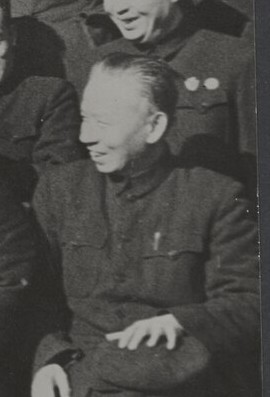
Photo: Camera Press (Fotocollectie Spaarnestad), CC0 1.0 (Nationaal Archief) Liu Shaoqi
Chairman of the People's Republic of China; Vice-Chairman of the CCP Central Committee · 1959 to 1968
Liu Shaoqi: Read more
Chaired the Standing Committee of the National People's Congress from 1954 and succeeded Mao as head of state in April 1959; labelled "China's Khrushchev" in 1967, expelled from the Party in October 1968, died in custody on 12 November 1969 and was rehabilitated in February 1980.
In their words
“Our entire Party press must propagate Mao Zedong Thought in a systematic way. The propaganda departments of the Party should edit Comrade Mao Zedong's important works into popular reading matter suited to the level of the average Party member.”
“This is due to the fact that the masses, especially the peasantry, accept things only on the strength of their own personal experience instead of on the strength of our general propaganda and slogans.”
“Some foreign commentators find it strange that while we safeguard the people's democratic freedoms and rights, we also suppress all counter-revolutionary activities and punish traitors and counter-revolutionaries. Of course, anyone who expects our Constitution to ensure freedom for the activities of traitors and counter-revolutionaries is bound to be disappointed. As for the foreign imperialists and their hangers-on, who would like to enslave us, our Constitution and laws will never give them the slightest loophole. Is it not precisely because we have deprived the traitors and counter-revolutionaries of their freedom that the people have genuine freedom?”
“Now the question arises: were the problems of the past few years caused more by natural disasters or by the mistakes we made in our work? Peasants in Hunan said, "It is thirty per cent natural disaster and seventy per cent man-made calamity." I have posed this question to cadres from several provincial Party committees.”
“Last year when I returned to Hunan, I visited an area suffering enormous difficulties. I asked the peasants, "What is the cause of your current troubles? Have you suffered from natural disasters?" They replied, "Yes, we have suffered natural disasters, but only to a certain extent, perhaps 30 per cent, while the remaining 70 per cent of production failures should be attributed to man-made disasters."”
All 5 quotes from Liu Shaoqi, and 1 often attributed but not verified
In the archive: Big-character posters: how the opening labels of China's Cultural Revolution did the work of charges (1966-68)
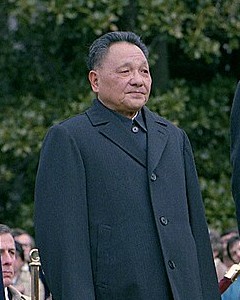
Photo: White House staff photographers (Carter administration), Public domain (PD-USGov) Deng Xiaoping
General Secretary of the CCP Central Committee's Secretariat · 1956 to 1966
Deng Xiaoping: Read more
Ran the Party's day-to-day business through the Secretariat from 1956, including much of the conduct of the Anti-Rightist Campaign; removed in 1966 as a "capitalist roader", returned as Vice-Premier in 1973 and was dismissed again in April 1976.
In their words
“Science and technology are part of the productive forces. Mental workers who serve socialism are part of the working people. A correct understanding of these two facts is essential to the rapid development of our scientific enterprises.”
“When views diverge on scholarly questions, we must follow the policy of “letting a hundred schools of thought contend” and encourage free discussion.”
“The most extensive uses of writing are in publishing articles in the newspapers, issuing pamphlets and broadcasting them over the radio. Moreover, if the work of the press and broadcasting is closely integrated with practical and central tasks, it will be more effective on a broader scale than other means and will play a greater role in the carrying out of the leaders’ intentions.”
“The Party and Party members should be subject to supervision, a point which was emphasized at the Party’s Eighth National Congress. Recently Chairman Mao stressed in particular that a set of rules and regulations should be formulated for the convenience of supervision. He said that we should allow others to challenge us with opposing views, because this is better than acting alone. Our Party is the ruling party and enjoys high prestige. A good many of our cadres hold leading posts. In China who is in a vulnerable position to make big mistakes? None other than the Chinese Communist Party. When it makes such mistakes, the effects are most widespread, so the Party should be particularly careful. The Party’s leadership position is stipulated in the Constitution. If the Party wants to exercise good leadership, it should constantly overcome subjectivism, bureaucratism and sectarianism, accept supervision and expand democracy within the Party and the state. If we do not accept supervision or work to expand democracy within the Party and the state, we shall surely cut ourselves off from the masses and make big mistakes.”
“When talking about fighting battles, Comrade Liu Bocheng often quotes a Sichuan proverb — “It does not matter if it is a yellow cat or a black cat, as long as it catches mice.””
All 7 quotes from Deng Xiaoping, and 1 often attributed but not verified
In the archive: The Hundred Flowers and Anti-Rightist Campaigns: soliciting criticism, then purging it (1956-1959), Boluan Fanzheng: how Deng Xiaoping's faction used a debate about truth to break Hua Guofeng's hold on power, 1977-1981
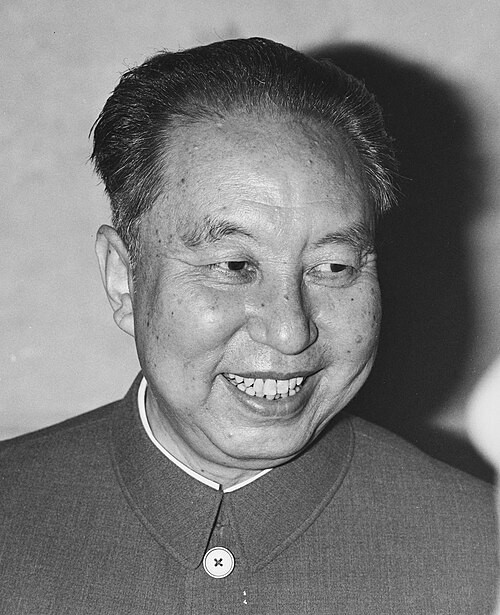
Photo: Bibliotheque de l'Hotel de Ville, Bibliotheques specialisees de la Ville de Paris, Public domain (PD-France) Hua Guofeng
Premier of the State Council; First Vice-Chairman of the CCP Central Committee · 1976
Hua Guofeng: Read more
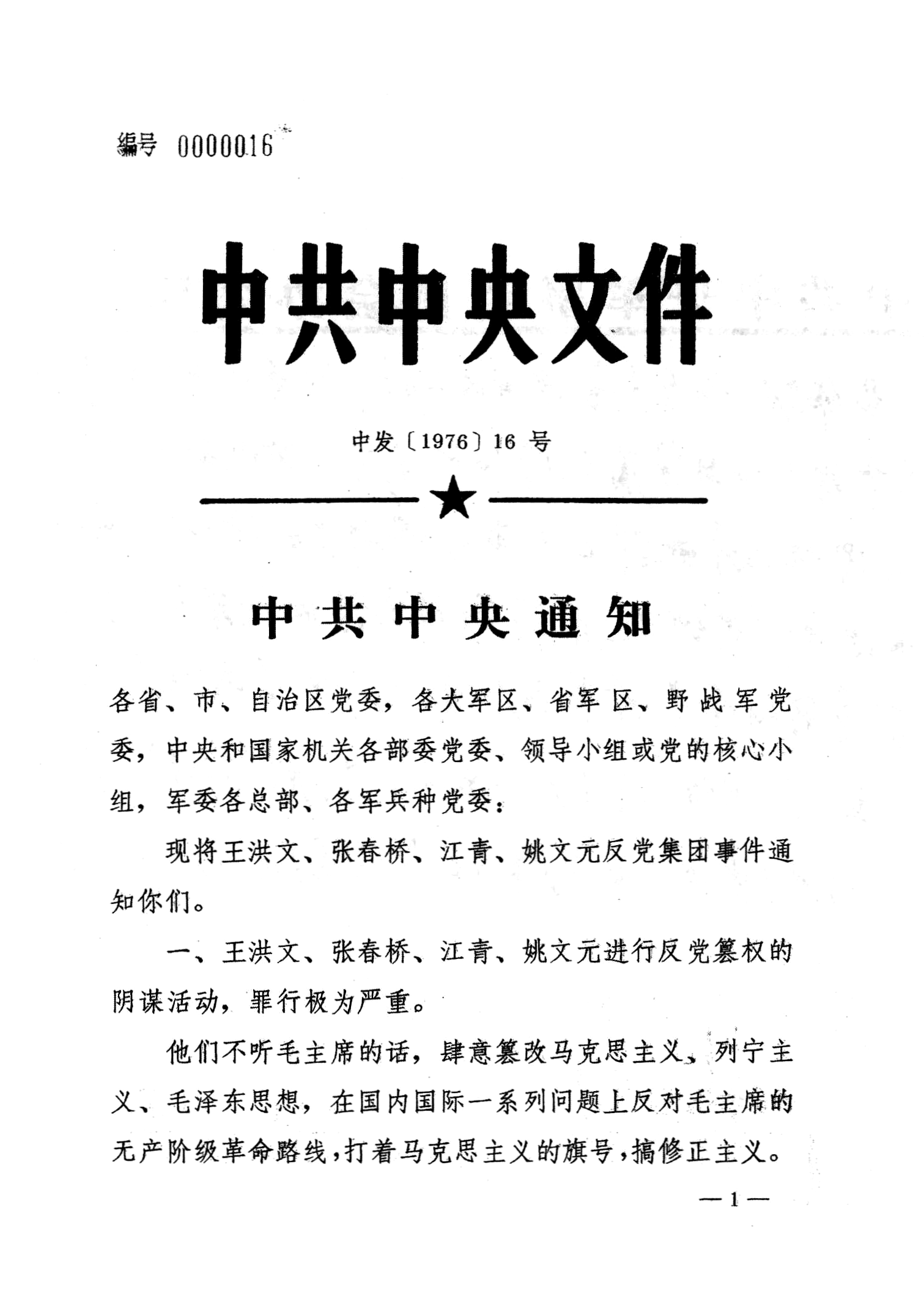
Named acting premier in February 1976 and premier in April, became Party chairman after Mao's death, and had Jiang Qing, Zhang Chunqiao, Yao Wenyuan and Wang Hongwen arrested on 6 October 1976.
In their words
“Under Chairman Mao’s leadership, our Party defeated the opportunist lines perused by Chen Tu-hsiu, Chu Chiu-pai, Li Li-san, Lo Chang-lung, Wang Ming, Chang Kuo-tao, Kao Kang - Jao Shu-Shih and Peng Teh-huai and again, during the Great Proletarian Cultural Revolution, triumphed over the counter-revolutionary revisionist line of Liu Shao-chi, Lin Piao and Teng Hsiao-ping.”
“Internally, we must conscientiously study Marxism-Leninism-Mao Tsetung Thought, take class struggle as the key link [...] deepen the struggle it criticize Teng Hsiao-ping and repulse the right deviationist attempt to reverse correct verdicts”
“The Party Central Committee took prompt and effective measures to help the people in the stricken areas restore production and rebuild their homes and to lead the masses in the heroic struggle to overcome the difficulties caused by the earth quakes. It was at this time that the "gang of four, " the Wang-Chang-Chiang-Yao anti-Party clique, perversely exploited the grave difficulty confronting the Party and the people and tried to usurp the supreme Party and state leadership, which was their long-cherished ambition. Before Chairman Mao’s death, they went against a series of directives issued by Chairman Mao and the Party Central Committee, sang another tune in the criticism of Teng Hsiao-ping and thus caused great ideological and political confusion and enormous economic losses. After Chairman Mao’s death, thinking their chance had come, they quickened their pace to usurp the supreme Party and state leadership and mounted unprecedentedly wild attacks in an attempt to knock down the Party and the people.”
All 4 quotes from Hua Guofeng, and 1 often attributed but not verified
In the archive: The Gang of Four: arrest, denunciation and a trial that closed the Cultural Revolution's books (1976-1981), Grief on schedule: Mao's death, Hua Guofeng's succession and the 'two whatevers', 1976-1978
State and government
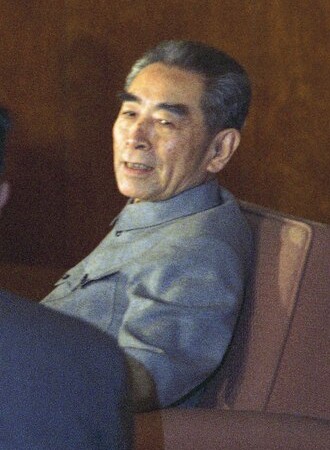
Photo: White House Photo Office (President Nixon), U.S. National Archives (via Digital Public Library of America), Public domain (U.S. federal government work) Zhou Enlai
Premier of the State Council; Minister of Foreign Affairs to 1958 · 1949 to 1976
Zhou Enlai: Read more
Headed the State Council, the executive of the state, from October 1949 until his death on 8 January 1976, and was foreign minister until 1958; he negotiated with the United States in 1971 and 1972.
In their words
“We Communists do not hide the fact that we believe in communism and that we consider the socialist system a good system. There is no need at this Conference to publicize one’s ideology and the political system of one’s country, although differences do exist among us.”
“Our great proletarian cultural revolution is acclaimed and warmly praised by all Marxists-Leninists and revolutionary people of the world and immensely fortifies their revolutionary fighting will and confidence in victory.”
“In order to expose Chiang Kai-shek's scheme, we should concentrate on propagating the four slogans against civil war, against dictatorship, for peace and for democracy.”
“The Chinese people enthusiastically love peace, but in order to defend peace they never have been and never will be afraid to oppose aggressive war. The Chinese people absolutely will not tolerate foreign aggression, nor will they supinely tolerate seeing their neighbours being savagely invaded by imperialists. Whoever attempt to exclude the nearly 500 million Chinese people from the U.N. and whoever set at nought and violate the interests of this one-fourth of mankind in the world and fancy vainly to solve any Eastern problem directly concerned with China arbitrarily, will certainly break their skulls.”
“On Chairman Mao's instructions, it was suggested in the report on the work of the government to the Third National People's Congress that we might envisage the development of our national economy in two stages beginning from the Third Five-Year Plan: The first stage is to build an independent and relatively comprehensive industrial and economic system in 15 years, that is, before 1980; the second stage is to accomplish the comprehensive modernization of agriculture, industry, national defence and science and technology before the end of the century, so that our national economy will be advancing in the front ranks of the world.”
All 5 quotes from Zhou Enlai, and 1 often attributed but not verified
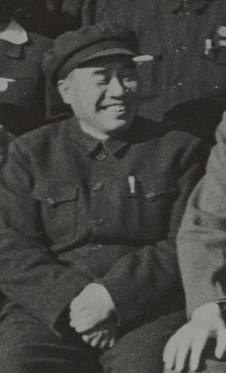
Photo: Camera Press (Fotocollectie Spaarnestad), CC0 1.0 (Nationaal Archief) Zhu De
Chairman of the Standing Committee of the National People's Congress · 1959 to 1976
Zhu De: Read more
Held the rank of commander-in-chief of the People's Liberation Army in the early 1950s, was a vice-chairman of the Republic from 1954 to 1959, and then presided over the National People's Congress Standing Committee until his death on 6 July 1976.
In their words
“The Central People's Government will certainly help the Tibetan people in wiping out the influence of imperialism in Tibet; it will achieve the unification of the territory and sovereignty of the People's Republic of China, and defend the national frontiers of our great Motherland, so that the Tibetan nationality and people will achieve liberation, return forever to the family of our great Motherland and, helped by the Central People's Government and the Han nationality, develop its own political, economic, cultural and educational work and improve and raise its standards of living step by step.”
“The Chinese people have a deep love of peace, but in order to defend peace, they have never been, and will never be, afraid of resisting an aggressive war.”
“Turn your guns in the opposite direction and fight to overthrow imperialism and the Kuomintang, which exploit, oppress, and butcher the Chinese labouring masses; fight to establish the Soviet Government and the Red Army of the workers, peasants, and soldiers!”
“American imperialism is now starting a new aggression against the People's Republic of China. The flames of aggressive war kindled by American imperialism around China are spreading.”
Armed forces
No public-domain or openly licensed portrait from his years in office found. Nearest: source, tagged public domain on Commons, 178 px, a derivative whose original publication and US status could not be verified. Peng Dehuai
Minister of National Defence; commander of the Chinese People's Volunteers · 1954 to 1959
Peng Dehuai: Read more
Commanded the Chinese People's Volunteers in Korea from October 1950 and was defence minister from 1954; after his letter to Mao of 14 July 1959 he was dismissed at Lushan as head of an "anti-Party clique", and he died in detention in 1974.
In their words
“The exaggeration trend has become so common in various areas and departments that reports of unbelievable miracles have appeared in newspapers and magazines to bring a great loss of prestige to the Party.”
“What is particularly serious in all this is that it was very hard for us to get to know the real situation for a fairly long period.”
“You can expel me from the Party and have me shot! If there are members of the ‘military club’ among you people, you can step forward to say so yourselves.”
“In the Great Leap Forward of 1958, I, like many other comrades, was misled by the achievements of the Great Leap Forward and the zeal of the mass movement. As a result, some “Left” tendencies developed in our heads. We were thinking of entering a communist society in one stride, and the idea of trying to be the first to do this gained an upper hand in our minds for a time.”
“Putting politics in command cannot replace economic laws, let alone concrete measures in economic work.”
In the archive: The Great Leap Forward's 'sputnik' harvests and the famine that followed
No public-domain or openly licensed portrait found. Nearest: source, tagged PD-China on Commons, but the photographer and first publication are not stated (source: a Baidu Baike page). Lin Biao
Minister of National Defence; Vice-Chairman of the CCP Central Committee · 1959 to 1971
Lin Biao: Read more
Became defence minister in September 1959 and made study of Mao's words part of army political study, was made Vice-Chairman in August 1966 and named Mao's successor in the party constitution of April 1969, and died in a plane crash on 13 September 1971.
In their words
“Therefore, the most fundamental task in our Party's political and ideological work is at all times to hold high the great red banner of Mao Tse-tung's thought, to arm the minds of the people throughout the country with it and to persist in using it to command every field of activity.”
“The newspapers should regularly carry quotations from Chairman Mao relevant to current issues for readers to study and apply.”
“Taking the entire globe, if North America and Western Europe can be called “the cities of the world”, then Asia, Africa and Latin America constitute “the rural areas of the world”.”
“This is a great revolution, an entirely new and creative revolution carried out after the seizure of political power by the proletariat. Its aim is to overthrow through struggle the small handful of persons within the Party who are in authority who have taken the capitalist road, to sweep away all ghosts and monsters in our society., and to break the old ideas, culture, customs and habits of the exploiting classes and foster the new ideas, culture, customs and habits of the proletariat, with a view to further consolidating the dictatorship of the proletariat and developing the socialist system.”
“Once Mao Tse-tung's thought is grasped by the broad masses, it becomes a source of strength and a spiritual atom bomb of infinite power.”
In the archive: The PLA's Political Commissar System: Dual Command, the General Political Department and PLA Daily, The Red Guards: how Mao turned millions of students into a political weapon, 1966-68
Propaganda and culture
No public-domain or openly licensed portrait from his years in office found. Nearest: source, public domain on Commons, a 1946 group photograph before his years in this office. Lu Dingyi
Director of the CCP Central Propaganda Department · 1940s to 1952 and 1954 to 1966
Lu Dingyi: Read more
Ran the department that licensed the press, broadcasting, film and education, elaborated the "double hundred" policy to Party and non-Party audiences in 1956, and was removed in May 1966 at the start of the Cultural Revolution.
In their words
“To artists and writers, we say, “Let flowers of many kinds blossom.” To scientists we say, “Let diverse schools of thought contend.” This is the policy of the Chinese Communist Party.”
““Letting flowers of many kinds blossom, diverse schools of thought contend” means that we stand for freedom of independent thinking, of debate, of creative work; freedom to criticize and freedom to express, maintain and reserve one’s opinions on questions of art, literature or scientific research.”
“We, on the contrary, hold that there must be democratic liberties among the people, but that no freedom should be extended to counter-revolutionaries: for them we have only dictatorship.”
In the archive: Zhongxuanbu: the Central Propaganda Department as the ruling party's standing ministry of message, 1949-2026, The Hundred Flowers and Anti-Rightist Campaigns: soliciting criticism, then purging it (1956-1959)
No public-domain or openly licensed portrait found. Nearest: source, a 1967 Hong Kong newspaper page whose licence was not verified. Chen Boda
Head of the Central Cultural Revolution Group · 1966 to 1969
Chen Boda: Read more
Mao's political secretary and the Party's leading ideologist, edited the journal Red Flag from its launch in 1958, headed the Group from its formation in May 1966 until it lapsed after the Ninth Congress in 1969, was removed in 1970, and was tried in 1980 and 1981.
In their words
“The modern revisionists with the C.P.S.U. leadership as their centre have betrayed the great Lenin and are on a honeymoon coexisting with the U.S. imperialists.”
“Historically, cultural revolutions, in most cases, begin in the field of literature and art. This is also true of the great proletarian cultural revolution we are now carrying out.”
“Likewise, the proletariat today must use its own new literature and art serving the workers, peasants and soldiers as a weapon in destroying the bourgeoisie and all other exploiting classes.”
In the archive: The Red Guards: how Mao turned millions of students into a political weapon, 1966-68
The Cultural Revolution group
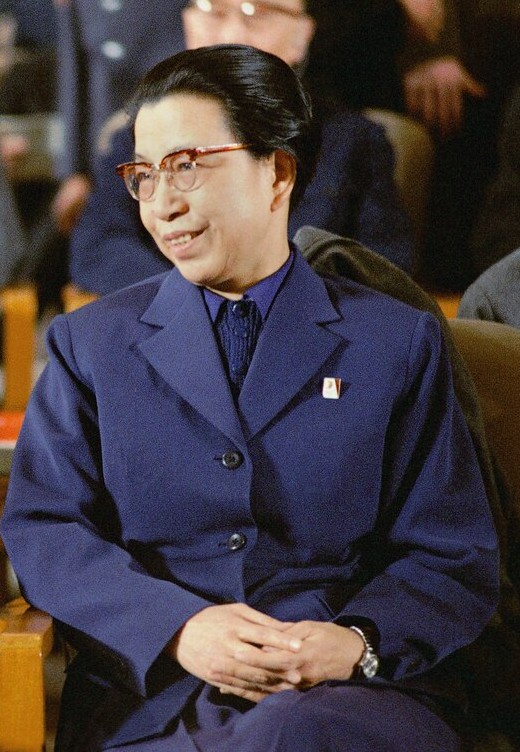
Photo: White House Photo Office (President Nixon), U.S. National Archives (via Digital Public Library of America), Public domain (U.S. federal government work) Jiang Qing
First Deputy Head of the Central Cultural Revolution Group; Politburo member from 1969 · 1966 to 1976
Jiang Qing: Read more
Mao's wife; supervised the "model operas" that dominated the stage and shaped the arts and press through the Group, sat on the Politburo from April 1969, and was arrested on 6 October 1976.
In their words
“I am a sort of roving sentry in the field of culture and education. What I have been doing is to subscribe to some magazines and newspapers, to leaf through them, and to pick out materials which I think noteworthy, including positive and negative materials. I finally submit them to Chairman Mao for reference.”
“After I saw the movie last evening, I felt uneasy. Is it possible for you to make some supplementary filming? If it is shown in the whole country as it is now, those workers, peasants and soldiers who have not seen these operas before would not be able to understand them; for they, unlike us, are not familiar with these operas.”
“Our operatic stage is occupied by emperors princes, generals, ministers, scholars, and beauties, and, on top of these, ghosts and monsters.”
“there are over 600 million workers, peasants, and soldiers in our country, whereas there is only a handful of landlords, rich peasants, counterrevolutionaries, bad elements, Rightists, and bourgeois elements. Shall we serve this handful, or the 600 million?”
“Comrades, I am not in favor of armed struggle, and you must not think that I like it, because I am firmly opposed to it. I resolutely support Chairman Mao's call for "peaceful struggle, not armed struggle." What I mean is: when the class enemies attack us, how can we afford not to have an inch of iron in our hands?”
All 8 quotes from Jiang Qing, and 1 often attributed but not verified
In the archive: The Gang of Four: arrest, denunciation and a trial that closed the Cultural Revolution's books (1976-1981)
No public-domain or openly licensed portrait found. Nearest: source, CC BY-SA 4.0, an image made by a Commons user in 2023, not a period photograph. Kang Sheng
Adviser to the Central Cultural Revolution Group; member of the Politburo Standing Committee · 1966 to 1975
Kang Sheng: Read more
Had headed the Party's Central Social Affairs Department, its security and intelligence arm, in the 1930s and 1940s; became adviser to the Group in 1966, sat on the Politburo Standing Committee from 1966, and died on 16 December 1975.
In their words
“Not spears. We now have the machine guns.”
“To be fair, you of the good group had also sent someone to collect material, as the Fart Faction had done.”
“They wish to control the movement all over the country.”
In the archive: The Yan'an Rectification Movement: doctrine, self-criticism and the Rescue Campaign (1942-1945)
No public-domain or openly licensed portrait found; no usable file on Commons. Zhang Chunqiao
Chairman of the Shanghai Revolutionary Committee; Vice-Premier · 1967 to 1976
Zhang Chunqiao: Read more
Led Shanghai's municipal government from February 1967, sat on the Politburo Standing Committee from 1973, became a Vice-Premier in 1975, and was arrested on 6 October 1976.
In their words
“Historical experience shows us that whether the proletariat can triumph over the bourgeoisie and whether China will turn revisionist hinges on whether we can persevere in exercising all-round dictatorship over the bourgeoisie in all spheres and at all stages of development in the revolution.”
“It is imperative to exercise all-round dictatorship over the bourgeoisie, and it is absolutely impermissible to give it up halfway.”
“It’s dangerous to stop half-way! The bourgeoisie is beckoning to you.”
In the archive: The Gang of Four: arrest, denunciation and a trial that closed the Cultural Revolution's books (1976-1981)
No public-domain or openly licensed portrait found. Nearest: source, a 1960s photograph whose publication and US copyright status could not be verified. Yao Wenyuan
Member of the Central Cultural Revolution Group; Politburo member from 1969 · 1966 to 1976
Yao Wenyuan: Read more
Wrote the November 1965 Shanghai article attacking a play about the Ming official Hai Rui, which opened the movement, sat in the Group and, from 1969, on the Politburo, and was arrested on 6 October 1976.
In their words
“We are of the opinion that the Dismissal of Hai Jui is not a fragrant flower but a poisonous weed.”
“What sort of thought was provoked? Was it not the thought that would pave the way for reversing the previous decisions on the Right opportunists and other anti-Party elements? Was it not the thought that would release monsters to attack socialism and the dictatorship of the proletariat?”
“It is essential for the workers and People's Liberation Army fighters to go to those places where intellectuals are concentrated, be they schools or other units, to smash the complete domination by intellectuals [...]”
In the archive: The Gang of Four: arrest, denunciation and a trial that closed the Cultural Revolution's books (1976-1981)
No public-domain or openly licensed portrait found. Nearest: source, tagged CC0 as the uploader's own work, but it is dated 1973 and its permission record is still pending, so it was not used. Wang Hongwen
Vice-Chairman of the CCP Central Committee · 1973 to 1976
Wang Hongwen: Read more
Led Shanghai's rebel workers in 1966 and 1967, was raised to the Party vice-chairmanship at the Tenth Congress in August 1973, and was arrested on 6 October 1976.
In their words
“Liu Shao-chi, Lin Piao and similar careerists, conspirators, double-dealers and absolutely unrepentant capitalist-roaders, though they manifested themselves in somewhat different ways, were all essentially the same; they were all chieftains in practising revisionism and thoroughly turned bourgeois ideologically, politically and in their way of life. They were rotten to the core!”
“The working class, the poor and lower-middle peasants and the masses of working people are the masters of our country. They have the right to exercise revolutionary supervision over cadres of all ranks of our Party and state organs.”
“In handling problems among the people, Party discipline absolutely forbids such wrong practices as resorting to "suppression if unable to persuade, and arrest if unable to sup-press."”
In the archive: The Gang of Four: arrest, denunciation and a trial that closed the Cultural Revolution's books (1976-1981)