Victor Emmanuel III
Illustration, not an archive object
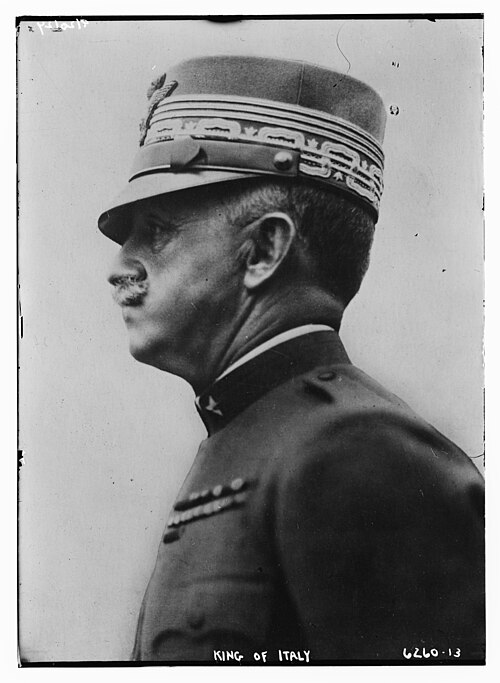

King of Italy · Italy
On the regime page: Fascist Italy under Mussolini
3 quotes, oldest first. Filter with other speakers.
“Soldiers of the army and navy: The solemn hour of national vindication has arrived. Following the example of my ancestors, I assume today the supreme command of the army and navy; with the assurance of faith and victory that your valor, your self-abnegation, and your discipline will know how to accomplish. The enemy you are preparing to combat is well equipped and a worthy adversary. Favored by location and by learned military tactics, he will oppose you with tenacious resistance, but your indomitable buoyancy will lead you to victory. Soldiers! To you will belong the glory of planting the flag of Italy upon the sacred confines which nature placed as the boundaries of our country. To you will belong the glory of finally finishing the work begun by our forefathers, with so much heroism.”
Original (Italian)
Soldati di terra e di mare! L'ora solenne delle rivendicazioni nazionali è suonata. Seguendo l'esempio del mio Grande Avo, assumo oggi il comando supremo delle forze di terra e di mare, con sicura fede nella vittoria che il vostro valore, la vostra abnegazione, la vostra disciplina sapranno conseguire. Il nemico che vi accingete a combattere è agguerrito e degno di voi. Favorito dal terreno e dai sapienti apprestamenti dell'arte, egli vi opporrà tenace resistenza, ma il vostro indomito slancio saprà, di certo, superarla. Soldati, a voi la gloria di piantare il tricolore d'Italia sui terreni sacri che natura pose ai confini della Patria nostra, a voi la gloria di compiere, finalmente, l'opera con tanto eroismo iniziata dai nostri padri.
English: Luigi Carnovale (the English half of the bilingual volume; the book does not say who translated the order), in Why Italy Entered Into the Great War (Italian-American Publishing Company, Chicago, 1917)
Italy had declared war on Austria-Hungary on 24 May 1915. The King issued the order to the armed forces as he assumed the supreme command.
Order of the day of King Victor Emmanuel III on taking the supreme command of the army and navy, General Headquarters, 26 May 1915, in Luigi Carnovale, Why Italy Entered Into the Great War / Perchè l'Italia è entrata nella guerra (Italian-American Publishing Company, Chicago, 1917), English p. 230, Italian p. 567 Source
“Italians, from today I have assumed command of all armed forces. In the solemn hour which has occurred in the destinies of our country each must take up again his post of duty and of fighting. No deviation must be tolerated, no recriminations must be allowed. We must stand against those who have wounded the sacred soil of Italy. Italy, by the valor of its armed forces and the determination of all its citizens, will find again a way of recovery. Italians! I feel myself more than ever indissolubly united with you in the unshakable belief in the immortality of the fatherland.”
Original (Italian)
Italiani! Assumo da oggi il comando di tutte le Forze Armate. Nell'ora solenne che incombe sui destini della Patria ognuno riprenda il suo posto di dovere, di fede e di combattimento: nessuna deviazione deve essere tollerata, nessuna recriminazione può essere consentita. Ogni italiano si inchini dinanz alle gravi ferite che hanno lacerato il sacro suolo della Patria. L'Italia, per il valore delle sue Forze Armate, per la decisa volontà di tutti i cittadini, ritroverà nel rispetto delle istituzioni che ne hanno sempre confortata l'ascesa, la via della riscossa. Italiani! Sono oggi più che mai indissolubilmente unito a Voi dall'incrollabile fede nell'immortalità della Patria.
English: Unnamed wire-service translation of the radio text, as printed in The Commercial and Financial Chronicle, 29 July 1943
On 25 July 1943, the day after the Grand Council of Fascism voted against Mussolini, the King accepted his resignation, named Marshal Badoglio head of government and took command of the armed forces. The proclamation was broadcast that evening.
Proclamation of King Victor Emmanuel III to the Italians, countersigned by Badoglio, broadcast 25 July 1943. Italian text: Radiocorriere, no. 31 (31 July 1943), p. 3 of the scan, "Storico evento: il proclama del Re". English: The Commercial and Financial Chronicle (New York), 29 July 1943, "The King's Proclamation" Source
“My dear Duce, it's no longer any good. Italy has gone to bits. Army morale is at rock bottom. The soldiers don't want to fight any more. The Alpine regiments are singing a song which says they don't want to make war on Mussolini's account any longer. [...] The Grand Council's vote is terrific - nineteen votes for Grandi's motion and among them four holders of the Order of the Annunciation. You can certainly be under no illusion as to Italy's feelings with regard to yourself. At this moment you are the most hated man in Italy. You can no longer count on more than one friend. You have one friend left you, and I am he. That is why I tell you that you need have no fears for your personal safety, for which I will ensure protection. I have been thinking the man for the job now is Marshal Badoglio. He will start by forming a government of experts for purely administrative purposes and for the continuation of the war. In six months' time we shall see. All Rome already knows about the Grand Council's resolution, and they are all expecting a change.”
English: Frances Lobb, in Benito Mussolini, Memoirs 1942-1943 (George Weidenfeld and Nicolson, London, 1949). Original-language text not found.
Mussolini went to the King on the afternoon of 25 July 1943, the day after the Grand Council voted for Dino Grandi's motion, and was dismissed and arrested after the meeting. The only account of the words in this form is Mussolini's own, written afterwards.
Words attributed to King Victor Emmanuel III at his meeting with Mussolini at the Villa Savoia, 25 July 1943, as recalled by Mussolini in his Memoirs 1942-1943, translated by Frances Lobb, ed. Raymond Klibansky (Weidenfeld and Nicolson, London, 1949), p. 81 Source
This is Mussolini's reconstruction of a private conversation; there was no stenographer, and the King's own account and those of his aides were not consulted for this entry. The [...] replaces the parenthesis in Mussolini's text "(The King repeated the verses of the song in Piedmontese dialect.)". OCR errors in the scan (for example "neoi" for "need") were repaired. The memoir was first published in Italy in 1944; the 1949 English edition carries editorial notes.