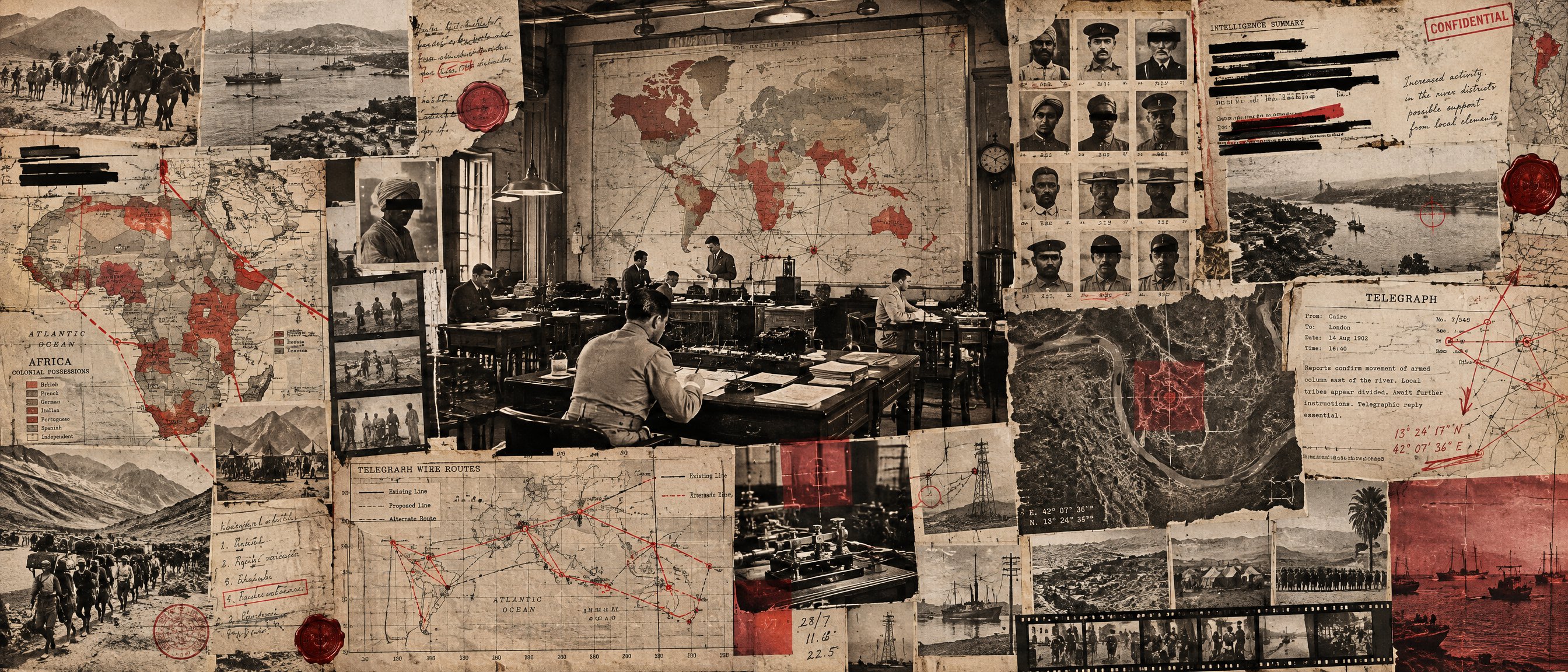
In one line: a British Labour MP's 1928 catalogue of false or unproven stories circulated during the First World War, mostly on the Allied side, which shaped interwar distrust of atrocity reports and later inspired Anne Morelli's ten "principles of war propaganda".
The source
- Citation: Arthur Ponsonby, Falsehood in War-Time: Containing an Assortment of Lies Circulated Throughout the Nations During the Great War (London: George Allen & Unwin, 1928).
- Author: Arthur Ponsonby (1871-1946), son of Sir Henry Ponsonby, private secretary to Queen Victoria; Liberal MP during the war, a founder of the Union of Democratic Control in 1914, Labour MP for Sheffield Brightside from 1922, later a Labour peer as Baron Ponsonby of Shulbrede.
- Language: English.
- Rights status on this archive: published in 1928 and in the public domain in the US; quoted directly where the wording was checked.
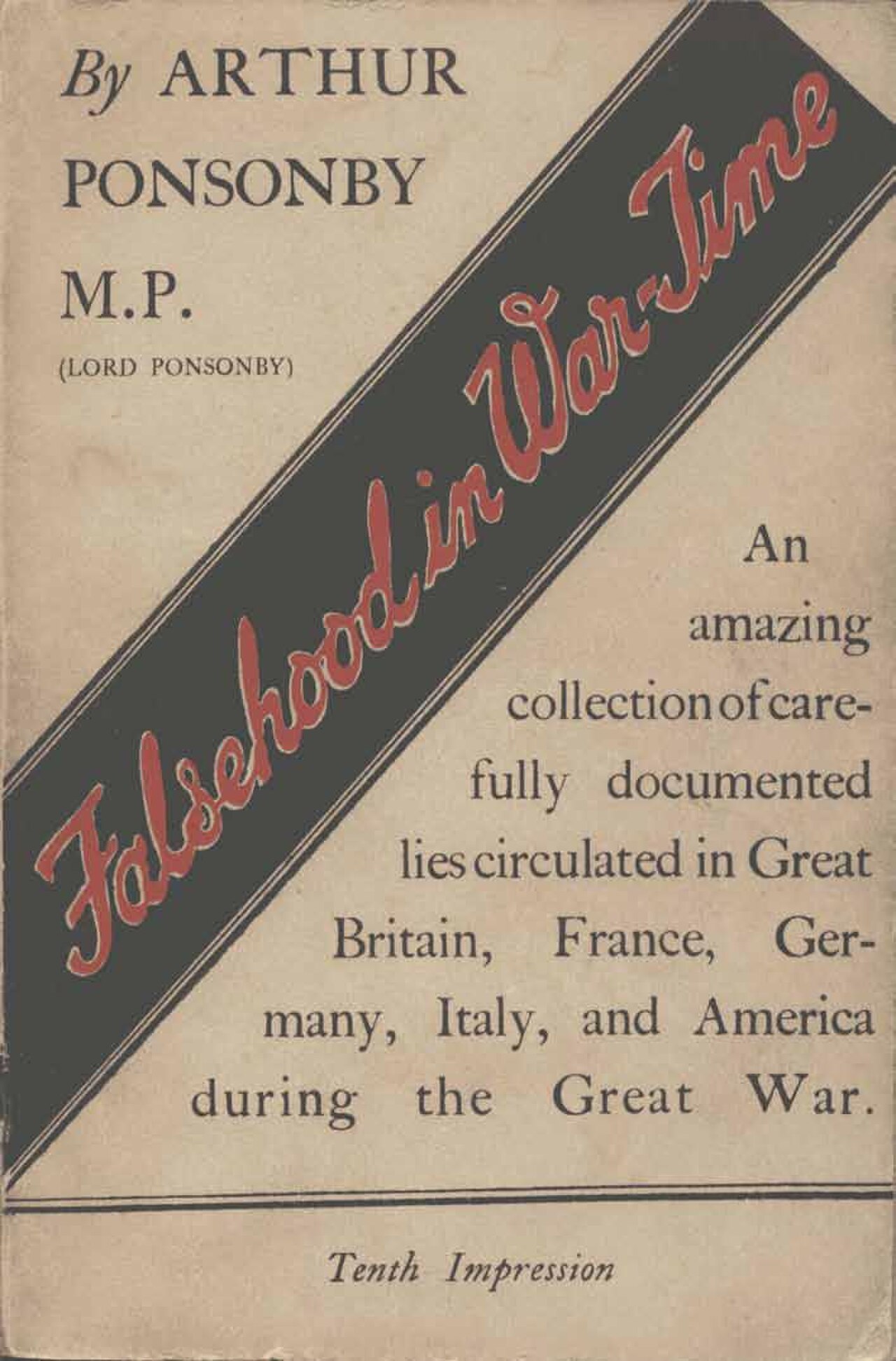
Front cover of the tenth impression of Arthur Ponsonby, Falsehood in War-Time (London: George Allen & Unwin, 1928). Scan via Wikimedia Commons, public domain (PD-old-70).
Context
Ponsonby opposed British entry into the war in August 1914 and helped found the Union of Democratic Control, which campaigned for parliamentary oversight of foreign policy and a negotiated peace. He was a pacifist, and his book is an argument as well as a record: he held that wars cannot be fought without lying to the public, and he wrote it partly to make the next war harder to sell.
The book arrived in a decade of postwar revelations. In 1925 a New York newspaper report quoted Brigadier General John Charteris, formerly head of intelligence at British GHQ in France, as saying he had helped invent the "corpse factory" story; Charteris denied the report, and in December 1925 Foreign Secretary Austen Chamberlain issued a statement accepting that there was no truth in the story. Harold Lasswell's Propaganda Technique in the World War appeared in 1927 (see Harold D. Lasswell, Propaganda Technique in the World War (1927)).
The most prominent British official account of German conduct was the Report of the Committee on Alleged German Outrages (the Bryce Report), chaired by Viscount Bryce and published on 12 May 1915. It named none of its witnesses and published extracts of depositions, some describing mutilations and rapes with no corroborating evidence; one committee member, Harold Cox, pressed for witnesses to be re-interviewed. The report's status in the 1920s is part of the background to Ponsonby's book.
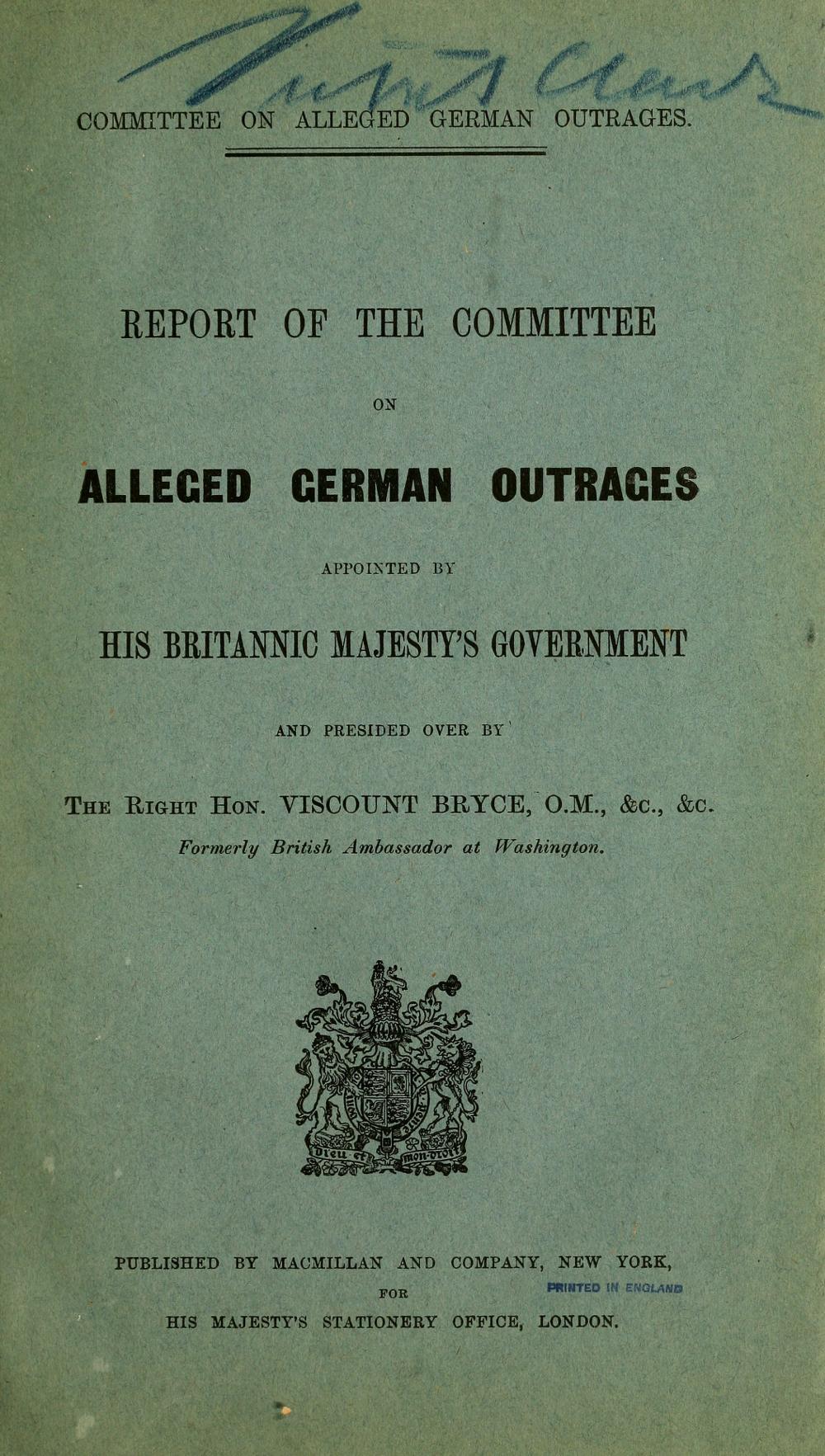
Cover of the Report of the Committee on Alleged German Outrages (Bryce Report), published by Macmillan and Company, New York, for His Majesty's Stationery Office, London, 1915. Library of Congress, General Collections. Public domain.
What it says
Lying as a standard weapon of every belligerent. The book opens: "Falsehood is a recognized and extremely useful weapon in warfare, and every country uses it quite deliberately to deceive its own people, to attract neutrals, and to mislead the enemy." The title page carries the epigraph "When war is declared, Truth is the first casualty", in quotation marks and not claimed as Ponsonby's own; the line is often attributed to US Senator Hiram Johnson in 1917, an attribution discussed by Quote Investigator (2020).
Case files, not theory. The body of the book is a sequence of short chapters, each on one story, with the original claim, how it spread, and the evidence against it. Titles include "Germany's Sole Responsibility for the War", "The Criminal Kaiser", "The Belgian Baby Without Hands", "The Crucified Canadian", "The Corpse Factory", "The Lusitania", "Faked Photographs", "The Doctoring of Official Papers" and "The Manufacture of News".
Atrocity stories. Ponsonby treats stories such as the Belgian child with severed hands and the mutilated nurse as unproven or false. On the crucified Canadian, accounts said a Canadian soldier had been crucified by German troops near Ypres in April 1915; the accounts conflicted, no body was recovered, and a 1915 inquiry by Canada's chief press censor, Ernest Chambers, found no proof. When Francis Derwent Wood's sculpture Canada's Golgotha (1918) depicted the scene, the German government complained during the 1919 peace negotiations and Canada could not supply evidence.
The corpse factory. On 17 April 1917 The Times and the Daily Mail, both owned by Lord Northcliffe, reported that Germany operated a Kadaververwertungsanstalt in which the bodies of its own soldiers were rendered for fats. The German installations processed animal carcasses. Ponsonby includes the story among his falsehoods; Neander notes that the British government declined to deny it during the war.
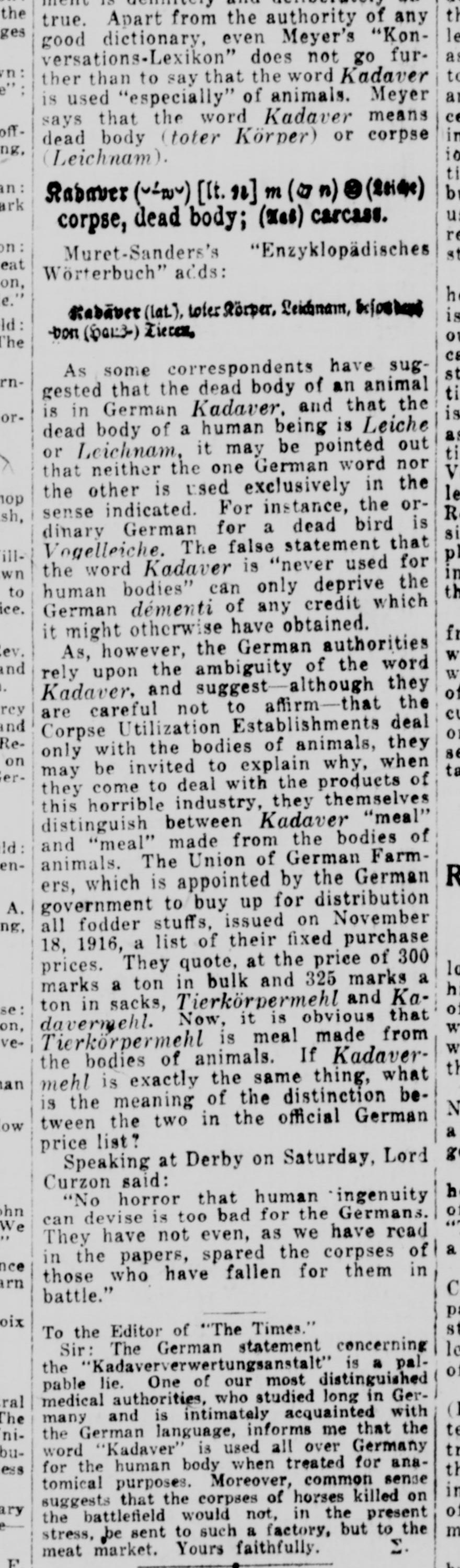
Column on the word "Kadaver" from "London Repeats Charge Germans Utilize Corpses", New-York Tribune, 12 May 1917, p. 8 (cropped). Library of Congress. Public domain.
Official documents and the question of war guilt. Chapters on the commitment to France, Serbia, the invasion of Belgium, "Germany's sole responsibility" and "The Doctoring of Official Papers" concern how the origins of the war were presented to the British public.
Other countries' lies. A closing section, "Foreign Lies", covers falsehoods circulated in Germany, France, the United States and Italy. Most of the book concerns British and Allied claims.
Scale. Ponsonby argues that there was more deliberate lying in the years 1914-1918 than in any earlier period of history.
Not a list of principles. The book contains no numbered list of rules. The "ten principles" often attributed to Ponsonby come from Anne Morelli's Principes élémentaires de propagande de guerre (Brussels: Labor, 2001), which systematises his material and applies it to later wars. Morelli's principles, paraphrased: we do not want war; the other side alone is responsible; the enemy is personified as a devil figure; we fight for a noble cause; the enemy commits atrocities on purpose; the enemy uses illegal weapons; our losses are small and theirs large; artists and intellectuals support us; our cause is sacred; those who question our propaganda are traitors. These are Morelli's formulation.
How it worked in practice
The book was a published critique rather than an apparatus, and its documented effects are on later belief:
- Interwar reception. It went through repeated printings; a tenth impression is dated June 1940.
- The effect on later atrocity reports. Joachim Neander and Randal Marlin argue that the discrediting of the corpse factory story contributed to disbelief when early reports of the Holocaust circulated.
- Morelli and after. Morelli applied her ten principles to the two world wars and to the conflicts in the Balkans, the Gulf, Kosovo, Afghanistan and Iraq; commentators have since applied them to other wars, including to Russian media coverage of the war in Ukraine (The Ukrainian Week, French edition).
Techniques in this archive's taxonomy
- Card stacking: the chapters "Faked Photographs" and "The Doctoring of Official Papers" document selection, recaptioning and omission. Charteris was reported (and then denied) to have swapped captions on photographs of German soldiers' bodies and of horse carcasses to support the corpse factory story.
- Name-calling: "The Criminal Kaiser" records the personal demonisation of Wilhelm II, which Morelli later generalised as the "devil figure" principle.
- Scapegoating: "Germany's Sole Responsibility for the War" records the placing of the whole blame for a war with many causes on one state; Ponsonby argues this was presented to the British public without the diplomatic record that complicated it.
Reception and criticism
- Contemporaries and interwar readers received the book as a corrective to wartime propaganda, and its epigraph became one of the most repeated lines about war and truth.
- Adrian Gregory records instances where Ponsonby charged the British press with inventing stories that came from rumour, soldiers' myths or German sources, and concludes that in the book "material from American isolationist sources, the British pacifist press and even from Germany is taken as truth, British official pronouncements and the British press are assumed to be lying" (The Last Great War, 2008).
- John Horne and Alan Kramer, working in Belgian, British, French, German and Italian archives, document that German troops killed about 6,500 Belgian and French civilians in the invasion of 1914, often in reprisals for resistance by francs-tireurs that German soldiers believed in but that did not exist. Their subtitle refers to the postwar denial of these killings, which they trace in German memory and also in Allied disillusionment with wartime atrocity propaganda (German Atrocities, 1914: A History of Denial, 2001).
- Trevor Wilson examined how the Bryce committee worked and how its evidence was handled (Journal of Contemporary History, 1979).
Same-standard note
German wartime propaganda used the same methods. The "Manifesto of the Ninety-Three" (4 October 1914), signed by leading German academics and artists, stated: "It is not true that our troops treated Louvain brutally", and denied German war guilt; a 1921 New York Times report quoted a German writer as saying that most of the signatories had come to regret signing. The German Foreign Office's White Book of 10 May 1915 on the "Belgian people's war" used testimony that historians, including Horne and Kramer, describe as manipulated to show that German reprisals answered civilian guerrilla attacks. Traffic also ran both ways: the Munich artist Karl Goetz's privately made 1915 medal on the Lusitania, with its mistaken date of 5 May, was copied in about 250,000 pieces by the British and sold as evidence of premeditation. Scale differed by case, and the 1914 killings in Belgium are documented while the corpse factory is not; each story is judged on its evidence.
Content note: German satirical medal showing a sinking passenger liner and Death selling tickets, made after the 1915 sinking that killed over 1,100 people. This object is shown as it was published. Why 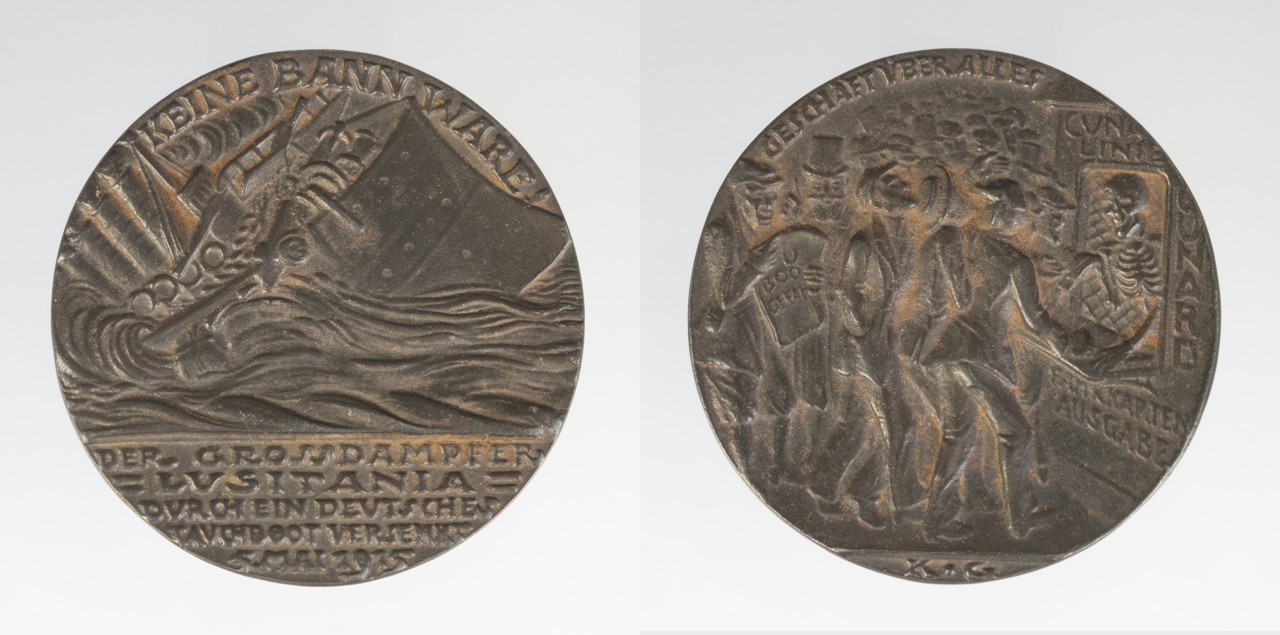
Obverse and reverse of Karl Goetz's Lusitania medal, Germany, 1915 (cast iron, 57.2 mm). Photographs: National Museum of Romanian History, Culturalia / Europeana, CC BY-SA 4.0; two images joined and reduced.
Sources
Full text in this archive: Falsehood in War-Time (1928) and the Bryce Report (1915).
- Arthur Ponsonby, Falsehood in War-Time: Containing an Assortment of Lies Circulated Throughout the Nations During the Great War (London: George Allen & Unwin, 1928). Text: WWI Resource Centre.
- Committee on Alleged German Outrages, Report of the Committee on Alleged German Outrages (London: HMSO, 1915). Text: firstworldwar.com.
- Anne Morelli, Principes élémentaires de propagande de guerre (Brussels: Labor, 2001).
- John Horne and Alan Kramer, German Atrocities, 1914: A History of Denial (New Haven: Yale University Press, 2001).
- Adrian Gregory, The Last Great War: British Society and the First World War (Cambridge: Cambridge University Press, 2008).
- Trevor Wilson, "Lord Bryce's Investigation into Alleged German Atrocities in Belgium, 1914-15", Journal of Contemporary History 14:3 (1979). SAGE.
- Joachim Neander and Randal Marlin, "Media and Propaganda: The Northcliffe Press and the Corpse Factory Story of World War I", Global Media Journal: Canadian Edition 3:2 (2010): 67-82.
- Joachim Neander, The German Corpse Factory: The Master Hoax of British Propaganda in the First World War (Saarbrücken: universaar, 2013).
- "An die Kulturwelt!" (Manifesto of the Ninety-Three), 4 October 1914. German History in Documents and Images.
- Auswärtiges Amt, Die völkerrechtswidrige Führung des belgischen Volkskriegs (Berlin, 1915); English translation The German Army in Belgium: The White Book of May 1915. Project Gutenberg.
- Imperial War Museums, "How a WW1 German Medallion Became a British Propaganda Tool". IWM.
- Quote Investigator, "Truth Is the First Casualty in War", 11 April 2020. Quote Investigator.