Content note. This page quotes official racial classification terms ("European and non-European races", "white race group") and official labels applied to people and publications, as evidence. It also refers to the death of Steve Biko in police custody.
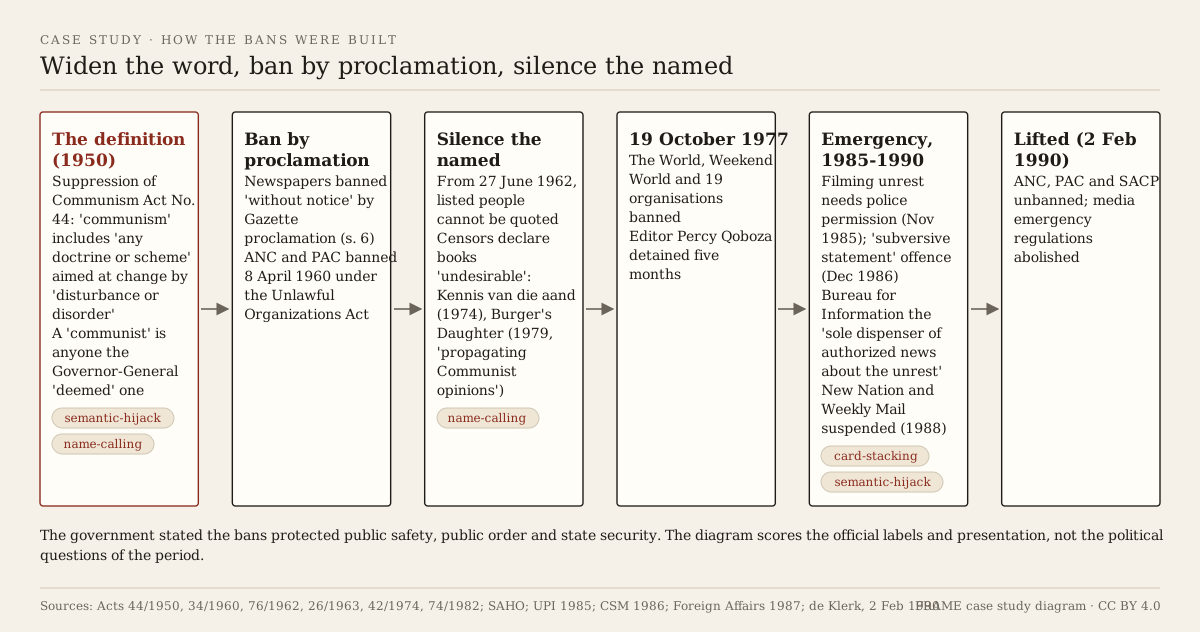
In one line: from 1950 South African law defined "communism" to include any doctrine aimed at change through "disturbance or disorder", let officials ban organisations, newspapers and people by proclamation "without notice", made it an offence to quote banned people, and from 1963 ran censorship boards that declared books and films "undesirable"; the bans were lifted from February 1990.
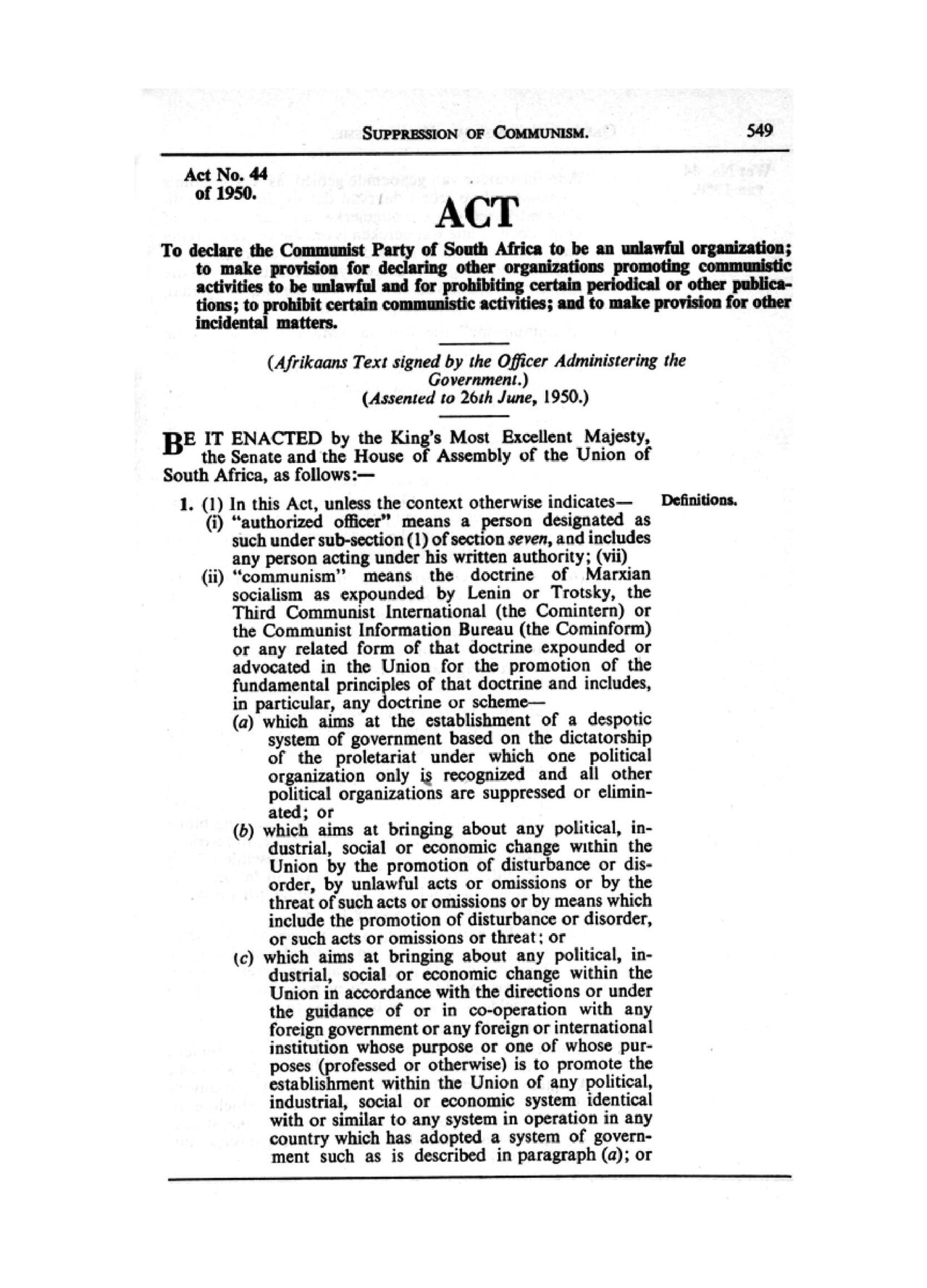
First page of the Suppression of Communism Act, No. 44 of 1950 (assented to 26 June 1950), Statutes of the Union of South Africa. Parliament of South Africa. Public domain (official legislative text).
What happened
The statutes
- 26 June 1950. The Suppression of Communism Act, No. 44 of 1950, is assented to. Its long title begins "To declare the Communist Party of South Africa to be an unlawful organization". Section 1 defines "communism" as Marxian socialism as expounded by Lenin or Trotsky, the Comintern or the Cominform, "and includes, in particular, any doctrine or scheme" which aims, among other things:
- "(b) ... at bringing about any political, industrial, social or economic change within the Union by the promotion of disturbance or disorder, by unlawful acts or omissions or by the threat of such acts or omissions";
- "(d) ... at the encouragement of feelings of hostility between the European and non-European races of the Union" where the consequences are calculated to further (a) or (b).
- Who is a "communist". A person the Governor-General "deemed ... to be a communist" for "advocating, advising, defending or encouraging" any of those objects, after "a reasonable opportunity of making such representations". People named this way came to be called "statutory communists".
- Publications. Section 6 lets the Governor-General, if "satisfied" that a periodical furthers "any of the objects of communism", "without notice to any person concerned, by proclamation in the Gazette prohibit the printing, publication or dissemination" of it.
- 7-8 April 1960. After the Sharpeville shootings of 21 March, the Unlawful Organizations Act, No. 34 of 1960, lets the Governor-General, if "satisfied that the safety of the public or the maintenance of public order is seriously threatened", declare the Pan Africanist Congress and the African National Congress unlawful "without notice to the body concerned". Both are banned on 8 April.
- 27 June 1962. The General Law Amendment Act, No. 76 of 1962, makes it an offence to print, publish or disseminate any speech, utterance, writing or statement of a person on the Act's lists or under an order barring them from gatherings, without the Minister's consent or except in court proceedings. From then on banned people could not be quoted in South African publications.
- 1963. The Publications and Entertainments Act, No. 26 of 1963, creates the Publications Control Board to declare publications and films "undesirable". Its publication decisions can be appealed to the Supreme Court.
- 9 October 1974. The Publications Act, No. 42 of 1974 (in force 1 April 1975), replaces the Board with a Directorate of Publications, publications committees and a Publications Appeal Board. Section 47(2) deems a publication "undesirable" if it or any part of it "(a) is indecent or obscene or is offensive or harmful to public morals; (b) is blasphemous or is offensive to the religious convictions or feelings of any section of the inhabitants of the Republic; (c) brings any section of the inhabitants of the Republic into ridicule or contempt; (d) is harmful to the relations between any sections of the inhabitants of the Republic; (e) is prejudicial to the safety of the State, the general welfare or the peace and good order". The appeal to the Supreme Court on the merits is not carried over.
- 1976 and 1982. The 1950 Act is renamed the Internal Security Act in 1976. The Internal Security Act, No. 74 of 1982 (Government Gazette No. 8232, 9 June 1982), follows the Rabie Commission and consolidates the 1950 and 1960 Acts with other security laws, keeping powers to ban organisations, publications, gatherings and people and to detain without trial.
Books
- 29 January 1974. André Brink's Afrikaans novel Kennis van die aand (1973) is declared "undesirable" under the 1963 Act, the first Afrikaans literary work banned. One story line is a relationship between a Coloured man and a white woman, then illegal. The Cape Provincial Division of the Supreme Court dismisses Brink's and his publisher's appeal on 1 October 1974. Brink publishes his own translation abroad as Looking on Darkness.
- 5 July 1979. Nadine Gordimer's Burger's Daughter is banned from import and sale a month after its London publication. The reasons given include "propagating Communist opinions" and "creating a psychosis of revolution and rebellion". In October 1979 the Publications Appeal Board, advised by literary experts and a state security specialist, lifts the ban. Gordimer, John Dugard and others document both decisions in What Happened to Burger's Daughter or How South African Censorship Works (1980).
19 October 1977 ("Black Wednesday")
- 12 September 1977. Steve Biko, a founder of the Black Consciousness Movement, dies in police custody. On 14 September the Minister of Justice, Jimmy Kruger, tells a National Party congress: "I am not glad and I am not sorry about Mr. Biko. It leaves me cold (Dit laat my koud)."
- 19 October 1977. Under the Internal Security Act the government bans The World and Weekend World, Johannesburg newspapers written for black readers, and 19 organisations, most of them Black Consciousness groups, together with the Christian Institute of Southern Africa. Its director Beyers Naudé and the Daily Dispatch editor Donald Woods receive banning orders. Percy Qoboza, editor of The World, is detained under section 10 of the Act and held for five months in Modderbee Prison.
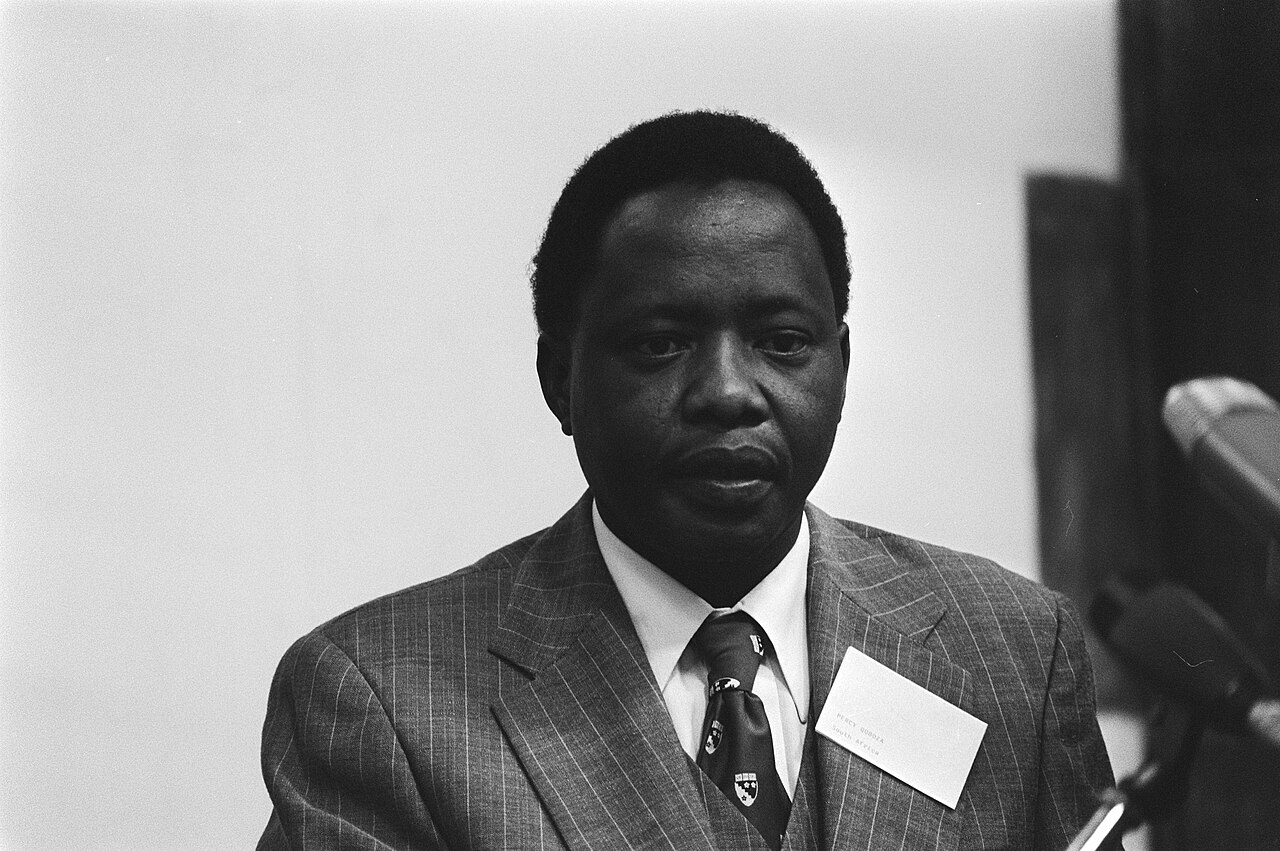
Percy Qoboza at the 31st congress of the International Federation of Newspaper Publishers (FIEJ), opened by Prince Claus, the Netherlands, 23 May 1978, after his release. Photo by Bert Verhoeff for Anefo, Nationaal Archief. CC0.
States of emergency, 1985-1990
- 21 July 1985. A state of emergency is declared in 36 magisterial districts. On 2 November 1985 regulations bar television, radio and still photographers from covering unrest in emergency areas, and print reporters from entering them, without police permission.
- 12 June 1986. A nationwide state of emergency is declared. Media regulations restrict reporting on "security action". From December 1986 it is an offence to make, publish or possess a "subversive statement", defined to cover, among other things, calls for sanctions or disinvestment and statements discrediting compulsory military service (Christian Science Monitor, 12 December 1986). A government Bureau for Information becomes, in Foreign Affairs' words, "the sole dispenser of authorized news about the unrest".
- 1988. In March the Minister of Home Affairs, Stoffel Botha, suspends New Nation, the Catholic bishops-backed weekly edited by Zwelakhe Sisulu, for three months (to 10 June), the first alternative newspaper suspended under the emergency. South is also suspended, and 26 English-language editors petition the government against the curbs. Late in the year the Weekly Mail, edited by Anton Harber and Irwin Manoim, is shut for a month.
The end
- 2 February 1990. State President F. W. de Klerk tells Parliament that "the prohibition of the African National Congress, the Pan Africanist Congress, the South African Communist Party and a number of subsidiary organisations is being rescinded", that restrictions on 33 organisations are lifted, and that "the media emergency regulations ... are being abolished in their entirety".
- 1996. The Films and Publications Act, No. 65 of 1996, replaces the Publications Act. South Africa now marks 19 October as National Press Freedom Day.
How it works
Censorship is not itself a technique id in FRAME's taxonomy; the tags below describe the official language and presentation that came with the bans.
- Semantic hijacking: the 1950 Act takes a word with a specific political meaning and widens it by definition. Paragraph (b) covers "any" doctrine aimed at change by "disturbance or disorder" or "unlawful acts or omissions"; as written, it needs no link to Marxism, Lenin or the Comintern. Paragraph (d) brings in "feelings of hostility between the European and non-European races". The 1986 "subversive statement" widened a second word in the same way, to cover calls for sanctions and criticism of conscription.
- Name-calling: the widened label is then attached to people and books. A person became a "communist" in law because the Governor-General "deemed" them one; "statutory communist" records that the label came from the statute. The reasons for banning Burger's Daughter apply the same label to a novel ("propagating Communist opinions"), and the Appeal Board lifted the ban within three months.
- Card stacking: under the emergencies, independent pictures and reports of "unrest" and "security action" were barred or needed police permission, while a government bureau issued the authorised account. What readers could lawfully see was the selection the government made. The fit is structural; it is not a finding that any particular official figure was false.
What joins these is the "without notice" wording in the 1950 and 1960 Acts and the 1962 ban on quoting listed people: once a person or group was named, their own account could not be printed in the country, so the official label was the one South African readers met.
Then and now
The sibling case China's Great Firewall and the June Fourth anniversary records a later use of security law against a civic organisation: in 2021 Hong Kong Alliance leaders were charged under the National Security Law with inciting subversion, and its members voted to dissolve the group. Both governments used a security statute against an organisation defined by its political aims. The differences:
- Process. South Africa's Acts let the Governor-General or a minister ban an organisation or newspaper by proclamation, with no trial. The Alliance's leaders were charged in court, and the dissolution was a members' vote.
- Racial basis. South Africa's bans operated inside a legal order of racial classification, visible in the 1950 Act's wording and in signs like the one below. The Hong Kong case has no racial classification element.
- Scale and duration. The South African system ran for four decades across organisations, newspapers, books, films and individual banning orders. The June Fourth case concerns one anniversary and the groups and platforms tied to it.
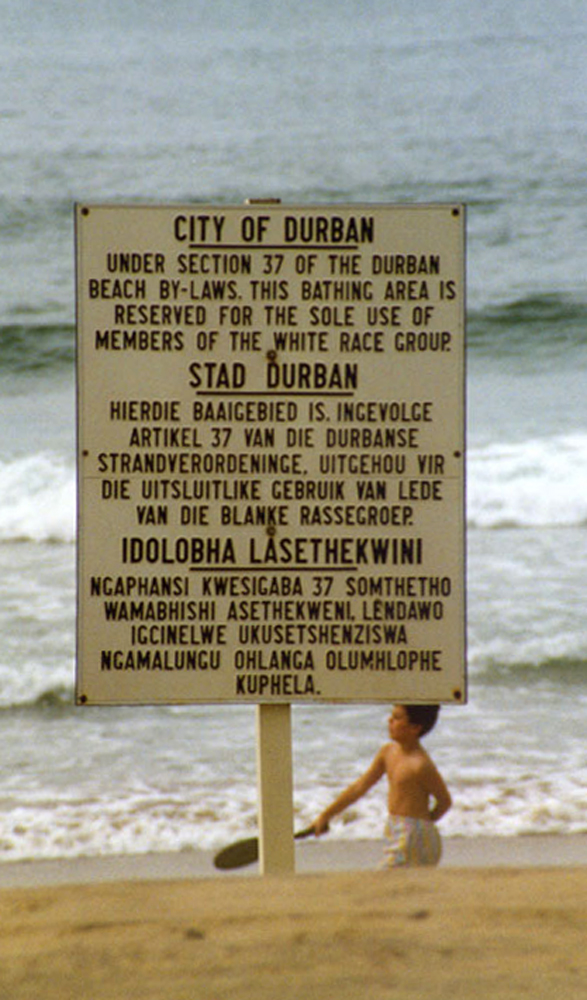
Sign on a Durban beach, 1989, reserving it for "members of the white race group" under section 37 of the city's beach by-laws. Photo by Guinnog. CC BY-SA 3.0.
Positions on the record
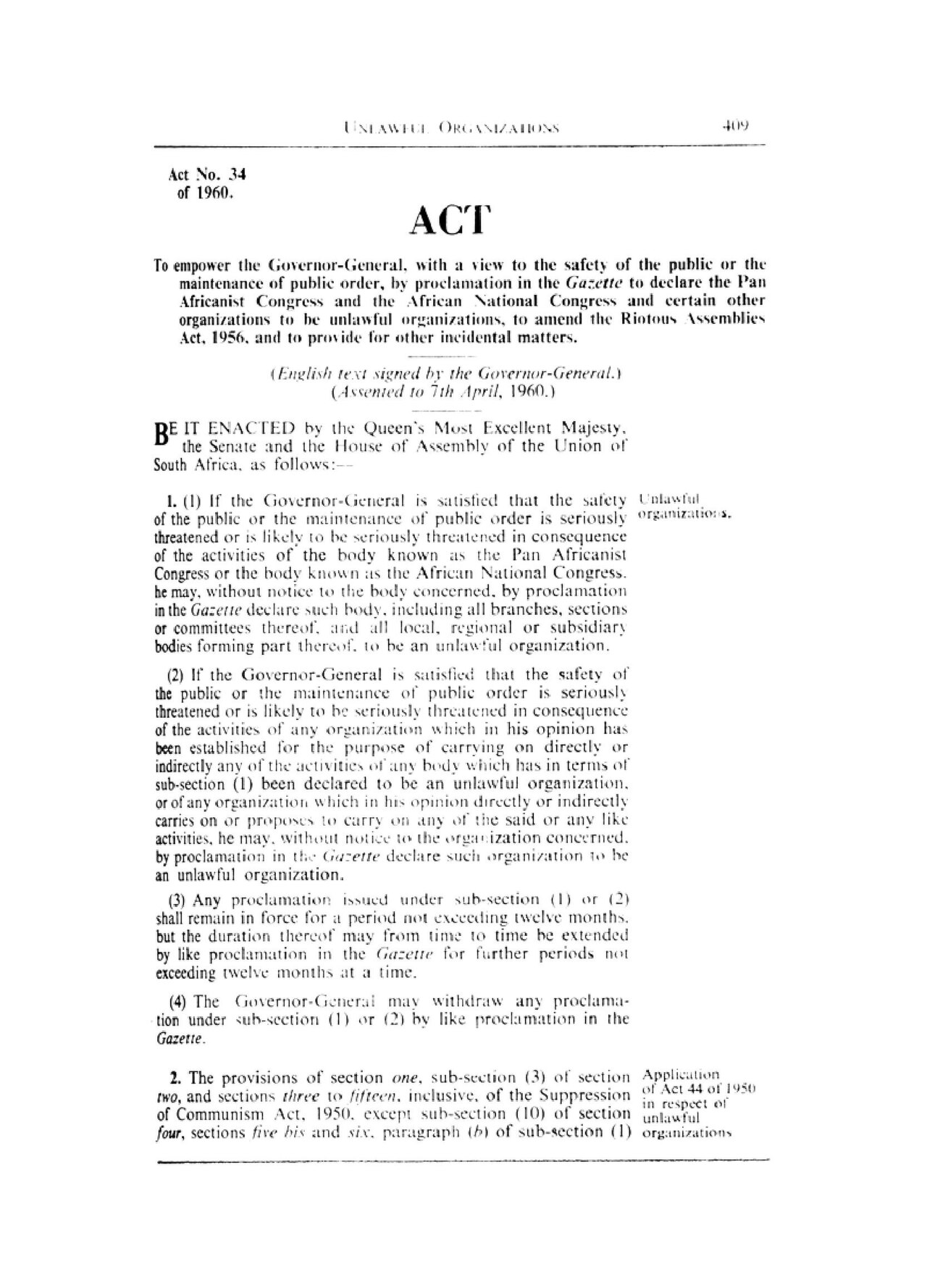
Unlawful Organizations Act, No. 34 of 1960 (assented to 7 April 1960), first page. Parliament of South Africa. Public domain (official legislative text).
- The South African government's stated position. The 1950 Act presents itself as suppressing communism and "communistic activities". The 1960 Act says its powers are exercised "with a view to the safety of the public or the maintenance of public order". On 19 October 1977 Kruger said the government's "factual investigation has shown beyond doubt that [the newspapers] were endangering law and order". In November 1985 the Minister of Law and Order, Louis le Grange, said the presence of cameras was fostering violence in the townships (as reported by UPI). The Publications Act presents its categories as protecting morals, religious feeling, relations between population groups and state security.
- Critics' position. Editors, writers and lawyers, including Qoboza, Gordimer, Brink and Dugard, said the laws were used against political opposition to apartheid, especially black political organisations and the black press, and that the "communist" label reached people and books outside communism as commonly understood. The literary experts advising the Appeal Board on Burger's Daughter accused the original censors of "bias, prejudice, and literary incompetence".
- This archive's reading. The statutes, the bannings, the 1977 detentions and the 1988 suspensions are documented in the statute book, the Gazette and contemporaneous reporting. The government's reasons are documented as statements; the evidence behind the 1977 "factual investigation" was not published and is not shown. This page does not rule on the political questions of the period.
Same-method test
Other governments have banned or restricted organisations on security grounds, often naming communism. Scored by the same definitions:
- United States, Internal Security Act of 1950. Passed over President Truman's veto on 23 September 1950, it set up a Subversive Activities Control Board to order "Communist-action organizations" to register. The Board ordered the Communist Party of the United States to register in 1953; the Supreme Court upheld the order in Communist Party v. Subversive Activities Control Board, 367 U.S. 1 (1961), and in Albertson v. SACB, 382 U.S. 70 (1965), held that compelling members to register violated the privilege against self-incrimination. The statutory label is scored as name-calling here too.
- United States, Smith Act (1940). Communist Party leaders' convictions for conspiring to advocate the violent overthrow of the government were upheld in Dennis v. United States, 341 U.S. 494 (1951); Yates v. United States, 354 U.S. 298 (1957), limited the Act to advocacy of action rather than abstract doctrine.
- West Germany, 1956. The Federal Constitutional Court banned the Communist Party of Germany (KPD) on 17 August 1956, on the federal government's application.
The differences are plain. In the US and West German cases, bans and penalties went through hearings, jury trials or a constitutional court, and courts narrowed them. South Africa's laws let officials ban organisations, newspapers and people by proclamation "without notice", made quoting a banned person an offence, and from 1975 removed the court appeal against publication bans. The South African system also rested on racial classification: its definition of "communism" names "European and non-European races", and it was enacted by a Parliament whose common voters' roll excluded black South Africans. No count of banned publications or persons is fixed here. Any government that widens a stigmatised word by statute and applies it to its opponents is scored the same way.
How to spot it
- Read a statute's definitions, not just its title. An "includes, in particular" clause can stretch a narrow label over a much wider group.
- Check who applies the label and how: a court after a hearing, or an official who is "satisfied" and acts "without notice".
- When a person or group cannot be quoted, look for their own account and compare it with the official one.
- When one official body is the only authorised source in an emergency, treat its figures as one source among those that can be recovered later.
Images
| Image | Source | Licence |
|---|---|---|
| Mechanism diagram (above) | Drawn for FRAME from this page's sourced facts (make_diagrams.py) |
CC BY 4.0, FRAME |
| Suppression of Communism Act 1950, first page | Wikimedia Commons, Parliament of South Africa, via Statutes of the Union of South Africa (UKZN) | Public domain (official legislative text) |
| Percy Qoboza, 23 May 1978 | Wikimedia Commons, Bert Verhoeff / Anefo, Nationaal Archief | CC0 |
| Durban beach sign, 1989 | Wikimedia Commons, Guinnog | CC BY-SA 3.0 |
| Unlawful Organizations Act 1960, first page | Wikimedia Commons, Parliament of South Africa, via Statutes of the Union of South Africa (UKZN) | Public domain (official legislative text) |
,_Bestanddeelnr_929-7355.jpg)

Image gaps
- Front pages of The World (October 1977), New Nation and the Weekly Mail (1988). Not openly licensed.
- Photographs of Steve Biko and of the 1985-1986 unrest. None found on Commons with a clear US licence status.
- Ernest Cole's photograph of "white" and "non-white" entrance signs. Public domain in South Africa per Commons, but US status unclear.
- The Gazette proclamations of 8 April 1960 and 19 October 1977, and the Publications Act 1974. Public domain as official texts, but no scan on Commons and South African archive sites were unreachable from the build environment. This gap can be filled.
- Covers of Burger's Daughter and Kennis van die aand. Copyrighted.
Sources
- Suppression of Communism Act, No. 44 of 1950 (assented to 26 June 1950), Statutes of the Union of South Africa 1950, pp. 549-561; scan on Wikimedia Commons.
- Unlawful Organizations Act, No. 34 of 1960 (assented to 7 April 1960), Statutes of the Union of South Africa 1960, p. 409; scan on Wikimedia Commons.
- General Law Amendment Act, No. 76 of 1962 (amending the 1950 Act from 27 June 1962).
- Publications and Entertainments Act, No. 26 of 1963.
- Publications Act, No. 42 of 1974, section 47(2).
- Internal Security Act, No. 74 of 1982, Government Gazette No. 8232, 9 June 1982; scan on Wikimedia Commons.
- Films and Publications Act, No. 65 of 1996.
- Nadine Gordimer, John Dugard and others, What Happened to Burger's Daughter or How South African Censorship Works (Taurus, 1980).
- André Brink, "The failure of censorship", Index on Censorship, vol. 10, no. 6 (1981).
- LitNet, "André Brink's Kennis van die aand - published 50 years ago - was the first Afrikaans literary work to be banned"; Daily Maverick, 29 January 2024.
- South African History Online, "Black Wednesday, the banning of 19 Black Consciousness Movement organisations"; SAHO, "IV - The Death of Steve Biko".
- Government Communication and Information System, statement on the commemoration of Black Wednesday.
- UPI, 2 November 1985, "South Africa Saturday issued a ban on all television ...".
- Christian Science Monitor, 12 December 1986, "Press curbs target Pretoria activists".
- Foreign Affairs, February 1987, "South Africa Embattled".
- SAHO, "New Nation and South newspapers are banned"; Mail & Guardian, 9 June 1995, "Death by a thousand pinpricks".
- SAHO, "FW de Klerk's speech to Parliament, 2 February 1990".
- Internal Security Act of 1950, Pub. L. 81-831 (64 Stat. 987); Communist Party v. Subversive Activities Control Board, 367 U.S. 1 (1961); Albertson v. Subversive Activities Control Board, 382 U.S. 70 (1965); Dennis v. United States, 341 U.S. 494 (1951); Yates v. United States, 354 U.S. 298 (1957).
- Federal Constitutional Court of Germany, judgment of 17 August 1956 (KPD ban), BVerfGE 5, 85.