Content note. This page concerns the killing of civilians and soldiers in Beijing on 3-4 June 1989 and the disputed death toll. The photographs show the aftermath, not the dead.
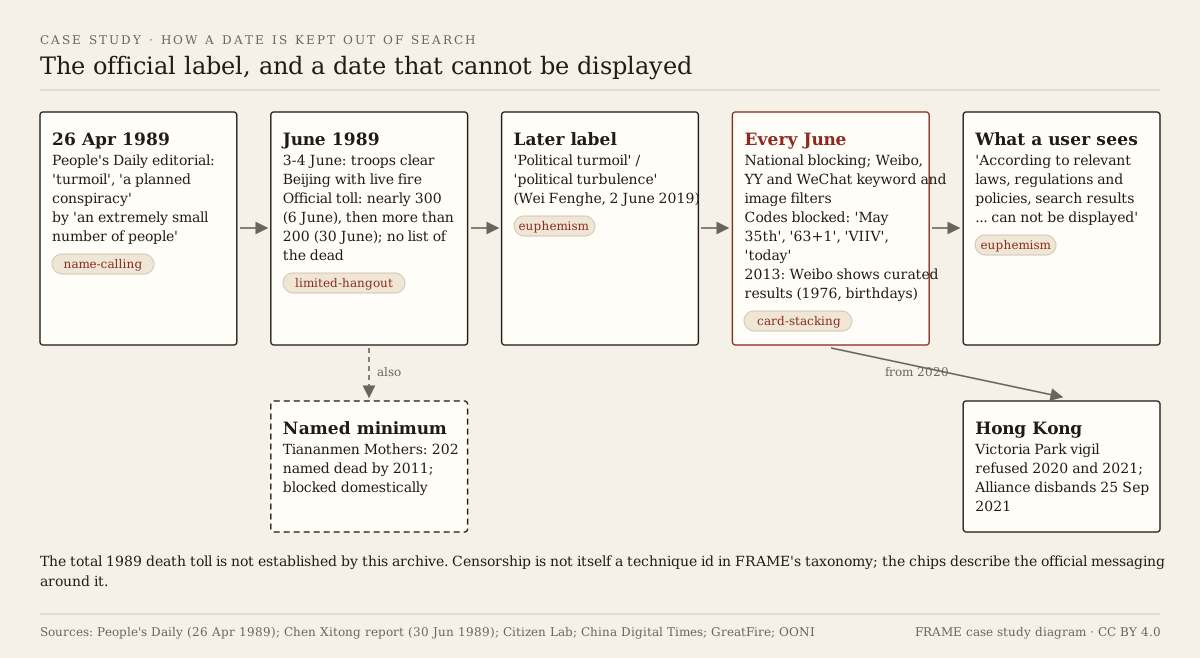
In one line: the Chinese government's official account of 1989 has changed labels over time ("turmoil", then "counter-revolutionary riot", then "political turmoil"), and each year around 4 June a layered system of national blocking, platform keyword lists and image filters removes references to the date, so that inside mainland China the official account is the only one easily found.
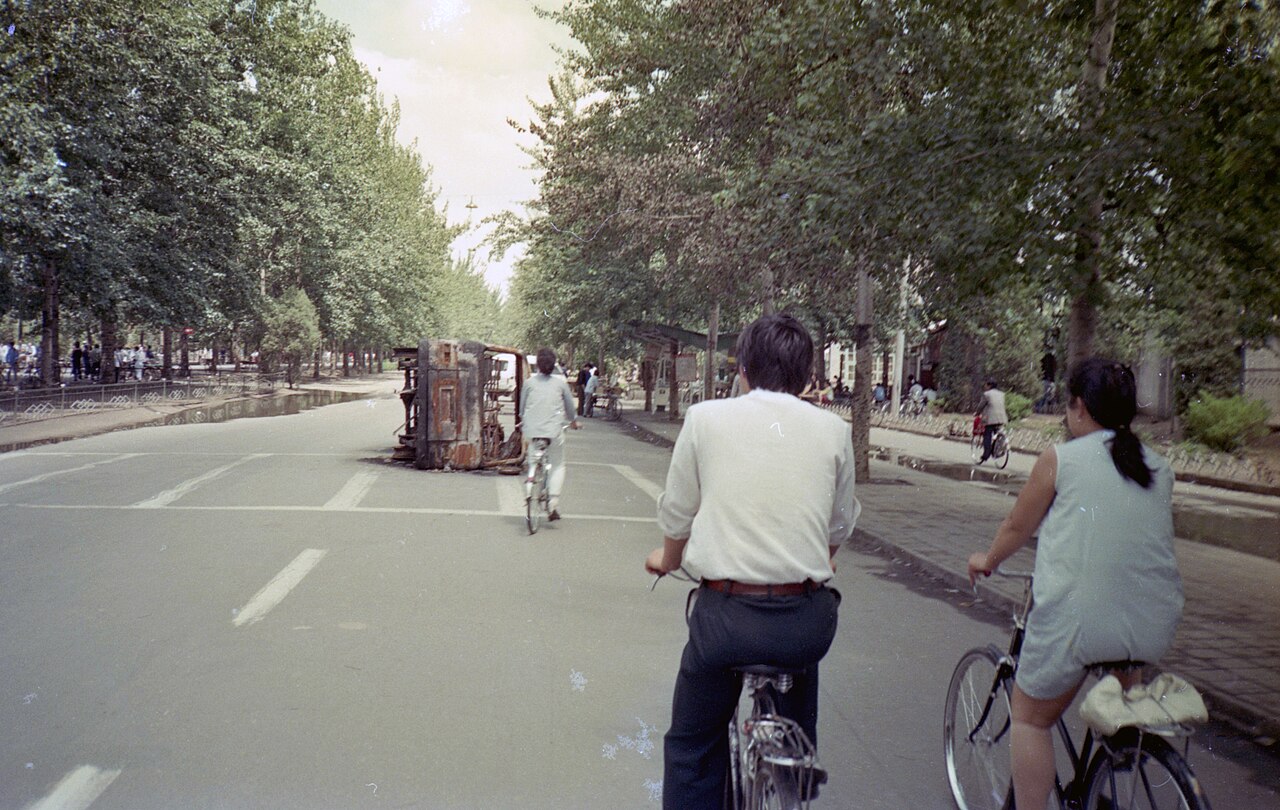
A burned vehicle on Zhongguancun street, Haidian, Beijing, photographed between 7 and 11 June 1989. Photo: Daiwenchen (Wikimedia Commons), CC BY-SA 4.0.
What happened
1989: the event and its first labels
- 26 April 1989. People's Daily runs a front-page editorial, 必须旗帜鲜明地反对动乱 ("We Must Take a Clear-cut Stand against Turmoil"). It describes the student movement as led by "an extremely small number of people" and calls it "a planned conspiracy and a disturbance" whose aim was to "negate the leadership of the CPC and the socialist system" (translation as given by The China Project and others). The key word is dongluan (动乱), "turmoil".
- 3-4 June 1989. Martial-law troops clear Beijing's streets and Tiananmen Square with live fire. Civilians and soldiers are killed.
- 6 June 1989. At a televised news conference, State Council spokesman Yuan Mu gives a figure of nearly 300 dead, counting soldiers, with 23 university students confirmed dead.
- 14 June 1989. UPI reports that China has reduced its official death toll to about 200.
- 30 June 1989. Beijing mayor Chen Xitong reports to the National People's Congress Standing Committee on "checking the turmoil and quelling the counter-revolutionary rebellion" (反革命暴乱, also translated "counter-revolutionary riot"). He gives more than 200 dead, including 36 university students, more than 3,000 civilians wounded, and several dozen soldiers killed.
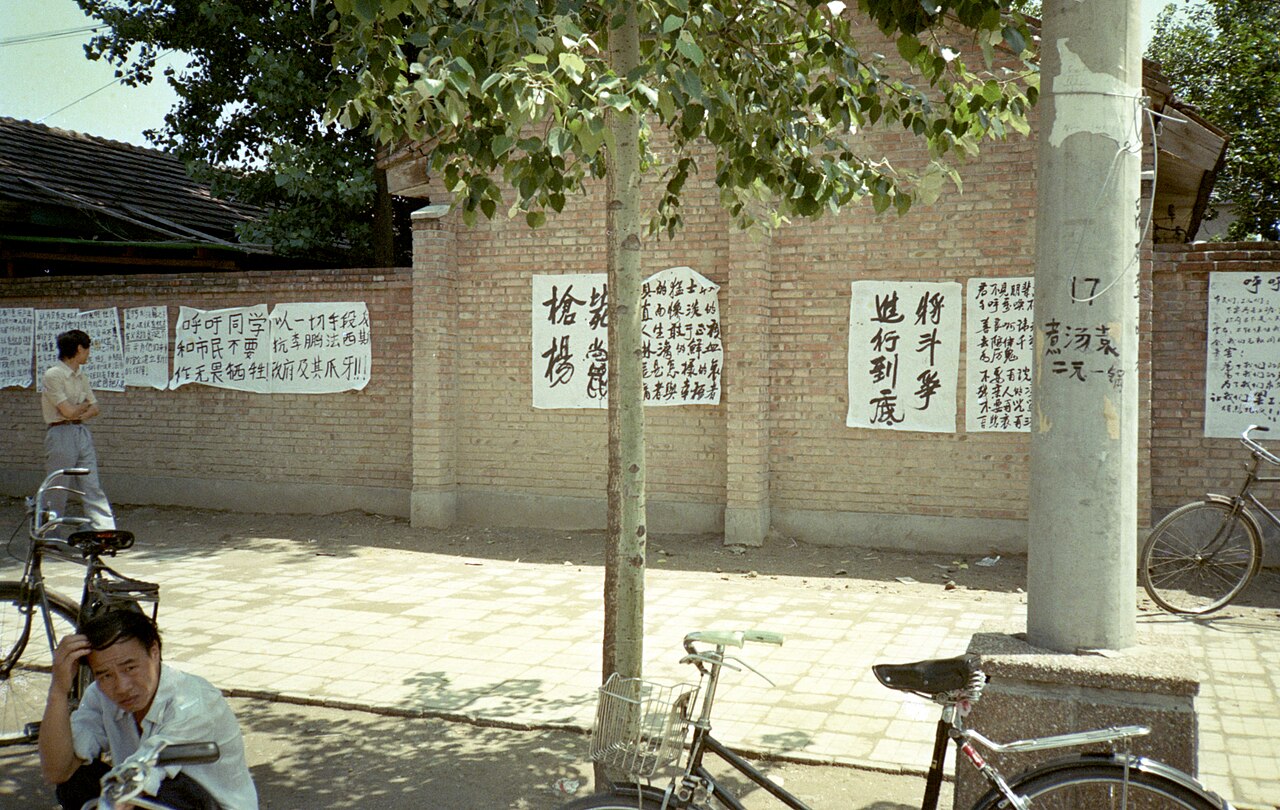
Hand-written posters on a wall on Zhongguancun street, Haidian, a few days after 4 June 1989: the street-level counter-accounts of the time. Photo: Daiwenchen (Wikimedia Commons), CC BY-SA 4.0.
1997-2019: the national filter
- June 1997. Wired publishes Geremie Barmé and Sang Ye's "The Great Firewall of China", the article that gave the national blocking system its common English name.
- 1998. The Ministry of Public Security begins the Golden Shield Project (金盾工程), a national network-control and policing system; it goes into operation after a national project meeting in September 2003.
- July 2009. Facebook and Twitter are blocked after the Ürümqi riots (TechCrunch, 7 July 2009).
- 2014. Just before the 25th anniversary, GreatFire.org reports that all Google services are disrupted in China, encrypted or not; Gmail is fully blocked in December 2014.
- 26 August 2014. A State Council notice gives the Cyberspace Administration of China (CAC) responsibility for internet information content management nationwide, including supervision and law enforcement.
- 2015 and 2019. The Chinese-language Wikipedia is blocked in 2015. From 25 April 2019, ahead of the 30th anniversary, the Open Observatory of Network Interference (OONI) measures every language edition of Wikipedia as blocked, by DNS injection and SNI filtering.
- 7 November 2016 / 1 June 2017. The Cybersecurity Law is adopted and takes effect. Article 12 bars using networks to endanger national security, incite subversion, or spread false information that disrupts the economic or social order; Article 47 requires network operators to stop transmission of prohibited information, delete it, keep records and report it. (China Law Translate lists a revised text for 2026.)
Every year: the anniversary layer
- Platform keyword lists. Citizen Lab has collected blocked-keyword lists from Chinese chat, microblog and live-streaming applications for more than a decade. On 3 June 2013 it found 71 June Fourth search terms blocked on Sina Weibo. Between 1 January and 31 May 2019, the live-streaming platform YY added 306 June Fourth keywords, including references to the Victoria Park candlelight vigil and to two Hong Kong Alliance events, "Kites for Democracy" (風箏行動) and the "Patriotic Democratic Parade".
- Coded dates. China Digital Times has logged the June Fourth terms blocked on Weibo each year since 2011 (264 by 2016). They include codes users invented for the date, such as "May 35th", "63+1", "65-1", "eight squared" (八的平方) and the Roman "VIIV", and ordinary words such as "that year", "this day" and "today". In 2012, NPR and Bloomberg reported that searches for the Shanghai stock index were blocked after its fall on 4 June matched the date.
- Symbols and images. In early June 2012 Weibo removed its candle emoji, saying it was being "optimized" (What's on Weibo). In 2013 "big yellow duck", used in a parody of the Tank Man photograph, was blocked (IBTimes UK). Citizen Lab's (Can't) Picture This (August 2018) found that WeChat filters images by the text in them and by visual similarity to a blacklist, and that images about the 1989 protests were among the most censored; its July 2019 follow-up found the same in private chats in real time.
- The search notice. From 31 May 2013 GreatFire recorded Sina Weibo searches for "June 4th" and related terms returning curated results (posts about the 1976 Tiananmen incident, wedding anniversaries, birthdays) instead of a block. By 3 June Weibo went back to its standard notice: "According to relevant laws, regulations and policies, search results for [the term] can not be displayed."
Hong Kong, 1990-2021
- Hong Kong held the largest public June Fourth commemoration on Chinese soil, a candlelight vigil in Victoria Park organised by the Hong Kong Alliance in Support of Patriotic Democratic Movements of China.
- 2020. Police refuse permission for the vigil, citing COVID-19 restrictions on gatherings. People gather in the park anyway.
- 2021. The vigil is refused again. In June the Alliance's June 4th Museum closes during a licensing investigation. In September, Alliance leaders are charged under the National Security Law with inciting subversion, and on 25 September the members vote to dissolve the group.
- 2022. Police make arrests on 4 June as gatherings are banned (AFP via Malay Mail).
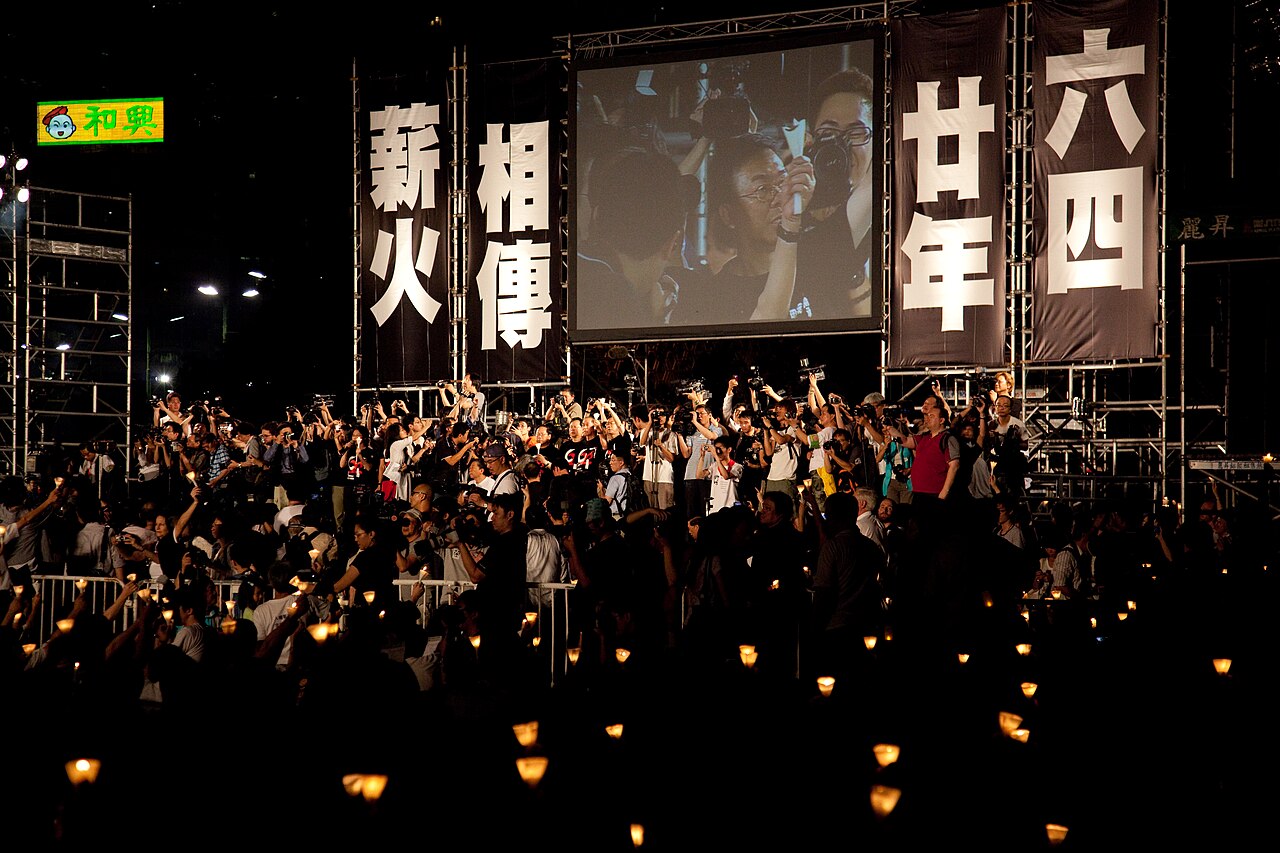
The Victoria Park candlelight vigil for the 20th anniversary, 4 June 2009; the banners read 薪火相傳 ("pass on the flame") and 六四廿年 ("June Fourth, twenty years"). Photo: Kap Leung (Flickr, via Wikimedia Commons), CC BY 2.0.
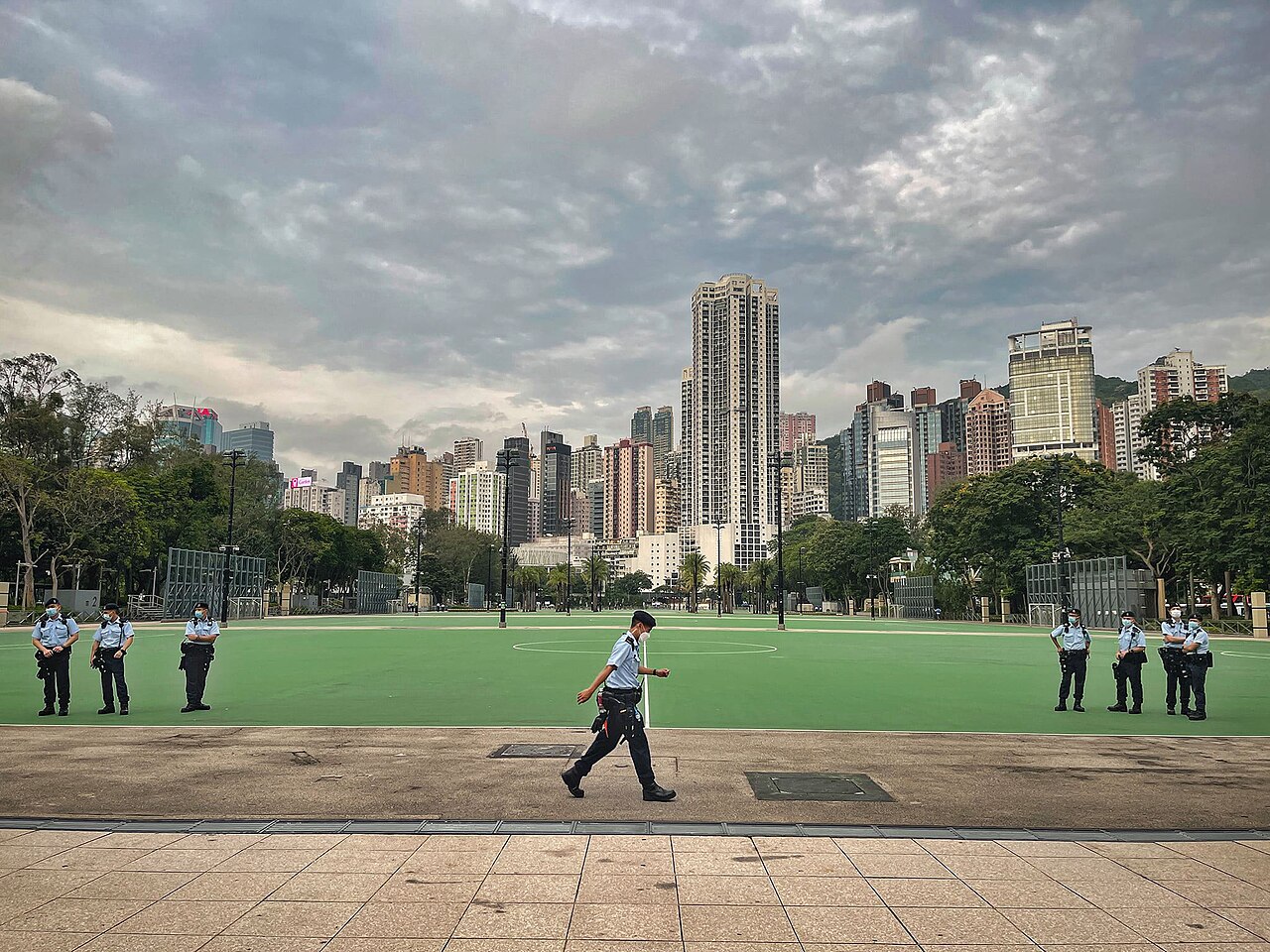
Police at the empty pitches of Victoria Park on 4 June 2021, after the vigil was refused. Photo: Studio Incendo (via Wikimedia Commons), CC BY 4.0.
How it works
Censorship is not itself a technique id in FRAME's taxonomy; the tags below describe the messaging around it: the official words for 1989 and the notices that stand in for removed material.
- Name-calling: the 26 April 1989 editorial labelled a movement that was still under way "turmoil" and "a planned conspiracy" run by "an extremely small number of people", before any investigation. The 30 June report raised the label to "counter-revolutionary rebellion". The labels changed later on the government's own initiative (see below), which shows they were characterisations, not fixed findings.
- Euphemism / doublespeak: the later formula "political turmoil" (政治风波, also "political turbulence" or "political disturbance") names a political event, not the use of live fire on city streets. The platform-side wording works the same way: Weibo's notice gives "relevant laws, regulations and policies" as the reason results "can not be displayed", without the word censored, and the 2012 candle emoji was removed to be "optimized".
- Limited hangout: the government published a death toll in June 1989, a partial account that concedes deaths, including soldiers' deaths. It has not published a list of the dead. The only named list, compiled by the Tiananmen Mothers (202 names by 2011), is itself blocked domestically.
- Card stacking: the 2013 Weibo search results replaced June Fourth material with posts about 1976 and about birthdays, so the pile a user saw could only be read one way. Official retrospective statements pair the 1989 verdict with China's development since, without the casualty question.
Considered and not tagged: Manufactured consensus. Inside mainland China the anniversary is marked by absence rather than by many voices repeating the official line, so the record shows removal, not a staged agreement.
Then and now
The sibling case The Gyirong flood and the official death toll shows the same apparatus applied in 2026 to a natural disaster: one official toll with rescue coverage, and higher counts deleted and prosecuted as "rumours" under the Clean Internet 2026 campaign.
The differences are as large as the likeness:
- Cause. Gyirong was a glacial collapse; June Fourth was an act of the state's own army, so the official account is also a verdict on the state.
- Visibility of the official line. After Gyirong the official figure was pushed out widely. After 1989 the official line is rarely repeated domestically; the main effect is that the date disappears from search.
- Time scale. Gyirong controls ran for weeks after one event. June Fourth controls run on a calendar every year, 37 years on, with keyword lists updated before each anniversary.
- Legal tools. Gyirong used police "rumour" cases under a named campaign. June Fourth relies on standing blocking, platform keyword lists and, in Hong Kong from 2020-2021, public-health rules and then the National Security Law.
In both cases the true toll is not established by this archive, and the official figure is the one that stays visible inside China.
Positions on the record
- The government's stated rationale. In 1989: the protests threatened "stability and unity" and the leadership of the Party, and ending them was necessary. Since then, spokespeople asked on anniversaries have referred to "the political turmoil of the late 1980s" and said the government reached a clear conclusion on it long ago. At the Shangri-La Dialogue on 2 June 2019, Defence Minister Wei Fenghe called the events "a political turbulence" and the measures taken a "correct policy", pointing to China's stability and development since. On the internet, the government's framework is legal and sovereign: the Cybersecurity Law bars content that endangers national security or spreads false information, and Xi Jinping's speech at the second World Internet Conference in Wuzhen (16 December 2015) set out "cyber sovereignty", each country's right to choose its own model of internet regulation. Hong Kong's government cited public-health rules in 2020 and national security thereafter.
- Critics. The Tiananmen Mothers, founded by Ding Zilin after her son Jiang Jielian was killed, have compiled a register of victims since 1994 and ask for truth, compensation and accountability. Amnesty International's 1990 report (ASA 17/09/90) documented killings and executions after June 1989. Rights and research groups (Citizen Lab, China Digital Times, GreatFire, OONI) document the anniversary controls as removal of history, not of false information.
- This archive's reading. Established: troops used live fire in Beijing on 3-4 June 1989; civilians and soldiers were killed; the government's own June 1989 figures concede more than 200 dead. The total death toll is not established. The estimates and their sources:
- Chinese government, June 1989: nearly 300 including soldiers (Yuan Mu, 6 June), later more than 200 including 36 students, plus several dozen soldiers (Chen Xitong, 30 June).
- Tiananmen Mothers: 202 named dead by August 2011, each checked with families. This is a documented minimum, not a total.
- Nicholas Kristof, New York Times, 21 June 1989: "about a dozen soldiers and policemen" and 400 to 800 civilians seemed plausible. He reported that a Chinese Red Cross figure of 2,600 circulated and was denied by the organisation.
- Sir Alan Donald, British ambassador, cable of 5 June 1989 (declassified December 2017): "minimum estimate of civilian dead 10,000", from a single second-hand source. Others, including The China Project (25 December 2017), dispute it. The anniversary controls themselves are documented by measurement (Citizen Lab, OONI, GreatFire, China Digital Times). The archive does not rule on the 1989 political dispute.
Same-method test
The same scoring applies to any government that filters domestic search results or removes references to a killing by its own forces: an official label applied before investigation is name-calling, a notice that omits the word censored is euphemism, a published toll with no list of the dead is a limited hangout. Two documented contrasts, with the differences stated:
- Filtering search results through a court. In Google Spain v AEPD (Case C-131/12, 13 May 2014), the EU Court of Justice required search engines to delist some results about private individuals on request. The differences are large: it covers personal data, not state conduct; it runs through an application, a published ruling and appeal to data-protection authorities and courts; and the pages stay online and searchable by other terms.
- An official account of a state killing, later overturned by the state. After British soldiers shot civil-rights marchers in Derry on 30 January 1972 (Bloody Sunday; 13 died that day, a 14th later), the Widgery Tribunal (April 1972) largely cleared the soldiers. The Saville Inquiry (report 15 June 2010) found the killings "unjustified and unjustifiable", and the Prime Minister apologised in Parliament. The press and families contested the first account openly throughout. The scale (14 dead against hundreds or more), the absence of domestic search filtering, and the public legal process that revised the verdict all differ from June Fourth.
How to spot it
- Track the label over time. When an official name for an event changes ("turmoil", "counter-revolutionary rebellion", "political turmoil"), each version is a characterisation to test, not a finding.
- Read the notice, not only the result. "Cannot be displayed under relevant laws" tells you a result was removed, not that it was false.
- Watch the calendar. Keyword lists that grow before a fixed date, and ordinary words ("today", "that year") that stop working on it, are a documented anniversary pattern.
- Ask for the list, not just the number. A toll with no names, beside a named list compiled by families, is a partial account.
Images
| Image | Source | Licence |
|---|---|---|
| Mechanism diagram (above) | Drawn for FRAME from this page's sourced facts (make_diagrams.py) |
CC BY 4.0, FRAME |
| Burned vehicle on Zhongguancun street, Beijing, 7-11 June 1989 | Wikimedia Commons, photo by Daiwenchen | CC BY-SA 4.0 |
| Posters on Zhongguancun street, Beijing, June 1989 | Wikimedia Commons, photo by Daiwenchen | CC BY-SA 4.0 |
| Victoria Park vigil, Hong Kong, 4 June 2009 | Wikimedia Commons, photo by Kap Leung (Flickr) | CC BY 2.0 |
| Police at an empty Victoria Park, 4 June 2021 | Wikimedia Commons, photo by Studio Incendo | CC BY 4.0 |


Image gaps
- The "Tank Man" photographs (5 June 1989). Not included: the photographs by Jeff Widener (AP), Stuart Franklin (Magnum), Charlie Cole and others are copyrighted and not openly licensed.
- The 26 April 1989 People's Daily front page. Not included: no openly licensed scan was found.
- A Weibo "cannot be displayed" search notice, a Great Firewall block page, or the candle emoji. Not included: no openly licensed screenshot was found; the reproductions by GreatFire, China Digital Times and news outlets are copyrighted.
- Citizen Lab's charts of YY and WeChat filtering. Not included: not openly licensed for reuse here.
- Photographs in Tiananmen Square during the protests (April-June 1989). One openly licensed Commons photo (Jiří Tondl, 2 June 1989, CC BY-SA 4.0) exists but is only 299 px wide; a 10 May 1989 march photo on Commons carries a CC BY 2.5 tag beside a Getty Images copyright notice, so its licence is unclear. Neither is used.
- The Goddess of Democracy statue (1989) and its replicas. No openly licensed photo of the 1989 original was found. Photos of later replicas (Hong Kong, San Francisco, Vancouver, Toronto) are on Commons; none was added, because the page already carries four photos and does not cover the replicas' history (the removal of the Chinese University of Hong Kong replica in December 2021 would need its own sourcing).
- The Donald cable of 5 June 1989. Scans are on Wikimedia Commons, but their licence status under UK Crown copyright was not confirmed for this page.
Sources
- People's Daily, 26 April 1989, editorial 必须旗帜鲜明地反对动乱; English excerpts in The China Project, 28 April 2021.
- Chen Xitong, report to the NPC Standing Committee on checking the turmoil and quelling the counter-revolutionary rebellion, 30 June 1989.
- Yuan Mu, State Council news conference, 6 June 1989; UPI, 14 June 1989: China reduces official Tiananmen death toll to about 200.
- Nicholas D. Kristof, "A Reassessment of How Many Died in the Military Crackdown in Beijing", New York Times, 21 June 1989.
- Sir Alan Donald, telegram of 5 June 1989, UK National Archives (declassified December 2017); The China Project, 25 December 2017: No, 10,000 were not killed.
- Tiananmen Mothers list of 202 people killed (1989-2011), English translation by David Cowhig; Human Rights in China: Tiananmen Mothers maps.
- Amnesty International, ASA 17/09/90 (1990).
- Geremie R. Barmé and Sang Ye, "The Great Firewall of China", Wired 5.06, June 1997.
- Britannica: Great Firewall; Global Voices Advox, 30 August 2017: The evolution of China's Great Firewall.
- TechCrunch, 7 July 2009: China blocks access to Twitter, Facebook after riots.
- GreatFire, June 2014: Google disrupted prior to Tiananmen anniversary; The Register, 3 June 2014; GreatFire, December 2014: Gmail completely blocked.
- OONI, May 2019: China is now blocking all language editions of Wikipedia.
- State Council notice empowering the CAC, 26 August 2014 (DigiChina translation).
- Cybersecurity Law of the People's Republic of China, adopted 7 November 2016, effective 1 June 2017, Articles 12 and 47; NPC Observer: Cybersecurity Law.
- Xi Jinping, speech at the opening of the second World Internet Conference, Wuzhen, 16 December 2015.
- Citizen Lab, June 2019: Censored Commemoration (YY); Citizen Lab, June 2013: June 4 search terms blocked on Weibo.
- Citizen Lab, August 2018: (Can't) Picture This; Citizen Lab, July 2019: (Can't) Picture This 2.
- China Digital Times, June 2016: Five years of sensitive words on June Fourth.
- GreatFire, May 2013: Sina testing subtle censorship ahead of Tiananmen anniversary.
- What's on Weibo: The disappearing emoji on Weibo in light of June 4; NPR, 4 June 2012; Bloomberg, 4 June 2012; IBTimes UK, 2013: big yellow duck.
- Hong Kong: Deccan Herald (2021): June 4th Museum closes over licensing probe; Malay Mail / AFP, 4 June 2022; reporting on the 2020 and 2021 vigil refusals and the Alliance's 25 September 2021 vote to dissolve.
- Wei Fenghe, remarks at the Shangri-La Dialogue, Singapore, 2 June 2019.
- Court of Justice of the European Union, Google Spain SL v Agencia Española de Protección de Datos, Case C-131/12, 13 May 2014; Report of the Bloody Sunday Inquiry (Saville), 15 June 2010; Widgery Tribunal report, April 1972.