
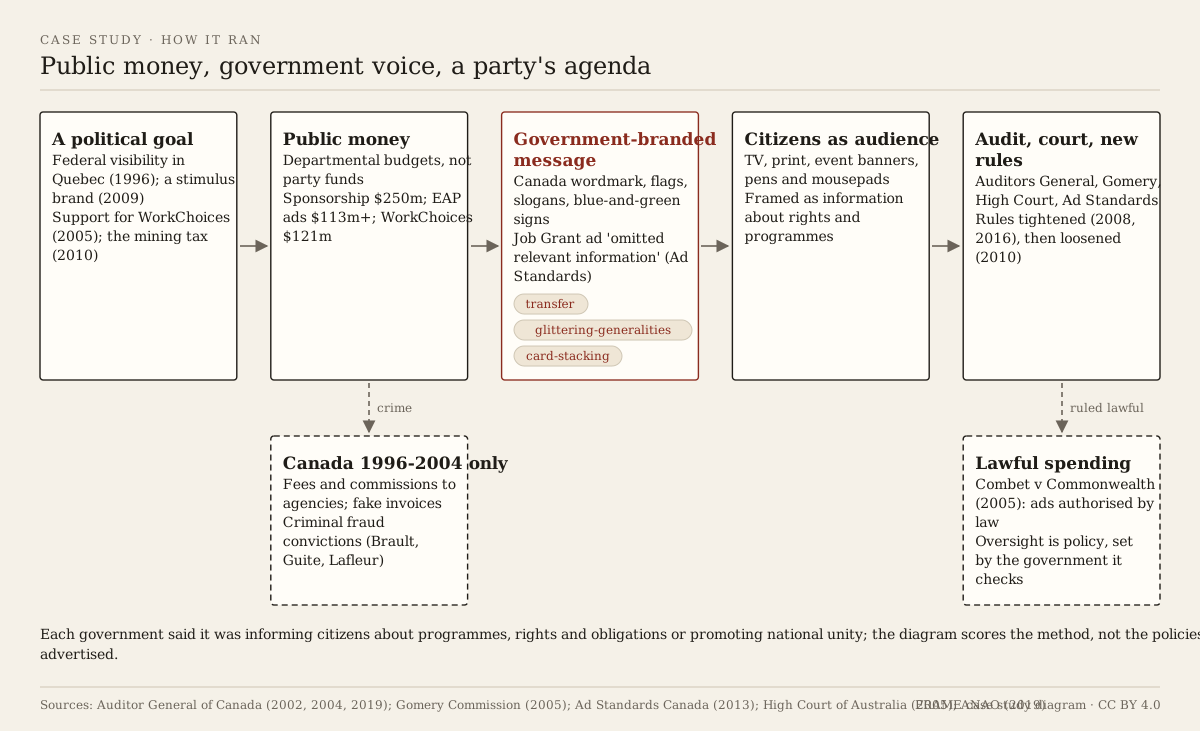
In one line: four governments of four parties, in two countries, spent public money on advertising and sponsorship that carried the state's name and symbols while promoting the governing party's own agenda. Each said it was informing citizens. Auditors, a commission of inquiry, a High Court and an industry standards body tested the spending. Only the Canadian sponsorship programme ended in criminal convictions.
What happened
Canada: the Sponsorship Program (Liberal government of Jean Chrétien)
- 1-2 February 1996. After the 30 October 1995 Quebec referendum, which kept Quebec in Canada by a very narrow margin, a special federal Cabinet meeting decides to make the federal presence more visible, particularly in Quebec, through advertising and displays at community, cultural and sporting events (as summarised in the Gomery Commission's account of the programme's history). The money flows from Public Works and Government Services to private advertising agencies, which place the Canada wordmark, the flag and federal logos at sponsored events.
- 8 May 2002. Auditor General Sheila Fraser reports on $1.6 million of contracts to the agency Groupaction. She says senior Public Works officials "broke just about every rule in the book" and refers the files to the RCMP.
- 10 February 2004. Fraser's audit of the whole programme is tabled. It finds that the Sponsorship Program spent $250 million, of which more than $100 million went to communications agencies as fees and commissions, with rules broken at every stage and little evidence of value received. She calls it "scandalous" and says she is "appalled" (CBC). The next day Prime Minister Paul Martin, who had cancelled the programme in December 2003, orders a commission of inquiry under Justice John Gomery.
- April 2004. Earlier in-camera testimony by Chuck Guité, the official who ran the programme, is released. He said: "We were basically at war trying to save the country... When you're at war, you drop the book and the rules" (Globe and Mail, 3 April 2004).
- 1 November 2005. Gomery's Phase 1 report, Who Is Responsible?, finds a "culture of entitlement". It names Liberal organiser Jacques Corriveau as "the central figure in an elaborate kickback scheme" that returned money to the Liberal Party's Quebec wing, and holds Chrétien's office and Public Works Minister Alfonso Gagliano responsible for how the programme was run. The Liberal Party repays $1.14 million, the amount it says it received improperly. On 26 June 2008 the Federal Court sets aside the report's findings against Chrétien and his chief of staff Jean Pelletier, citing a reasonable apprehension of bias. The Federal Court of Appeal upholds that ruling in 2010.
- 2005-2007: convictions. Paul Coffin pleads guilty to 15 counts of fraud; his conditional sentence is replaced on appeal with 18 months in jail. Jean Brault of Groupaction pleads guilty to five counts and is sentenced on 5 May 2006 to 30 months. Guité is convicted on five counts of fraud on 6 June 2006 and sentenced to 42 months. Jean Lafleur pleads guilty to 28 counts and in 2007 is sentenced to 42 months and ordered to repay $1.6 million. Gilles-André Gosselin later pleads guilty to fraud totalling $655,276.
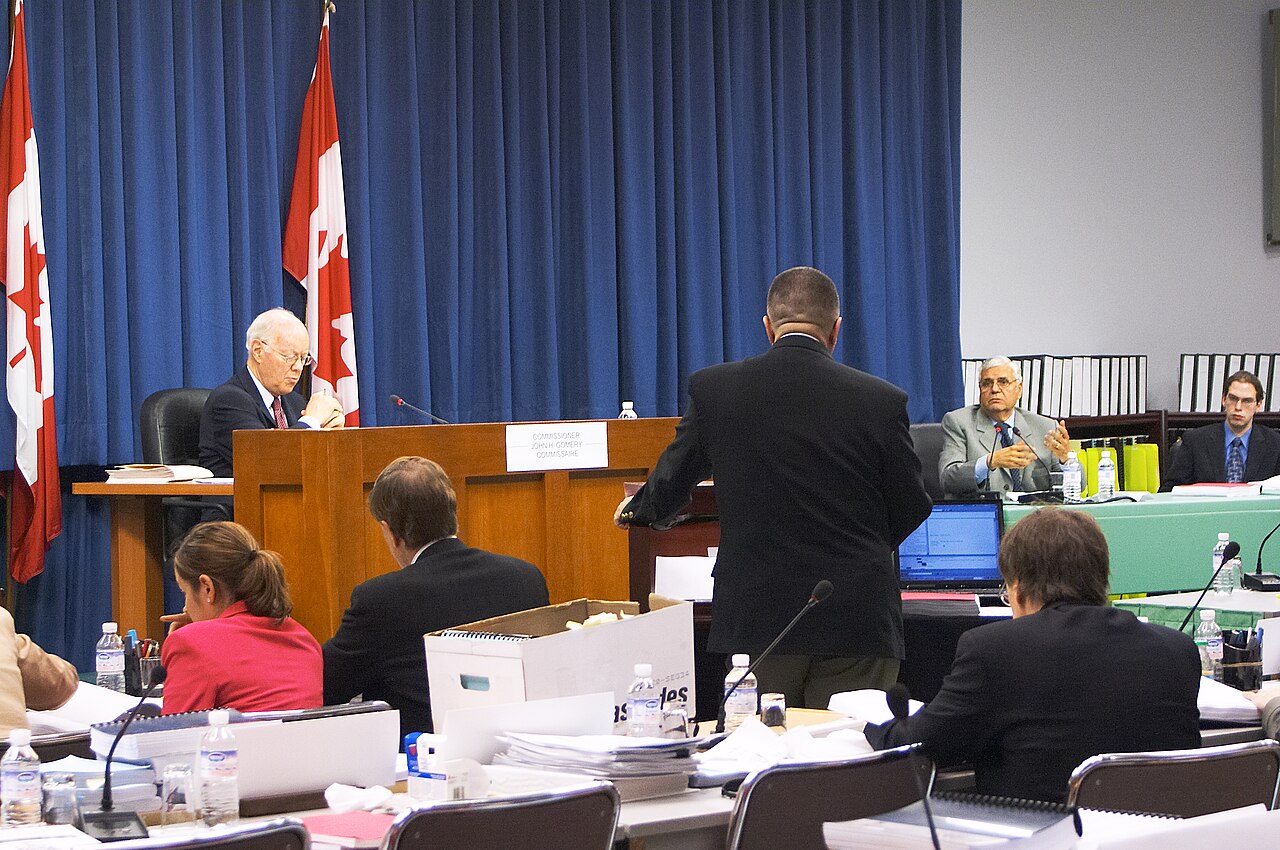
Former Public Works minister Alfonso Gagliano testifies at the Gomery Commission, 2 June 2005, the last witness heard. Photo by Dimitrios Papadopoulos / QuebecPress.com, released into the public domain.
Canada: the "Economic Action Plan" (Conservative government of Stephen Harper)
- 2009. The stimulus budget is branded "Canada's Economic Action Plan". Projects that receive funds must put up blue-and-green signs. Eighteen departments report weekly to the Privy Council Office on where each of more than 8,500 signs has been installed (CBC).
- 2009-2013. Of $136.3 million in federal advertising in 2009-10, $53.2 million goes on the Economic Action Plan. By May 2013 the government has spent at least $113 million on the brand. The brand stays in use after the two-year stimulus ends: a $14.8 million campaign in 2012-13 is that year's most expensive (Globe and Mail).
- May 2013. Television ads for a "Canada Job Grant" run in prime time during the NHL playoffs, at a cost of $2.5 million to $2.6 million. The grant had been announced in the 2013 budget but needed agreement from the provinces, which had not agreed to it. After more than 20 complaints, Advertising Standards Canada rules that "the commercial omitted relevant information," because it gave the impression the programme was imminent when "the implementation of this program is not imminent." The government had already withdrawn the ad.
- May 2016. The new Liberal government of Justin Trudeau adopts a policy defining "non-partisan communications". It requires independent review of ads by Advertising Standards Canada, bars ministers' names, voices and images and the dominant use of a governing party's colour, bars ads for measures Parliament has not yet approved, and sets a 90-day blackout before a fixed-date election.
- May 2019. Auditor General's Report 4, covering October 2015 to June 2018, finds "little evidence" that Public Services and Procurement Canada or Ad Standards "thoroughly applied" the criteria, and that Ad Standards did not ask for data behind factual claims in ads. External review applied only to campaigns over $500,000; the threshold was later lowered to $250,000.
Australia: WorkChoices (Coalition government of John Howard)
- July-August 2005. The government runs newspaper ads for its planned industrial-relations changes from 23 July, before any bill exists. On 15 August it signs $3.84 million in advertising contracts. Stage one of the campaign, including booklets and a hotline, costs about $46 million (Sydney Morning Herald).
- 29 September 2005. In Combet v Commonwealth, brought by ACTU secretary Greg Combet and Labor MP Nicola Roxon, the High Court rules 5-2 that the spending was authorised by the Appropriation Act. The Commonwealth argued the ads served its stated outcome of "higher productivity, higher pay workplaces". The majority held that departmental funds need not be tied to those outcomes. In dissent, Justice McHugh called the ads "feel good", and Justice Kirby said they were "not simply informative or descriptive" but "argumentative … rhetorical".
- 2005-2008. The Australian reports in October 2007 that the WorkChoices ads cost $121 million. In March 2008 Labor's industrial-relations minister, Julia Gillard, puts the same figure on what she calls "WorkChoices propaganda". The government's own polling from August 2005 to February 2006, released in March 2008, found that the ads had not made workers less apprehensive (SMH).
Australia: the Rudd and Gillard Labor governments, then the Coalition again
- October 2007. As opposition leader, Kevin Rudd calls publicly funded advertising "a sick cancer within our system, … a cancer on democracy."
- 2 July 2008. The Rudd government issues campaign-advertising guidelines under which the Auditor-General reviews campaigns over $250,000 before launch.
- 31 March 2010. The government replaces the Auditor-General's review with an Independent Communications Committee.
- May 2010. Special Minister of State Joe Ludwig exempts a $38 million campaign for the proposed mining "super profits" tax from the guidelines, citing urgency and the mining industry's own ad campaign. The ads start on 28 May (ABC). Both sides pull their ads in June as part of a truce under Julia Gillard.
- 2019. The ANAO's audit of June 2015 to April 2019 under the Coalition, including the $9.5 million "Powering Forward" energy campaign, recommends cutting the "large measure of discretion" in the framework and letting the third-party reviewer look at campaigns at any stage. In 2022 the Canberra Times reports that the Morrison government spent a record $340 million on advertising before that year's election.
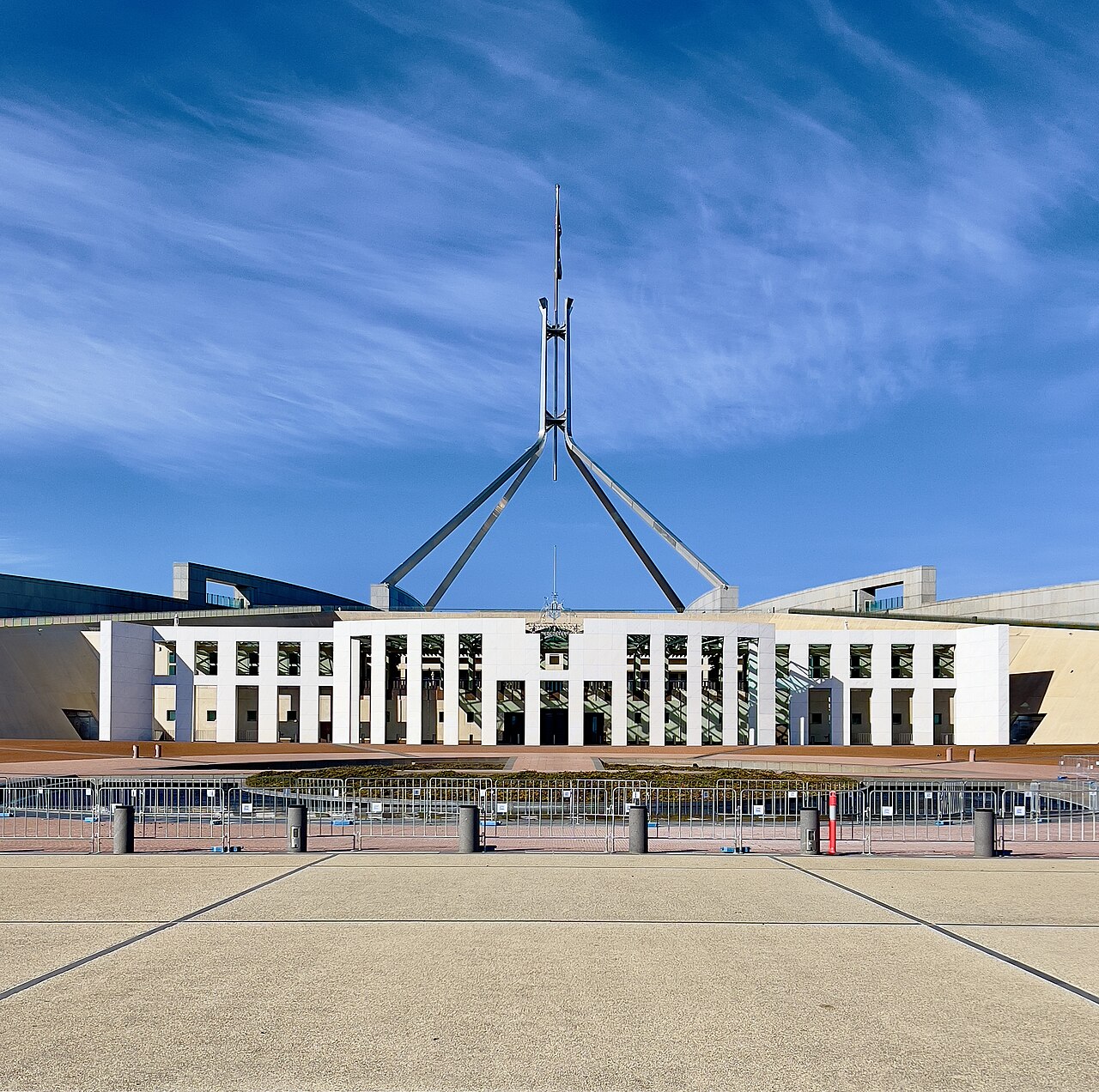
Parliament House, Canberra: the Appropriation Acts that the High Court found authorised the WorkChoices advertising were passed here. Photo by Kgbo, 2022, CC BY-SA 4.0.
How it works
- Transfer: the Sponsorship Program existed to attach federal symbols (the Canada wordmark, the flag) to events Quebecers already valued, so that the goodwill would pass to the federal government. The Economic Action Plan signs put a government slogan on public works paid for by public money. Canada's 2016 rule against the dominant use of a governing party's colour was adopted after years of criticism of the Economic Action Plan's branding (CBC).
- Glittering generalities: brand names and slogans such as "Economic Action Plan", "WorkChoices" and "higher productivity, higher pay workplaces" stand in for a checkable statement of what changed and for whom. Justice Kirby's description of the WorkChoices ads as "argumentative … rhetorical" rather than informative is the court record's version of this finding.
- Card stacking: the Canada Job Grant ad showed the benefit and left out the fact that the provinces had not agreed and the programme did not yet exist. Advertising Standards Canada found that it "omitted relevant information." The WorkChoices ads ran before the bill was published, when their message could not yet be checked against the bill.
Then and now
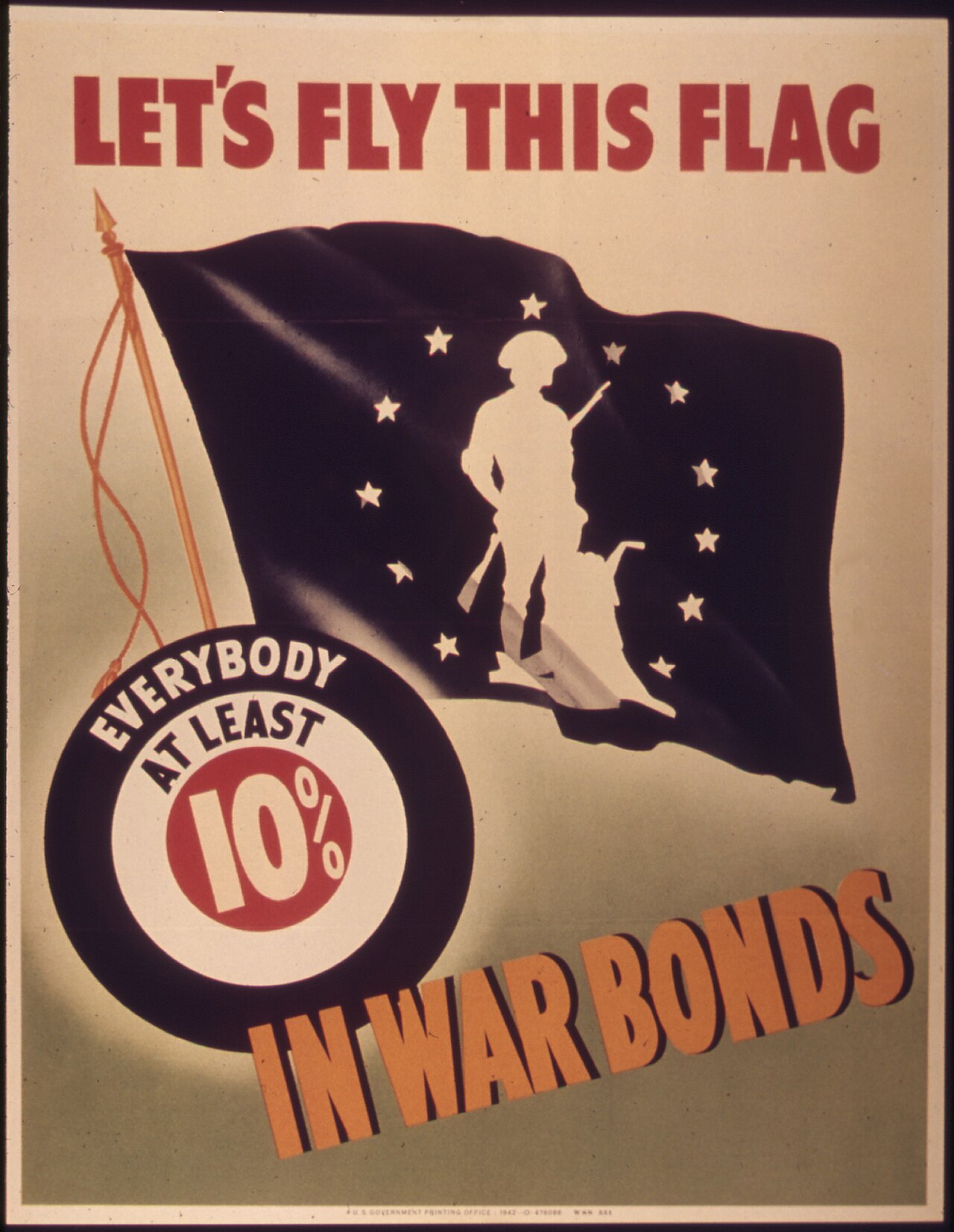
Let's Fly This Flag: Everybody at Least 10 Percent in War Bonds, U.S. Treasury Department, 1943. Public domain.
The U.S. Treasury's wartime payroll campaign also used the national flag to sell a government programme to its own citizens with public money. The difference is in what was asked of the audience. The 1943 poster asked workers to buy bonds, a specific act they could refuse. Most of the later ads asked for nothing concrete. They built approval of a policy or a brand at times that fell within the governing party's electoral cycle. What they share is the flag lending its authority to the government of the day.
Positions on the record
- The governments' stated rationale: citizens need to know about programmes, rights and obligations, and major changes need explaining. The Chrétien government presented sponsorship as a way to raise federal visibility in Quebec after a near-loss in the 1995 referendum, and Chrétien defended it on those grounds before Gomery. Harper defended the Economic Action Plan ads by saying that "Canadians understand and are very proud of the fact that Canada's economy has performed so much better than other developed countries". The Howard government told the High Court that the WorkChoices ads served its goal of higher-productivity, higher-pay workplaces. The Rudd government said the mining-tax exemption was urgent because industry ads could affect markets.
- Critics' position: in both countries the opposition of the day called the government's campaigns partisan advertising paid for by taxpayers: the Conservatives and Bloc over sponsorship, Justin Trudeau's Liberals over the Economic Action Plan in Question Period, the ALP and ACTU over WorkChoices. The ACTU called the WorkChoices ads "deceitful". Rudd called the practice "a cancer on democracy" and his government later exempted its own mining-tax campaign from the guidelines (May 2010, above).
- This archive's reading: it is documented that these campaigns were funded from public money, carried government branding, and in the cases cited were found by auditors, a standards body or dissenting judges to be persuasive rather than purely informative, or to leave out conditions. Criminal fraud is documented only for the Sponsorship Program, where it concerned how agencies billed, not what the ads said. It is not shown that any of these campaigns changed an election result. The government's own polling found the WorkChoices ads did not achieve their aim. Gomery's findings against Chrétien and Pelletier were set aside by the courts and are not relied on here.
Same-method test
The finding does not depend on the party. The Liberal Party (Canada), the Conservative Party (Canada), the Liberal-National Coalition (Australia) and the Australian Labor Party all ran publicly funded campaigns that promoted their own agenda under a neutral government label. The Labor case shows the same party on both sides: Rudd condemned the practice in opposition, then his government replaced the Auditor-General's review and exempted its own mining-tax campaign. The differences are real and should be stated as plainly: the Sponsorship Program involved fraud convictions and kickbacks, while the Economic Action Plan, WorkChoices and mining-tax campaigns were lawful spending. Combet confirmed that in Australia, and none of the others was found unlawful. Scale also differed, from a $2.5 million ad to a $250 million programme.
How to spot it
- Ask whether the ad tells you something you can act on (a deadline, an entitlement, a phone number) or only asks you to feel something about the government's programme.
- Check whether the programme exists yet. An ad for a measure that has not passed Parliament, or that needs partners who have not signed, is promotion rather than information.
- Look at timing and colour: heavy spending in the months before an election, and a palette or slogan shared with the governing party.
- Find out who approved the campaign. An auditor-general has statutory independence. A committee appointed by the government, or a paid industry reviewer, does not.
Images
| Image | Source | Licence |
|---|---|---|
| Mechanism diagram (above) | Drawn for FRAME from this page's sourced facts (make_diagrams.py) |
CC BY 4.0, FRAME |
| Alfonso Gagliano at the Gomery Commission (2005) | Wikimedia Commons, Dimitrios Papadopoulos / QuebecPress.com | Public domain (released by the author) |
| Parliament House, Canberra (2022) | Wikimedia Commons, Kgbo | CC BY-SA 4.0 |
| Let's Fly This Flag (1943) | FRAME gallery | Public domain (U.S. government work) |


Image gaps
- An "Economic Action Plan" sign or TV ad frame. Canadian federal works are Crown copyright and are not under an open licence by default, and no openly licensed photo of a sign was found on Wikimedia Commons. Fillable if a freely licensed photo of a roadside sign is located or taken.
- The Canada wordmark as used at sponsored events. The wordmark is on Commons as a public-domain text logo, but the Government of Canada restricts reproduction of its official symbols without written authorisation, so it is left out.
- WorkChoices ads, booklets and logo. These are Commonwealth copyright and not openly licensed. The logo on Wikipedia is used under a fair-use claim. Not fillable under this archive's licence rule unless the material is released.
- The Canada Job Grant commercial and the mining-tax ads. Crown copyright. Not fillable.
- Portraits of Chrétien, Harper, Howard and Rudd. Openly licensed portraits exist on Commons, but they were not added because the Commons API rate-limited licence checks from this environment. Fillable.
Sources
- CBC News: Auditor general gives details of "scandalous" sponsorship program (February 2004)
- CBC In Depth: Auditor General's 2004 report
- Office of the Auditor General of Canada: 2003 Report, Chapters 3-5 (Sponsorship Program), tabled 10 February 2004
- Auditor General, 8 May 2002 speech and Groupaction findings
- Gomery Commission, Who Is Responsible? Phase 1 Report (1 November 2005)
- CBC: History of the Sponsorship Program (Gomery report summary)
- CBC In Depth: Gomery report analysis
- Globe and Mail, 3 April 2004: Guité: "When you're at war you drop ... the rules"
- Chrétien v. Canada, 2008 FC 802 (26 June 2008) and Canada (AG) v. Chrétien, 2010 FCA 283
- Globe and Mail: Brault gets 30 months for sponsorship fraud
- CBC News: Chuck Guité found guilty of fraud
- CBC News: Lafleur sentenced to 42 months in ad scandal
- CBC News: Paul Coffin sentenced
- Globe and Mail: Sponsorship player (Gosselin) gets two years in prison
- CBC News: Harper government ordered stimulus signs count
- Globe and Mail: Harper cites civic pride in defending "economic action plan" ads (May 2013)
- Globe and Mail: Government spends millions on ads for "Economic Action Plan" that ended two years ago
- CBC News: Canada Job Grant ads cost $2.5M for non-existent program
- Globe and Mail: Harper government buying ads to promote job program that doesn't yet exist
- Treasury Board of Canada Secretariat, May 2016: independent oversight of government advertising
- CBC News: Liberals announce new rules to limit government advertising (2016)
- Auditor General of Canada, 2019 Spring Reports, Report 4: Oversight of Government of Canada Advertising
- High Court of Australia: Combet v Commonwealth [2005] HCA 61
- Senate, Papers on Parliament No. 46 (December 2006)
- Sydney Morning Herald, 7 March 2008: Howard ignored his own polling
- The Australian, 16 October 2007: Work Choices ads cost $121m
- ABC News, 18 March 2008: Gillard attacks Opposition over spending criticism
- Van Onselen and Errington, "Managing Expectations: The Howard Government's WorkChoices Information Campaign", Media International Australia (2007)
- "Public Contest through the Popular Media: The Mining Industry's Advertising War against the Australian Labor Government" (Rudd quotation)
- ANAO: Campaign Advertising Review 2008-09
- ANAO: Campaign Advertising Review July 2009 - March 2010
- ABC News, 28 May 2010: Government mining tax ad blitz to cost $38m
- ABC News, 24 June 2010: Gillard, BHP can ads in mining tax truce
- ANAO Auditor-General Report No. 7 2019-20: Government Advertising, June 2015 to April 2019
- Canberra Times: Morrison government spent record $340m on taxpayer-funded ads before 2022 election