In one line: after the Soviet Union tested an atomic bomb in August 1949, the U.S. government's Federal Civil Defense Administration put a cheerful cartoon turtle in front of millions of schoolchildren to teach them to drop under a desk at the flash of a bomb; historians say the instruction would have helped at some distances from a blast and not at others, the film's calm tone matched the FCDA's stated "warn, but don't frighten" line, and historians still disagree about what the programme did to the children who rehearsed it.
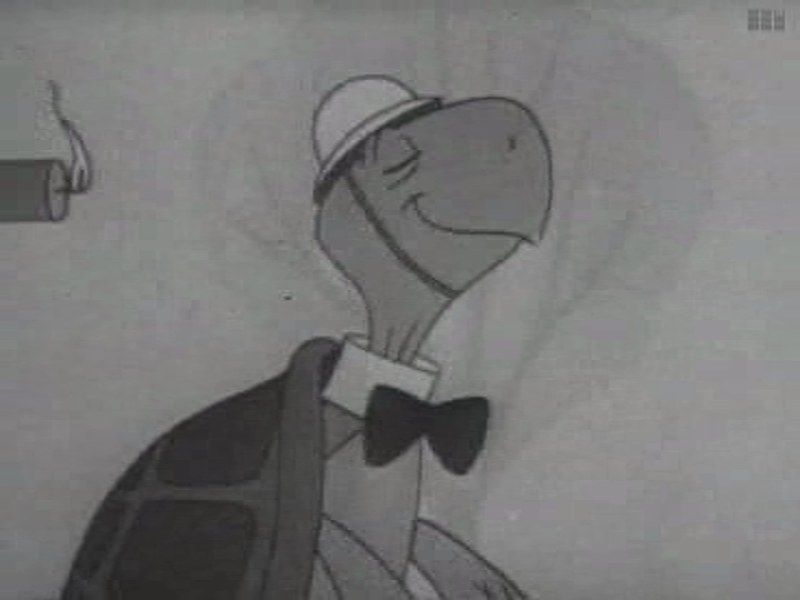
Bert the Turtle, frame from Duck and Cover (Archer Productions for the Federal Civil Defense Administration, produced 1951, released January 1952). Internet Archive, Prelinger Archives copy. Public domain; still taken from the video, low resolution.
What happened
- 29 August 1949. The Soviet Union detonates its first atomic device (RDS-1) in Kazakhstan, ending the U.S. monopoly. U.S. officials and the public begin to treat an atomic attack on American cities as a planning problem (History.com).
- 1950. The National Security Resources Board's Civil Defense Office issues the adult booklet Survival Under Atomic Attack (see below). Its "survival secrets" include dropping flat on the ground or floor and burying the face in the arms. Drills for schoolchildren begin in the 1950-51 school year in target cities including New York, Los Angeles, Chicago and Detroit. Early drills were unannounced: a teacher shouted "Drop!" and pupils knelt with their hands behind their necks (JoAnne Brown, as summarised by Slate).
- January 1951. President Truman creates the Federal Civil Defense Administration. Congress gave it no money for public shelters, so it put out educational material instead (Slate, citing the historians' accounts).
Show all 9Show fewer
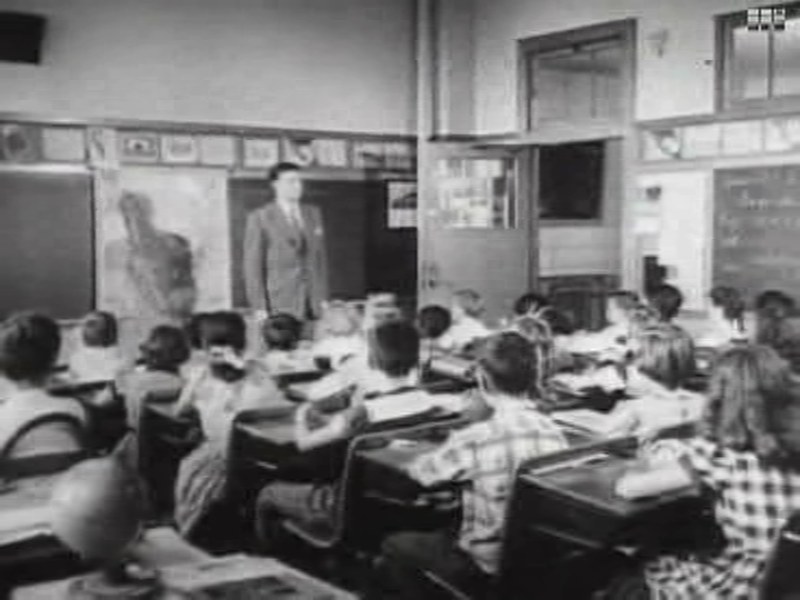
- 1951. The FCDA works with Archer Productions, a New York company, on Duck and Cover. It was shot at a school in Astoria, Queens, with local teachers and children. Writer: Raymond J. Mauer. Director: Anthony Rizzo. Narrator: Robert Middleton. The film runs 9 minutes 15 seconds, mixes animation with live action, and was first shown publicly in January 1952, so sources date it to either year (Wikipedia; Internet Archive record).
- 1951. Some school systems issue identification tags to pupils. New York's school budget included $87,000 for them. Supporters described them as a way to identify children after an attack; some also saw them as a kind of protective charm (Slate).
- 1950-1953. Opposition appears. In 1950 Mary Jane Melish tried to organise New York parents against the drills; the New York Times reported that teachers were told to smile, treat the drills as a game and offer entertainment. When the Levittown Educational Association opposed the film, a Nassau County civil-defense spokesman, Forrest Corson, called the criticism Communist-inspired (Slate).
- 5 May 1955. The FCDA's Operation Cue (the Apple-2 shot, 29 kilotons, Nevada) exposes houses, stocked with mannequins and canned food, to a nuclear blast. The FCDA distributes a short film about the test (Wikipedia).
- Late 1950s and 1960s. Emphasis moves from ducking to fallout shelters. In 1960 and 1961 groups of New York mothers refused to take cover during air-raid drills (Dee Garrison, as summarised by Slate).
- 2004. The Library of Congress selects the film for the National Film Registry, saying it "was seen by millions of schoolchildren in the 1950s".
Explain moreShow less
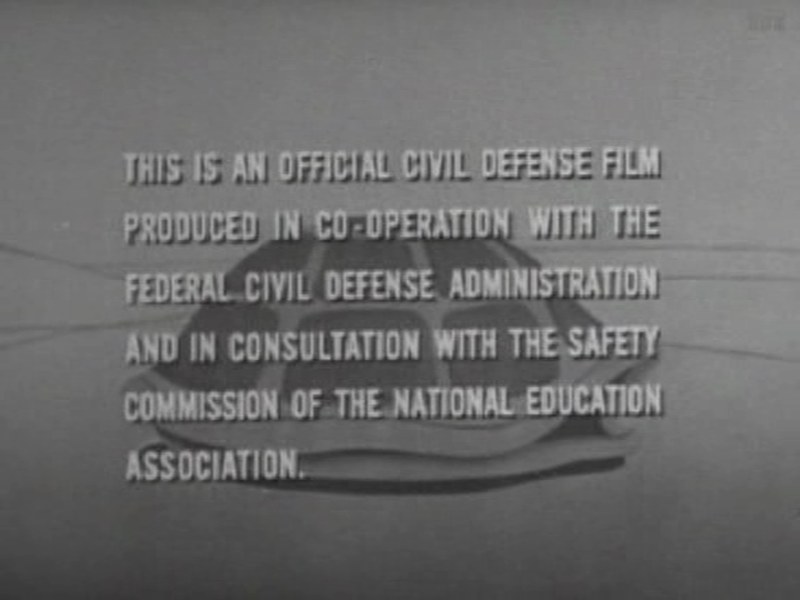
Title card from Duck and Cover. The film names its government sponsor and the NEA's Safety Commission on screen. Internet Archive, Prelinger Archives copy. Public domain.
How it works
The film is open about who made it. Its first card calls it "an official civil defense film" made with the FCDA, so it is a state product with an attributed source, not a covert one. What it does with that position:
Explain moreShow less
- Fear appeal: the narrator tells children that "the atomic bomb is very dangerous", describes a flash "brighter than the sun", and says it could knock them down, throw them against a wall, break glass across town and burn them "worse than a terrible sunburn". The fear is real content here, not an invention: the threat the film names is a real weapon. What the scoring looks at is the structure. The danger is delivered to children together with a single action that is presented as the answer.
- Euphemism / doublespeak: the cartoon turtle, the friendly narration and the likening of the bomb to fire and traffic ("we are ready for fire... we have safety rules for cars... now we must be ready for a new danger") put atomic attack in the same category as ordinary hazards. Brown's research found educators avoiding the words "atom bomb" and "death" in favour of "emergency" or "disaster", and a New York educator praised the film's "cheerfulness and optimism" (Slate). The FCDA's instruction to educators was reported as "warn, but don't frighten" (Slate).
- Repetition and the illusory truth effect: the film repeats the two-word instruction throughout ("duck and cover") in every setting it shows: classroom, corridor, lunch table, school bus, doorway, schoolyard, a picnic. The drills extend the same method from film to muscle memory. A drill is repetition by design.
- Card stacking: the film shows the cases where the instruction helps, in a world where "most of the time we will be warned" and the flash is at some distance. It does not show what happens to a person near the explosion, and it teaches no distinction between distances. Whether that is selective emphasis or a fair choice for a nine-minute film for children is part of what historians dispute (see below).
Classroom frame from Duck and Cover. The live-action sections were shot with local teachers and pupils at a school in Astoria, Queens. Internet Archive, Prelinger Archives copy. Public domain.
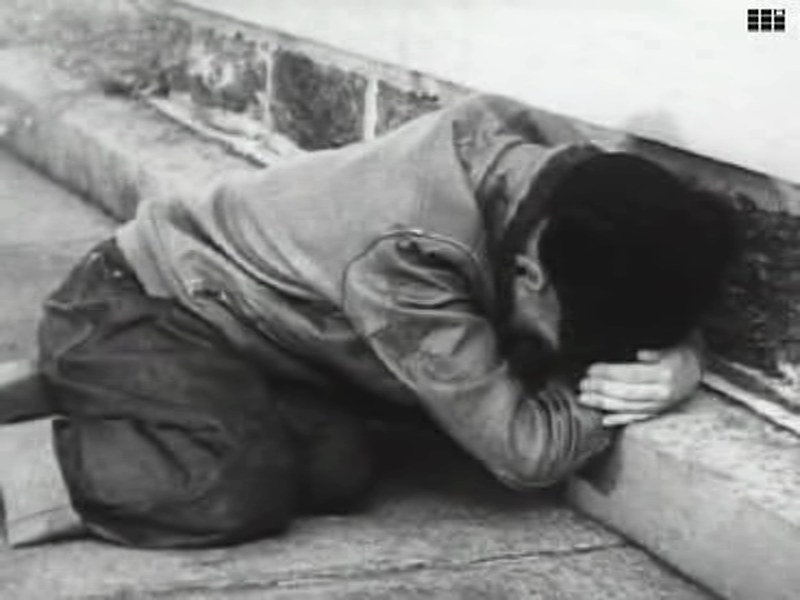
Frame from Duck and Cover: the instruction in action, face down against a wall with the neck covered. Internet Archive, Prelinger Archives copy. Public domain.
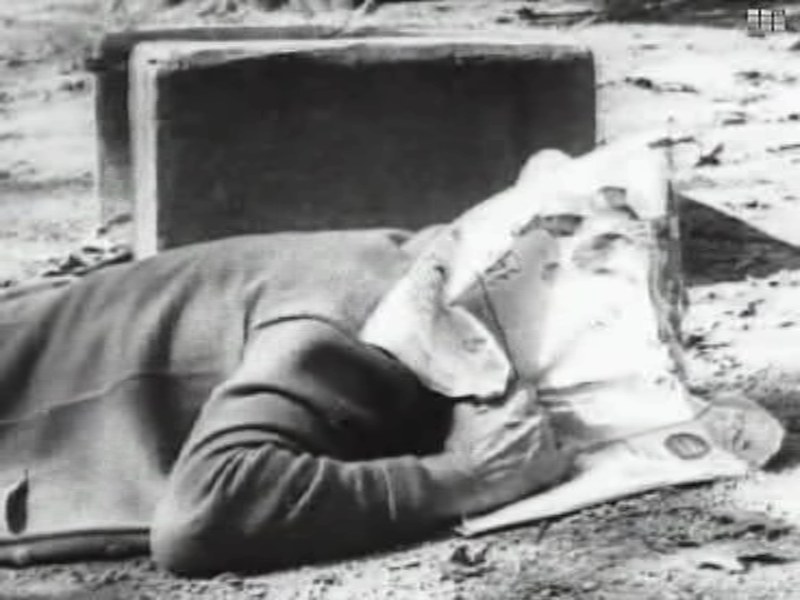
Frame from Duck and Cover's picnic sequence: children caught outdoors are shown lying on the ground and covering themselves with whatever is to hand, here a cloth or paper. The film says that "even a newspaper" helps against a burn. Internet Archive, Prelinger Archives copy. Public domain.
Then and now
Survival Under Atomic Attack (official U.S.
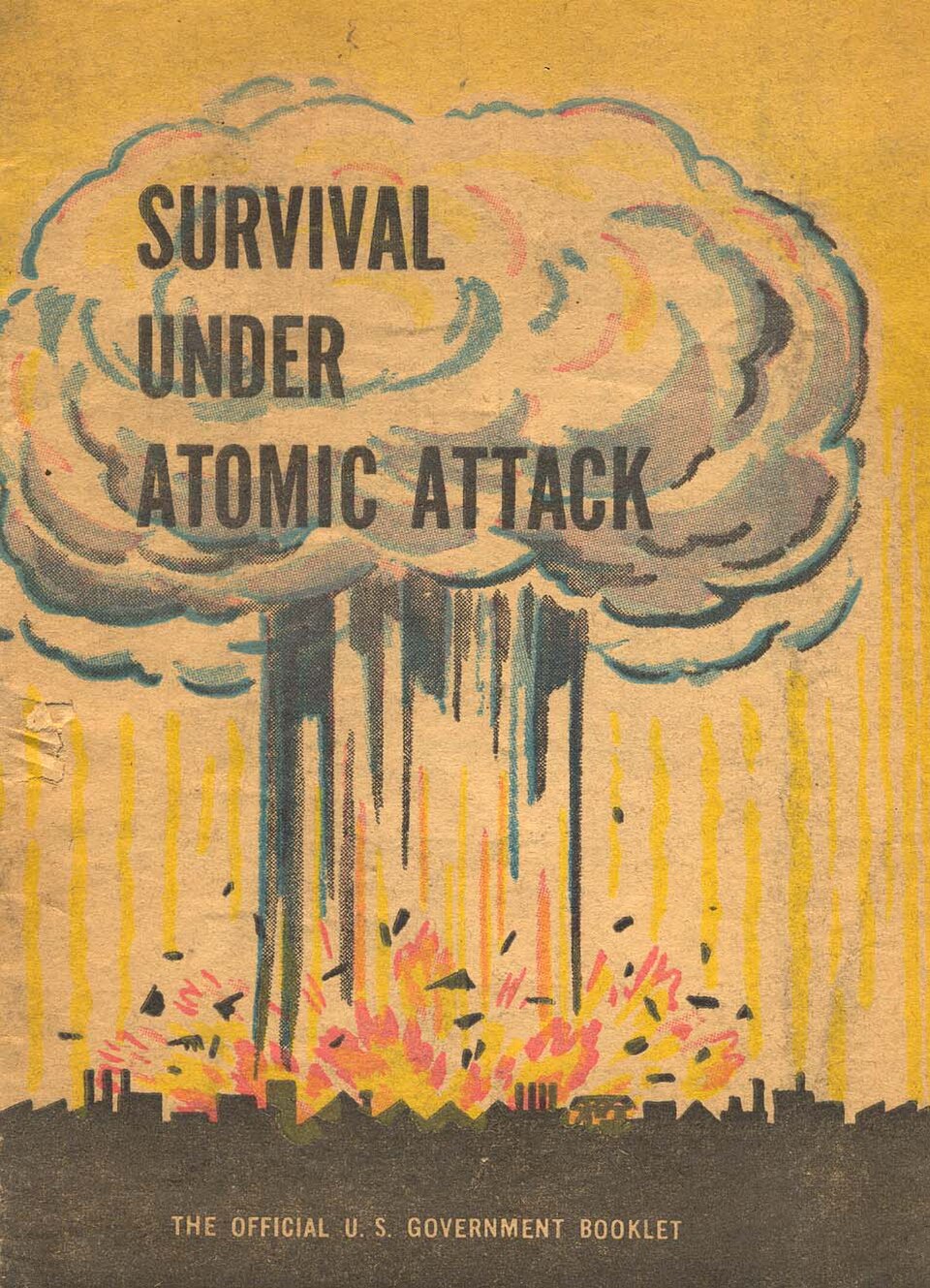
Survival Under Atomic Attack (official U.S. Government booklet, cover), National Security Resources Board, Civil Defense Office, 1950. Public domain.
The adult booklet that preceded the film carries the same advice for grown-ups and uses a plainer, grimmer register. The film re-presents it for schoolchildren with a character and a song. Both are state products aimed at the public, so the comparison shows one message adjusted to two audiences.
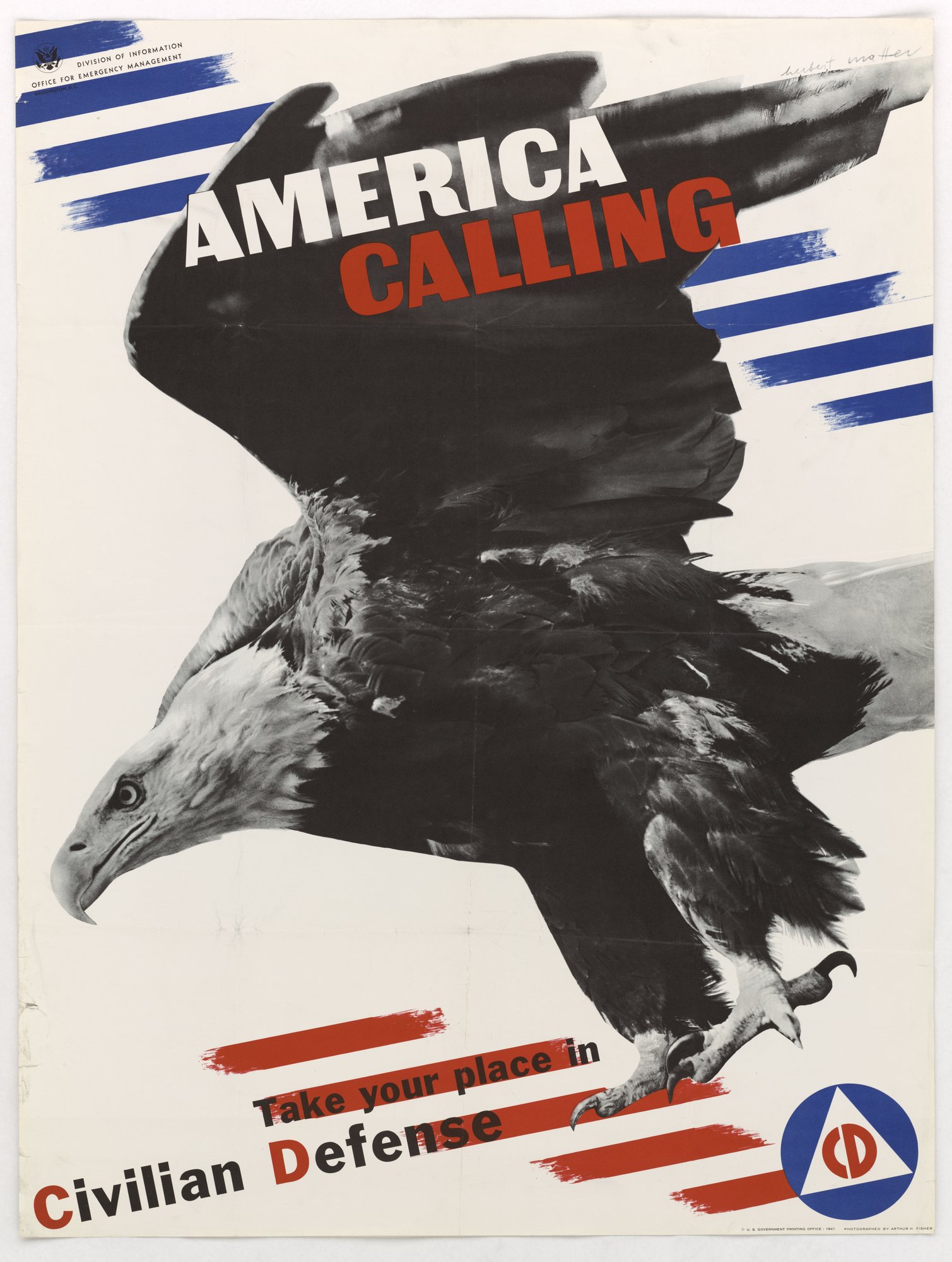
America Calling: Take your place in Civilian Defense, U.S. Office of Civilian Defense, 1941. Public domain.
Civil-defence appeals did not start in 1951. A decade earlier the U.S. government's Office of Civilian Defense recruited volunteers for air-raid wardens and blackouts in the Second World War, when attack was a present possibility on both coasts. The difference is the weapon: a drill that was a sensible response to incendiary and high-explosive bombs in 1941 was being asked, in 1951, to answer a weapon that could destroy a city.
The Soviet counterpart
The Soviet Union ran its own civil-defence system for the same reason: it too faced an adversary with atomic weapons. The record available to this page is thinner than the U.S. one, and this section says what is documented.
Explain moreShow less
- Structure. The Soviet local air-defence organisation, the MPVO, was reorganised in 1949 and became the Civil Defence of the USSR in 1961 (Academy of the Ministry of Emergency Situations history, via Wikipedia). In September 1951 the paramilitary society DOSAAF succeeded OSOAVIAKHIM and took on civil-defence training and instruction, per a CIA report of the 1950s and a GlobalSecurity history of Soviet civil defence.
- Children. Vladislav Zubok and Constantine Pleshakov, in Inside the Kremlin's Cold War, are cited for the statement that Soviet children received "almost identical classes" on countermeasures to those in the U.S. (as reported in Wikipedia, "Duck and cover"). Margaret Peacock's Innocent Weapons (2014) compares Soviet and American politics of childhood in the Cold War; its detailed material on children's drills could not be opened for this page.
- Differences on the record. The U.S. programme was a federal agency producing educational materials, with Congress refusing shelter money and the drills run city by city. The Soviet programme was run through state and quasi-state organisations. The U.S. case also had a public opposition on record: parents' groups, a teachers' association and press coverage. This page has found no equivalent Soviet public argument, which is consistent with the Soviet press being state-controlled and is not proof that no one objected.
- Image gap. No verified, openly licensed Soviet civil-defence image from the 1950s is hosted here; see the gaps below.
Positions on the record
8 items · The FCDA and its supporters: the programme taught a simple action to children who might…
- The FCDA and its supporters: the programme taught a simple action to children who might be caught away from shelter, and the agency's aim was to prepare people without frightening them. A once-classified 1950s war game, described by the National Security Archive, estimated that about 27 million Americans could have been saved with civil-defence education (Wikipedia cites this).
- Spencer Weart: the training was a rational use of Second World War sheltering techniques, suited to the very small number of bombs that existed in the early 1950s; The Atomic Cafe (1982) later made it look absurd (Slate).
- Alex Wellerstein: at the time the Soviet Union had only a handful of Nagasaki-sized bombs. Ducking could help against a blast some distance away but not one overhead, and the FCDA did almost no testing of whether its materials worked. He also argues that physically practising a drill makes the threat feel real (Slate; History.com).
- Guy Oakes (The Imaginary War, 1994): the drills had more psychological than practical use; they kept the danger in public view while telling Americans that something could be done.
- Melissa Smith (British Journal for the History of Science, 2010) calls the instruction propaganda.
- JoAnne Brown: educators gained professional standing by joining civil defence, which helped them answer attacks on public schools (Slate).
- Dee Garrison: civil defence in schools helped radicalise some students and parents later into antiwar and antinuclear activism. Anecdotes support this, such as Joan Baez refusing to take part in a drill, Todd Gitlin's account of fear and Robert Musil's of numbness; Slate notes that no systematic study of the drills' psychological effect exists.
- This archive's reading: documented are the film, its credits, the sponsor, the drills, the tags, the cost figure and the tests. Disputed: how far the advice would have helped in a real attack and what the drills did to children. Not shown: that the film was a covert operation (it names its sponsor), or that the programme produced a measurable change in children's mental health either way.
Same-method test
A Soviet children's film made by a state-linked body that named its sponsor, used a friendly animal to explain a "new danger",…
A Soviet children's film made by a state-linked body that named its sponsor, used a friendly animal to explain a "new danger", compared the enemy bomb to fire and traffic, and drilled schoolchildren to cover their necks at a flash would score the same on Fear appeal, Euphemism / doublespeak and Repetition and the illusory truth effect as the U.S. film. Differences in scale and context remain: the U.S. programme drew open public criticism that the press reported, while the Soviet press was state-controlled, and the two countries held different numbers of weapons in the early 1950s (the U.S. far more). The method is the same and the political setting is not.
How to spot it
- Check who the sponsor is and whether the piece says so. This one does, in its first card.
- Look for tone doing the work of information: a happy cartoon about a weapon is a choice about how to feel, not a statement about the weapon.
- Ask what range of cases the advice covers and whether the piece tells you where it stops working.
Show all 5Show fewer
- Treat a drill as part of the message: practising an action makes it seem both necessary and manageable.
- Read criticism and defence from the same decade; Levittown's teachers and the FCDA's spokesman both left a record.
Sources and further reading
Images
5 items · A photograph of a 1950s New York school drill. Press and agency photographs exist, but…
| Image | Source | Licence |
|---|---|---|
| Duck and Cover stills (Bert; official-film title card; classroom; boy at wall; picnic sequence), Archer Productions for the FCDA, 1951 | Internet Archive, Prelinger Archives | Public domain (Internet Archive licence marker "publicdomain"; official U.S. civil defense film) |
| Survival Under Atomic Attack booklet cover, 1950; America Calling, 1941 | FRAME gallery | Public domain |
Image gaps
- A photograph of a 1950s New York school drill. Press and agency photographs exist, but none was found with a verified public-domain status. Held.
- The pupil identification tags. Photographs exist in the archival record; none found here with a verified licence. Held.
- Operation Cue photographs (houses and mannequins). U.S. government test photographs are normally public domain, but no file was checked in this pass. Fillable from NARA or the DOE/Nevada Test Site collections.
- A Soviet civil-defence poster or children's textbook page from the 1950s. Not found with a verified open licence. Fillable from Russian or Commons archives.
- A higher-resolution scan of the film. The stills here come from a low-resolution video copy; a NARA or Library of Congress scan would improve them.
Sources
10 items · Duck and Cover (Archer Productions, Inc., for the Federal Civil Defense Administration,…
- Duck and Cover (Archer Productions, Inc., for the Federal Civil Defense Administration, 1951-1952), 9 min 15 s; Prelinger Archives copy, Internet Archive. Library of Congress National Film Registry, 2004.
- National Security Resources Board, Civil Defense Office, Survival Under Atomic Attack (Washington: Government Printing Office, 1950).
- Guy Oakes, The Imaginary War: Civil Defense and American Cold War Culture (New York: Oxford University Press, 1994).
- Dee Garrison, Bracing for Armageddon: Why Civil Defense Never Worked (New York: Oxford University Press, 2006).
- Melissa Smith, article on duck and cover, The British Journal for the History of Science, 2010 (cited as summarised in Wikipedia).
- Vladislav Zubok and Constantine Pleshakov, Inside the Kremlin's Cold War: From Stalin to Khrushchev (Cambridge, MA: Harvard University Press, 1996).
- Margaret Peacock, Innocent Weapons: The Soviet and American Politics of Childhood in the Cold War (Chapel Hill: University of North Carolina Press, 2014).
- Slate, "Are duck-and-cover school drills from the nuclear era a useful parallel to active shooter drills?" (2018), summarising Brown, Weart, Wellerstein and Garrison.
- History.com, "How 'Duck-and-Cover' Drills Channeled America's Cold War Anxiety".
- Wikipedia, "Duck and Cover (film)", "Duck and cover", "Operation Cue", used for production credits, dates and secondary citations.