In one line: from 1971 Mobutu's government renamed the country, its river, its people and their clothes in the name of African authenticité, then wrote into the 1974 constitution that the ruling party was the nation, that every citizen belonged to it from birth, and that the doctrine to be taught in schools was "Mobutism".
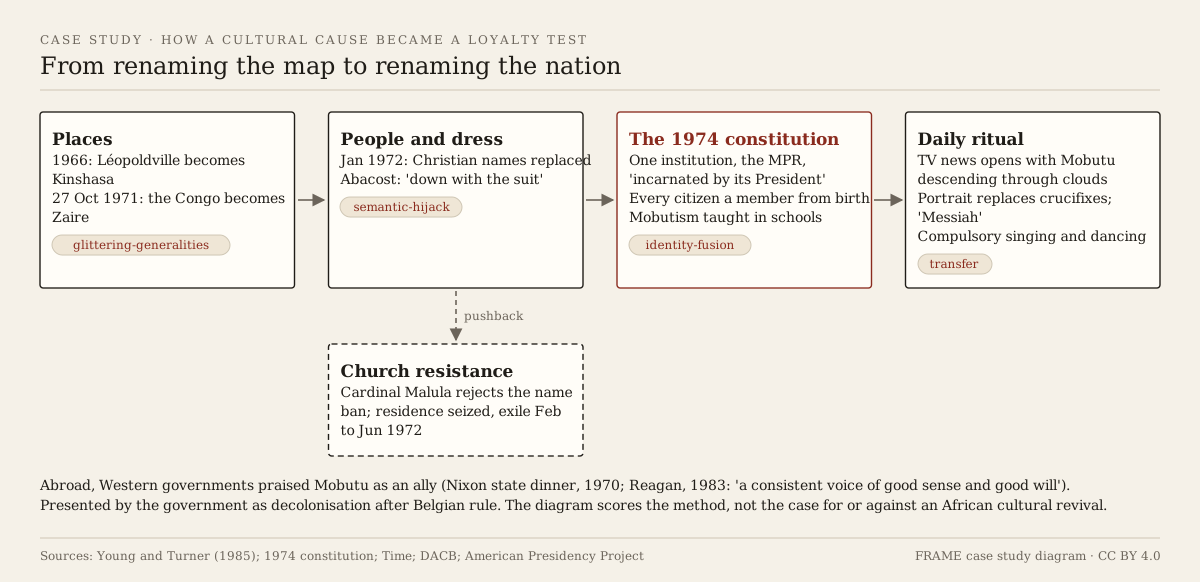
What happened
- 1966. Colonial city names are replaced: Léopoldville becomes Kinshasa, Stanleyville Kisangani, Élisabethville Lubumbashi. (Sources give 3 May or June 1966.) These renamings came before authenticité had a name.
- 27 October 1971. Mobutu announces that the Democratic Republic of the Congo will be called the Republic of Zaire. The Congo River becomes the Zaire River; Katanga province later becomes Shaba. The policy is called recours à l'authenticité, "recourse to authenticity": a return to African names, customs and dress after Belgian colonial rule.
- January 1972. Citizens with Christian or European first names are ordered to replace them with African ones. Joseph-Désiré Mobutu becomes Mobutu Sese Seko Kuku Ngbendu wa Za Banga, officially translated as "the all-powerful warrior who, because of his endurance and inflexible will to win, will go from conquest to conquest, leaving fire in his wake". Citoyen and citoyenne ("citizen") replace monsieur and madame.
- 1972 to 1973. The abacost, from à bas le costume ("down with the suit"), a collarless tunic worn without a tie, becomes the required dress for men in public life; Western suits and ties are discouraged and then banned. Sources link its final form to Mobutu's 1973 visit to Beijing.
- 1972. Cardinal Joseph-Albert Malula, Archbishop of Kinshasa, tells his bishops to ignore the ban on Christian names. On 24 January his residence is taken over as headquarters of the party youth wing (JMPR), and he spends 11 February to 28 June in exile in Rome.
- 15 August 1974. A new constitution states that there is a single institution, the MPR, "incarnated by its President", that the MPR is "the politically organized Zairian nation", that every Zairian is a member from birth, and that Mobutism is the national doctrine. Mobutism has no fixed text; it is described as the cumulative teaching of the president's statements and actions. By 1974 it is taught in schools in place of religious instruction.
- About 1974. Interior Minister Engulu Baanga Mpongo tells a party gathering, as Time reported: "God has sent a great prophet, our prestigious Guide Mobutu. This prophet is our liberator, our Messiah. Our Church is the MPR. Its chief is Mobutu. That is why the crucifixes must be replaced by the image of our Messiah." In late 1974 and 1975 religious schools (which ran most of the country's schools) are nationalised, public Christmas is dropped, and crucifixes in public buildings give way to Mobutu's portrait.
- Daily ritual. Evening news on Télé Zaïre opens with an image of Mobutu descending through clouds, a sequence attributed to Information Minister Dominique Sakombi Inongo. Animation politique et culturelle, state-scripted singing and dancing in praise of the party and its founder, is required at workplaces, schools and public events, performed by trained troupes known as animateurs. Officials wear lapel badges with his portrait, and he is styled Guide, Father of the Nation and Helmsman.
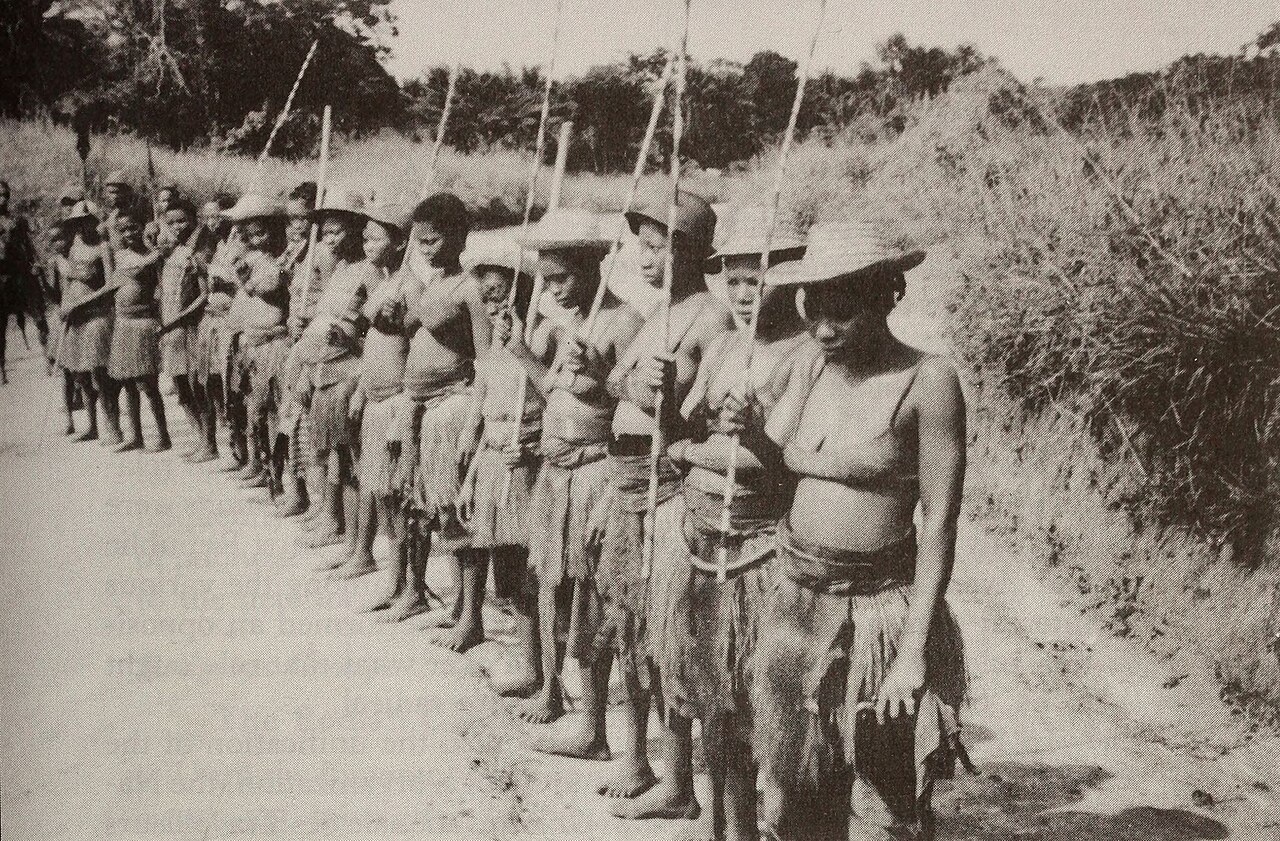
Animateurs, the MPR's organised cheerleaders, after a rally in Équateur Region, Zaire, between 1980 and 1993. Library of Congress Federal Research Division, public domain. - 30 October 1974. The Muhammad Ali v George Foreman fight in Kinshasa, underwritten by the government (about US$10 million, $5 million to each fighter), is billed on posters in the capital as "a gift to the Zairean people from Citizen-President Mobutu Sese Seko" and, in another reported slogan, as "a victory for Mobutuism". - 1990. Mobutu announces a return to multiparty politics, and the suit and tie are allowed again.
How it works
- Identity fusion: the 1974 constitution makes the party the "politically organized nation" and every citizen a member from birth. Under that wording, opposing the party or its founder is written as leaving the nation itself.
- Semantic hijacking: authenticité began as a claim about culture (African names, dress and customs over colonial ones). Once "Mobutism", defined as whatever the president had said and done, became the doctrine of the authentic nation, the prestige of decolonisation covered loyalty to one man.
- Transfer: religious imagery is moved onto the ruler. The news opens with him coming down from the clouds, a minister calls him "Messiah" and "prophet", and his portrait hangs where crucifixes had. The anti-colonial cause lends its prestige the same way: dropping a Belgian name for an African one is presented as the same act as accepting the MPR.
- Glittering generalities: "authenticity", "the people" and "the revolution" are virtue words that stand in for a testable programme. The one measurable claim, a return to pre-colonial custom, sat beside things with no pre-colonial source: a Beijing-inspired tunic, a single party and a presidential doctrine.
Then and now
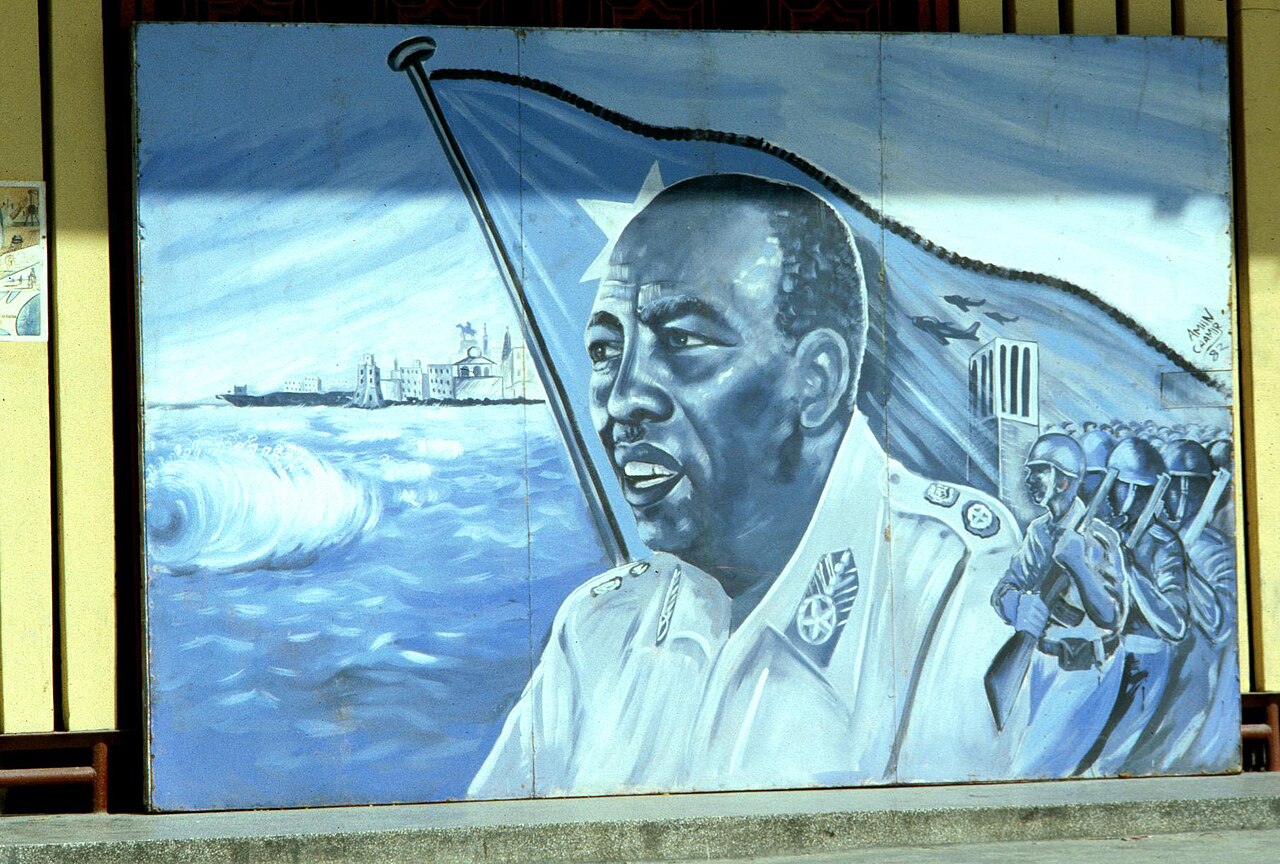
Barre Cult of Personality Mural, Somali Democratic Republic, 1976. CC0, University of Wisconsin Libraries.
In the same decade, and on the same continent, Somalia's government painted Siad Barre's face into the national flag. Zaire did in law and daily routine what the mural did in paint: it made the leader and the nation one object. The differences matter as much. Barre's state was Soviet-aligned until 1977 and called its doctrine "scientific socialism". Zaire was Western-aligned and presented authenticité as an African alternative to both capitalism and communism. The same device served opposite Cold War camps.
Positions on the record
- As the government presented it: authenticité was decolonisation of the mind, restoring African names, dress and dignity after eight decades of Belgian rule, and the single party was presented as a way to hold a large, diverse country together after the civil wars of 1960 to 1965.
- Critics at the time: Cardinal Malula and the Catholic bishops objected to the ban on Christian names and the replacement of religious symbols; the government answered with the measures listed above.
- Western governments: the United States, France and Belgium backed Mobutu as an anti-communist ally. President Nixon hosted him at a state dinner on 4 August 1970 and met him again in the Oval Office on 10 October 1973. On 4 August 1983 President Reagan called him "a consistent voice of good sense and good will" in African and international councils. In June 1989 President Bush called him "one of our most valued friends" on the continent. French and Belgian paratroopers intervened at Kolwezi in May 1978 during the Shaba II invasion. This page records these statements as positions, not as part of the domestic campaign.
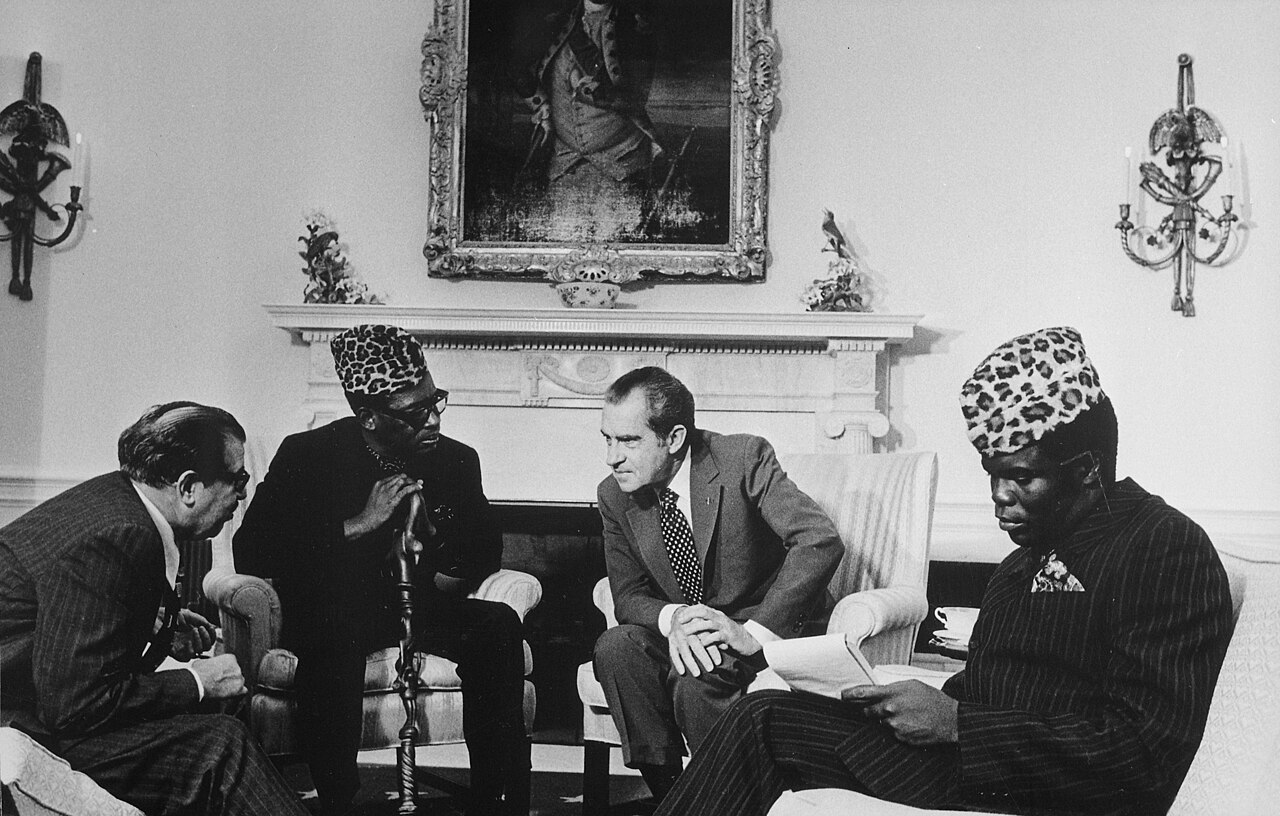
President Nixon meets President Mobutu, Oval Office, 10 October 1973. White House Photo Office (Jack E. Kightlinger), public domain. - What is documented: the renamings, the name and dress decrees, the 1974 constitutional text, the Engulu speech as reported, the church measures, and the fight posters. - What is not shown here: exact years the cloud sequence ran, and article numbers of the 1974 constitution, which the sources used for this page summarise but do not quote by article.
Same-method test
Any government that wrote into its constitution that one party is the nation, enrolled every citizen in it at birth and made the leader's accumulated sayings the school doctrine would be scored the same way here, whatever its alignment and whether the symbols it borrowed were religious, anti-colonial or patriotic.
How to spot it
- Check whether a cultural or national cause has been given an official definition that ends in one person's words. "Authentic" defined as "what the Guide said" is a loyalty test, not a cultural one.
- Look for membership that cannot be refused. "Every citizen is a member from birth" removes the possibility of opting out of the party without appearing to opt out of the country.
- Notice when religious language (prophet, messiah, descending from the sky) is attached to a living officeholder by his own ministers and broadcasters.
Images
| Image | Source | Licence |
|---|---|---|
| Mechanism diagram (above) | Drawn for FRAME from the sources below (make_diagrams_regions.py) |
CC BY 4.0, FRAME |
| Mobutu's face on a television broadcast (1973) | Wikimedia Commons (Nationaal Archief / Anefo) | CC0 |
| Mobutu and MPR political bureau members (1970) | Wikimedia Commons | Public domain |
| Animateurs after an MPR rally, Équateur Region | Wikimedia Commons (Library of Congress) | Public domain |
| Nixon and Mobutu, Oval Office (1973) | Wikimedia Commons (White House Photo Office) | Public domain |
| Barre mural (1976) | FRAME gallery | CC0 |

Mobutu's face during a Télé Zaïre broadcast, 24 October 1973. Photo: Rob Mieremet / Anefo, Nationaal Archief, CC0. The nightly news device described above, in a photograph from the same period.
Image gaps
- Zaire 74 fight posters. No openly licensed scans were found.
- Engulu's speech and the 1974 constitution. Available only as quotation and translation; no scan of an official gazette was reachable from the build environment.
Sources
- Crawford Young and Thomas Turner, The Rise and Decline of the Zairian State (University of Wisconsin Press, 1985).
- Michela Wrong, In the Footsteps of Mr Kurtz: Living on the Brink of Disaster in Mobutu's Congo (Fourth Estate, 2000).
- Kenneth Lee Adelman, "The Recourse to Authenticity and Négritude in Zaïre", Journal of Modern African Studies.
- Constitution of the Republic of Zaire (1974), English translation, Wikisource.
- "Religion: Mobutu as Messiah", Time (archive).
- Dictionary of African Christian Biography, Joseph-Albert Malula.
- Bob W. White, Rumba Rules: The Politics of Dance Music in Mobutu's Zaire (Duke University Press, 2008).
- "Dancing Disorder in Mobutu's Zaire: Animation Politique and Gendered Nationalisms", Duke University Press.
- Origins (Ohio State University), "The Rumble in the Jungle".
- American Presidency Project: Nixon and Mobutu toasts, 4 August 1970; Reagan remarks, 4 August 1983.
- George H.W. Bush Presidential Library, remarks following discussions with President Mobutu, June 1989.
- Thomas P. Odom, Shaba II: The French and Belgian Intervention in Zaire in 1978 (U.S. Army Combat Studies Institute).
- Association for Diplomatic Studies and Training, "Kleptocracy and Anti-Communism: When Mobutu Ruled Zaire".