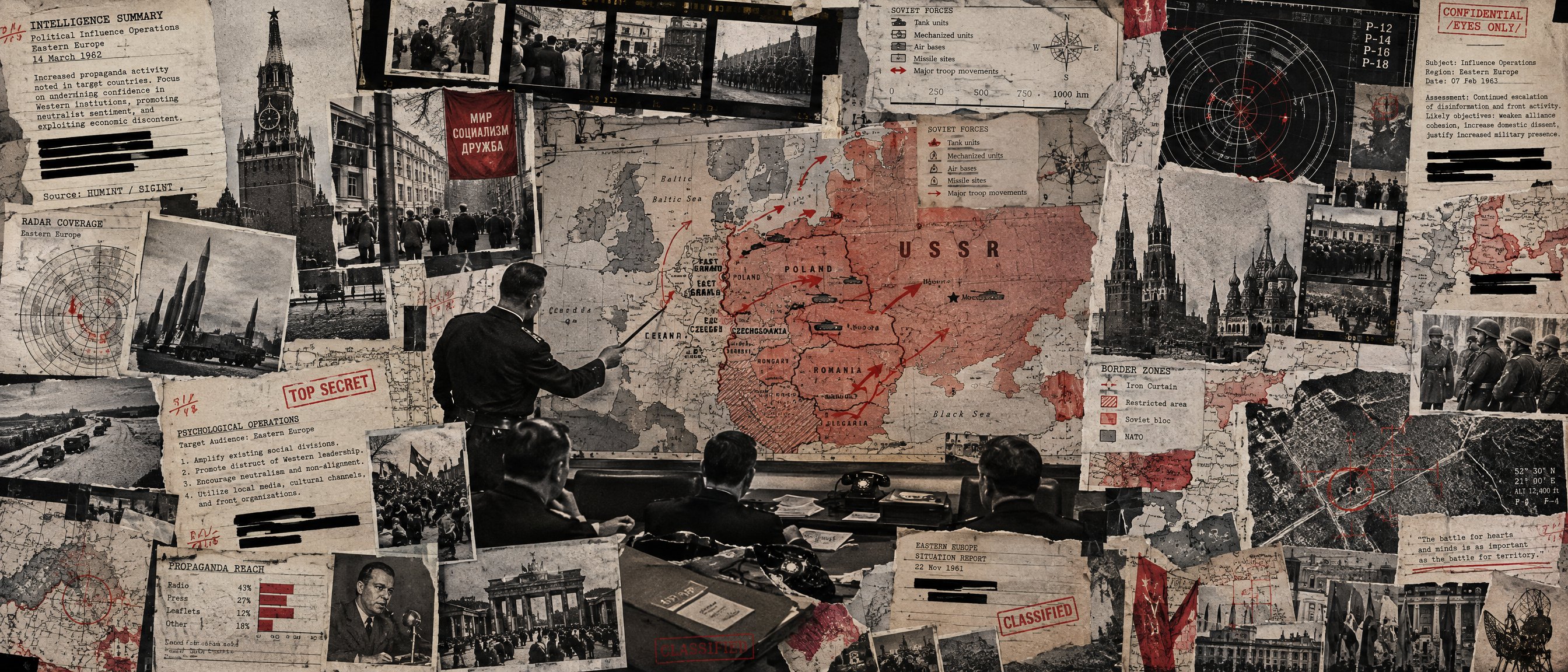
In one line: the Senate's Church Committee (1976) and Carl Bernstein's Rolling Stone article (1977) document a CIA that kept covert relationships with about 50 American journalists, used news organisations for cover and placed propaganda in foreign media; a CIA document uses the name "Project Mockingbird" only for a 1963 wiretap of two Washington columnists, and the sweeping "Operation Mockingbird" of popular retelling, a single programme that controlled U.S. newsrooms, is not in the Church report, in Bernstein's article or in the declassified CIA memo.
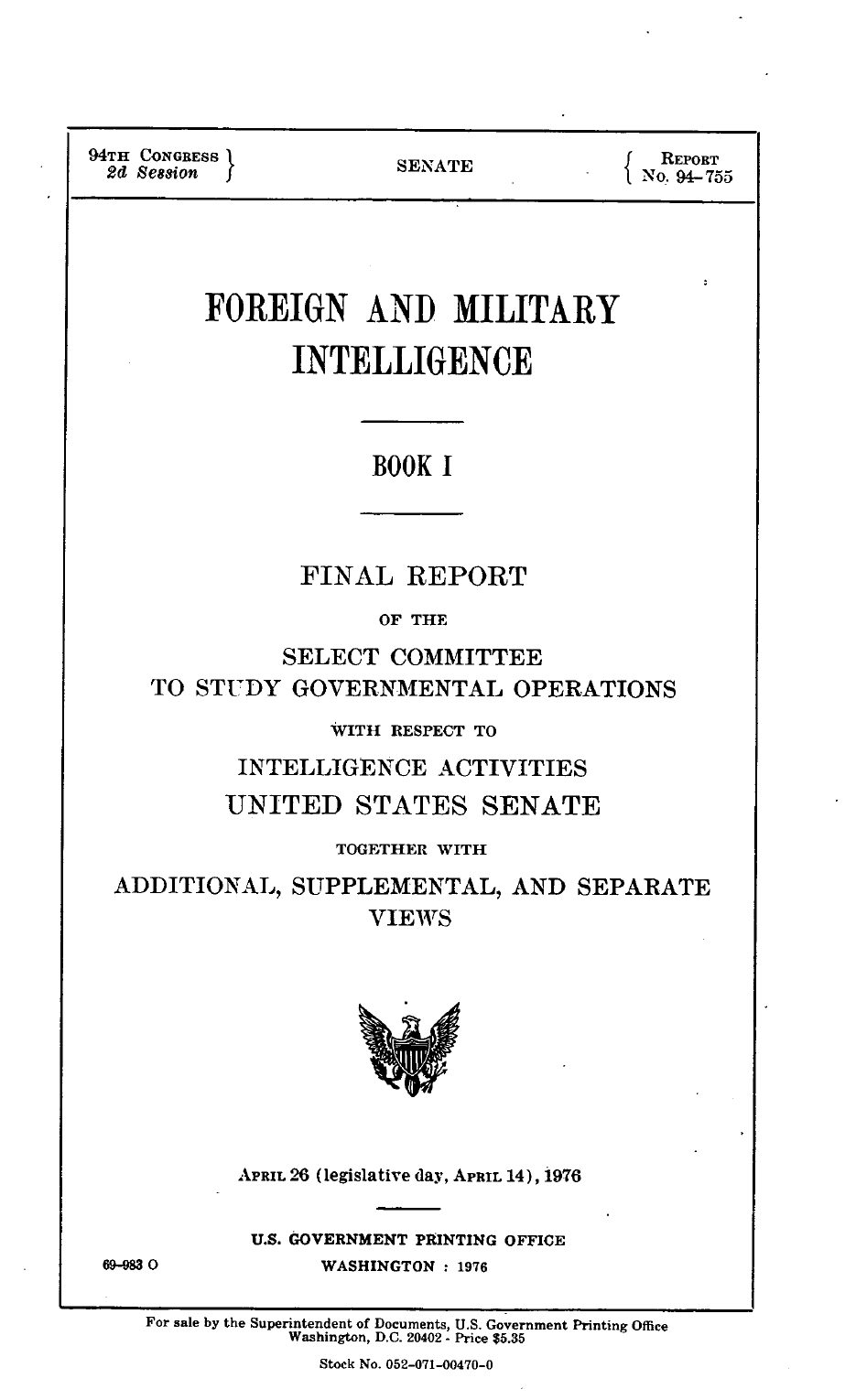
Title page, Book I, "Foreign and Military Intelligence", Final Report of the Senate Select Committee to Study Governmental Operations with Respect to Intelligence Activities, S. Rep. 94-755 (April 1976). U.S. government work, public domain; rendered from the Senate's PDF.
What happened
- June 1948. The CIA's Office of Policy Coordination (OPC) is created for "psychological warfare, political warfare, economic warfare, and paramilitary activities" (Church Committee, Book I). Frank Wisner is its director. Its budget goes from $4.7 million in 1949 to $82 million in 1952, and its stations from 7 to 47.
- 1950s to 1960s. According to Bernstein (1977), who cites CIA files and unnamed CIA officials, Allen Dulles and later directors set up a "recruiting-and-cover capability" inside American news organisations, and returning correspondents were debriefed as a matter of routine. Bernstein reports Wisner boasting of his "mighty Wurlitzer", a propaganda instrument "he built, and played, with help from the press". These are Bernstein's sourced accounts; the CIA did not release the files.
- 12 March to 15 June 1963. The CIA taps the telephones of two Washington newsmen suspected of publishing classified material, under the code name Project MOCKINGBIRD. A 1973 internal CIA compilation, later called the "Family Jewels", records this (see below).
Show all 9Show fewer
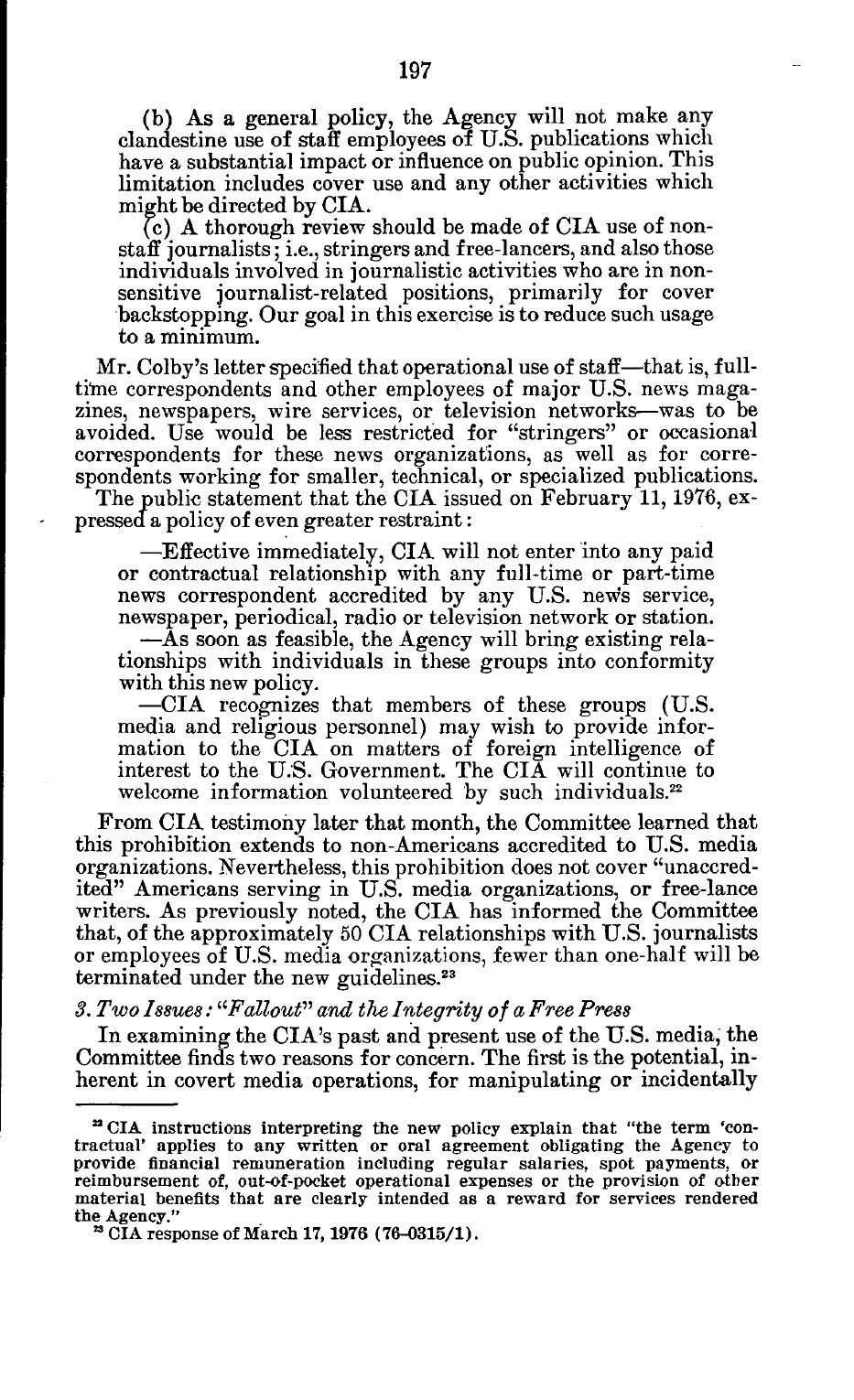
- Fall 1973. DCI William Colby sets limits, which he later described to the Committee: the agency will avoid clandestine use of staff employees of U.S. publications "which have a substantial impact or influence on public opinion", and will "reduce such usage to a minimum" for stringers and freelancers (Colby letter, 21 October 1975, quoted in Church Book I).
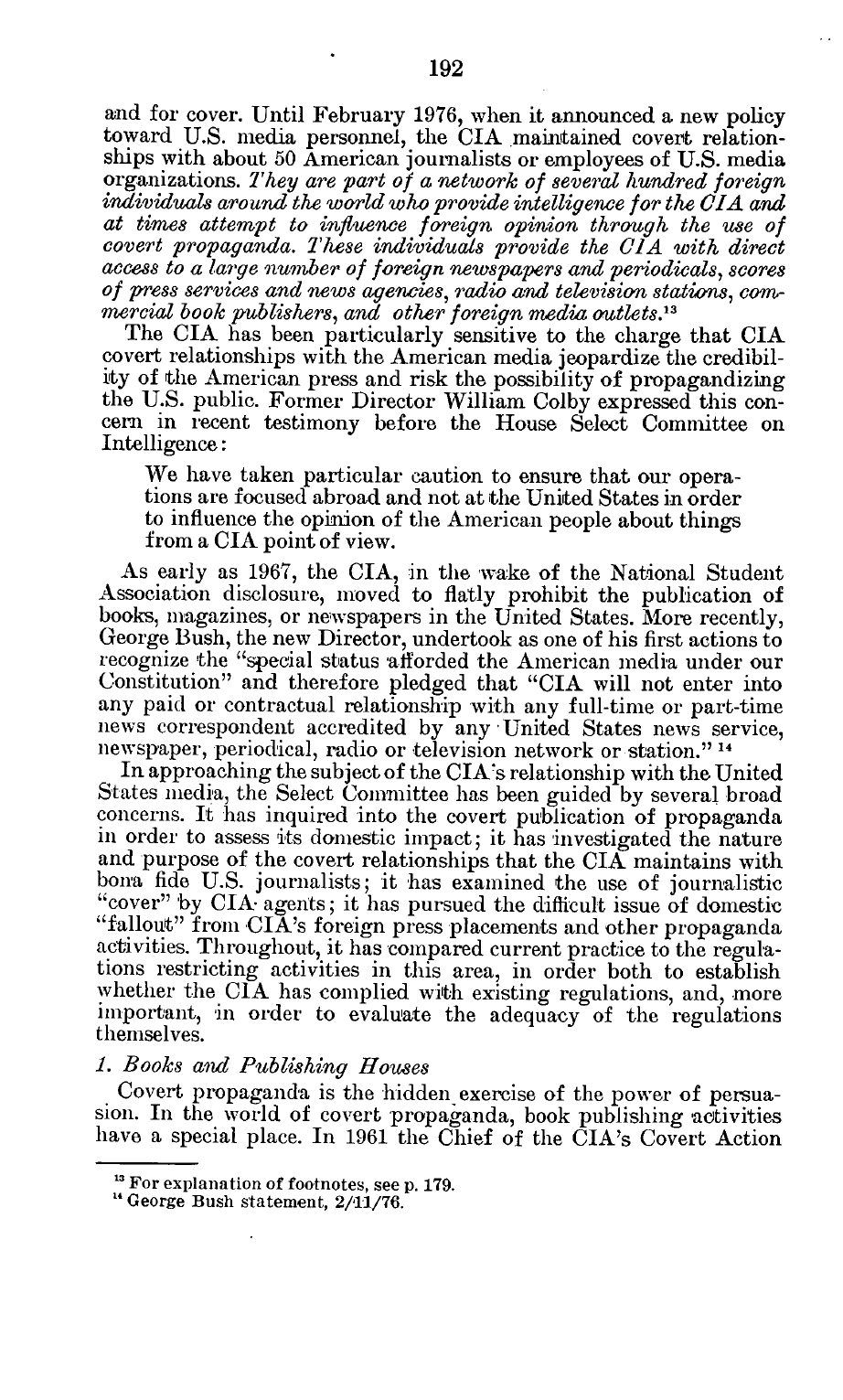
- 1975-1976. The Church Committee examines the subject. Its Book I reports that, until February 1976, the CIA "maintained covert relationships with about 50 American journalists or employees of U.S. media organizations", part of "a network of several hundred foreign individuals around the world who provide intelligence for the CIA and at times attempt to influence foreign opinion through the use of covert propaganda" (Book I, p. 192).
- 11 February 1976. DCI George H. W. Bush announces that "CIA will not enter into any paid or contractual relationship with any full-time or part-time news correspondent accredited by any U.S. news service, newspaper, periodical, radio or television network or station." The Committee notes that fewer than half of the roughly 50 relationships would end, because the rule did not cover "unaccredited" Americans, such as freelancers.
- 26 April 1976. The Committee's final report is filed. It recommends putting the prohibition into law and extending it to anyone who "regularly contributes material to" or helps edit U.S. media (recommendations 46 and 47).
- 20 October 1977. Bernstein's "The CIA and the Media" appears in Rolling Stone. It states that more than 400 American journalists had "secretly carried out assignments for the Central Intelligence Agency" over twenty-five years, "according to documents on file at CIA headquarters", and that the Church Committee had understated the matter.
- 1996. DCI John Deutch tells the Senate intelligence committee that an exception to the 1976 policy might be needed in "extremely rare...highly improbable circumstances". Congress then writes the policy into law (50 U.S.C. § 3324): intelligence agencies may not use as an agent or asset anyone with credentials as a correspondent of a U.S. news organisation, unless the President or the DNI waives it in writing for an "overriding national security interest", with notice to the intelligence committees (Congressional Research Service, 2024).
Explain moreShow less
Church Committee Book I, p. 192: "Covert Relationships with the United States Media". U.S. government work, public domain; rendered from the Senate's PDF.
What the documents say and do not say
The Church Committee (1976). Book I treats the media in two places. It says the CIA used the U.S. media "for both the collection of intelligence and for cover", that "more than a dozen United States news organizations and commercial publishing houses formerly provided cover for CIA agents abroad", and that "a few of these organizations were unaware that they provided this cover." It sorts the roughly 50 relationships into Colby's four categories: staff of general-circulation papers (nearly phased out, "only two current relationships"), staff of small or specialised publications (under ten), freelancers, stringers and "propaganda writers" (the largest group, "most are paid... virtually all are witting; few, however, of the news organizations... are aware"), and unpaid occasional contacts. It reports that the CIA gave the Committee summaries but not names. It also finds that "covert media operations can result in manipulating or incidentally misleading the American public": after the 1967 Katzenbach inquiry, a CIA directive said "Fallout in the United States from a foreign publication which we support is inevitable and consequently permissible", and since 1967 the agency had published "some 250 books abroad". The Committee was "concerned that the use of American journalists and media organizations for clandestine operations is a threat to the integrity of the press." The word "Mockingbird" does not occur in Book I.
Explain moreShow less
Church Committee Book I, p. 197: Colby's 1973 limits and the 11 February 1976 announcement. U.S. government work, public domain.
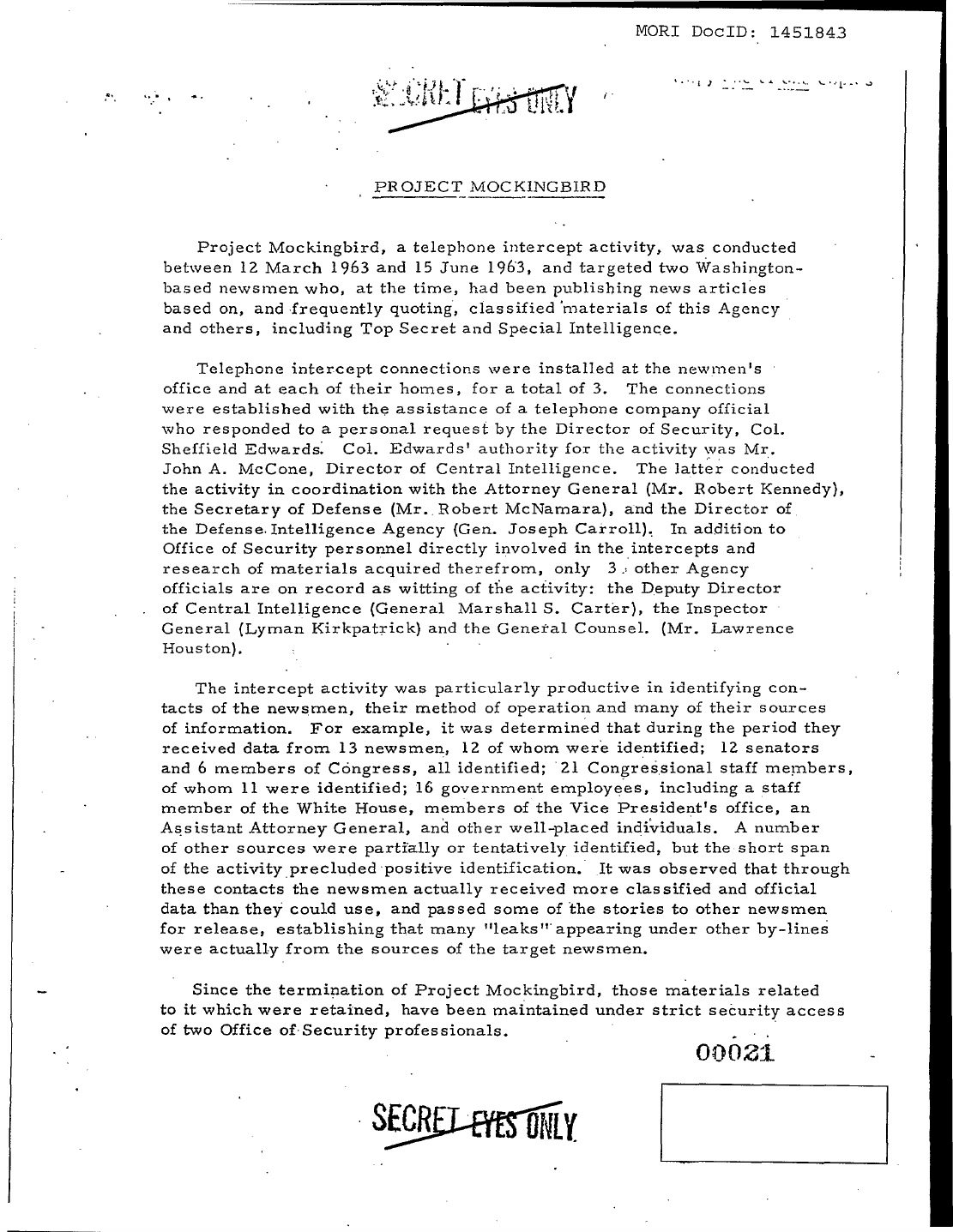
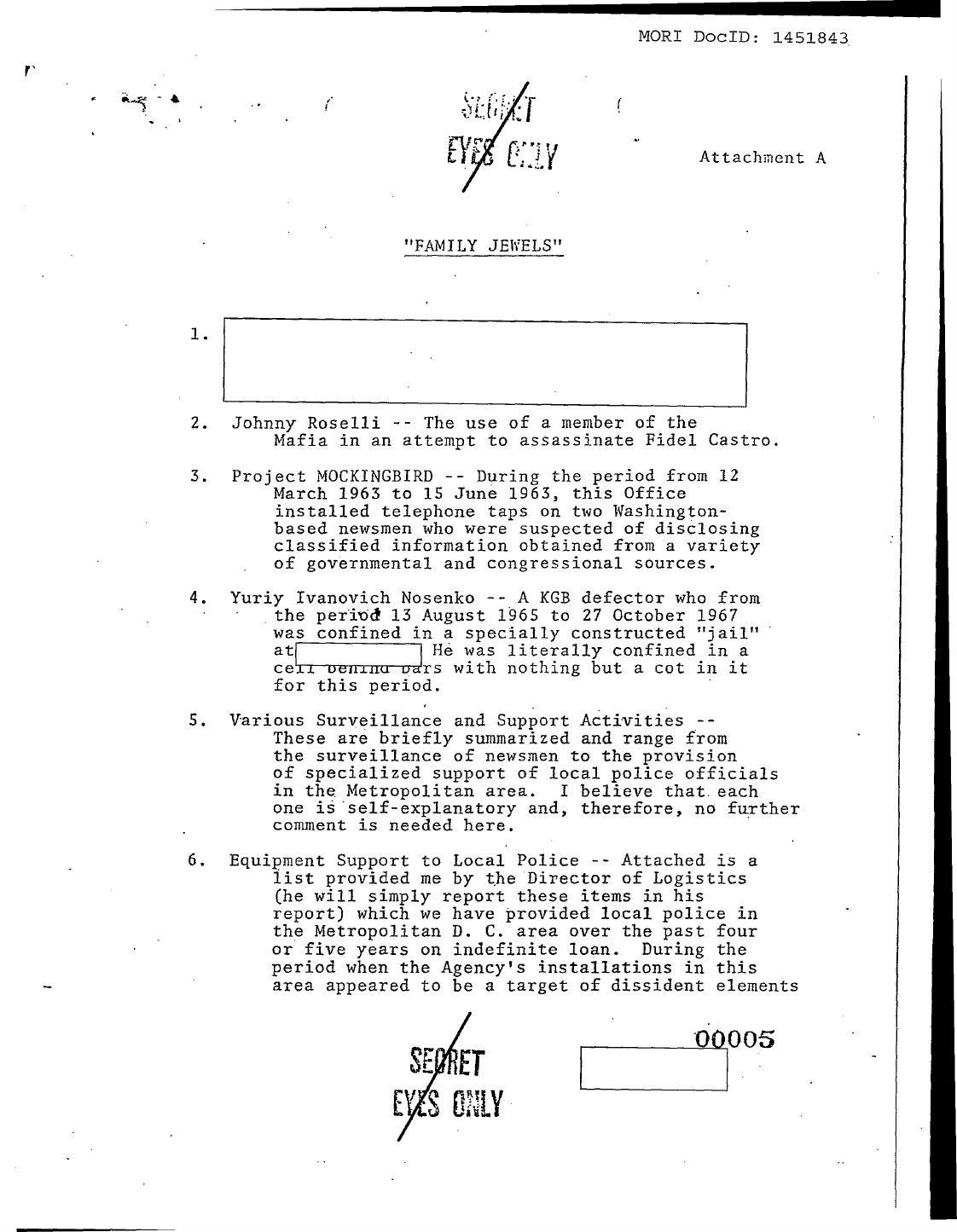
The "Family Jewels" (1973, declassified 2007). The compilation lists "Project MOCKINGBIRD" among the agency's questionable activities: "During the period from 12 March 1963 to 15 June 1963, this Office installed telephone taps on two Washington-based newsmen who were suspected of disclosing classified information." The attached summary says the taps were set at the newsmen's office and two homes, that Director John McCone gave the authority "in coordination with the Attorney General (Mr. Robert Kennedy), the Secretary of Defense... and the Director of the Defense Intelligence Agency", and that the intercepts identified sources including 12 senators and 6 members of Congress. The memo does not name the two men; later reporting names them as the columnists Robert S. Allen and Paul Scott (Reporters Committee for Freedom of the Press). This is a documented CIA action against journalists. It is surveillance of reporters, not influence through them.
"Project MOCKINGBIRD", Family Jewels compilation, CIA, 1973 (declassified 2007; National Security Archive copy). U.S. government work, public domain.
Attachment A of the Family Jewels, item 3. U.S. government work, public domain.
Bernstein (1977). His article is the main source for the larger claims: that about 25 news organisations gave cover, that executives including William Paley (CBS), Henry Luce (Time Inc.) and Arthur Hays Sulzberger (New York Times) cooperated, that "about ten CIA employees" had Times cover from 1950 to 1966, and that Church staff reviewed summaries of "400-some" relationships and 25 sanitised files whose names were blanked. Much of it rests on unnamed current and former CIA officials. Several named people deny parts of it: C. L. Sulzberger denies one incident Bernstein reports, and Joseph Alsop calls the claim that his brother Stewart was an agent "absolute nonsense", while confirming his own 1952 Laos trip at Wisner's request. Bernstein also says Bush and Colby persuaded the Committee to keep the report vague; the Committee's text gives the "about 50" figure and does not discuss that. The text of his article, as hosted on his own website, does not contain the word "Mockingbird" either.
Where "Operation Mockingbird" comes from
The Church Committee did not use the name for media work, and the CIA's document uses it for the 1963 wiretap. The wider meaning is usually traced to Deborah Davis's biography of Katharine Graham, Katharine the Great (1979), which describes a Wisner-run programme called Mockingbird that recruited Philip Graham of the Washington Post and was run by Cord Meyer after 1951. Historian David P. Hadley (The Rising Clamor, 2019) writes that Davis gave no sources for these claims and that the Church Committee and later inquiries did not reveal an operation like the one she describes, while adding that this should not hide the CIA's real work with the press. Bernstein reports that Graham was a close friend of Wisner and was told by CIA officials that the CIA "occasionally used" Newsweek for cover; the CIA sources he quotes say Graham "apparently knew little of the specifics". This page uses "Mockingbird" only for the 1963 project. For the rest, it uses the terms in the Church report ("covert relationships", "covert propaganda", "cover").
Explain moreShow less
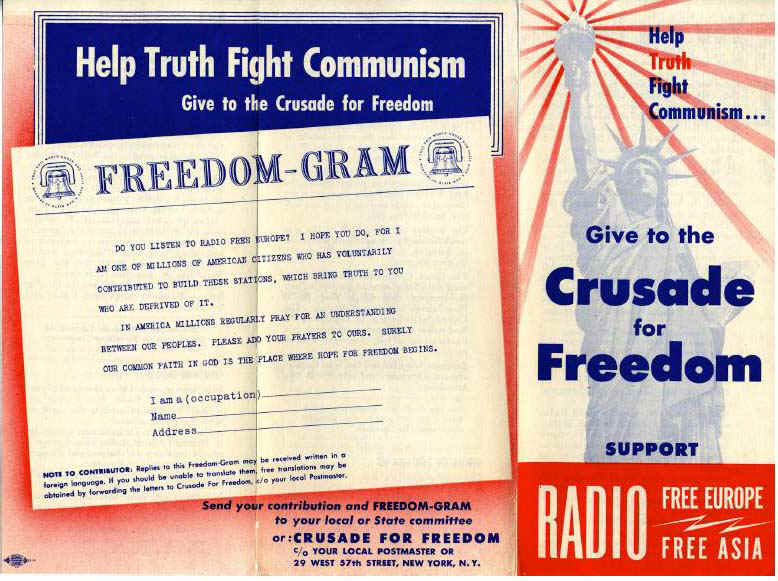
Freedom-Gram: Help Truth Fight Communism, Crusade for Freedom, 1952. Public domain.
How it works
- Narrative laundering: the Church Committee describes the foreign side. CIA-subsidised books and articles reached readers as the work of independent authors and publishers, in one case through a trust fund "established for the purpose" so that the publisher "was unaware of any U.S. Government interest". The domestic side was "fallout": a foreign placement picked up by a wire service, or a book written for foreign readers and reviewed in the United States by another CIA agent. The same arrangement is documented at the The Congress for Cultural Freedom: a CIA-funded intellectuals' network, 1950-1967 and the The Crusade for Freedom: Truth Dollars for a CIA-funded radio, 1950-1971 fundraising mailer above. The 1976 policy and the 1996 statute are rules about who may be a paid or contractual asset; they do not govern unpaid, volunteered information, which the CIA said it would "continue to welcome".
- Semantic hijacking: a name for one 90-day wiretap was stretched over a whole programme of influence, and the stretched name is now in wide use. The documented parts (about 50 relationships, press cover, foreign placements, fallout) carry no name of their own, and the Church Committee's plainer words are rarely quoted. The stretch cuts both ways: it lets some readers treat every media story as proof of control, and lets others dismiss the Church findings along with the name.
Then and now
Press and Freedom poster, Free World supplement (English, Manila) , U.S.
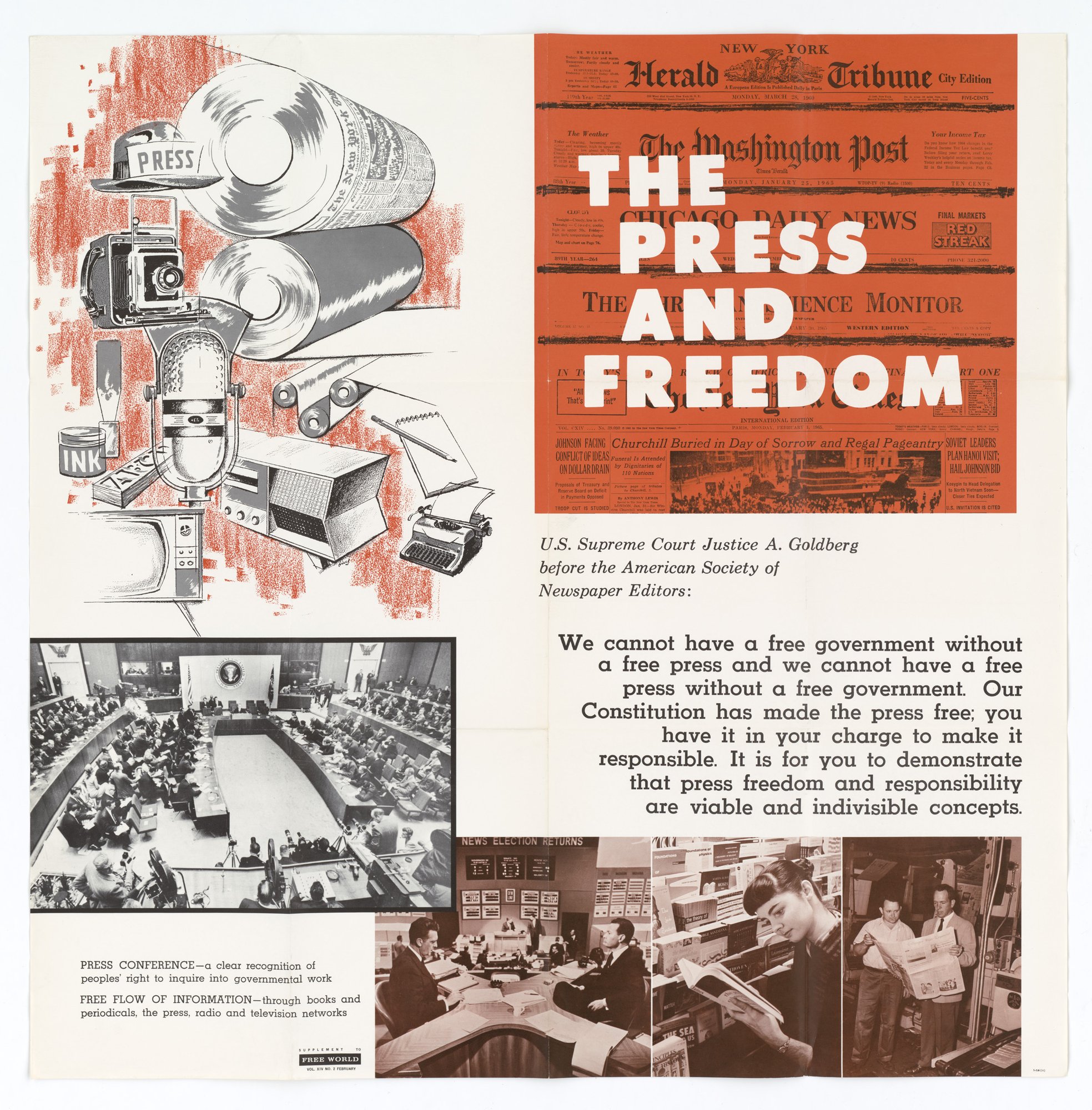
Press and Freedom poster, Free World supplement (English, Manila), U.S. Information Agency, Manila, 1965. Public domain (U.S. government work).
The U.S. government also addressed press audiences openly. This 1965 USIA sheet, headed "The Press and Freedom", carries its sponsor and says what it is. The difference from the covert relationships above is concealment of the source, not the topic. The Church Committee drew the same line when it recommended that the CIA not subsidise material for distribution inside the United States "unless publicly attributed to the CIA" (recommendation 45).
For another government's use of a press placement, see The Active Measures Working Group (1981 to 1992): the 1983 AIDS story in India's Patriot was placed in a foreign paper so its origin could not be seen, and Russia's intelligence chief acknowledged KGB responsibility in 1992. The differences are of record and scale. The U.S. practice was exposed by a U.S. Senate inquiry and U.S. journalists within a generation, and then limited by statute; the Soviet service's practice was exposed mainly by its adversary and acknowledged in the 1990s. For the FBI's domestic equivalent, see COINTELPRO: the FBI's covert media and information operations against U.S. groups, 1956-1971.
Positions on the record
4 items · The CIA. Colby told the House committee in 1975: "We have taken particular caution to…
- The CIA. Colby told the House committee in 1975: "We have taken particular caution to ensure that our operations are focused abroad and not at the United States in order to influence the opinion of the American people about things from a CIA point of view." Bernstein quotes him telling Church investigators "Let's not pick on some poor reporters... Let's go to the managements. They were witting." Bush's 1976 statement recognised the "special status afforded the American media under our Constitution".
- The journalists and papers named. Alsop and C. L. Sulzberger deny elements of Bernstein's account (above). The Courier-Journal's executive editor and publisher deny knowing that a 1964-65 hire was a CIA operative. Katharine Graham told Bernstein she had never been informed of CIA relationships with Post or Newsweek personnel.
- The critics. Bernstein argues the media were "handmaidens to the intelligence services" and that the Committee understated it. The Church Committee itself calls the practice a "threat to the integrity of the press". Hadley writes that the popular Mockingbird theory "does not appear to be grounded in reality" while the real relationships stand.
- This archive's reading. Documented: the OPC's growth, the Family Jewels' MOCKINGBIRD entry, the roughly 50 relationships, the foreign network, the cover arrangements, the 250 books abroad, the "fallout" directive, the 1973 and 1976 policies and the 1996 statute. Disputed or unverified: Bernstein's count of more than 400 (his figure comes from CIA file summaries the Committee did not publish; the Church report says about 50 as of February 1976), the named executives' roles, the Times cover arrangements (Bernstein's sources), and Davis's account of a Wisner-run Mockingbird with Philip Graham and Cord Meyer. Not shown by anything cited here: that one named programme directed U.S. newsroom content.
Same-method test
A foreign service that placed paid or contractual agents in the staff of a major U.S.
A foreign service that placed paid or contractual agents in the staff of a major U.S. newspaper, handed a publisher a book through a trust fund without telling him, and kept 50 relationships with American correspondents secret would be scored Narrative laundering by the same definition. So would the Soviet Patriot placement. The 1963 wiretap is surveillance of the press and is scored on the page as that, not as influence. The same word "Mockingbird" would be a Semantic hijacking whoever stretched it.
How to spot it
- Ask what the source document actually says. The Church report says "about 50" relationships and names no programme; the Family Jewels names a wiretap.
- Separate cover (a spy with press credentials), collection (a reporter talking to an officer), placement (a story planted abroad) and surveillance (a wiretap on reporters). They are different activities with different records.
- Treat "400 journalists" and "50 journalists" as different counts from different sources and dates, not as one fact in two forms.
Show all 5Show fewer
- Check whether a rule covers volunteers. A ban on "paid or contractual" relationships leaves unpaid ones, and the CIA said so in 1976.
- When a label travels faster than its documents, look for the first source that uses it.
Sources and further reading
Images
4 items · Portraits of Frank Wisner, William Colby and George H. W. Bush as DCI. U.S. government…
| Image | Source | Licence |
|---|---|---|
| Church Committee Book I, title page (1976) | U.S. Senate Select Committee on Intelligence | Public domain (U.S. government work) |
| Church Committee Book I, pp. 192 and 197 | U.S. Senate Select Committee on Intelligence | Public domain (U.S. government work) |
| Family Jewels, "Project MOCKINGBIRD" page and Attachment A (1973) | National Security Archive, Electronic Briefing Book 222 | Public domain (CIA, U.S. government work; declassified 2007) |
| Freedom-Gram (1952); Press and Freedom supplement (1965) | FRAME gallery | Public domain |
Image gaps
- Portraits of Frank Wisner, William Colby and George H. W. Bush as DCI. U.S. government photographs exist; the Commons searches run were refused, so no licence was verified. Fillable from the CIA or Library of Congress.
- Bernstein's Rolling Stone pages (20 October 1977). In copyright; not hosted. Linked in Sources.
- Church Committee hearing photographs. Not found with a verified public-domain statement. Fillable from the Senate Historical Office.
- The New York Times series on the CIA and the press (December 1977). In copyright; not hosted.
Sources
7 items · U.S. Senate, Select Committee to Study Governmental Operations with Respect to…
- U.S. Senate, Select Committee to Study Governmental Operations with Respect to Intelligence Activities, Foreign and Military Intelligence, Book I, Final Report, S. Rep. 94-755 (26 April 1976): "Covert Relationships with the United States Media" (pp. 192-197), the OPC history, and recommendations 42-48.
- Central Intelligence Agency, "Family Jewels" compilation (1973), National Security Archive copy (declassified 2007).
- Carl Bernstein, "The CIA and the Media", Rolling Stone, 20 October 1977.
- Reporters Committee for Freedom of the Press, on Project MOCKINGBIRD and the Allen-Scott wiretap.
- Congressional Research Service, Restrictions on the Use of Journalists for Intelligence Purposes, IN12369 (30 May 2024); 50 U.S.C. § 3324.
- Deborah Davis, Katharine the Great: Katharine Graham and Her Washington Post Empire (New York: Harcourt Brace Jovanovich, 1979).
- David P. Hadley, The Rising Clamor: The American Press, the Central Intelligence Agency, and the Cold War (Lexington: University Press of Kentucky, 2019).