In one line: for two decades Americans were asked to fund Radio Free Europe with "Truth Dollars" and signatures, as if it were a private citizens' station, while most of its money, and Radio Liberty's, came from secret CIA budgets, until Senator Clifford Case put the funding on the record in January 1971.
What happened
- 1-2 June 1949. The National Committee for a Free Europe (NCFE) is set up in New York with former ambassador Joseph C. Grew as chairman. Grew tells a press conference it will "put the voices of these exiled leaders on the air". Allen Dulles is among the organisers. It presents itself as a private corporation of American citizens; its money comes mainly from the CIA's Office of Policy Coordination.
- 4 July 1950. Radio Free Europe (RFE) begins broadcasting to Czechoslovakia.
- 4 September 1950, Labor Day. General Dwight D. Eisenhower opens the Crusade for Freedom in a radio address carried on all major networks: "The Crusade for Freedom will provide for the expansion of Radio Free Europe into a network of stations. They will be given the simplest, clearest charter in the world: 'Tell the truth.'" General Lucius D. Clay, military governor of occupied Germany during the Berlin airlift, chairs the Crusade.
- September-October 1950. A ten-ton Freedom Bell, cast by Gillett and Johnston in England and designed to recall the Liberty Bell, arrives in New York to a ticker-tape parade and tours U.S. cities (sources give 21 or 26). Americans sign Freedom Scrolls, a declaration of belief in the dignity of the individual and a right to freedom derived from God. The campaign reports some 16 million signatures. The bell carries a line adapted from Lincoln: "That this world under God shall have a new birth of freedom."
- 24 October 1950. The bell is rung for the first time at Schöneberg town hall in West Berlin before a crowd reported at more than 400,000, with Clay among the speakers. The scrolls are kept with it.
- 1951. Ronald Reagan records the second Crusade's television appeal: "My name is Ronald Reagan. Last year the contributions of 16 million Americans to the Crusade for Freedom made possible the World Freedom Bell." A 1952 Freedom-Gram has donors sign a statement that they have "voluntarily contributed to build these stations".
- 13-17 August 1951. The "Winds of Freedom" balloon launches begin from West Germany into Czechoslovakia; Time reports Crusade chairman Harold Stassen releasing balloons for the cameras. Later operations include Prospero (July 1953), Veto (Czechoslovakia, 1954) and Focus (Hungary, from 1 October 1954). Some leaflets speak in the name of domestic "national resistance movements" that did not exist as organisations. The balloon programme ends in November 1956.
- 1 March 1953. Radio Liberation, later Radio Liberty, starts broadcasting to the Soviet Union for a second CIA-funded committee, Amcomlib.
- 5 December 1956. After the Soviet suppression of the Hungarian uprising, RFE political adviser William Griffith completes an internal review of the Hungarian service's broadcasts. It finds a 27 October broadcast that "fairly clearly implies that foreign aid will be forthcoming" if the insurgents set up a "central military command", and quotes a 4 November line: "In the Western capitals a practical manifestation of Western sympathy is expected at any hour." Its overall finding: the service "(with one exception) made no direct promise or commitment of Western or UN military support or intervention," but its broadcasts "may well, however, have encouraged Hungarians to have false hopes in this respect; they certainly did little or nothing to contradict them." West German government and Council of Europe inquiries find no broadcast that promised armed intervention; Chancellor Adenauer says the charges are "not founded on fact", while the West German report criticises tone and "gratuitous advice".
- 1967-1969. After press disclosures of CIA funding for U.S. private groups, the Katzenbach committee bars covert funding of private voluntary organisations. In February 1969 the 303 Committee determines that RFE and RL are not such organisations, so CIA funding continues.
- 25 January 1971. Senator Clifford Case introduces S. 18 and tells the Senate that "several hundred million dollars" from "secret CIA budgets" had paid "almost totally" for the two stations over 20 years, over $30 million in the last fiscal year alone, and that Congress had never been asked to approve it. CIA involvement ends in 1971; the International Broadcasting Act of 19 October 1973 creates the Board for International Broadcasting to fund the radios openly.
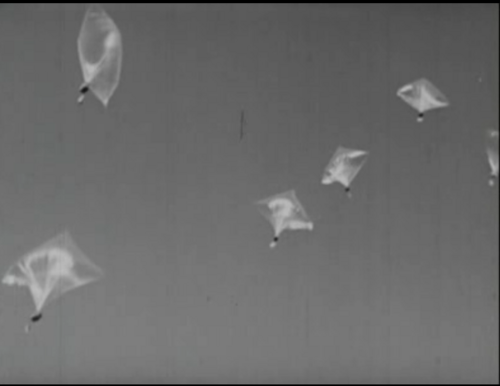
Still from a 1956 Crusade for Freedom advertisement: balloons crossing the Iron Curtain. U.S. government film (National Security Council record group, National Archives), public domain. The balloons were shown to American donors as part of what their money bought.
How it works
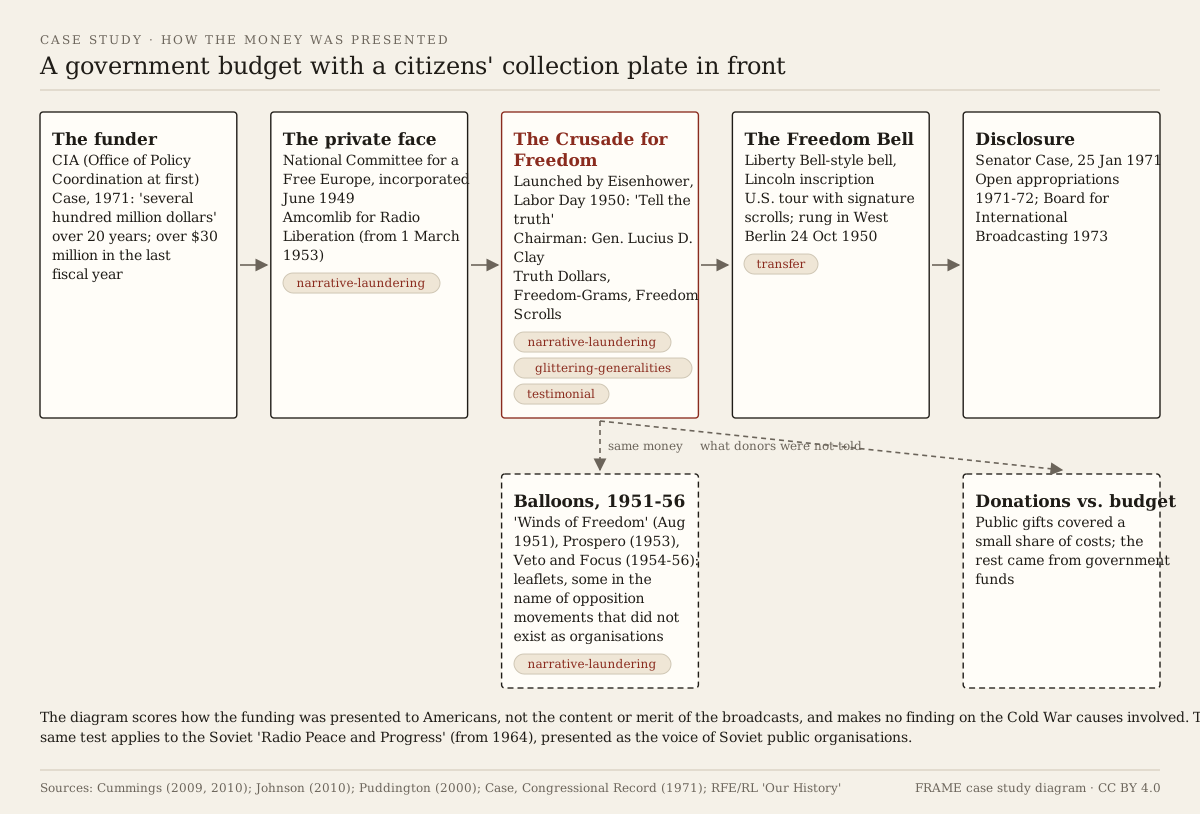
- Narrative laundering: a government-funded broadcaster reaches the domestic public through a surface built to look independent: a committee of prominent private citizens, a charity-style drive, donor stamps and pledge cards. The Freedom-Gram's "voluntarily contributed to build these stations" invites donors to see themselves as the funders. The same surface let the balloon leaflets speak in the name of resistance groups that did not exist as organisations.
- Glittering generalities: "Truth", "Freedom" and "Crusade" carry the appeal. A "Truth Dollar" asks for trust in a label rather than a checkable claim about who paid for, or directed, the broadcasts. Eisenhower's "Tell the truth" charter was accurate about the mission as stated, and silent about the funding.
- Testimonial: Eisenhower, Clay, Stassen, Reagan and, in later drives, broadcasters such as Edward R. Murrow and Walter Cronkite vouch for the cause. Their standing stands in for the disclosure a donor might otherwise ask for.
- Transfer: the Freedom Bell borrows the Liberty Bell's shape and the Gettysburg Address, and the Truth Dollar puts George Washington on the appeal. The prestige of the American founding is moved onto a covertly funded foreign-broadcasting operation.
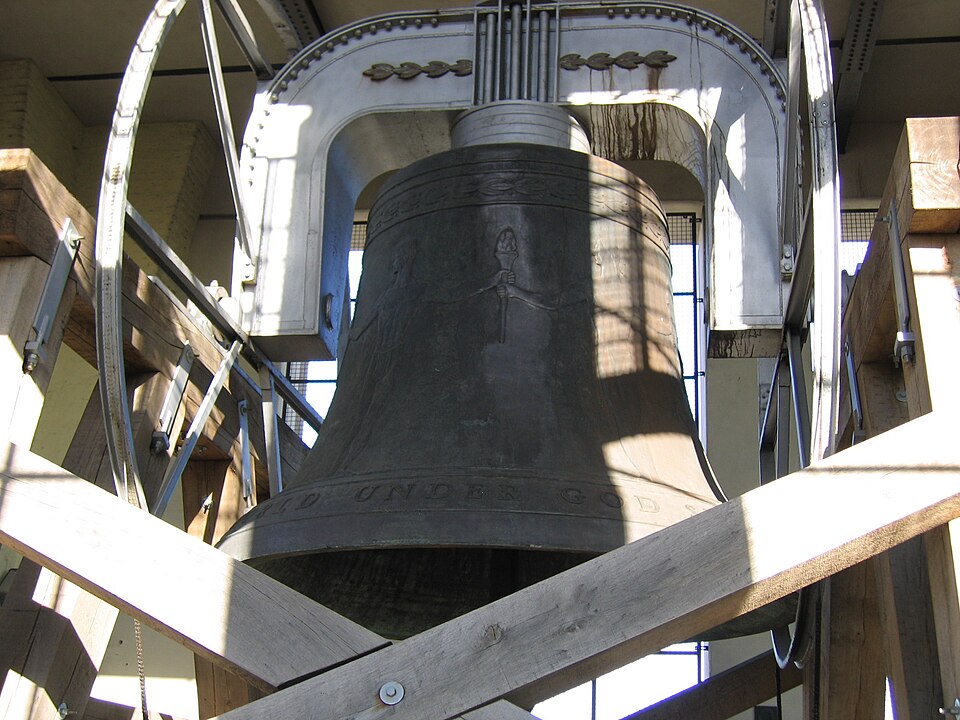
The Freedom Bell in Schöneberg town hall, Berlin, photographed in 2004. Photo by ANKAWÜ, released into the public domain by the photographer. The bell still hangs there.
Then and now
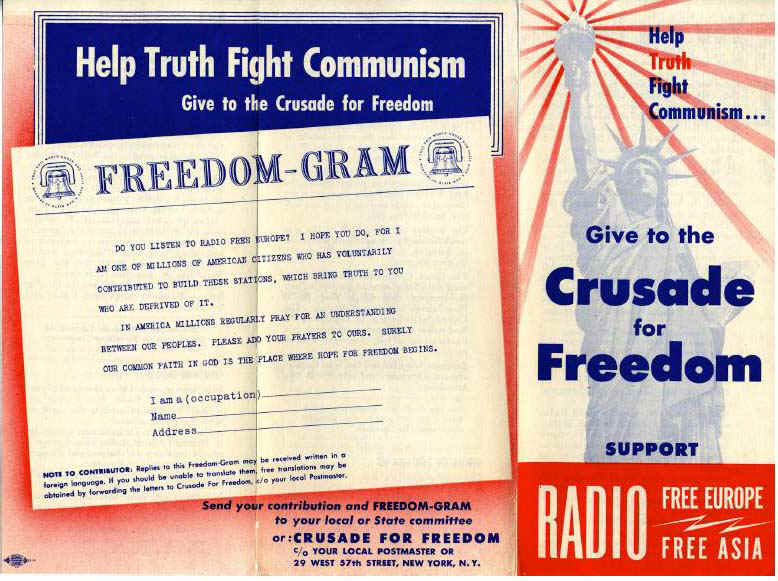
Freedom-Gram: Help Truth Fight Communism, Crusade for Freedom, 1952. Public domain.
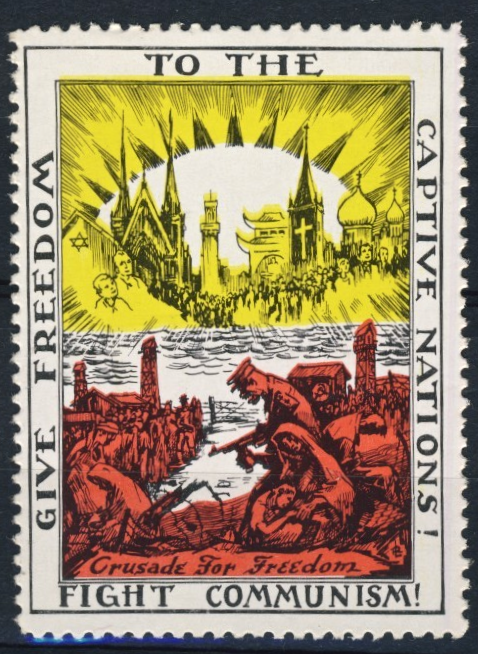
Give Freedom to the Captive Nations! Fight Communism!, Crusade for Freedom, 1951. Public domain. See also Invest a "Truth Dollar" in Radio Free Europe.
The 2026 The Hanover Institute: reports written for chatbots to cite case uses the same move: a state-paid message reaches the public under a name that looks independent. The differences matter. The Crusade was a domestic fundraising drive for a broadcaster whose on-air content was produced openly under its own name; Hanover placed unsigned reports built to be cited by chatbots. Hanover's sponsorship was disclosed in a FARA filing and a site footer from the start; the Crusade's government funding was not publicly acknowledged by the U.S. government for about two decades. The Crusade reached tens of millions of Americans through radio and television networks and parades; the Hanover operation ran for weeks, through search results and chatbot answers.
Positions on the record
- The radios and their historians: RFE/RL's own history states that the stations were funded principally by Congress through the CIA until 1971. A. Ross Johnson and Arch Puddington, both former RFE/RL officials, argue that the CIA acted mainly as funder and broad policy sponsor, and that the broadcasts themselves were professional surrogate journalism by émigré staff; Johnson writes from declassified CIA and State Department files. Richard H. Cummings, a former RFE security director, documents the Crusade as a campaign that both raised money and gave the radios a private public face.
- Critics: Senator Case's objection was constitutional: Congress was never asked to approve the spending. The Soviet and East European governments described the stations as CIA instruments throughout.
- What is documented: the CIA funding and its scale (Case, the 303 Committee record, RFE/RL's own history); the Crusade's slogans, artefacts and endorsers; the balloon operations; and the text of the Griffith review.
- Contested: Hungary. A 1996 newspaper headline read "Radio Free Europe Promised Aid To Hungarian Rebels, Documents Confirm". The Griffith review itself found one broadcast that implied aid and others that encouraged false hopes, and concluded there was no direct promise apart from that exception. Whether the broadcasts changed what insurgents did is not shown by any of these reviews.
- What is not shown: that individual donors, endorsers such as Reagan, or most Crusade volunteers knew of the CIA funding.
Same-method test
The Soviet Union ran a close parallel. Radio Peace and Progress (Radio Mir i Progress, from 1964) presented itself as "the voice of Soviet public opinion", sponsored by public bodies such as the journalists', writers' and composers' unions, the Soviet Peace Committee and the Soviet Women's Committee. It used Radio Moscow's studios and many of its announcers, and its broadcasts at times went further than Radio Moscow's, carrying lines the government could disclaim. Same finding: a state broadcaster given a civic face.
The differences: the Crusade's civic face was aimed mainly at the sponsor's own citizens, as donors; Radio Peace and Progress aimed its civic face at foreign listeners. By contrast, Radio Moscow and the Voice of America were openly state stations, white by this archive's scale, and are not tagged here. RFE and RL became white in the same sense once Congress funded them openly after 1971. The white, grey and black stations of the Second World War that came before them are covered in Wartime radio voices: open and hidden broadcasts aimed at the enemy, 1939-1945.
How to spot it
- Ask who pays most of the running costs, not who is invited to give. A public drive can cover a small share while a budget line covers the rest; the existing gallery entry cites about $50 million raised from 1951 to 1976.
- Watch for a funding claim put in the donor's mouth ("I have voluntarily contributed") rather than a statement by the organisation.
- A committee of eminent private citizens with a very large operation is worth a look at the accounts.
- Symbols of national founding (bells, founders, founding texts) attached to a request for money are prestige transfer, whatever the cause.
Images
| Image | Source | Licence |
|---|---|---|
| Mechanism diagram (above) | Drawn for FRAME from the sources below (make_diagrams.py) |
CC BY 4.0, FRAME |
| Crusade for Freedom advertisement still, 1956 | Wikimedia Commons, National Archives film | Public domain (U.S. government work) |
| Freedom Bell, Schöneberg town hall, 2004 | Wikimedia Commons, photo by ANKAWÜ | Public domain (dedicated by the photographer) |
| Freedom-Gram (1952), donor stamp (1951) | FRAME gallery | Public domain |


Image gaps
- The Freedom Bell's 1950 U.S. tour and Berlin dedication. No photograph with a verified U.S. public-domain status was found on Wikimedia Commons; U.S. Army Signal Corps photos may exist at the National Archives but could not be reached from this environment.
- West Berlin's 1951 and 1953 Freedom Bell stamps. On Commons as German official works; their U.S. status was not verified, so they are not used.
- Balloon leaflets themselves, including those issued in the name of non-existent resistance movements. Copies are held by the Hoover Institution and the Blinken Open Society Archives; no openly licensed scans were found.
- Radio Peace and Progress material (QSL cards, programme schedules). Soviet works with unclear U.S. status; dropped.
- The Congressional Record page of Case's 1971 statement. Public domain, but govinfo.gov was not reachable from this environment. This gap can be filled.
Sources
- Richard H. Cummings, Radio Free Europe's "Crusade for Freedom": Rallying Americans Behind Cold War Broadcasting, 1950-1960 (McFarland, 2010).
- Richard H. Cummings, Cold War Radio: The Dangerous History of American Broadcasting in Europe, 1950-1989 (McFarland, 2009).
- A. Ross Johnson, Radio Free Europe and Radio Liberty: The CIA Years and Beyond (Woodrow Wilson Center Press / Stanford University Press, 2010).
- Arch Puddington, Broadcasting Freedom: The Cold War Triumph of Radio Free Europe and Radio Liberty (University Press of Kentucky, 2000).
- RFE/RL, "Our History".
- William Griffith, "Policy Review of Voice for Free Hungary Programming, October 23-November 23, 1956", 5 December 1956, National Security Archive, Electronic Briefing Book 76, doc. 10.
- Wilson Center History and Public Policy Program, Occasional Paper on the role of Radio Free Europe in the Hungarian Revolution of 1956.
- The Spokesman-Review (AP), 28 September 1996: "Radio Free Europe Promised Aid To Hungarian Rebels, Documents Confirm".
- Blinken Open Society Archives, "Radio Free Europe in 1956, as Hungarian Refugees Remembered".
- Time, "Propaganda: Winds of Freedom" (1951).
- "Burn after reading: Operation Focus and the fictional Nemzeti Ellenzéki Mozgalom in the lead-up to the 1956 Hungarian Uprising", Cold War History 23, no. 2 (2023).
- Bezirksamt Tempelhof-Schöneberg, "75 Years Freedom Bell in Berlin".
- Foreign Relations of the United States, 1969-1976, vol. XXIX, doc. 28, Memorandum for the 303 Committee, with the Case bill S. 18 (25 January 1971) and the 1969 Katzenbach exemption.
- Katzenbach Committee Report (1967).
- UK National Archives, "Broadcasting: Radio Peace and Progress; background brief on the Soviet station".