Also called Cutout publishing, Think-tank front
Pass a state or factional message through a more legitimate-looking surface so origin is hard to see.
The tell
New institute, borrowed academic form, contractor chain, or 'research' with no scholars.
Not this
A disclosed advocacy shop making an argument in its own name.
History and effect
A tradecraft term from intelligence and PR history describing the use of cutouts, contractor chains, and think-tank-shaped fronts.
It lets a state or factional message inherit the credibility of an independent research or advocacy voice it never earned.
Lineage: Intelligence cutouts; think-tank and NGO fronts
How it works
Narrative laundering borrows its name from money laundering, and the stages map closely. First comes placement: the message is put into circulation somewhere its origin is hard to see, such as an anonymous letter to a small newspaper, a report from a newly founded institute, an article paid into a local paper, or a charity appeal that does not name its main funder. Then comes layering: the message is picked up, cited and restated by other outlets, each step adding distance from the original sender. Finally comes integration: the claim reaches a mainstream audience attributed to the intermediate surface ("a research institute found", "an Indian newspaper reported", "a citizens' committee says") rather than to the state or faction that produced it.
The intermediate surface is chosen for the credibility the real sender lacks. A government speaking about its own interests is expected to be partisan; a think tank, a university-style center, a human rights witness, a freelance journalist or a private donors' campaign is expected to be independent. Documented operations use cutouts (an intermediary organization that hides the funder), contractor chains (a ministry pays an agency, which pays a firm, which runs a site), front organizations with a public mission statement and no disclosed backer, and unwitting participants, such as real writers hired by an outlet whose ownership they do not know. The chain is often legal at each step and may include a disclosure, filed with a regulator or printed in small type, that does not travel with the message.
What the audience experiences is an ordinary-seeming source making an argument. Nothing in the message itself is necessarily false; laundering is about provenance, not content. The technique depends on the audience judging a claim partly by who seems to be making it, on that judgment being made at the moment of reading rather than after investigation, and on the origin staying hidden long enough for the claim to be repeated by people and outlets who genuinely are independent. Once honest intermediaries have repeated it, the claim can survive even the later exposure of its source.
Why it works
Carl Hovland and Walter Weiss gave people identical articles attributed either to a trusted source or to a distrusted one; in one pairing, the same piece on atomic submarines was credited either to the physicist J. Robert Oppenheimer or to Pravda. Readers changed their opinions more when they thought the source was trustworthy, even though they recalled the content equally well (Sources: Hovland and Weiss 1951). Later work confirms that perceived credibility shapes persuasion, with effects varying by audience and topic (Sources: Pornpitakpan 2004). Laundering is an attempt to swap the distrusted label for the trusted one while leaving the content untouched.
Richard Petty and John Cacioppo's elaboration likelihood model explains when this matters most. When people are not motivated or able to scrutinize an argument closely, they rely on peripheral cues such as the apparent expertise or independence of the source (Sources: Petty and Cacioppo 1986). An institutional name, a bibliography, a formal report layout or a witness's personal testimony all function as such cues. Marian Friestad and Peter Wright's persuasion knowledge model adds a second mechanism: audiences resist messages they recognize as persuasion attempts by an interested party (Sources: Friestad and Wright 1994). Laundering works by keeping that recognition from being triggered, since the reader sees research or reporting, not a campaign.
Memory helps the laundered claim outlast its exposure. Research on source monitoring shows that people often remember what they heard more reliably than where they heard it (Sources: Johnson, Hashtroudi and Lindsay 1993). Hovland's group noticed that the persuasive gap between credible and non-credible sources shrank over the following weeks, which later became known as the sleeper effect. That effect has had a contested history: a meta-analysis by Tarcan Kumkale and Dolores Albarracín found it appears reliably only under specific conditions, such as when the discounting information comes after the message and the message was strong enough to make an impression at first (Sources: Kumkale and Albarracín 2004). The archive has a separate page on the Sleeper effect as a technique.
Examples across eras and sides
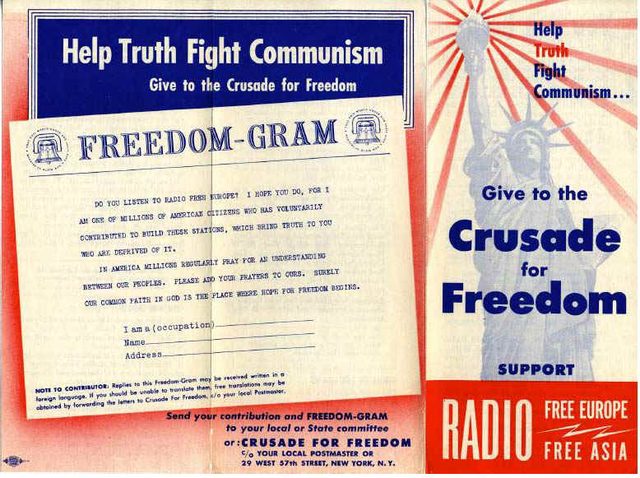
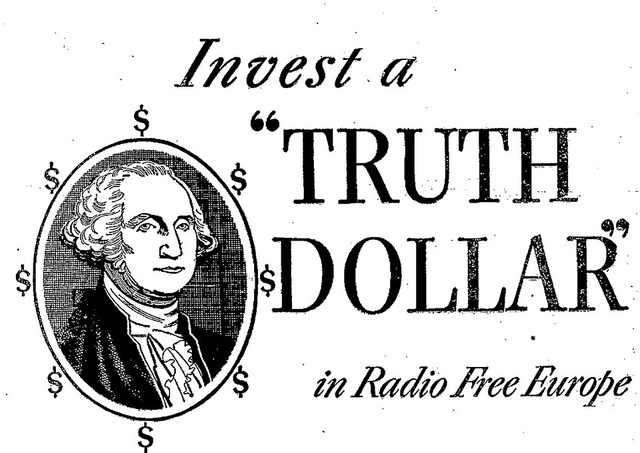
- United States, 1950s and 1960s: CIA-funded private fronts. Radio Free Europe was presented to Americans as a project sustained by citizen donations to the Crusade for Freedom, while its main funding came from the U.S. government through the CIA until Congress moved it to open appropriations in the early 1970s (Sources: Cummings 2010). The archive's Freedom-Gram: Help Truth Fight Communism shows the donation drive. The CIA also funded the Congress for Cultural Freedom and its magazines through foundations that presented themselves as private, which press investigations exposed in 1966 and 1967 (Sources: Saunders 1999).
- United Kingdom, 1948 to 1977: the Information Research Department. A unit of the Foreign Office prepared anti-communist briefing material that journalists, broadcasters and politicians in Britain and abroad used without attribution, and it arranged for books to appear under commercial imprints that did not disclose government involvement (Sources: Lashmar and Oliver 1998). Readers met the material as independent journalism or scholarship.
- Soviet Union, 1983 to the late 1980s: the AIDS origin story. An anonymous letter in the Indian newspaper Patriot in 1983 claimed that the U.S. military had created AIDS. In 1985 the Soviet weekly Literaturnaya Gazeta cited that article as its source, and a paper by an East German biophysicist later gave the claim a scientific form; the story then spread through outlets in dozens of countries (Sources: Boghardt 2009). Each step cited the previous one, so a Soviet-bloc claim reached audiences as a report from India and a finding from a scientist.
- Kuwait and a U.S. public relations firm, 1990. Before the Gulf War, Citizens for a Free Kuwait, an organization funded almost entirely by the Kuwaiti government, retained Hill & Knowlton. A fifteen-year-old identified only as Nayirah testified to a congressional human rights caucus that she had seen Iraqi soldiers remove babies from hospital incubators. It later emerged that she was the daughter of Kuwait's ambassador to the United States and had been prepared by the firm, and later investigations did not substantiate the incubator account (Sources: MacArthur 1992). A government's case reached Congress and the public as the testimony of an anonymous eyewitness speaking for a citizens' group.
- United States military, 2005: paid placement in Iraq. The Los Angeles Times reported that articles written by U.S. military information operations personnel were translated and placed in Iraqi newspapers through a contractor, the Lincoln Group, and presented as independent journalism without disclosure of their origin (Sources: Mazzetti and Daragahi 2005). The Pentagon opened a review after the report.
- Russia, 2020: Peace Data. Facebook removed a network behind Peace Data, a website presenting itself as an independent global news outlet, after an FBI tip. Graphika linked it to individuals associated with the Internet Research Agency and found that it had recruited real freelance writers, including Americans, to write for it, mainly on themes aimed at left-leaning audiences (Sources: Nimmo et al. 2020). The unwitting writers gave the site authentic bylines. The archive's 'Russian Ads on Facebook' (House Intelligence Committee exhibit) shows the same organization's earlier pages built for both left- and right-leaning U.S. audiences.
- Israel, 2026: the Hanover Institute. Israel's state advertising agency paid, through a German media buyer and a U.S. firm registered under the Foreign Agents Registration Act, for a site styled as a U.S. public-policy institute with no named staff, whose reports chatbots then cited as research. The disclosure sat in the site footer and did not travel with the citations. See The Hanover Institute: reports written for chatbots to cite.
The scale and stakes of these cases vary. A multi-year intelligence operation that reached dozens of countries, a congressional testimony on the eve of a war, and a small news site with modest reach are different events; what they share is a message passed through a surface chosen to hide its sender.
How to spot it
- Look up who funds and runs the source. A research body or campaign with no named staff, board, address or funders is a warning sign, especially if it is new.
- Check whether an "institute" has scholars. Unsigned reports, authors with no traceable record, and bibliographies that cite the same few sources suggest borrowed academic form.
- Follow a claim back through its citations. If each outlet cites the one before it and the chain ends at an anonymous letter, a new site or a single interested party, the claim has been layered rather than confirmed.
- Look for contractor chains in public records. For material aimed at U.S. audiences on behalf of foreign governments, the Foreign Agents Registration Act database lists registrants, principals and informational materials.
- Watch for testimony from witnesses whose identity is withheld and whose link to an interested party is not stated.
Where it ends: edge cases and legitimate persuasion
Narrative laundering sits among several neighboring techniques. Corpus poisoning is a modern variant aimed at machines: the laundered surface is built to be retrieved by search engines and chatbots, so the laundering step is performed by software that strips the source away. Disclosure theater is what happens when the chain is legally disclosed somewhere the audience will not look. Manufactured consensus multiplies a message across many apparently independent voices; laundering can work with a single voice, as long as it is the wrong one. Testimonial and Transfer describe the borrowed authority itself, the witness or the institutional form, while laundering is the concealment of who arranged it. The Alaj: the portal Iranian state media promoted for reporting 'traitors abroad' case shows a softer form, in which public-service language gives a monitoring system the appearance of a help desk.
The line with legitimate communication is disclosure at the point of reading. Governments may publish their own research, fund exchange programs and hire public relations firms; industries may sponsor studies; advocacy groups may argue their case. Each is honest when a reader can see who is speaking and who paid, in the same place as the message. A white paper from a ministry, a study that names its industry funder in the byline, and a coalition that lists its donors are not laundering, even if the reader disagrees with them. The test a reader can apply is simple: would the audience weigh this message differently if they knew who produced and paid for it, and has that information been kept from them where they meet the message? If yes to both, the message has been laundered.
Sources
- Boghardt, Thomas. 2009. "Soviet Bloc Intelligence and Its AIDS Disinformation Campaign." Studies in Intelligence 53(4): 1-24.
- Cummings, Richard H. 2010. Radio Free Europe's "Crusade for Freedom": Rallying Americans Behind Cold War Broadcasting, 1950-1960. Jefferson, NC: McFarland.
- Friestad, Marian, and Peter Wright. 1994. "The Persuasion Knowledge Model: How People Cope with Persuasion Attempts." Journal of Consumer Research 21(1): 1-31.
- Hovland, Carl I., and Walter Weiss. 1951. "The Influence of Source Credibility on Communication Effectiveness." Public Opinion Quarterly 15(4): 635-650.
- Johnson, Marcia K., Shahin Hashtroudi, and D. Stephen Lindsay. 1993. "Source Monitoring." Psychological Bulletin 114(1): 3-28.
- Kumkale, G. Tarcan, and Dolores Albarracín. 2004. "The Sleeper Effect in Persuasion: A Meta-Analytic Review." Psychological Bulletin 130(1): 143-172.
- Lashmar, Paul, and James Oliver. 1998. Britain's Secret Propaganda War, 1948-1977. Stroud: Sutton.
- MacArthur, John R. 1992. Second Front: Censorship and Propaganda in the Gulf War. New York: Hill and Wang.
- Mazzetti, Mark, and Borzou Daragahi. 2005. "U.S. Military Covertly Pays to Run Stories in Iraqi Press." Los Angeles Times, 30 November 2005.
- Nimmo, Ben, et al. 2020. IRA Again: Unlucky Thirteen. New York: Graphika.
- Petty, Richard E., and John T. Cacioppo. 1986. Communication and Persuasion: Central and Peripheral Routes to Attitude Change. New York: Springer-Verlag.
- Pornpitakpan, Chanthika. 2004. "The Persuasiveness of Source Credibility: A Critical Review of Five Decades' Evidence." Journal of Applied Social Psychology 34(2): 243-281.
- Saunders, Frances Stonor. 1999. Who Paid the Piper? The CIA and the Cultural Cold War. London: Granta. (Published in the United States as The Cultural Cold War, New Press, 2000.)
Case studies
- Alaj: the portal Iranian state media promoted for reporting 'traitors abroad' — Alaj: the portal Iranian state media promoted for reporting 'traitors abroad'
- Wellington House and the Bryce Report: atrocity evidence, confirmed and unconfirmed (1914-1915) — Wellington House and the Bryce Report: atrocity evidence, confirmed and unconfirmed (1914-1915)
- The Hanover Institute: reports written for chatbots to cite — The Hanover Institute: reports written for chatbots to cite
- The Armenian genocide, 1915-1923: the wartime 'internal enemy' frame, the rival record, and a century of state denial — The Armenian genocide, 1915-1923, and a century of state denial
- Collectivisation, the 1932-33 famine and its denial: the kulak label, the silence and the foreign press — Collectivisation, the 1932-33 famine and its denial
- Anti-Rohingya propaganda in Myanmar, 2012-2018: the 'Bengali' label, the monks' sermons and the military's covert Facebook pages — Anti-Rohingya propaganda in Myanmar, 2012-2018
- The Office of War Information's Domestic Branch, 1942-43 — The Office of War Information's Domestic Branch, 1942-43
- The Nayirah testimony: a Kuwaiti government PR campaign at a House human rights caucus — The Nayirah testimony: a Kuwaiti government PR campaign at a House human rights caucus
- How the US and UK governments presented the case for war in Iraq, 2002-03 — How the US and UK governments presented the case for war in Iraq, 2002-03
- The Pentagon's retired military analyst outreach programme (2002-2008) — The Pentagon's retired military analyst outreach programme (2002-2008)
- COINTELPRO: the FBI's covert media and information operations against U.S. groups, 1956-1971 — COINTELPRO: the FBI's covert media and information operations against U.S. groups, 1956-1971
- RICU and the Integrity Initiative: UK government-funded messaging that did not show its source — RICU and the Integrity Initiative: UK government-funded messaging that did not show its source
- Israel's Strategic Affairs Ministry paid for news content, and a later ministry's STOIC campaign aimed at U.S. lawmakers — Israel's Strategic Affairs Ministry paid for news content, and a later ministry's STOIC campaign aimed at U.S. lawmakers
- Torches of Freedom: the 1929 Easter Parade cigarette march — Torches of Freedom: the 1929 Easter Parade cigarette march
- The tobacco industry's smoking-and-health doubt campaign, 1953 to 1998 — The tobacco industry's smoking-and-health doubt campaign, 1953 to 1998
- The Sugar Research Foundation and the 1967 heart disease review — The Sugar Research Foundation and the 1967 heart disease review
- Fossil-fuel industry climate doubt campaigns, 1977 to the 2000s — Fossil-fuel industry climate doubt campaigns, 1977 to the 2000s
- The Congress for Cultural Freedom: a CIA-funded intellectuals' network, 1950-1967 — The Congress for Cultural Freedom: CIA money behind an intellectuals' network
- The Crusade for Freedom: Truth Dollars for a CIA-funded radio, 1950-1971 — The Crusade for Freedom: a donation drive in front of a CIA-funded radio
- The Korean War germ-warfare charges: commissions, confessions and the 1953 recall — The Korean War germ-warfare allegations, 1952
- Lubang Buaya, 1965: the mutilation story the autopsies did not support — Indonesia 1965: the Lubang Buaya story
- Algeria 1954-1962: 'events', psychological action, and the FLN's single voice — Algeria 1954-1962: 'events', psychological action, and the FLN's single voice
- The Congo Free State press war: Leopold II's Press Bureau and the Congo Reform Association — The Congo Free State press war: Leopold II's Press Bureau and the Congo Reform Association
- Soviet montage cinema as state film: Battleship Potemkin and October — Soviet montage cinema: Battleship Potemkin and October
- Britain's Ministry of Information films and London Can Take It! (1940-1942) — Britain's Ministry of Information films and London Can Take It!
- Wartime radio voices: open and hidden broadcasts aimed at the enemy, 1939-1945 — Wartime radio voices, open and hidden
- State television across borders: from Der schwarze Kanal and ZDF-Magazin to RT, CGTN, Alhurra and Al Jazeera — State television across borders, from Der schwarze Kanal to RT and CGTN
- Indian Chronicles: fake local outlets, revived NGOs and a borrowed professor — Indian Chronicles: fake local outlets, revived NGOs and a borrowed professor
- The Active Measures Working Group (1981 to 1992) — The Active Measures Working Group (1981 to 1992)
- The State Department's Global Engagement Center (2016 to 2025) — The State Department's Global Engagement Center
- The 1800 election: "Jefferson and no God" and "squints at monarchy" — The 1800 election: "Jefferson and no God" and "squints at monarchy"
- Just Say No and the fried egg: anti-drug campaigns, 1971-2016 — Just Say No and the fried egg: anti-drug campaigns, 1971-2016
- Labor organizing and anti-union campaigns in the United States, 1910-1941 — Labor organizing and anti-union campaigns in the United States, 1910-1941
- Black Lives Matter and Blue Lives Matter: two slogans, their campaigns, and a foreign operation that posed as both — Black Lives Matter and Blue Lives Matter: two slogans, their campaigns, and a foreign operation that posed as both
- Voice of the Arabs and the Voice of Britain: the Arab radio war, 1953-1967 — Voice of the Arabs and the Voice of Britain: the Arab radio war, 1953-1967
- South Africa's information war: the apartheid state's secret projects and the ANC's Radio Freedom — South Africa's information war: the apartheid state's secret projects and the ANC's Radio Freedom
- The Cuba-United States radio war: Radio Swan's cover story and Havana's 'gusanos' — The Cuba-United States radio war: Radio Swan's cover story and Havana's 'gusanos'
- Soviet wartime propaganda, 1939-1945: Sovinformburo, Agitprop and the Red Army press — Soviet wartime propaganda, 1939-1945: Sovinformburo, Agitprop and the Red Army press
- Britain's Ministry of Information and Political Warfare Executive: posters at home, black radio abroad — Britain's Ministry of Information and Political Warfare Executive: posters at home, black radio abroad
- The U.S. Office of War Information and the Writers' War Board: a 'strategy of truth' meets the advertising men — The U.S. Office of War Information and the Writers' War Board: a 'strategy of truth' meets the advertising men
- Chinese wartime propaganda, 1937-1945: Chongqing, Yan'an and Wang Jingwei's Nanjing — Chinese wartime propaganda, 1937-1945: Chongqing, Yan'an and Wang Jingwei's Nanjing
- Bolshevik agitprop, 1917-1921: soviets, decrees, agit-trains and the ROSTA windows — Bolshevik agitprop, 1917-1921: soviets, decrees, agit-trains and the ROSTA windows
- The Lenin cult after 1924: an embalmed body, a mausoleum and a doctrine called "Leninism" — The Lenin cult after 1924: an embalmed body, a mausoleum and a doctrine called "Leninism"
- The Yan'an Rectification Movement: doctrine, self-criticism and the Rescue Campaign (1942-1945) — The Yan'an Rectification Movement: doctrine, self-criticism and the Rescue Campaign (1942-1945)
- The Mao cult before the state: 'Mao Zedong Thought' and 'The East Is Red', 1943-1949 — The Mao cult before the state: 'Mao Zedong Thought' and 'The East Is Red', 1943-1949
- The SS as its own propaganda institution: Das Schwarze Korps, the Ahnenerbe and the order myth, 1931-1945 — The SS as its own propaganda institution: Das Schwarze Korps, the Ahnenerbe and the order myth, 1931-1945
- The Agitprop Department: the Communist Party's standing propaganda apparatus, 1920-1991 — The Agitprop Department: the Communist Party's standing propaganda apparatus, 1920-1991
- Pravda, Izvestia and TASS: the institutional structure of the Soviet press monopoly, 1912-1991 — Pravda, Izvestia and TASS: the institutional structure of the Soviet press monopoly, 1912-1991
- Selling the Gulag: the "re-forging" of the White Sea-Baltic Canal, 1930-1937 — Selling the Gulag: the 're-forging' of the White Sea-Baltic Canal, 1930-1937
- Zhongxuanbu: the Central Propaganda Department as the ruling party's standing ministry of message, 1949-2026 — Zhongxuanbu: the Central Propaganda Department as the ruling party's standing ministry of message, 1949-2026
- The All-Union Pioneer Organization: scouting rebuilt as a communist pipeline, 1922-1991 — The All-Union Pioneer Organization: scouting rebuilt as a communist pipeline, 1922-1991
- The Little Octobrists (Oktyabryata): a red star badge for seven-year-olds — The Little Octobrists (Oktyabryata): a red star badge for seven-year-olds
- The Pavlik Morozov cult: a Soviet martyr built from a disputed murder — The Pavlik Morozov cult: a Soviet martyr built from a disputed murder
- Red scarf to Party card: a century of the Communist Youth League of China — Red scarf to Party card: a century of the Communist Youth League of China
- Grief on schedule: Mao's death, Hua Guofeng's succession and the 'two whatevers', 1976-1978 — Grief on schedule: Mao's death, Hua Guofeng's succession and the 'two whatevers', 1976-1978
- Boluan Fanzheng: how Deng Xiaoping's faction used a debate about truth to break Hua Guofeng's hold on power, 1977-1981 — Boluan Fanzheng: how Deng Xiaoping's faction used a debate about truth to break Hua Guofeng's hold on power, 1977-1981
- The peoples of three continents: OSPAAAL, a Havana secretariat, and Tricontinental — The peoples of three continents: OSPAAAL, a Havana secretariat, and Tricontinental
- Playa Girón and the Bay of Pigs: mercenaries in one telling, Cuban patriots in the other — Playa Girón and the Bay of Pigs: mercenaries in one telling, Cuban patriots in the other
Then and now
- Then and now: "the Americans made it" (Soviet AIDS story 1983, Chinese Fort Detrick claim 2020) — "The Americans made it": the Soviet AIDS story 1983 and the Chinese Fort Detrick claim 2020