Content note. This case quotes FBI documents as the Senate record reproduces them. They include racial and anti-gay slurs, a letter that its recipients read as urging suicide, and loaded labels the Bureau gave to groups. They are quoted as evidence of the method. They are not this archive's description of anyone.
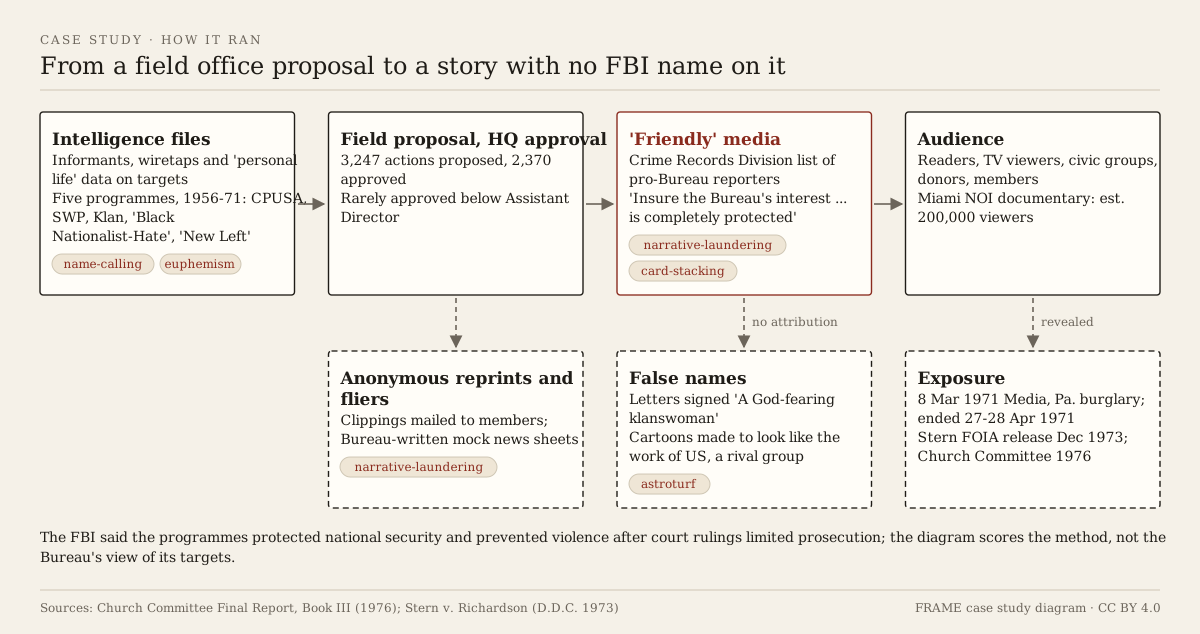
In one line: for fifteen years under four presidents, the FBI placed material about U.S. political groups in the news through reporters it rated "friendly", and mailed clippings, fliers, cartoons and letters that did not name the Bureau as their source, some of them written as if they came from the targets' own members or rivals.
What happened
- August 1956. Director Hoover approves the first formal counterintelligence programme (COINTELPRO), against the Communist Party USA. The Senate Select Committee (the Church Committee) later found that the Bureau traced the decision partly to Supreme Court rulings that its officials said had made Smith Act prosecutions of Party members impossible. The CPUSA programme produced 1,388 of the 2,370 approved actions.
- March 1960. A directive widens the CPUSA programme to alleged Communist "infiltration" of other organisations. According to the Committee, this was increasingly done "by planting a news article about Communists active in the organization". In one case a newsman was given information about Communist participation in a SANE march "with the express purpose being to discredit SANE as well as the participants".
- 12 October 1961. The Socialist Workers Party programme begins. It ran until 1969, with 45 approved actions. The Committee records that the Bureau conceded the SWP had never engaged in organisational violence.
- 2 September 1964. A directive to 17 field offices opens the Klan programme (filed as "White Hate Groups") "to expose, disrupt, and otherwise neutralize" 17 Klan and nine other "hate" organisations. The Committee called this programme "very precisely targeted".
- Late 1964. Separately from the formal COINTELPRO captions, the FBI mails Martin Luther King Jr. a tape from its hotel-room microphones with an unsigned letter. An FBI agent flew to Miami on 21 November 1964 and mailed the package there. Andrew Young and Ralph Abernathy told the Committee they read the letter as inviting King to take his own life.
- 25 August 1967. The "Black Nationalist-Hate Group" programme begins in 23 field offices, "to expose, disrupt, misdirect, discredit, or otherwise neutralize". It directs offices to "use news media contacts to disrupt, ridicule, or discredit" groups (the Committee's summary). The nonviolent Southern Christian Leadership Conference is among the first targets.
- 4 March 1968. The programme expands to 41 offices. One of its goals is to prevent the rise of a "messiah" who could "unify, and electrify" the movement, naming King, Stokely Carmichael and Elijah Muhammad. Another is to stop groups gaining "respectability" by discrediting them to the "responsible" Negro community, the white community and "liberals".
- 28-29 March 1968. The Domestic Intelligence Division recommends that a "blind memorandum" on King's Memphis march be given to "cooperative news media sources". Hoover marks it "O.K.", and it is noted as "handled on 3/28/68". The next day the Division recommends a planted item saying King, "like Judas leading lambs to slaughter", led marchers to violence and then stayed at a white-owned Holiday Inn.
- 28 October 1968. The "New Left" programme begins. The Committee notes that no Bureau document ever defined the term; its supervisor called it "more or less an attitude". A July 1968 list of suggested actions includes using "cooperative press contacts" and "friendly news media", anonymous letters signed "A Concerned Alumni" or "A Concerned Taxpayer", and "cartoons, photographs, and anonymous letters" to "ridicule" targets.
- 1969-1970. The San Diego field office mails cartoons "composed to look like a product of the US organization" to Black Panther Party members during a violent feud between the two groups. Headquarters approves a further series on 29 January 1970.
- 8 March 1971. A group calling itself the Citizens' Commission to Investigate the FBI breaks into the FBI resident agency in Media, Pennsylvania. The Committee records that the stolen documents were "widely circulated and published by the press". Some carried the caption "COINTELPRO". As reported by WHYY and PBS, the Washington Post published first, on 24 March 1971.
- 27-28 April 1971. FBI headquarters ends all COINTELPROs "for security reasons", with a memorandum of 27 April and a letter to all field offices on 28 April. The letter allows "counterintelligence action" to continue "in exceptional circumstances" under individual case captions. The Committee found a case four months later in which an attorney's political background was given to "friendly newspaper sources" under a "Mass Media Program".
- 1973-1976. NBC reporter Carl Stern sues under the Freedom of Information Act (Stern v. Richardson, D.D.C. 1973). According to NBC, the first COINTELPRO documents are released and reported on 6 December 1973. Further releases, a Justice Department (Petersen) review made public in November 1974, and the Church Committee's Book III report of 23 April 1976 follow.
Title page of Book III of the Church Committee's final report (S. Rep. 94-755), 23 April 1976. U.S. Senate Select Committee on Intelligence Activities. Public domain (U.S. government work), rendered from the scan on Wikimedia Commons.
How it works
- Narrative laundering: the Committee found that "much of the Bureau's propaganda efforts involved giving information or articles to 'friendly' media sources who could be relied upon not to reveal the Bureau's interests". The Crime Records Division kept a list of such reporters, and the Bureau ran "name checks" on them. Headquarters told Boston that the NOI material should be "either public source or known to enough people as to protect your sources", and to "insure the Bureau's interest in this matter is completely protected". A Miami station made four documentaries from material the Bureau secretly supplied. One, on the Nation of Islam, reached an estimated 200,000 viewers. A Bureau memo recorded that attendance by visitors at NOI meetings "dropped 50%". Planted articles could then be reprinted and mailed anonymously, so the Bureau's claim came back to readers as independent press coverage.
- Astroturfing: letters and groups presented as coming from inside a movement. Examples include a letter to a Klan leader's wife signed "A God-fearing klanswoman" and "typed on plain paper in an amateurish fashion"; a letter to a Black Liberators leader's wife in a "penmanship, spelling style to imitate that of the average Black Liberator member"; and a letter to Panther headquarters over "the forged signature of a San Diego BPP member". There was also a newsletter from a "Committee for Expansion of Socialist Thought in America", an organisation with no members, that attacked the CPUSA "from the 'Marxist right'" for at least two years. The San Diego cartoons were made to look like the work of the rival US organization. The field office wrote that they were "FBI cartoons in actuality".
- Name-calling: the programme titles were labels in their own right. The Committee wrote that they "imply a precision of definition and of targeting which did not exist", and that the SCLC "was labeled as a Black Nationalist 'Hate Group.'" The Bureau-written material used the same device. The 1964 letter called King "an evil, abnormal beast"; the Memphis item called him a "Judas"; and a New York flier asked readers to "pick the faggot" from photos of Dave Dellinger, Mark Rudd, Herbert Marcuse and Che Guevara.
- Card stacking: facts were gathered to support a conclusion already reached. The May 1968 New Left directive asked for material on "immorality", and said: "Every avenue of possible embarrassment must be vigorously and enthusiastically explored." After the 1968 Democratic Convention, Chicago agents were told to "obtain all possible evidence that would disprove" police-brutality charges and to "consider measures by which cooperative news media may be used to counteract these allegations". The Committee noted that "there was no attempt to determine whether the allegations were true".
- Euphemism / doublespeak: "counterintelligence" and "neutralize" described covert action against U.S. citizens. The Committee's own heading calls the name "A Misnomer for Domestic Covert Action". It found that "covert action" was "a more accurate term".
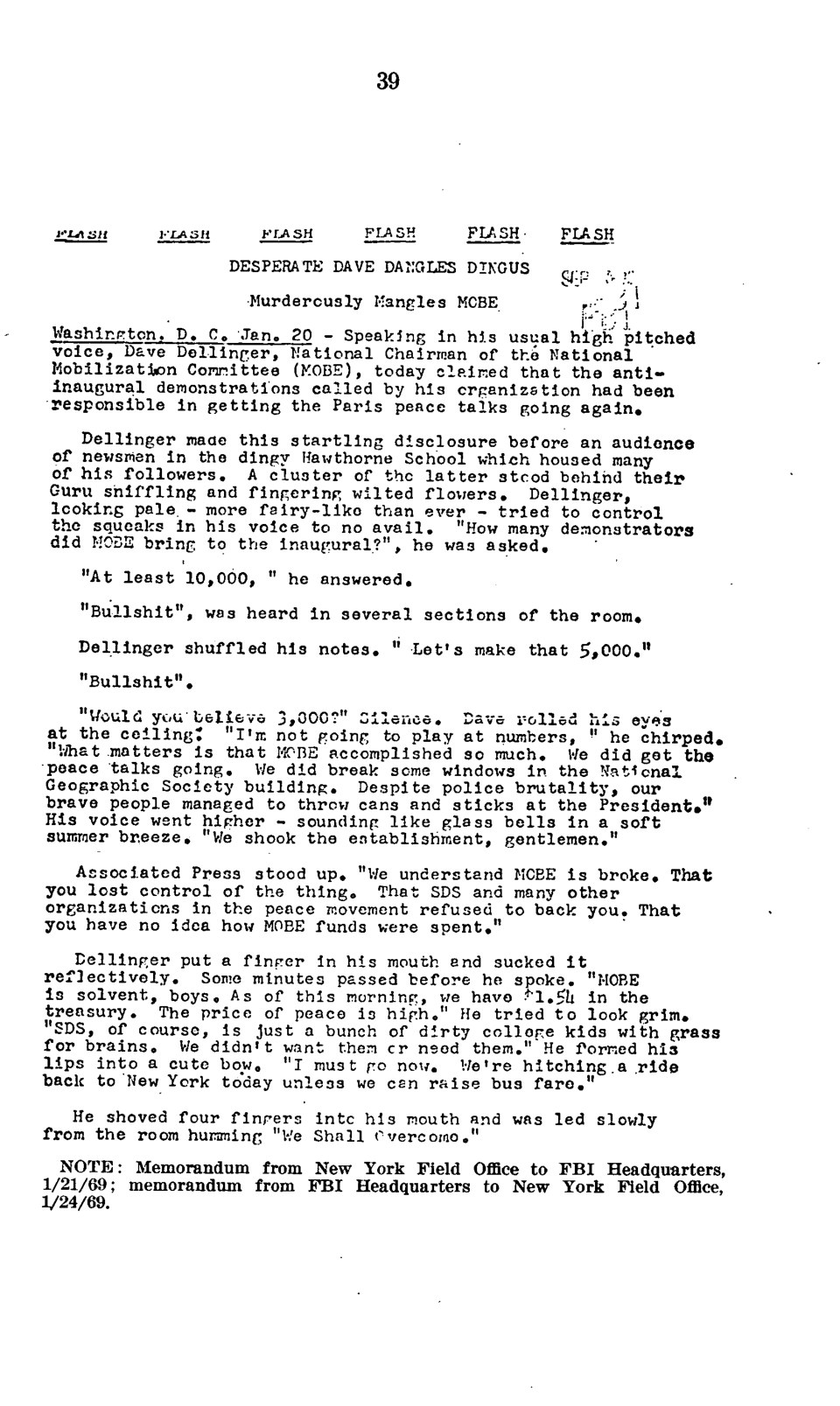
A Bureau-written flier styled as a wire-service "FLASH" report ridiculing Dave Dellinger of the National Mobilization Committee (New York field office proposal of 21 January 1969, approved 24 January 1969). It is reproduced in Church Committee Book III, p. 39, under "Bureau-Authored Pamphlets and Fliers". U.S. government work, public domain.
Then and now
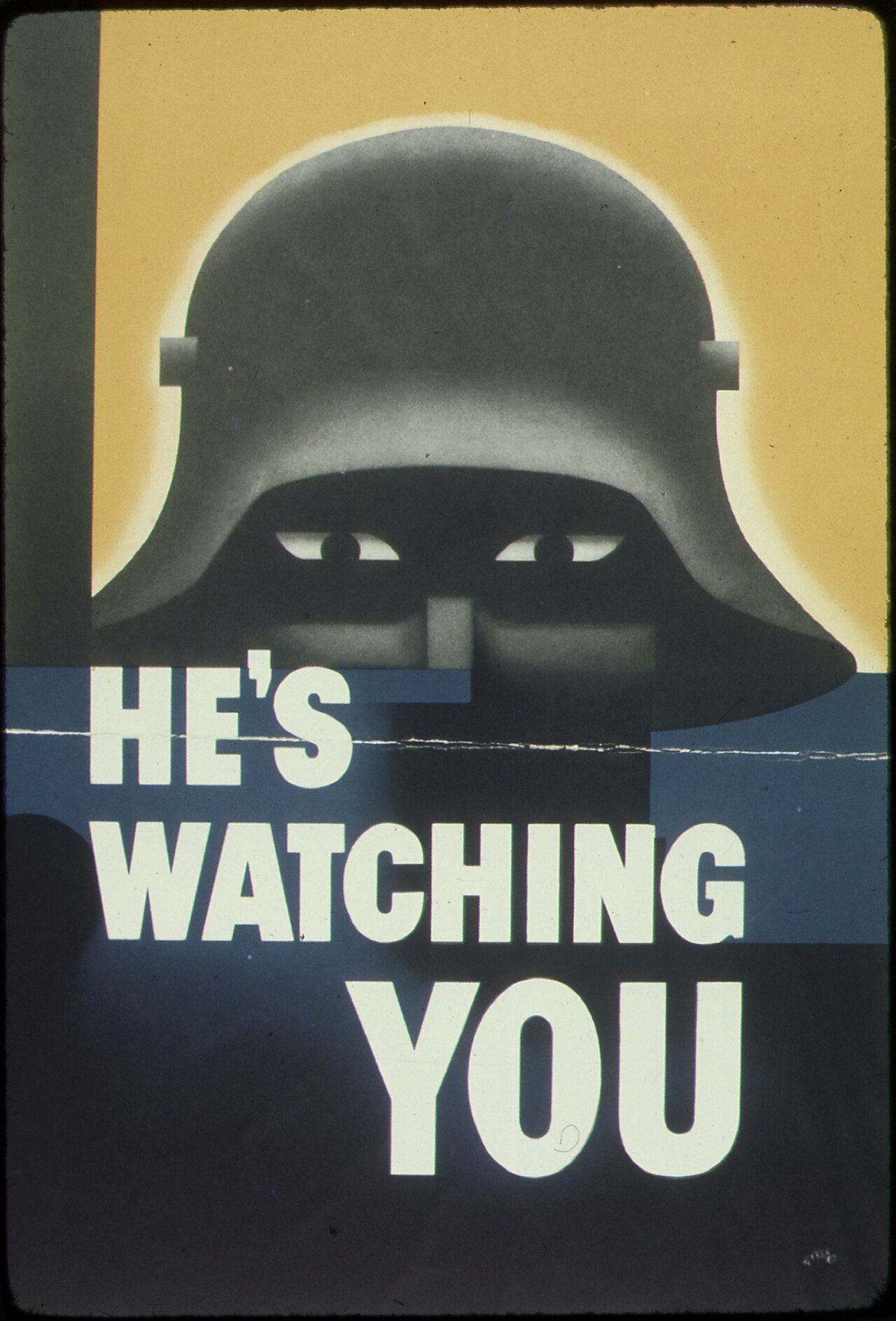
He's Watching You, U.S. government home-front security campaign, artist Glenn Grohe, 1942. Public domain.
In wartime, the U.S. government told its own public that a foreign enemy was watching and that careless citizens could help him. The Church Committee found that COINTELPRO's techniques "were adopted wholesale from wartime counterintelligence" and turned on domestic groups. William C. Sullivan, a former Assistant to the Director, testified: "We have used [these techniques] against Soviet agents... [The same methods were] brought home against any organization against which we were targeted. We did not differentiate." The 1942 poster was openly signed by the government. The COINTELPRO media work was built so that readers could not see that the Bureau was the source. That is the main difference between them.
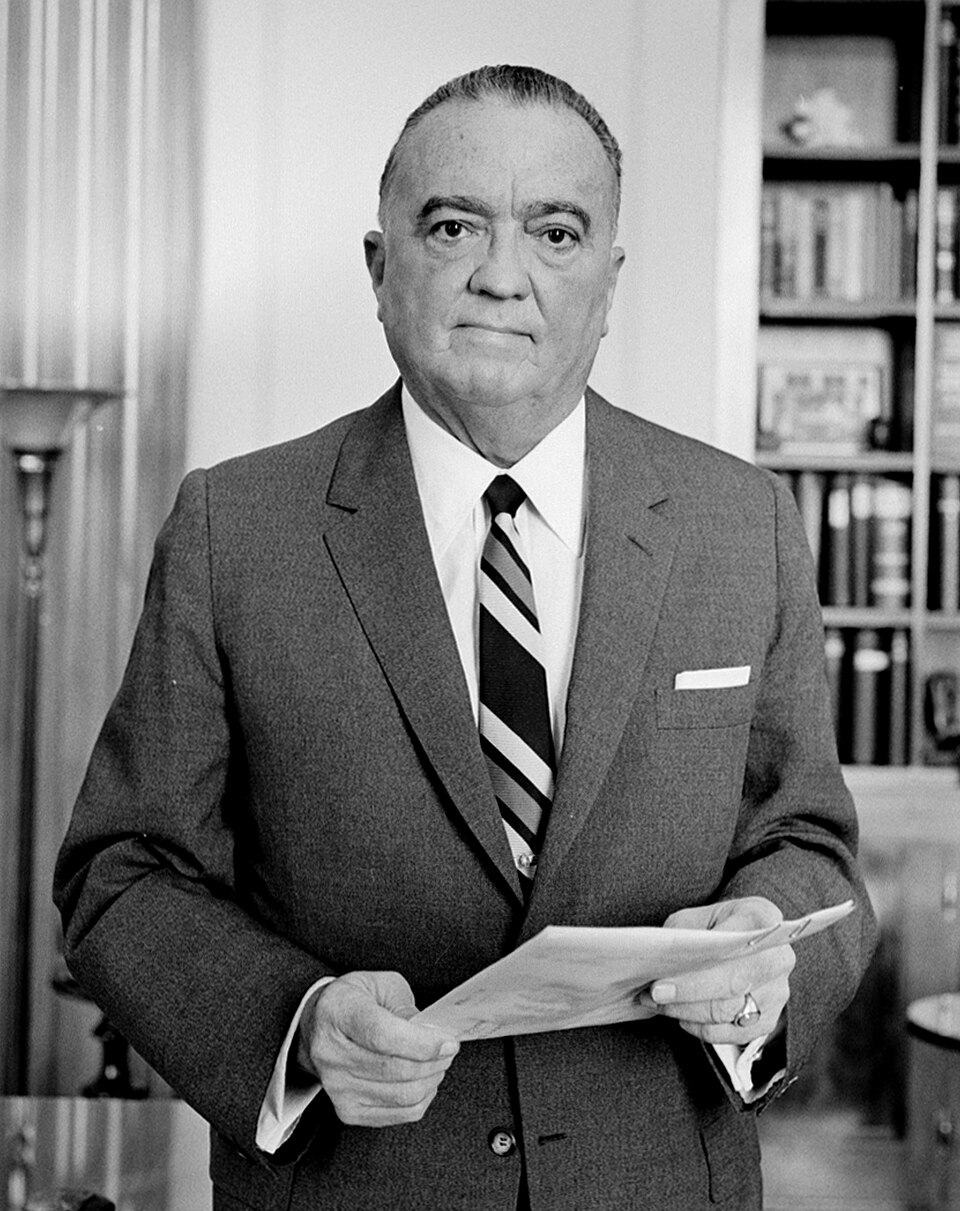
J. Edgar Hoover, FBI Director 1924-1972, photographed 28 September 1961. Marion S. Trikosko, U.S. News & World Report collection, Library of Congress. Public domain.
Positions on the record
- The Bureau's stated position. Every Bureau witness the Committee deposed said the programmes were meant to deter violence. The first programme was meant to counter a Party the Bureau believed had been used for Soviet "political and intelligence purposes". Witnesses described law enforcement as unable to act: rulings had made the Smith Act "technically unenforceable", and local police were "uncooperative or ineffective". The Committee itself acknowledged that "Congress and the public looked to the Bureau for protection". The unit chief said: "The Bureau people did not think that they were doing anything wrong." George C. Moore said the Klan programme was "one of the most effective ... programs I have ever seen the Bureau handle". In 1974 Attorney General Saxbe's public statement said most activities "were legitimate". The Petersen review classed "disseminating public source material on such individuals and groups to media representatives" as "entirely proper and appropriate law enforcement procedures".
- Critics on the record. The Church Committee concluded that the Bureau "conducted a sophisticated vigilante operation aimed squarely at preventing the exercise of First Amendment rights of speech and association". It also wrote that "the unexpressed major premise of the programs was that a law enforcement agency has the duty to do whatever is necessary to combat perceived threats to the existing social and political order". It asked of the reprint mailings: "should the Bureau be in the anonymous propaganda business?" Former Attorney General Ramsey Clark called the Chicago directives "highly improper". Attorney General Levi called much of the programme "foolishness". The Petersen review itself called some actions "abhorrent in a free society".
- This archive's reading. Documented: the directives, the friendly-media method, the Bureau-written fliers, the letters and cartoons in false names, and the Bureau's own memos claiming results. The record also shows real differences between the programmes. The Committee found the Klan programme "very precisely targeted" and said it used "comparatively few" techniques carrying a risk of serious harm, while the Black Nationalist programme used such techniques "extensively". Not shown: that the FBI placed the 29 March 1968 Memphis article (the Committee found "no proof"), or that the 1970 cartoon series led to violence. The Committee said the files did not show this. The San Diego office's claim that unrest was "directly attributable to this program" is the office's own claim. This page makes no finding on the targets' politics or conduct. It scores how the material was built and hidden.
Same-method test
The finding would be the same with the flag swapped. Canada is the closest counterpart. As reported by UPI in March 1981, Quebec's Keable inquiry found that the RCMP Security Service had distributed a fake communiqué ostensibly from a cell of the Front de libération du Québec in the early 1970s. It recommended charges over clandestine "disruptive tactics" against the Parti Québécois and left-wing groups, including Operation Bricole, a 1972 break-in at the left-wing news agency Agence de Presse Libre du Québec. The federal McDonald Commission (1977-1981) recommended taking security intelligence away from the RCMP, and the Canadian Security Intelligence Service was created in 1984. The scale differs: the Committee counted 2,370 approved FBI actions over fifteen years. The method is the same: a security service speaking in a target's voice, or through a news outlet that does not name its source.
How to spot it
- Ask where a story's facts came from. A news item that repeats a security agency's file material with no named source may be a relay, not reporting. The Bureau told field offices to use only "public source" material so that the handoff would not show.
- Watch for letters or leaflets "from a concerned member" that happen to push a group toward a split, and for rival-group material that appears just when two sides are talking. In San Diego, fresh cartoons followed news that the two groups were trying to "talk out their differences".
- Check the label against the target's conduct. A category like "Hate Group" or "New Left" that no document defines can cover a pacifist church group as easily as an armed one.
- Keep three things apart: what the directive ordered (a record), what a field office claimed it achieved (a self-report), and what an inquiry found (a finding).
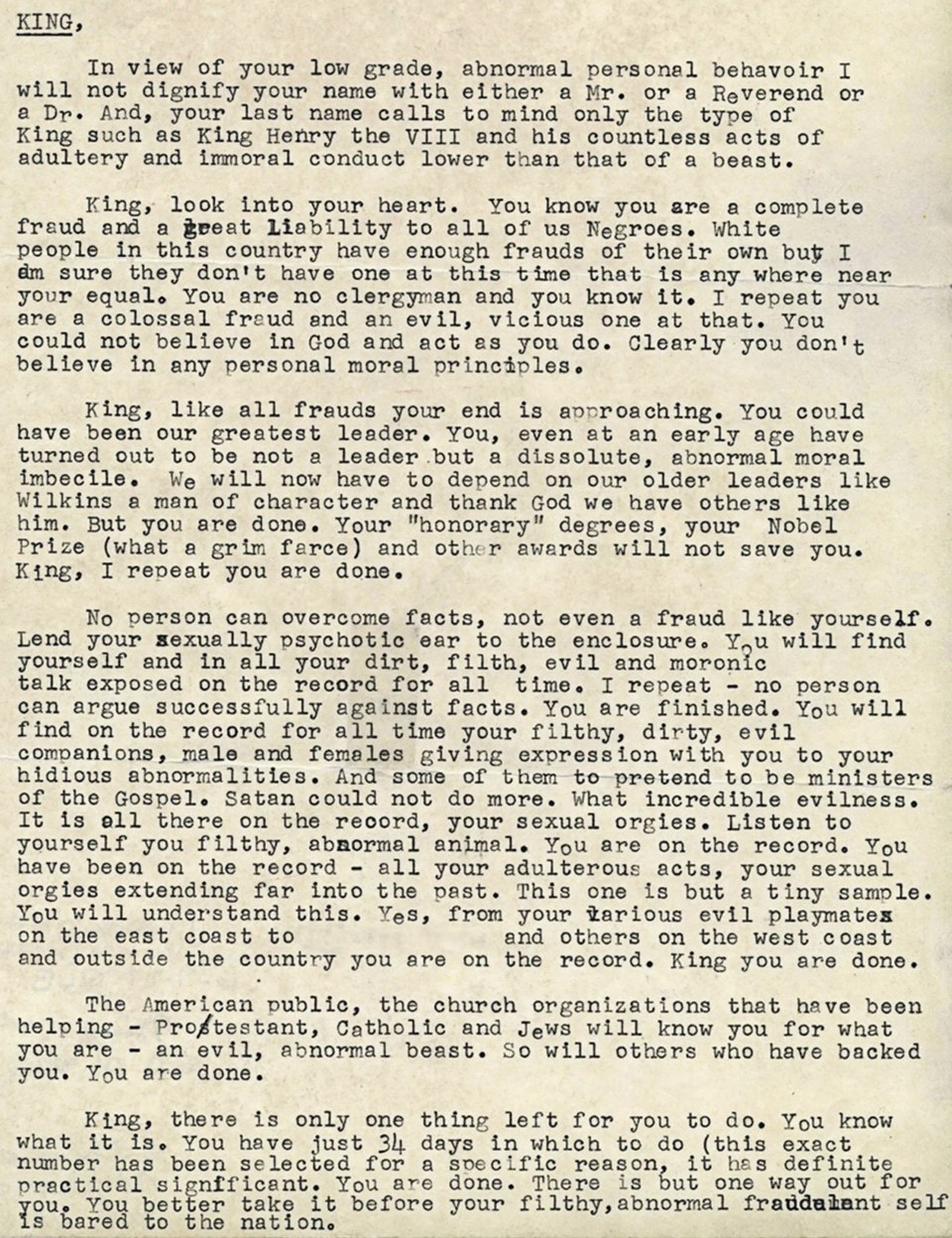
The anonymous letter of 1964, in the unredacted version from FBI files. The Church Committee quoted a draft of it found in William Sullivan's office files. Commons gives the author as "FBI, presumably William C. Sullivan". U.S. government work, public domain.
Images
| Image | Source | Licence |
|---|---|---|
| Mechanism diagram (above) | Drawn for FRAME from the Church Committee record (make_diagrams.py) |
CC BY 4.0, FRAME |
| Church Committee Book III title page (1976) | Wikimedia Commons, U.S. Senate | Public domain (U.S. government work) |
| FBI mock "FLASH" report on Dave Dellinger (1969), Book III p. 39 | Wikimedia Commons, U.S. Senate / FBI | Public domain (U.S. government work) |
| He's Watching You (1942) | FRAME gallery | Public domain (U.S. government work) |
| J. Edgar Hoover (1961) | Wikimedia Commons, Marion S. Trikosko, U.S. News & World Report / Library of Congress | Public domain (PD-USNWR) |
| Anonymous letter to Martin Luther King Jr. (1964) | Wikimedia Commons, FBI | Public domain (U.S. government work) |


Image gaps
- The San Diego cartoons attributed to the US organization, and the Miami and Tampa documentaries. The cartoons are FBI works and so public domain, but Book III describes them without reproducing them, and no scan was found on Commons. This gap can be filled from the FBI's released COINTELPRO files (vault.fbi.gov), which could not be reached from the environment used to build this page. The television films are station productions and probably copyrighted.
- The Media, Pennsylvania documents as first published in March 1971. The documents are FBI works, but the newspaper pages that printed them are copyrighted. Scans of the documents themselves could be added. Fillable from a machine that can reach archive.org or the FBI Vault.
- The "pick the faggot" contest flier and the SWP flier (Book III pp. 37-38). Both are in the same public-domain Commons PDF. They were left out to keep the page to four images, not for licence reasons. Fillable.
- A photo of the Media resident agency or of the Church Committee hearings. No openly licensed photo was confirmed. News photos of the hearings are mostly agency copyright.
Sources
- U.S. Senate Select Committee to Study Governmental Operations with Respect to Intelligence Activities, Final Report, Book III: Supplementary Detailed Staff Reports on Intelligence Activities and the Rights of Americans, S. Rep. 94-755 (23 April 1976). Read in the full scan on Wikimedia Commons. Sections used: "COINTELPRO: The FBI's Covert Action Programs Against American Citizens" (incl. IV.A "Propaganda", "'Friendly' Media", "Bureau-Authored Pamphlets and Fliers", IV.B, IV.D, V); "Dr. Martin Luther King, Jr., Case Study"; "The FBI's Covert Action Program to Destroy the Black Panther Party".
- Stern v. Richardson, 367 F. Supp. 1316 (D.D.C. 1973)
- NBC News: NBC reporter recounts breaking FBI spying story (Carl Stern)
- WHYY: Remembering the 1971 raid on the FBI office in Media, Pennsylvania
- PBS Independent Lens: 1971, Citizens Who Exposed COINTELPRO
- UPI, 6 March 1981: Keable inquiry report on alleged police wrongdoing
- UPI, 25 August 1981: McDonald Royal Commission report on the RCMP
- Commission of Inquiry Concerning Certain Activities of the RCMP (McDonald), Second Report, Freedom and Security under the Law (1981)