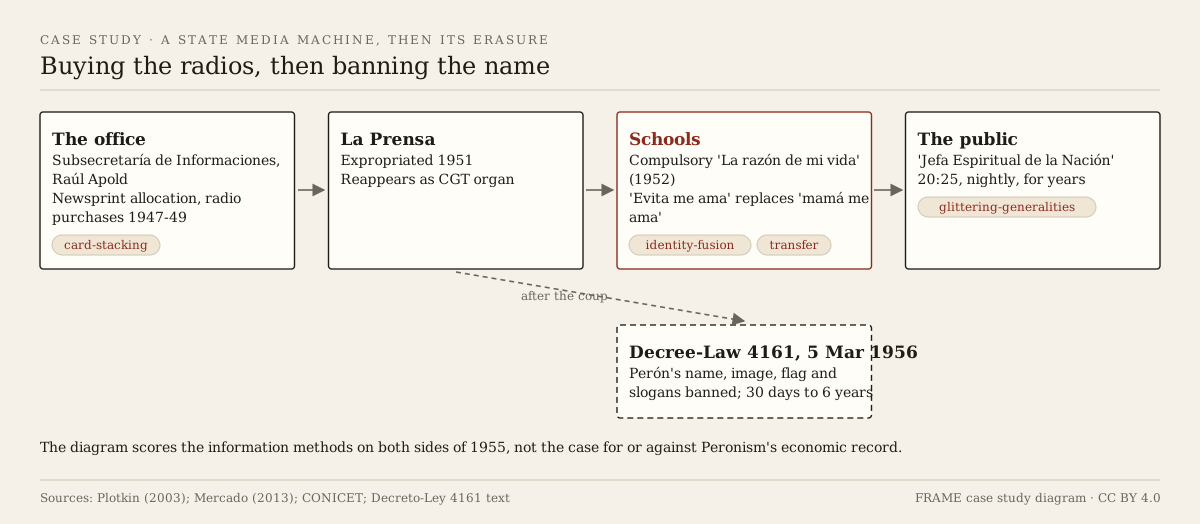
In one line: Argentina's Peronist government built a state office that bought the country's radio networks, expropriated its leading opposition newspaper, made Eva Perón's ghost-written memoir compulsory school reading, and taught first-graders "Evita me ama" in place of "mamá me ama"; after the 1955 coup that overthrew Perón, a decree made using his name, image or slogans a crime.
What happened
- 4 June 1946. Juan Domingo Perón takes office as President. A government information office founded under the previous military government in 1943 is expanded and centralised under him, distributing all official news and notices.
- 1947 to 1949. Raúl Apold, previously a press officer for a film studio, becomes Director General de Difusión (1947) and then Subsecretario de Informaciones (1949). Under him, the office's newsprint-allocation power pushes independent papers toward self-censorship, and the state and allied buyers acquire Argentina's three leading private radio networks, Belgrano, El Mundo and Splendid, between 1947 and 1949.
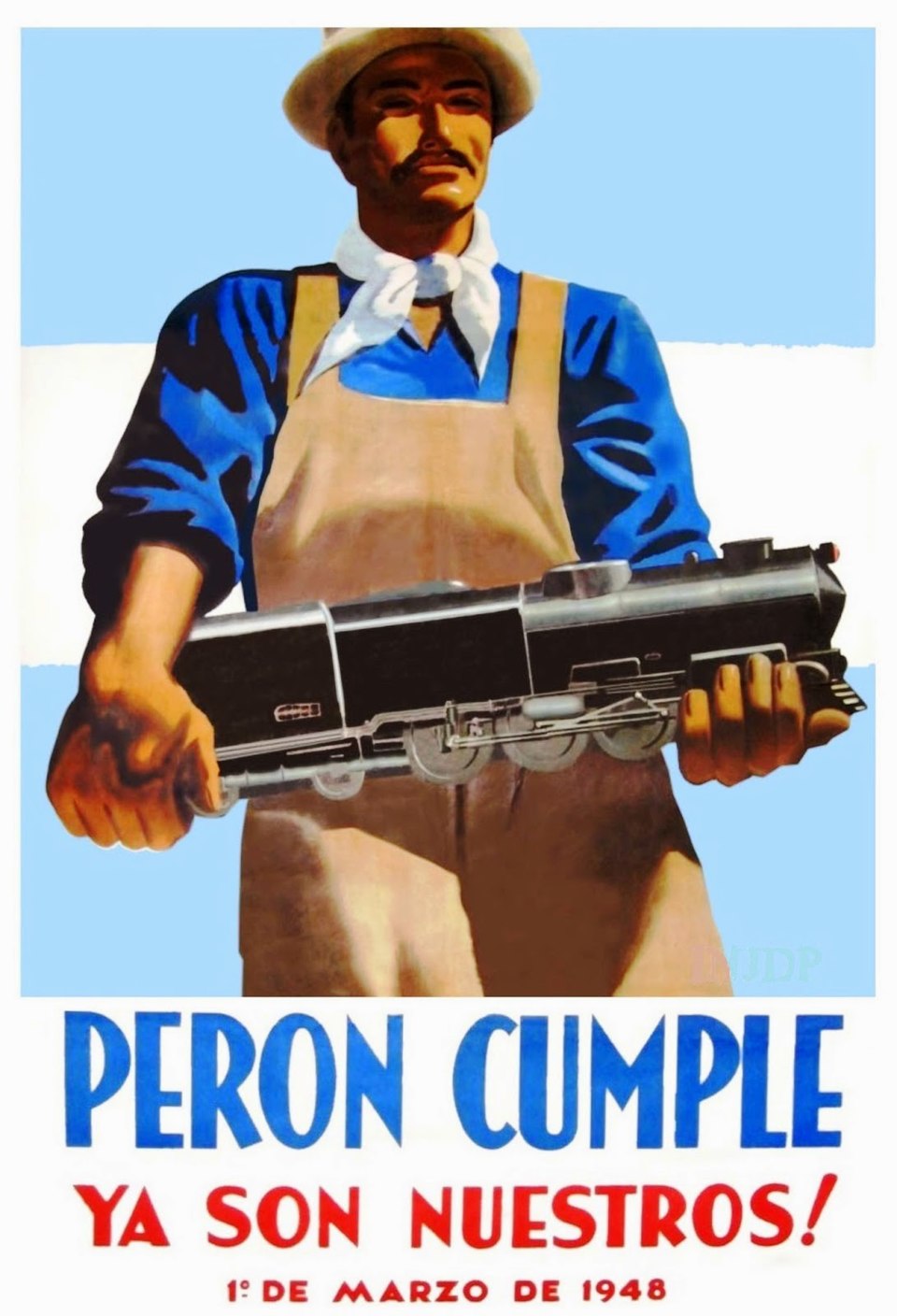
Poster, "Perón cumple. ¡Ya son nuestros!" ("Perón delivers. They are ours now!"), dated 1 March 1948, the date the government took over the British-owned railways; artist not credited. Commons; public domain (Argentine anonymous work, pre-1996).
- 23 January to 27 February 1951. A newspaper-vendors' union dispute with La Prensa, the country's leading opposition daily, ends in a fatal picket-line shooting. Congress creates a commission to investigate and take over the paper.
- 12 April 1951. Law 14,021 declares "of public utility and subject to expropriation" all the assets of the La Prensa partnership. Director Alberto Gainza Paz leaves the country. On 19 November 1951 the paper reappears as the organ of the CGT, the national trade-union confederation, under the slogan "al servicio del pueblo" ("at the service of the people").
- 15 October 1951. La razón de mi vida, presented as Eva Perón's own memoir but ghost-written by the Spanish journalist Manuel Penella de Silva and, according to later reporting, reworked on Perón's orders, is published with a first run of 300,000 copies. Law 14,126, sanctioned 17 July 1952, makes it compulsory reading at every level of education.
- Early 1950s. School primers approved by the Ministry of Education, including a first-grade reader titled Evita, call Perón "el Libertador de la República" ("the Liberator of the Republic") and Eva Perón "la Jefa Espiritual de la Nación" ("the Spiritual Leader of the Nation"). The phrase "Evita me ama" ("Evita loves me") replaces the traditional first-reading sentence "mamá me ama" ("mummy loves me").
- 17 October 1950. From the Casa Rosada balcony, Perón reads the "Veinte Verdades" (Twenty Truths), including "en la Nueva Argentina los únicos privilegiados son los niños" ("in the New Argentina the only privileged ones are the children"). The date, 17 October, commemorates the 1945 mobilisation that won Perón's release from detention and became Peronism's central holiday, the Día de la Lealtad.
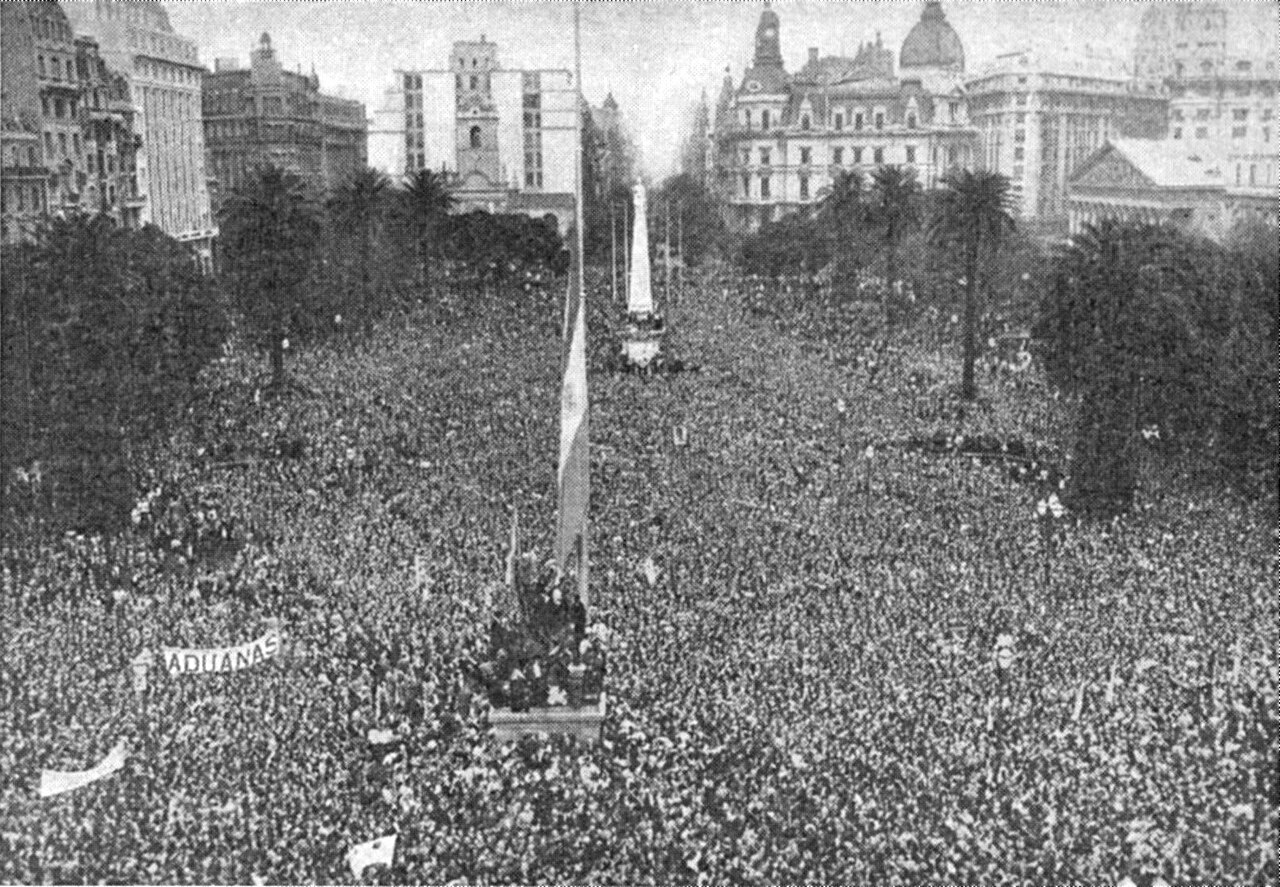
Crowd in the Plaza de Mayo, Buenos Aires, at a rally of Perón's government, c. 1951 (Commons title: "Manifestación oficialista durante el primer gobierno de Perón"). Unknown photographer; public domain (Argentina, photograph). Crowd size is not stated in the source.
- 7 May 1952. Congress confers on Eva Perón the title "Jefa Espiritual de la Nación", the only time it has granted such a title.
- 26 July 1952, 20:25. The Subsecretaría de Informaciones announces Eva Perón's death on national radio at 20:25. For years afterward, radio stations interrupt programming nightly at that hour to mark what state media call "la hora en que Eva Perón pasó a la inmortalidad" ("the hour at which Eva Perón passed into immortality").
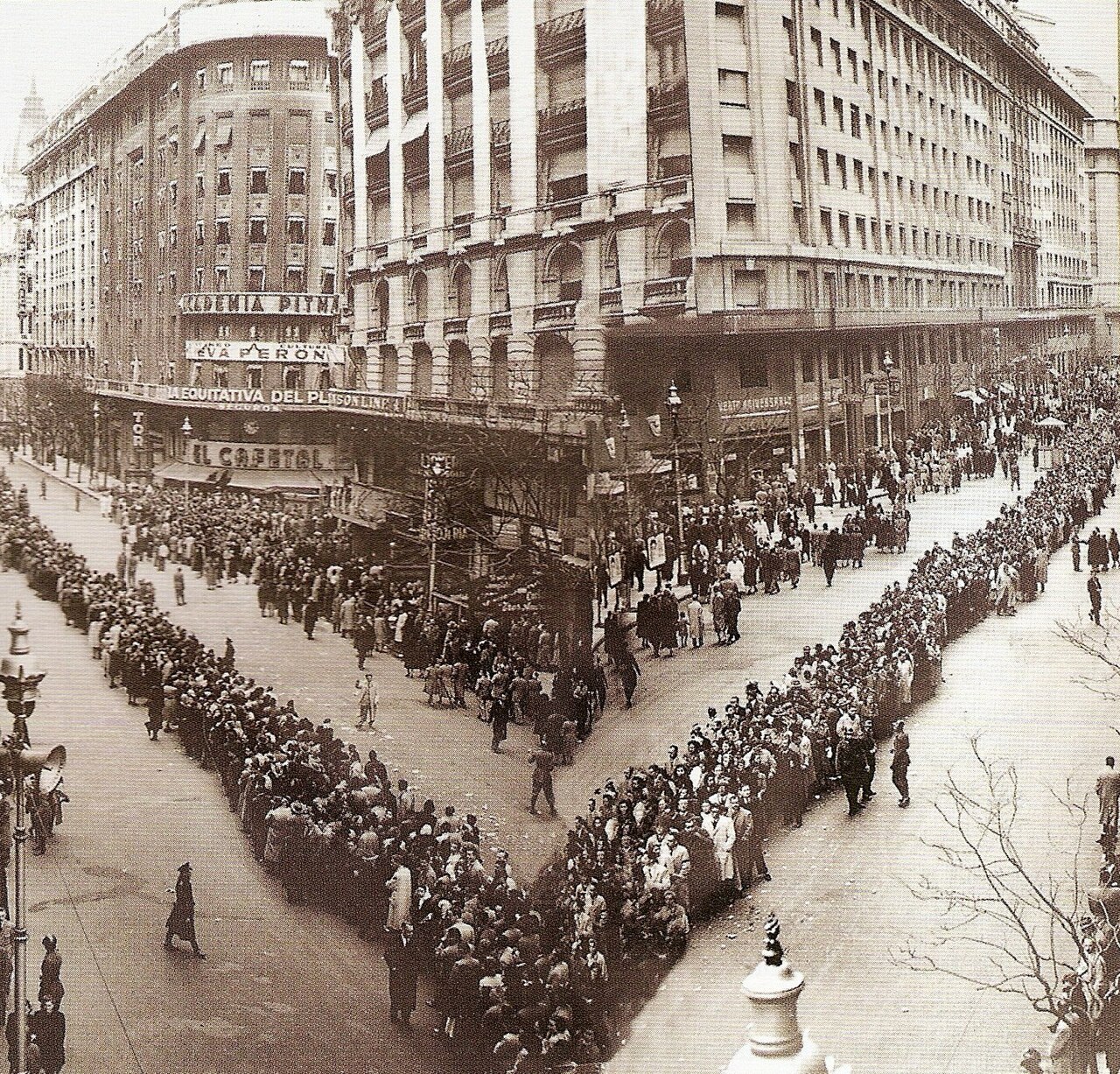
Queues of mourners on two converging streets in Buenos Aires during Eva Perón's lying-in-state and funeral, July to August 1952. Commons, unknown photographer; public domain (Argentina, photograph).
- July 1955. Apold, described by the historian Silvia Mercado as "the second most powerful and feared man in Peronist Argentina", leaves the country in a cabinet shake-up shortly before Perón's own overthrow.
- 5 March 1956. Six months after the coup that removed Perón, the de facto government of Gen. Pedro Aramburu signs Decree-Law 4161. It bans "items of Peronist ideological affirmation or propaganda", including Perón's and his relatives' names, Peronist symbols and flags, the words "peronismo" and "justicialismo", and the Marcha Peronista, on penalty of 30 days to 6 years in prison and a fine. Perón's name is replaced in press and official usage with "el tirano prófugo" ("the fugitive tyrant"). Eva Perón's embalmed body is removed and hidden. The decree is enforced, with a gap under Frondizi's presidency, until its repeal by Law 16,648 on 18 November 1964.
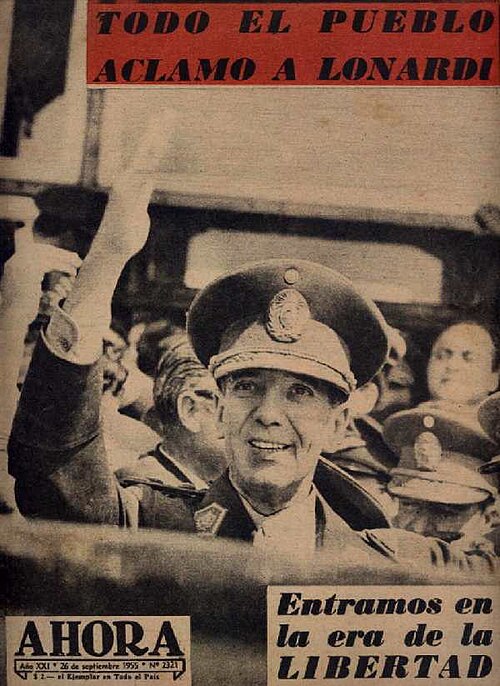
Cover of the magazine Ahora (Buenos Aires), 26 September 1955, days after the coup that removed Perón: a uniformed general waving, with the headlines "Todo el pueblo aclamó a Lonardi" ("All the people acclaimed Lonardi") and "Entramos en la era de la libertad" ("We enter the era of freedom"). Commons, unknown photographer; public domain (Argentina, photograph; US term expired).
How it works
- Transfer: "Jefa Espiritual de la Nación" and "Libertador de la República" moved the prestige of spiritual and national leadership onto two living politicians, and a compulsory memoir carried Eva Perón's authorial voice, though the text was written by someone else on the president's instruction.
- Glittering generalities: "el pueblo", "dignifica" and "los únicos privilegiados son los niños" are virtue phrases repeated at scale rather than specific, checkable claims about policy.
- Identity fusion: a first-grade sentence that replaces "mummy loves me" with a political leader's name teaches affection for the state alongside literacy itself, before a child can evaluate either.
- Card stacking: state control of newsprint allocation, radio ownership and the leading former opposition paper meant that by the early 1950s, most of what a reader or listener encountered had passed through the same office.
Then and now
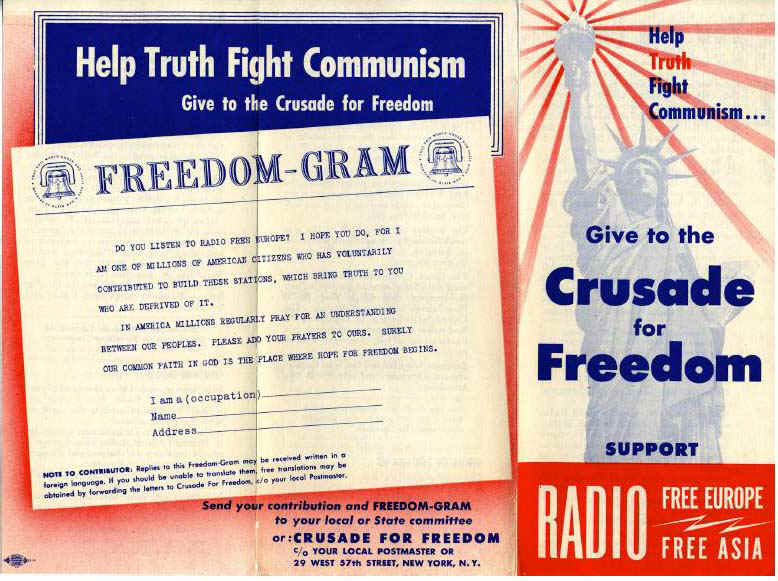
Freedom-Gram: Help Truth Fight Communism, Crusade for Freedom, 1952. Public domain.
In the same year Argentine schoolchildren read "Evita me ama", an American donor drive asked citizens to sign a card declaring they had voluntarily funded Radio Free Europe, when the station's main funding in fact came from the US government through the CIA. Both cases moved a state's message through a channel dressed as something else, a memoir, a donation drive, a school primer, so that its origin would not be weighed alongside its content. The scale and setting differ sharply: Argentina's programme ran inside the country it governed and reached into classrooms; the Crusade for Freedom addressed an allied democracy's own donors about a foreign broadcaster.
Positions on the record
- Peronist institutions, then and since: present the 1946-55 information programme as social justice publicised for a population that had been ignored by the pre-1946 press, and Decree-Law 4161 as political proscription, a cause of later "gorila" hatred (Peronist slang for anti-Peronists).
- Opponents, then and since: the 1946 opposition coalition and the US Embassy's "Blue Book" (February 1946) cast Perón as Nazi-fascist, a framing Perón used to win the election by casting the contest as "Braden o Perón" (after US Ambassador Spruille Braden). The Libertadora government called the Perón years "la segunda tiranía" ("the second tyranny").
- On La Prensa: the Peronist reading treated the case as a labour dispute compounded by tax evasion; a later Peronist-sympathetic commentator (Infobae, 2021) called it "a mistake Perón regretted".
- What is documented: the Subsecretaría's structure and radio purchases, the La Prensa expropriation law and date, the memoir's authorship and compulsory-reading law, the primer texts, the 20:25 broadcast, and Decree-Law 4161's text and penalties.
- What is not shown here: the exact instrument or law number for Eva Perón's title beyond the congressional declaration, and full circulation figures for the primers. This page takes no position on Peronism's economic or labour record.
Same-method test
A government of any party that bought its country's broadcasters, took over its leading opposition paper through an expropriation law, and put a compulsory book bearing the leader's spouse's name into every school would be scored the same way here. A successor government that made using the ousted leader's name a criminal offence would be scored on the same terms as the rule it replaced.
How to spot it
- Ask who owns the paper or the station a message reaches you through, and how it came to own it.
- Notice when a school text replaces a universal phrase ("mummy loves me") with a political name. Literacy and loyalty should not be taught in the same sentence.
- Watch what a new government criminalises, not only what the old one promoted. A ban on a name, a flag or a word is itself an act of information control.
Images
| Image | Source | Licence |
|---|---|---|
| Mechanism diagram (above) | Drawn for FRAME from the sources below (make_diagrams_regions.py) |
CC BY 4.0, FRAME |
| "Perón cumple" railways poster (1948) | Wikimedia Commons | Public domain (PD-AR-Anonymous; PD-1996) |
| Plaza de Mayo rally (c. 1951) | Wikimedia Commons | Public domain (PD-AR-Photo) |
| Eva Perón's funeral queue (1952) | Wikimedia Commons | Public domain (PD-AR-Photo; PD-1996) |
| Ahora magazine cover on Gen. Lonardi (26 Sep 1955) | Wikimedia Commons | Public domain (PD-AR-Photo; PD-US-expired) |
Image gaps
- The cover of La razón de mi vida (1951). Only a 2020 photograph of a printed copy is on Commons, under a CC BY-SA licence for the photograph; the underlying 1951 design carries no separate public-domain tag and its US copyright status is unclear.
- "Braden o Perón" 1946 campaign poster. Tagged public domain on Commons but only available at 300px, too small to use.
- Peronist school primers ("Evita me ama", "Privilegiados") and a scan of Decree-Law 4161. No openly licensed image files were found.
Sources
- Mariano Ben Plotkin, Mañana es San Perón: A Cultural History of Perón's Argentina (Scholarly Resources, 2003; Spanish edition Ariel, 1993).
- Silvia D. Mercado, El inventor del peronismo: Raúl Apold, el cerebro oculto que cambió la política argentina (Planeta, 2013).
- "El desarrollo de la Subsecretaría de Informaciones (1943-1945)", Redalyc.
- "La radiofonía privada deviene gubernamental. El proceso de adquisición de emisoras por el Peronismo (1947-1949)", Redalyc.
- "La expropiación de 1951", La Prensa.
- Mara Glozman, "Debate parlamentario e imaginarios pedagógicos durante el primer peronismo: La Razón de Mi Vida como objeto de disputa", CONICET.
- "«Evita me ama»: Autoras de libros escolares (1952-1955)", CONICET.
- Decreto-Ley 4161/1956, full text, El Historiador.
- "Cuando nombrar a Perón, a Evita y cantar la marcha estuvo prohibido por ley", Infobae.
- "La expropiación de La Prensa, un error del que Perón se arrepintió", Infobae.