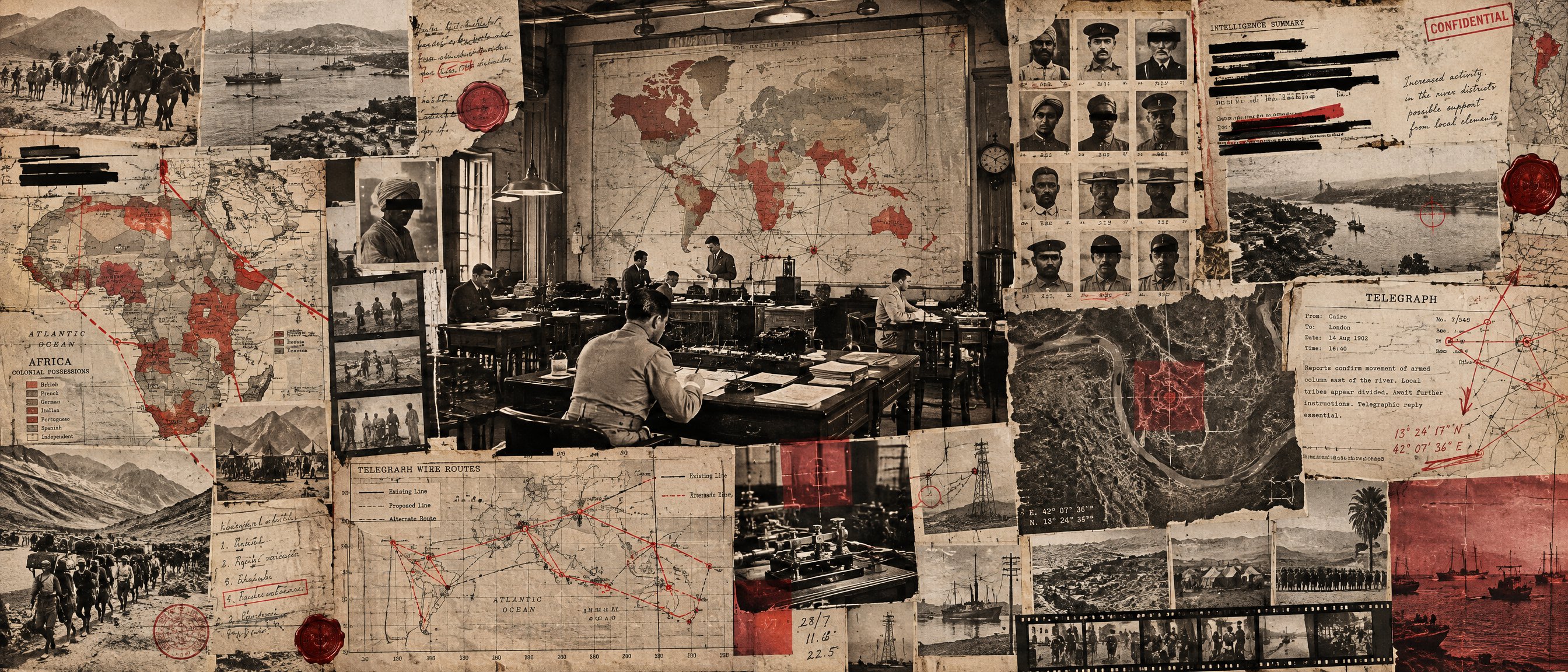
In one line: the word "propaganda" entered modern languages from the name of a Catholic missionary office founded in Rome in 1622, the Sacra Congregatio de Propaganda Fide ("for propagating the faith"), and only over the next three centuries came to carry the hostile meaning it has today.
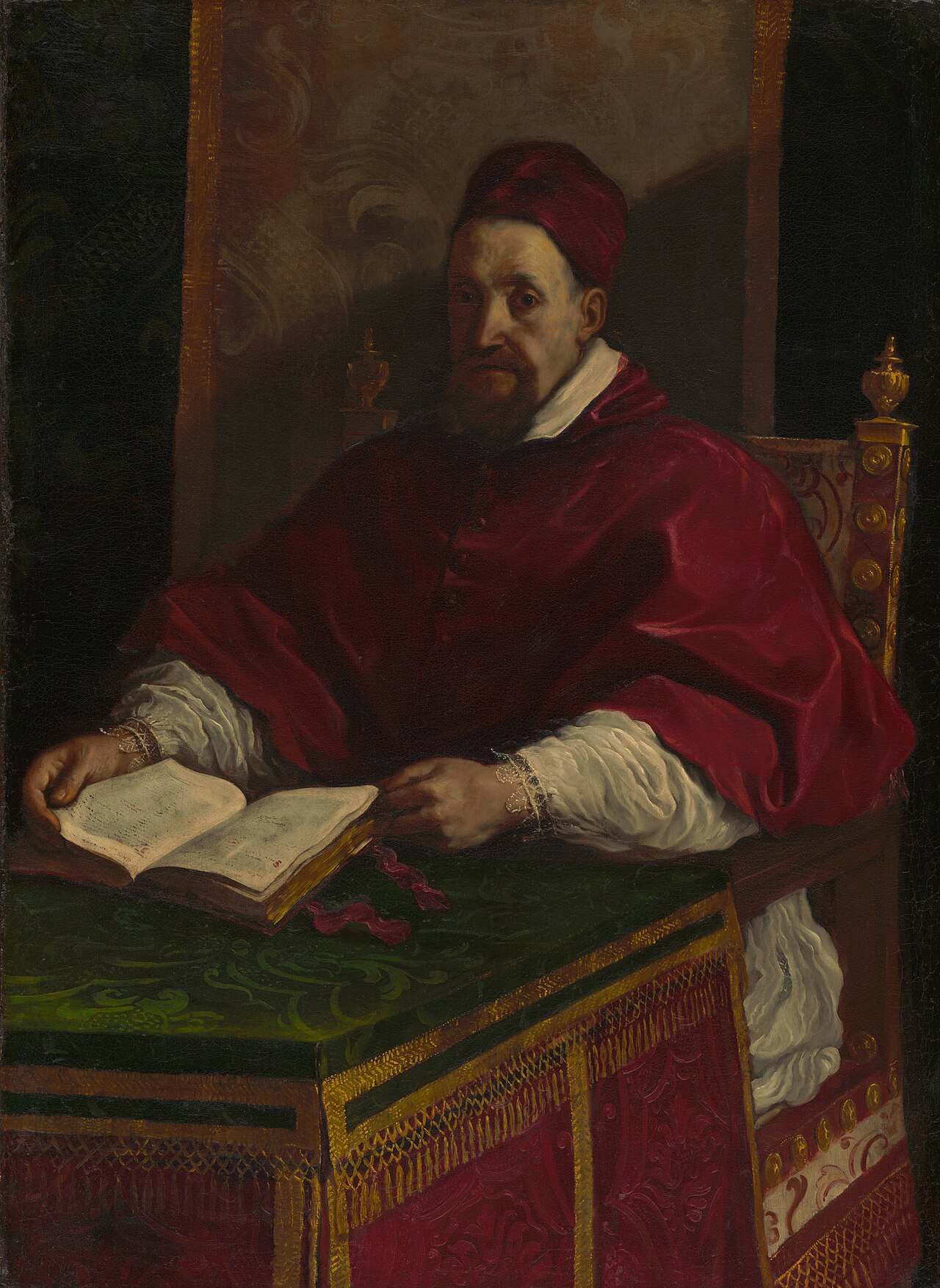
Pope Gregory XV (Alessandro Ludovisi, pope 1621 to 1623), painted by Guercino, about 1622 to 1623. Public domain.
This page is about a word, not about an influence campaign. The Congregation is described here in its own terms and in the terms of its historians. Calling it "propaganda" in the modern, pejorative sense would read the twentieth century back into the seventeenth.
What happened
- Before 1622. Popes had tried to bring missionary work under one Roman body before. Historians of the Congregation (Guilday 1921; Metzler 1971) note a short-lived commission of cardinals under Clement VIII around 1599. Most missions overseas ran under the royal patronage of Spain and Portugal (patronato and padroado), which gave those crowns a large say in appointing missionaries and bishops.
- 6 January 1622. Gregory XV sets up a standing congregation of cardinals for the missions. Francesco Ingoli becomes its first secretary and stays in the post until 1649.
- 22 June 1622. The bull Inscrutabili Divinae (from its opening words, "by the inscrutable [counsel] of divine [providence]") gives the Congregation its formal constitution. In the Church's own account, its task is to propagate the Catholic faith among those who do not hold it, and to oversee missions everywhere, including the Catholic minorities of Protestant northern Europe. It is to coordinate the religious orders sent abroad and report to the pope on the state of the missions.
- 1626. The Congregation sets up its own printing house, later known as the Typographia Polyglotta, to print catechisms, grammars and alphabets in the languages of mission territories. It is housed in a palazzo in Piazza di Spagna given for the purpose by the Spanish prelate Juan Bautista Vives.
- 1627. Urban VIII founds the Collegium Urbanum to train priests for the missions, including men from the mission territories themselves. The name survives today as the Pontifical Urban University.
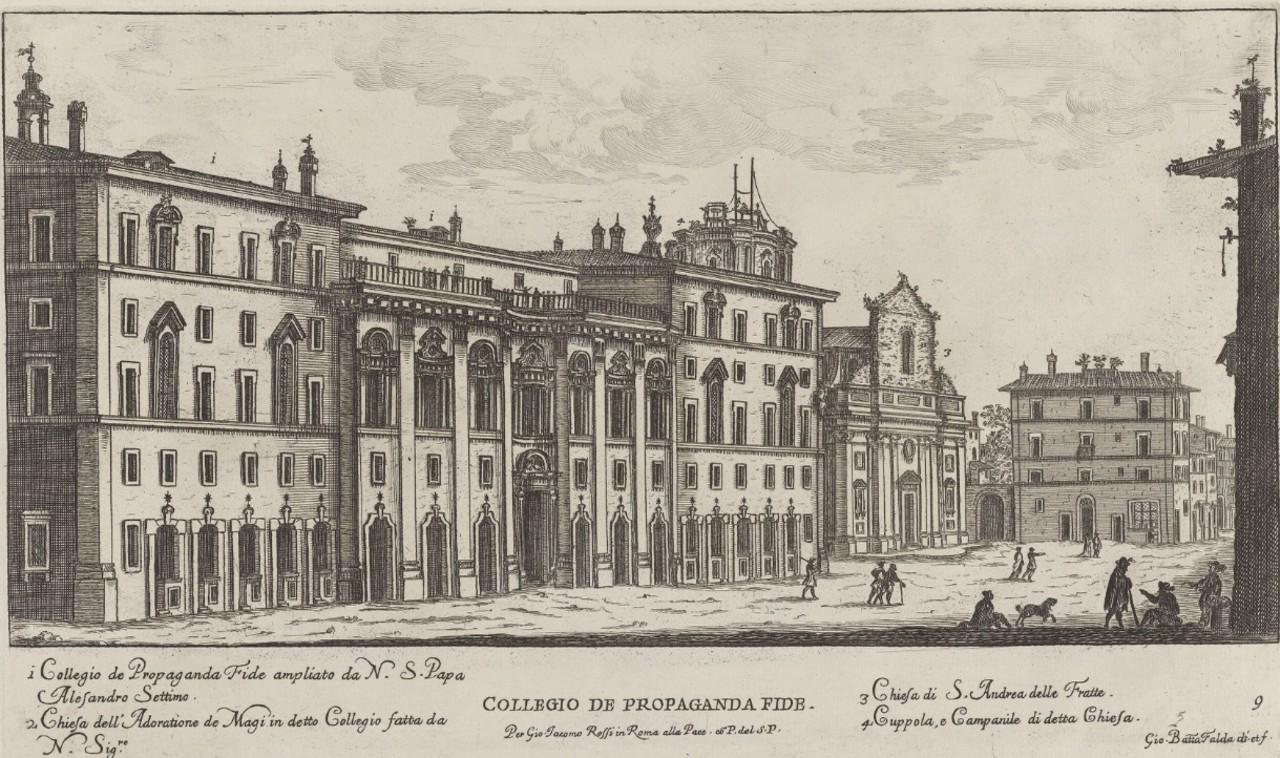
The Collegio de Propaganda Fide on what is now Via di Propaganda, etched by Giovanni Battista Falda and published by Giovanni Giacomo Rossi, Rome, 1665. The key reads, in part, "Collegio de Propaganda Fide ampliato da N. S. Papa Alessandro Settimo" (enlarged by our lord Pope Alexander VII). Public domain.
- 1640s to 1660s. The building is rebuilt by the two leading architects of Baroque Rome. Gian Lorenzo Bernini designs the front on Piazza di Spagna. From 1646 Francesco Borromini takes over, building the long concave front on the side street and the chapel of the Three Kings (Re Magi) inside.
- 1659. The Congregation's instruction to the first French vicars apostolic bound for Tonkin, Cochinchina and China (François Pallu and Pierre Lambert de la Motte, founders of the Paris Foreign Missions Society) tells them not to press local peoples to change their customs and manners unless these are clearly against religion or morals. It asks, in a widely quoted passage paraphrased here, what could be more absurd than carrying France, Spain or Italy into China, and tells the missionaries to bring the faith, not European customs. It also presses them to train local clergy.
- 1715 and 1742. In the Chinese Rites controversy, popes Clement XI and Benedict XIV nonetheless ruled against Confucian and ancestral rites for Chinese Catholics. Pius XII relaxed those rulings in 1939. The 1659 instruction set a direction; later rulings did not always follow it.
- 1967. Paul VI's reform of the Roman Curia renames the office the Congregation for the Evangelization of Peoples, keeping "de Propaganda Fide" as a secondary title.
- 2022. Francis's constitution Praedicate Evangelium merges it with the Pontifical Council for Promoting the New Evangelization to form the Dicastery for Evangelization, headed directly by the pope.
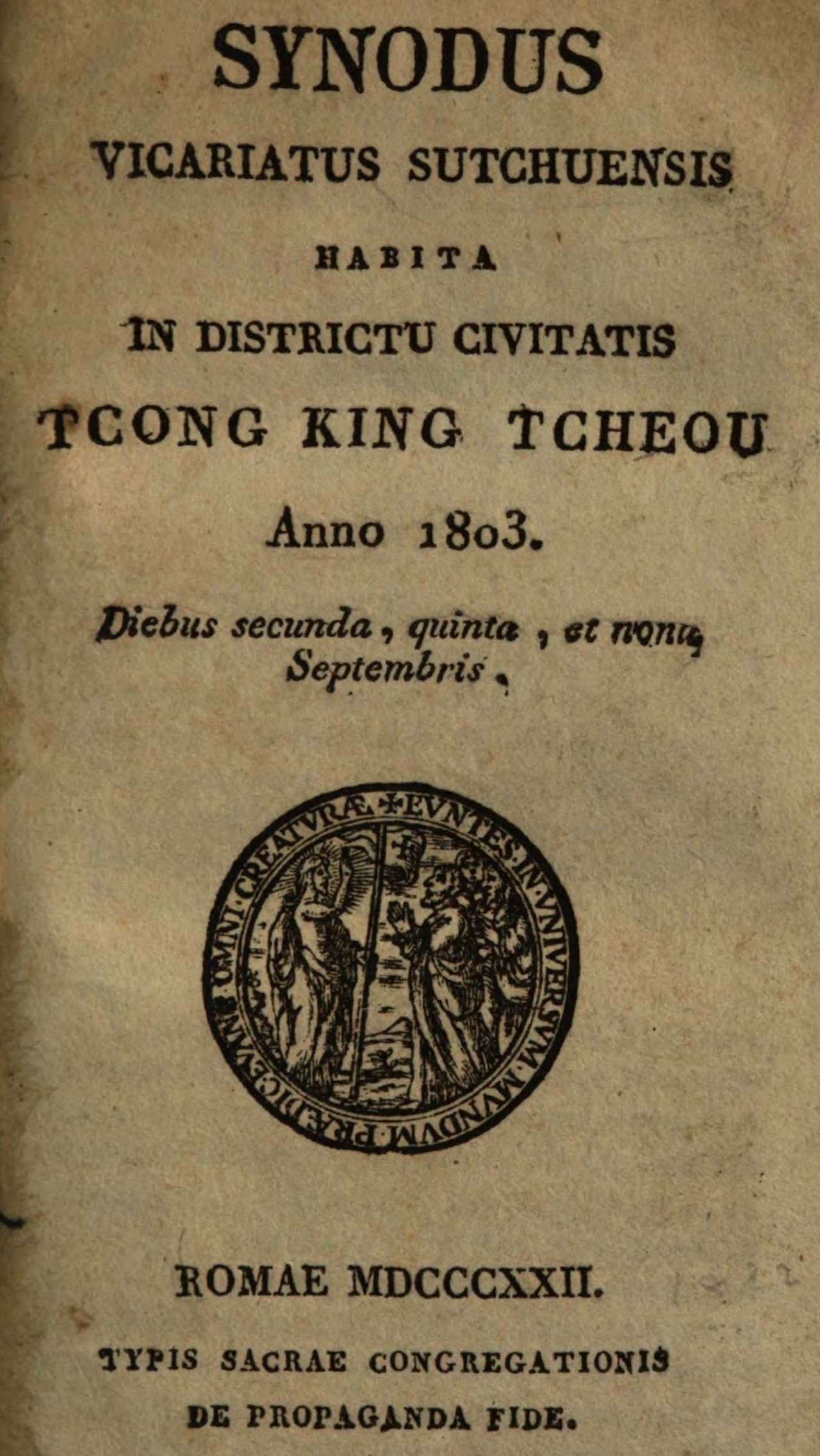
The acts of the 1803 synod of the vicariate of Sichuan, printed in Rome in 1822 "Typis Sacrae Congregationis de Propaganda Fide" (on the presses of the Sacred Congregation for Propagating the Faith). The seal's legend is Mark 16:15, "Euntes in universum mundum praedicate evangelium omni creaturae" ("Go into all the world and preach the gospel to every creature"). Public domain.
How the word travelled
- The grammar. Propaganda is a Latin gerundive of propagare, "to propagate". The verb comes from gardening: a propago is a slip or layer of a plant set in the ground to grow a new one. In the Congregation's title, de propaganda fide means "concerning the faith that is to be propagated": propaganda agrees with fide. Cut loose from the title, the same form reads as a neuter plural, "things to be propagated", and this is how it became a free-standing noun in Italian, French, English and German.
- 17th and 18th centuries: a proper name, and a label. In Catholic usage "the Propaganda" was simply the name of an office in Rome. Scholars of the word (Jowett and O'Donnell; Qualter) note that in Protestant countries the same name took on a hostile edge, as shorthand for Rome's organised effort to win converts, including in Protestant lands. This page does not quote a specific Protestant text using the word that way; see Image gaps.
- 1790s onwards: politics. In the revolutionary decade after 1789 the word moved into secular political writing in French and English for organised efforts to spread political principles, and opponents of the French Revolution used it for groups they said were exporting the Revolution. Through the nineteenth century "propaganda" became an ordinary term for spreading a doctrine, used by supporters of that doctrine as much as by their opponents.
- 1877: "propaganda by the deed". Anarchists used the word of themselves. Paul Brousse's article "La propagande par le fait" (Bulletin de la Fédération jurassienne, August 1877) argued that action would spread ideas that speeches and print could not reach. The phrase was later tied to a wave of assassinations and bombings by self-described anarchists, among them the killings of French President Sadi Carnot (1894), Empress Elisabeth of Austria (1898), King Umberto I of Italy (1900) and U.S. President William McKinley (1901).
- 1902: Lenin's distinction. In What Is to Be Done? Lenin, following Georgi Plekhanov, used "propaganda" and "agitation" as neutral working terms: the propagandist gives many ideas to a few people, the agitator one or a few ideas to many. The Bolshevik party later ran an "agitprop" department. In this tradition the word was a job description, not an accusation.
How it works
No technique is tagged on this page. It records where a word came from and how its meaning changed; it does not document a message built to bypass checking, which is what this archive's techniques describe.
- Semantic hijacking was considered and not tagged. The definition covers a speaker who captures a word and stretches it within an argument. The drift of "propaganda" from a Roman office to a general term, and then to a term of abuse, happened across three centuries, many languages and opposed users. No single speaker's swap of definitions is shown.
- Name-calling was considered and not tagged. Hostile uses of "the Propaganda" by Protestant writers, and later uses of "propaganda" for an opponent's speech, fit the definition, but this page does not quote a specific dated instance. A page on a particular text could tag it.
- What the page does show is a labelling asymmetry that readers can use elsewhere. By the First World War the same word could name one's own work openly (Lenin, Bernays, Goebbels' ministry), be kept for the enemy's work only (the Allied governments), or name wartime lies on all sides (Ponsonby, Lasswell).
Then and now
- 1914 to 1918: the enemy's propaganda, our information. Every major belligerent ran official persuasion offices: Britain's War Propaganda Bureau at Wellington House (1914) and Department of Propaganda in Enemy Countries (1918), Germany's press and foreign-propaganda offices, and the U.S. Committee on Public Information (1917). The CPI's chairman, George Creel, wrote in How We Advertised America (1920) that his committee did not call its work propaganda, because the word had come to be linked with German deceit.
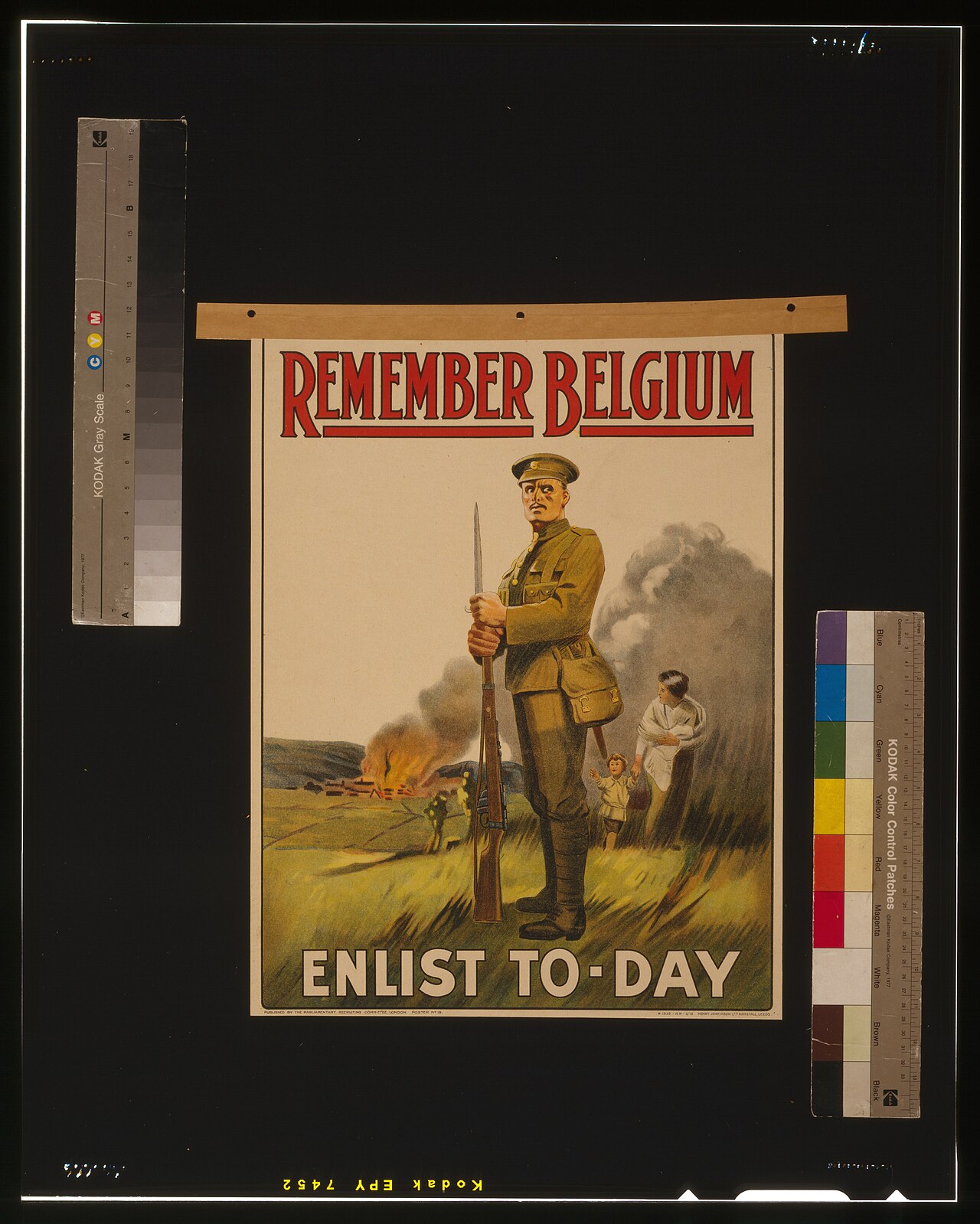
Remember Belgium — Enlist To-Day, Parliamentary Recruiting Committee, United Kingdom, 1915. Public domain.
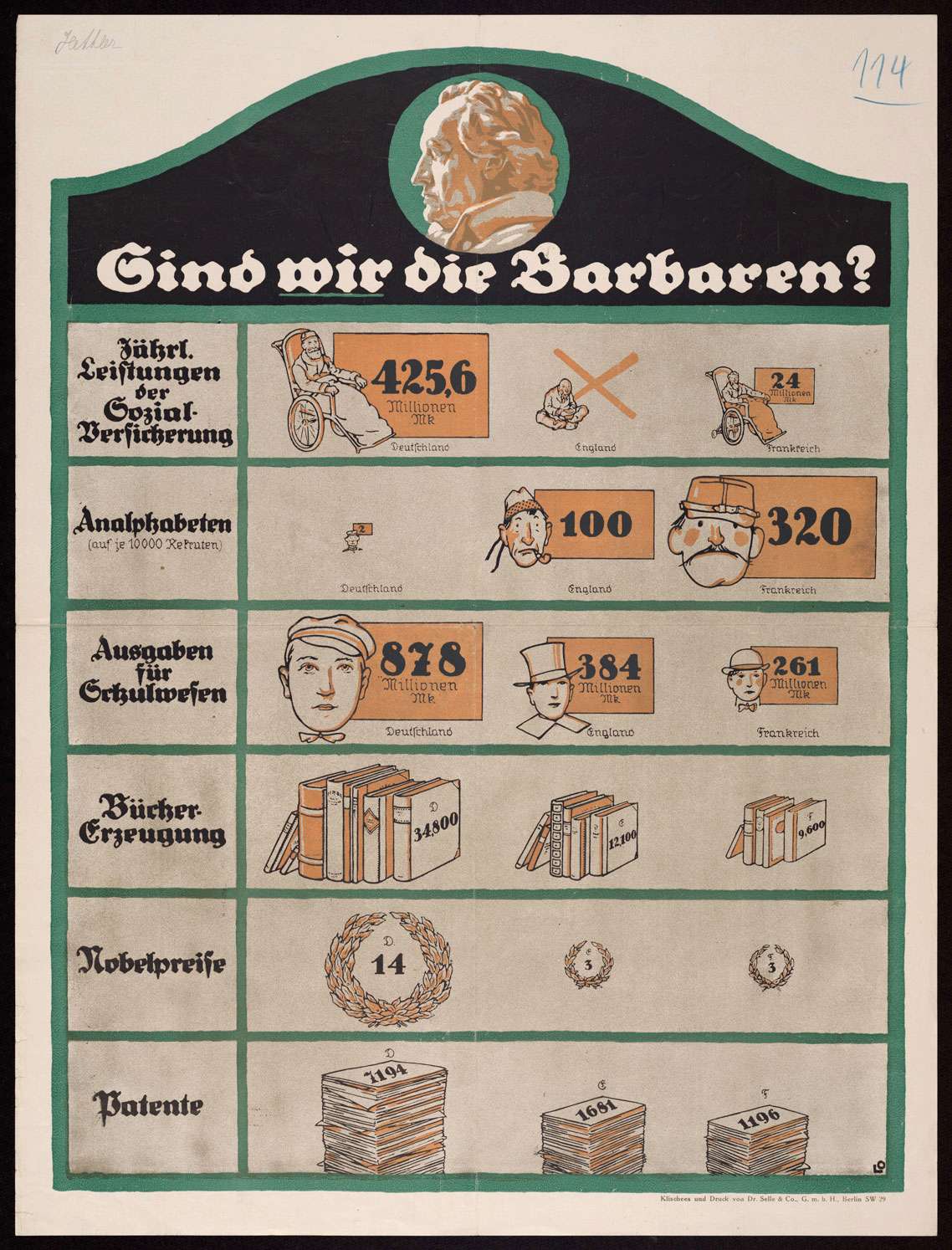
Sind wir die Barbaren? (Are We the Barbarians?), Imperial German government, artist Louis Oppenheim, 1916. Public domain.
- These two gallery posters are a British appeal built on the invasion of Belgium and a German chart answering the charge of barbarism. Postwar critics catalogued claims from both sides.
- 1927 and 1928: the word turns. Harold Lasswell's Propaganda Technique in the World War (1927) studied wartime persuasion as a technique of controlling opinion through symbols. Arthur Ponsonby's Falsehood in War-Time (1928) collected war stories from several countries that he argued were false.
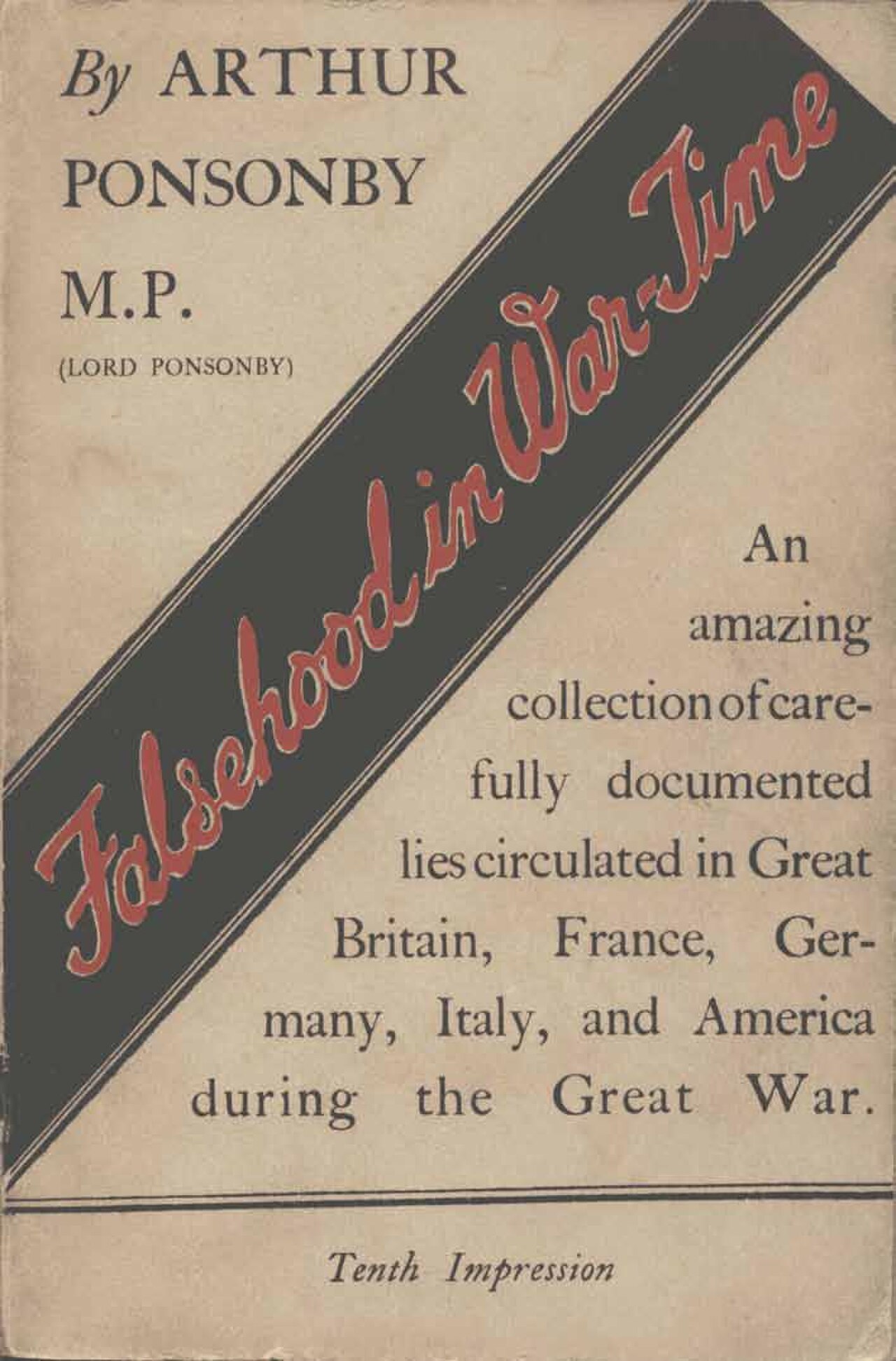
Cover of a later (tenth) impression of Arthur Ponsonby's Falsehood in War-Time, first published by George Allen and Unwin, London, 1928. The cover reads "An amazing collection of carefully documented lies circulated in Great Britain, France, Germany, Italy, and America during the Great War." Public domain (author died 1946).
- 1928: the word defended. In the same year Edward Bernays, who had worked for the CPI, published Propaganda (Horace Liveright, New York). It opens: "The conscious and intelligent manipulation of the organized habits and opinions of the masses is an important element in democratic society." Bernays used the word as a neutral or positive term for his trade, which he later called public relations.
- 1933: the word in a ministry's name. In March 1933 the new German government created the Reich Ministry for Public Enlightenment and Propaganda under Joseph Goebbels. Hitler had already praised British wartime propaganda in a chapter of Mein Kampf (1925). The gallery's Ein Volk, ein Führer, ein Ja (One People, One Leader, One Yes) banner comes from the November 1933 referendum campaign of that year.
- Today. The word still carries two senses in law and ordinary speech. The U.S. Foreign Agents Registration Act of 1938 used "political propaganda" as a statutory term. The Supreme Court upheld that label in Meese v. Keene (1987), and Congress replaced it with "informational materials" in 1995. The 2026 Justice Department release in The Justice Department's FARA release and public demonstrations still uses "propaganda" of a foreign power's goals. The difference in scale and context is large: a seventeenth-century church office named itself after what it wanted to spread, while modern uses mostly attach the word to other people's messages.
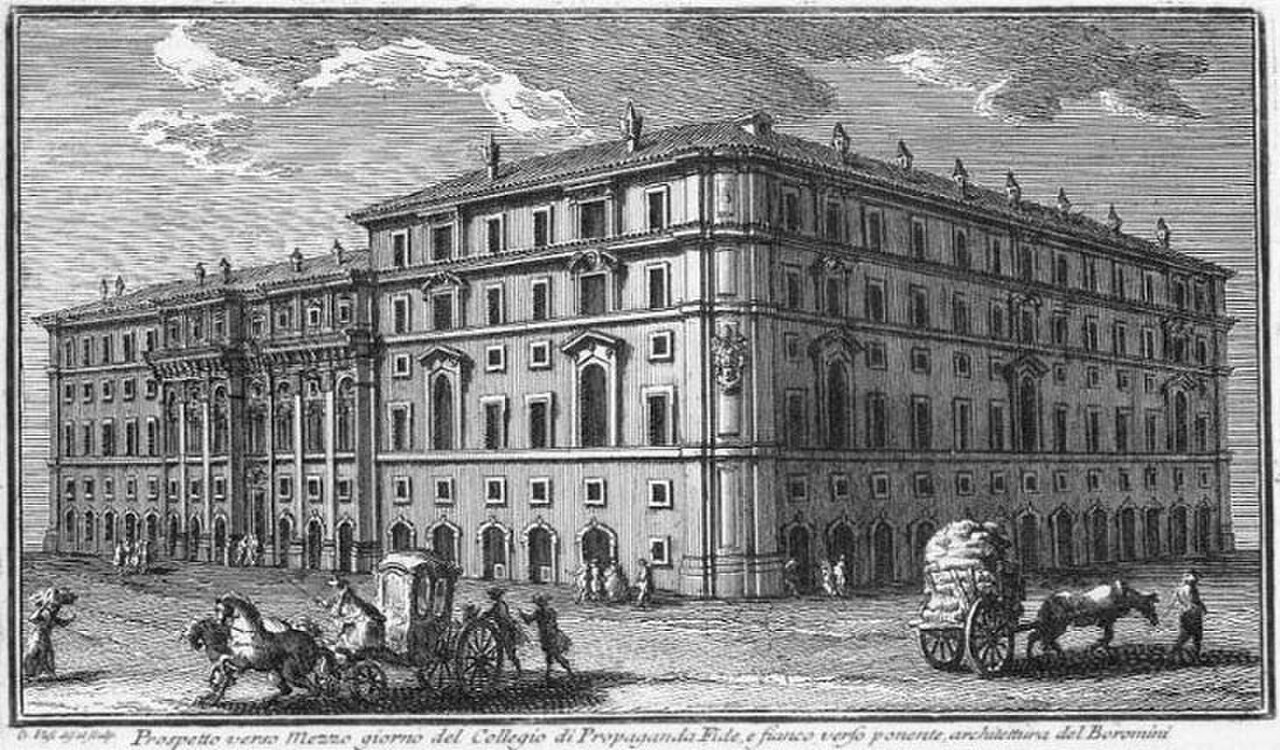
"Prospetto verso mezzo giorno del Collegio di Propaganda Fide, e fianco verso ponente, architettura del Boromini": the south front and west flank of the Collegio, Borromini's architecture, engraved by Giuseppe Vasi for his views of Rome, 1759. Public domain.
Positions on the record
- The Church's stated position. The Congregation exists to spread the Christian faith and to organise missions: to send and coordinate missionaries, form local clergy, print texts in local languages and report on the missions to the pope. Its later names, "Evangelization of Peoples" and "Dicastery for Evangelization", describe the same task in current Church language. The 1659 instruction is cited in Catholic mission history as an early statement that the faith should not arrive packaged with European customs.
- Contemporary critics. Protestant writers and states saw "the Propaganda" as Rome's engine for reclaiming Protestant lands, and the Congregation did oversee Catholics and missions in England, the Dutch Republic and Scandinavia. Catholic crowns objected too. Portugal treated the Congregation's vicars apostolic in Asia as an infringement of its padroado rights, a dispute that ran into the nineteenth century.
- What historians say. Mission historians (Guilday; Metzler's multi-volume Memoria Rerum) describe the founding as partly an effort to bring missions under papal rather than royal control, and to separate mission work from Spanish and Portuguese colonial administration. Historians of the word (Jowett and O'Donnell; Qualter; O'Shaughnessy) trace its negative sense chiefly to the First World War and the exposés of the late 1920s. Some also point to earlier Protestant hostility to the name.
- This archive's reading. Documented: the Congregation's founding dates, its title, its press and college, the 1659 instruction's advice on customs, the later renamings, and the word's documented uses by Brousse, Lenin, Lasswell, Ponsonby, Bernays, Creel and the 1933 ministry. Not shown on this page: a specific seventeenth-century Protestant text using "propaganda" as a slur, and any finding that the Congregation's own work met this archive's working definition of propaganda. The archive's definition turns on method, not on the name an organisation gave itself.
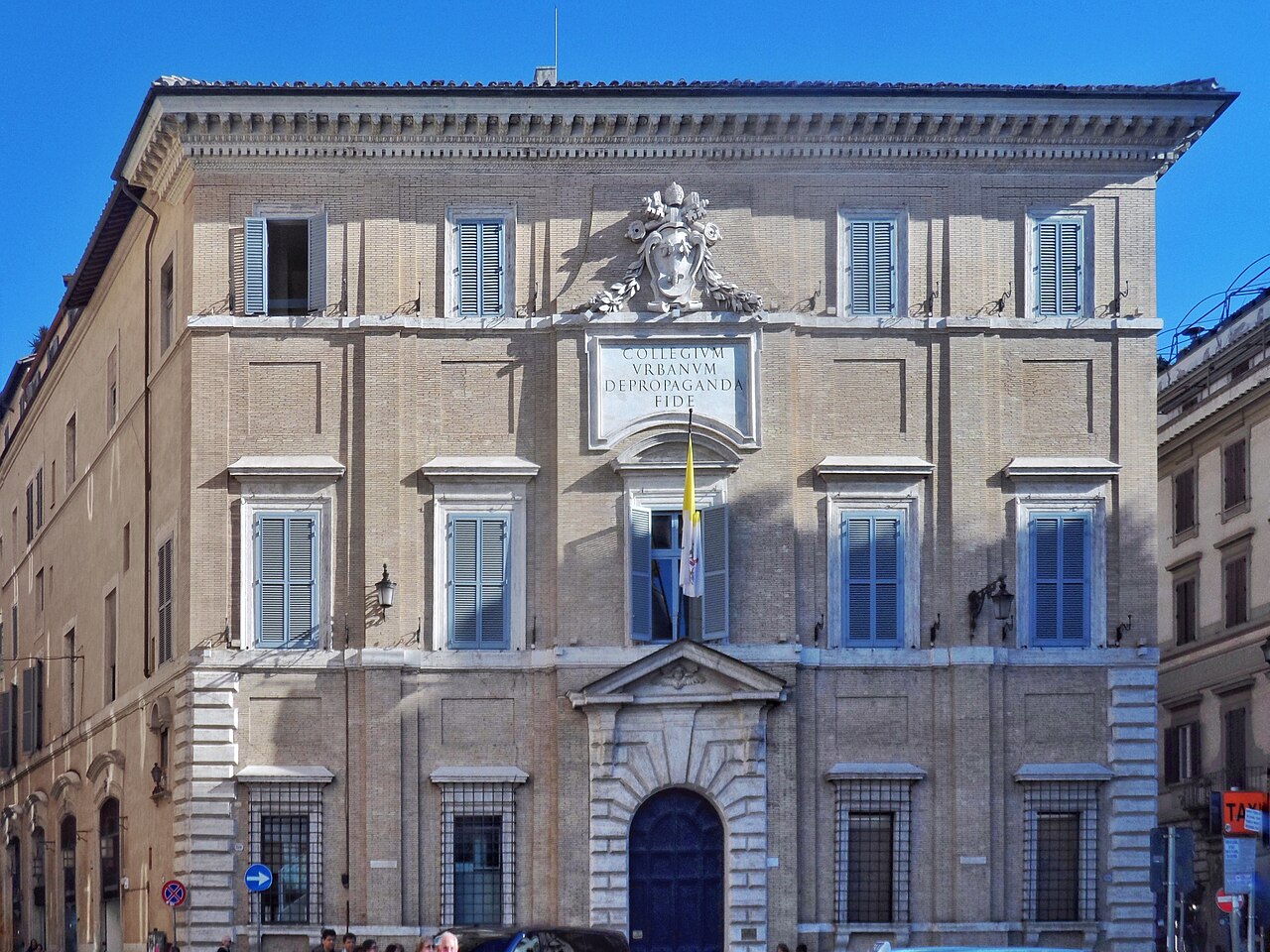
The Palazzo di Propaganda Fide's front on Piazza di Spagna, designed by Bernini, with the inscription "Collegium Urbanum de Propaganda Fide". Photo by Sheila1988, 2019, CC BY-SA 4.0.
Same-method test
The finding on this page is about labels, so the test swaps who applies the label. Had a Catholic writer of the 1810s called the British and Foreign Bible Society's translation work "the Protestant propaganda", this archive would read it the same way: as a label that reveals the writer's stance, not as evidence about the method. The same holds when a modern government calls a rival's broadcasts "propaganda" and its own "public diplomacy" or "information". The archive scores the method under one definition, whoever is speaking. A body with "propaganda" in its name, whether a 1622 Roman congregation or a 1933 German ministry, is not proven to use disabling methods by its name. A body that avoids the word is not cleared by avoiding it.
How to spot it
- When a source before about 1914 says "propaganda", check which sense it means: the Roman congregation, spreading a doctrine in a neutral sense, or a hostile label. Do not import the post-1918 meaning.
- Ask who is applying the word to whom. A word used only of the other side is a sign of the writer's position, not a measurement of the message.
- Look at the method (concealed origin, stacked evidence, identity or fear offered in place of a claim that can be tested), not at the name on the door.
Images
| Image | Source | Licence |
|---|---|---|
| Pope Gregory XV, Guercino (c. 1622 to 1623) | Wikimedia Commons, Google Art Project | Public domain (PD-Art) |
| Collegio de Propaganda Fide, Falda (1665) | Wikimedia Commons | Public domain (PD-Art) |
| Synodus Vicariatus Sutchuensis, title page (Rome, 1822) | Wikimedia Commons | Public domain |
| Remember Belgium (1915) | FRAME gallery | Public domain |
| Sind wir die Barbaren? (1916) | FRAME gallery | Public domain |
| Falsehood in War-Time, cover of the tenth impression | Wikimedia Commons, first page of the scan | Public domain (author died 1946) |
| Collegio di Propaganda Fide, Vasi (1759) | Wikimedia Commons | Public domain (PD-Art) |
| Palazzo di Propaganda Fide, Piazza di Spagna (2019) | Wikimedia Commons, Sheila1988 | CC BY-SA 4.0 |
_-_Google_Art_Project.jpg)
.png)


Image gaps
- The printed text of Inscrutabili Divinae (1622). It is printed in the eighteenth- and nineteenth-century collections of papal bulls (the Bullarium Romanum), several volumes of which are scanned on Wikimedia Commons, but the page carrying the bull was not identified for this page. This gap can be filled by locating the bull in a scanned Bullarium volume.
- Typographia Polyglotta alphabet specimens. Commons holds scans of the press's Alphabetum series (Tibetan, Burmese, Malayalam and others), but the first page of the scans tried here is a binding, not type. This gap can be filled with a specimen page.
- A dated Protestant text using "the Propaganda" as a hostile label. Not found in an openly licensed scan for this page. The claim above is attributed to scholars of the word rather than shown.
- Edward Bernays's Propaganda (1928). The book is public domain in the United States and scanned on Commons, but the first page of the scan is a list of the author's other books. Library of Congress photographs of Bernays have rights "not evaluated", so they are not used.
- Portraits of Lasswell, Lenin, Brousse or Goebbels. Left out to keep the page on the word. Openly licensed photographs exist for some of them.
Sources
- Gregory XV, bull Inscrutabili Divinae, 22 June 1622, in Bullarum, diplomatum et privilegiorum sanctorum Romanorum pontificum Taurinensis editio (Turin edition).
- Sacra Congregatio de Propaganda Fide, Instructio vicariis apostolicis ad regna Sinarum, Tonchini et Cochinchinae proficiscentibus (1659), in Collectanea S. Congregationis de Propaganda Fide (Rome, 1907).
- Peter Guilday, "The Sacred Congregation de Propaganda Fide (1622-1922)", Catholic Historical Review 6 (1921).
- Josef Metzler (ed.), Sacrae Congregationis de Propaganda Fide Memoria Rerum: 350 anni a servizio delle missioni, 1622-1972 (Herder, Rome/Freiburg, 1971-1976).
- Paul VI, apostolic constitution Regimini Ecclesiae Universae (15 August 1967); Francis, apostolic constitution Praedicate Evangelium (19 March 2022).
- Garth S. Jowett and Victoria O'Donnell, Propaganda and Persuasion (Sage), on the history of the word.
- Terence H. Qualter, Propaganda and Psychological Warfare (Random House, 1962).
- Nicholas O'Shaughnessy, Politics and Propaganda: Weapons of Mass Seduction (Manchester University Press, 2004).
- Paul Brousse, "La propagande par le fait", Bulletin de la Fédération jurassienne, 5 August 1877.
- V. I. Lenin, What Is to Be Done? (1902), chapter 3.
- George Creel, How We Advertised America (Harper and Brothers, 1920).
- Harold D. Lasswell, Propaganda Technique in the World War (Kegan Paul / Knopf, 1927).
- Arthur Ponsonby, Falsehood in War-Time (George Allen and Unwin, 1928).
- Edward L. Bernays, Propaganda (Horace Liveright, 1928).
- Meese v. Keene, 481 U.S. 465 (1987).