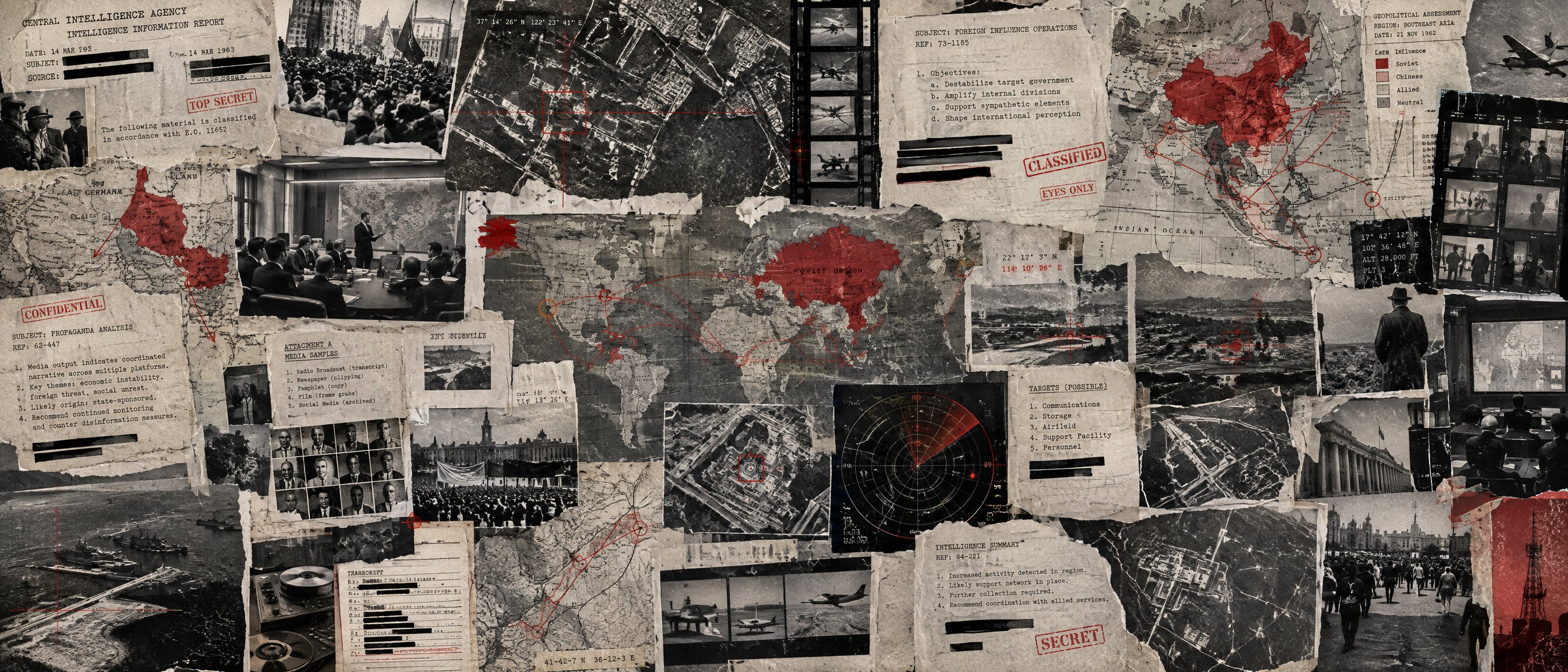
Content note. This page describes 2005 Labour posters that critics said drew on antisemitic imagery (Jews shown as pigs; a Fagin or Shylock figure). Labour denied that reading. The images are described, not reproduced.
In one line: over five general elections, both of Britain's main parties paid advertising agencies to turn the other side's record or leader into a single image (a dole queue, a "bombshell", red eyes, a film poster, a flying pig), and in each case the argument over the image became part of the campaign.
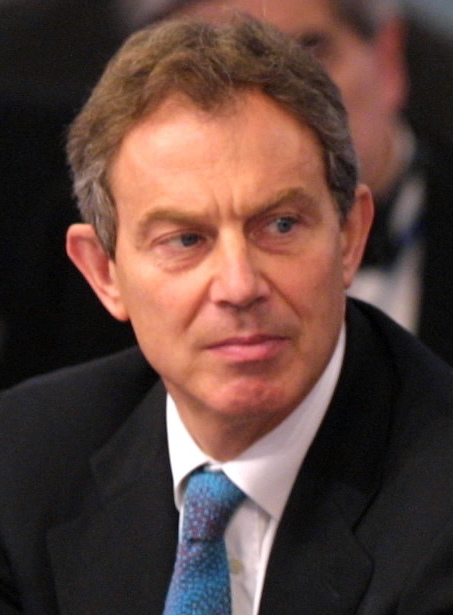
Tony Blair, Labour leader from 1994 and the subject of the 1996 "demon eyes" poster. White House photo by Paul Morse, 2002. Public domain (U.S. government work).
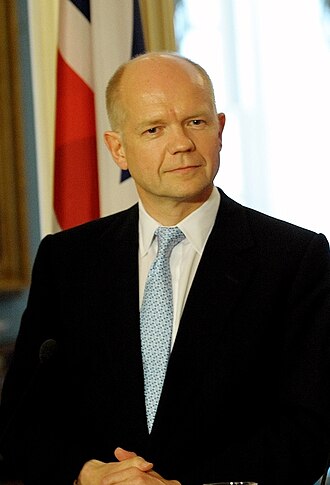
William Hague, Conservative leader from 1997 to 2001 and the subject of Labour's 2001 posters. U.S. Department of State photo, 2010. Public domain (U.S. government work).
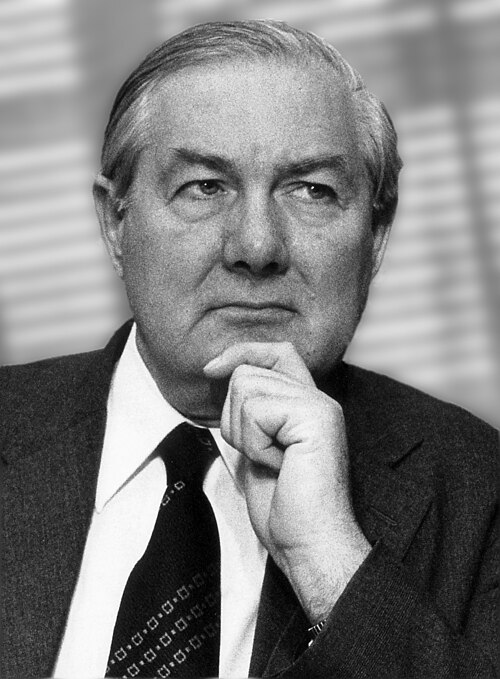
James Callaghan, Labour Prime Minister from 1976 to 1979, when the Conservatives' "Labour isn't working" poster (1978) was issued. Photograph of 17 July 1975 by Christian Lambiotte, European Communities. CC BY 4.0; the Commons version is a retouched greyscale extract of the original.
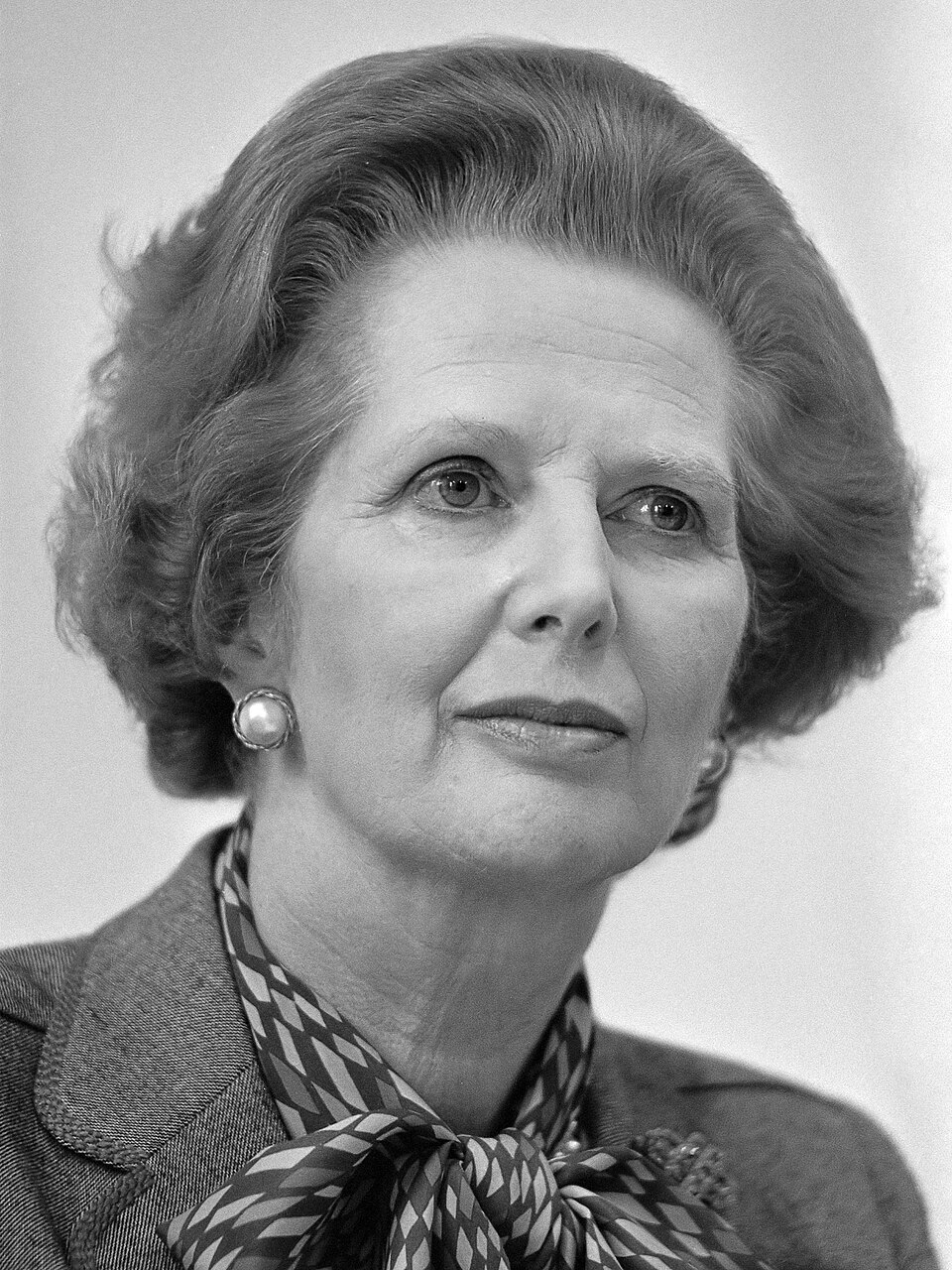
Margaret Thatcher, Conservative leader from 1975 and Prime Minister from 1979, whose party commissioned the 1978 poster; in 2001 a Labour poster placed her hair on William Hague. Photograph of 19 September 1983 by Rob Bogaerts for Anefo, Nationaal Archief (Netherlands). CC0.
What happened
- 1978. Saatchi & Saatchi, for the Conservatives, produces "Labour isn't working": a queue outside an unemployment office, with "Britain's better off with the Conservatives" below. The V&A credits the creative team as Martyn Walsh and Andrew Rutherford. About 20 volunteers from the Hendon Young Conservatives turned up for a shoot planned for 100 extras. The same people were photographed repeatedly and the shots joined into one queue.
- 1978, Commons. Chancellor Denis Healey attacks the poster. He says the people in it were not genuinely unemployed and that the Conservatives were "selling politics like soap powder". Campaign magazine later wrote that his attack guaranteed the poster front-page coverage. The poster is revived for the May 1979 election. Lord Thorneycroft, a senior party figure, later said it won that election; that is his view, not a measured effect.
- January 1992. On 7 January John Major issues a "Labour Tax Bombshell" statement, launching the Conservative campaign. It says Labour's tax plans would raise at most £10 billion against spending commitments of at least £35 billion a year. Saatchi & Saatchi's "Labour's Tax Bombshell" poster runs alongside it. Conservative material put the cost at "£1,000 more tax a year for the average taxpayer" (Sloman), and a later party reprint cites £1,250 per household. Labour's answer was John Smith's "Shadow Budget", modelled at the LSE, which said eight in ten taxpayers would be better off. The same campaign ran "Labour's Double Whammy" (a boxer with "1. More Taxes" and "2. Higher Prices" on his gloves).
- 24 March 1992. Labour's party election broadcast shows a five-year-old girl with glue ear who waits a year for an operation, set against a girl whose parents pay for private treatment. Neil Kinnock's line is "If you want to vote Conservative, don't fall ill". The broadcast keeps the child anonymous.
- Following days. The real case behind the film is named as Jennifer Bennett; Peter Hitchens of the Daily Express breaks the story. Her father had written to Robin Cook and agreed to the film on the basis that she would not be identifiable. Her consultant, Mr Ardouin, publicly blamed an administrative error for the delay; a private letter from him to the family blamed lack of resources. Health Secretary William Waldegrave accused Labour of "techniques that would not have been out of place in prewar Germany", then admitted he had urged a doctor involved to contact a newspaper. The Sun ran: "If Kinnock will tell lies about a sick little girl, will he ever tell the truth about anything?" The row became known as the "War of Jennifer's Ear". The Conservatives won on 9 April.
- July 1996. M&C Saatchi, commissioned by party chairman Brian Mawhinney, puts "New Labour, New Danger" on about a thousand billboards: red eyes behind curtains. Jeremy Sinclair is credited with the eyes. A second version sets the red eyes on a smiling photo of Tony Blair, with small text quoting Clare Short on "dark forces" behind Blair.
- August 1996. The Advertising Standards Authority, after more than 100 complaints (150 in later accounts, one from the Bishop of Oxford), rules against the Blair version. The ASA found that it portrayed Blair as "dishonest and sinister" (UPI's report has "Satanic and dishonest") and that the party had not asked his permission to use his photograph. The Conservatives were told not to use it again. The curtains version drew no complaints. A senior Tory source said the party had not planned to reuse it. Blair called the campaign "nasty, vicious, negative".
- 1999. The ASA's code committee drops political advertising from its remit, citing the problem of ruling within an election's short timetable. Trade press accounts link this to the "demon eyes" case and report that the ASA was unable to adjudicate on a Labour poster from the same cycle, "Same old Tories, same old lies".
- 2001. Labour's agency TBWA/London runs spoof film posters at about 1,000 sites, casting William Hague and shadow chancellor Michael Portillo as "Mr Boom and Mr Bust": "Economic Disaster II", "coming to a home, hospital, school and business near you", and "Towering Interest Rates". Labour officials later reported that some people found them confusing. A separate poster by creative director Trevor Beattie puts Margaret Thatcher's hair and earrings on Hague, with "Get out and vote. Or they get in." The V&A holds a copy titled "Be afraid. Be very afraid". Beattie said it was planned from January, not a reaction to Thatcher joining the campaign.
- 2001 spending. The Electoral Commission's figures, as reported by Marketing Week, put Labour's election advertising at £5.02m and the Conservatives' at £4.41m.
- Late January 2005. Labour puts draft posters on its website and to its email list, asking supporters to vote for the best. One shows Michael Howard and Oliver Letwin, both Jewish, as flying pigs with "The day Tory sums add up" (a play on "pigs might fly"). Another shows Howard as a stage hypnotist swinging a watch, captioned "I can spend the same money twice". The release fell in what reports called Auschwitz memorial week.
- Early February 2005. Conservatives, some Jewish organisations and some Jewish Labour donors object. Labour withdraws the posters. Campaign chief Alan Milburn tells the Commons they were not "in any way, shape or form anti-Semitic", while saying he respected those who found them offensive. Labour says the hypnotist is a reference to Kenny Craig from the BBC comedy Little Britain. Press reports attribute the concept to Alastair Campbell, then Labour's campaign communications director, with TBWA producing the artwork. Campaign magazine put the value of the resulting press coverage at over £290,000.
How it works
- Fear appeal: each side stages a harm that the other side's victory would bring. Conservative: the dole queue (1978), the "bombshell" (1992), the "danger" behind Blair's eyes (1996). Labour: the untreated child (1992), the "disaster" sequel (2001), "Get out and vote. Or they get in." (2001). The prescribed remedy is always the same single act, a vote.
- Card stacking: "Tax Bombshell" gives one headline per-taxpayer figure built on the Conservatives' own costing of Labour's plans; Labour's Shadow Budget distribution tables, which reached the opposite conclusion, are not on the poster. The 1992 broadcast turns one real case into the NHS story, and leaves out the consultant's public explanation. The 1978 queue was staged with volunteers, though the unemployment it stood for was real.
- Name-calling: a label or caricature does the work. "New Danger" plus red eyes; Hague as Thatcher; Hague and Portillo as "Mr Boom and Mr Bust"; Howard and Letwin as pigs and Howard as a hypnotist. Each asks the viewer to reject the person before weighing a policy.
- Transfer: both parties borrow stigma from a figure the audience already reacts to. The Conservatives use the language of the demonic. Labour, in 2001, pastes Thatcher onto Hague so that feelings about her record transfer to him. Critics of the 2005 posters said the images borrowed from much older anti-Jewish stereotypes; Labour said it was borrowing from a comedy sketch.
Then and now
No gallery poster in this archive is a British party poster, so the comparison is in prose. Saatchi & Saatchi followed its own poster with a sequel, "Labour Still Isn't Working" (V&A; credited to Bob Cramp, Martyn Walsh and Andrew Rutherford), keeping the queue in play. Reuse runs through this page: Labour's 2001 posters borrow the film-sequel form ("Economic Disaster II"), and the Conservative Party shop still sells reprints of "Labour isn't working" and "Tax Bombshell". The technique that changes least between 1978 and 2005 is the one-image summary of the other side. What changes is the regulator. In 1996 the ASA could rule against a party poster. From 1999 it no longer covers party election advertising, and the 2005 posters were ended by the party itself, not by any ruling.
Positions on the record
- Conservative position. Maurice Saatchi described the work as "a world of trial by combat, in which you would hit and be hit". Major's 1992 statement set out the costing behind "Tax Bombshell". On "demon eyes", the party pointed to Clare Short's own words and said it had not planned to reuse the poster.
- Labour position. In 1992 Kinnock's press secretary Julie Hall described the broadcast as based on an actual case; the consultant's private letter to the family blamed lack of resources. In 2001 Beattie presented the Thatcher-hair poster to Blair as "the most iconic image of this election". In 2005 Labour said the posters were not antisemitic and that the hypnotist was Kenny Craig, and withdrew them; a press report says Milburn admitted they left the party open to legitimate criticism.
- Critics. Healey (1978) said the queue was fake. The Bishop of Oxford complained to the ASA about the red-eyes poster, and senior clergy called it "puerile", "silly" and "potentially dangerous"; Edward Heath, a former Conservative prime minister, criticised it in September 1996. The Sun and Waldegrave said Labour misled voters about Jennifer Bennett. The row also turned on who had exposed the family: Waldegrave admitted urging a doctor to go to the press, and accounts also question Labour's part in the name becoming public. In 2005 Julian Lewis (Conservative) called the hypnotist poster an "outrageous Fagin smear"; Jewish Chronicle editor Ned Temko said the campaign "clearly draws on an old stereotype"; Labour MP Louise Ellman called it "very insensitive" but said "I do not think it is deliberately antisemitic". The Board of Deputies reportedly declined to raise the issue formally, though members complained.
- This archive's reading. Documented: the posters and broadcast existed with the wording above; the 1978 queue was staged with party volunteers; the ASA ruled against the Blair "demon eyes" poster in 1996 (the only formal regulatory ruling on this page); Labour withdrew its 2005 posters after complaints; both parties spent comparable sums on advertising in 2001. Not shown: that any single poster or broadcast decided an election (claims by Thorneycroft and about The Sun are claims); and that the 2005 posters were intended as antisemitic, which Labour denied. Whether the 1992 wait was caused by resources or by an administrative error remained disputed between the consultant's two statements.
Same-method test
A Labour poster that put glowing red eyes on a Conservative leader, or a Conservative film about one child's hospital wait, would be scored with the same ids. The 2001 Thatcher-hair poster and the 1996 red eyes use the same move (a face altered to carry a feeling), and are scored the same here, though only the second met a regulator. Formal outcomes differ and are stated as they were: one ASA ruling against the Conservatives (1996); one voluntary withdrawal by Labour (2005); and a disputed broadcast (1992) that no regulator ruled on.
How to spot it
- Ask what the image asserts that the words do not. Red eyes, a pig or a wig make a claim no one has to defend.
- Find the denominator behind the headline number. "£1,000 a year" or "£1,250 per household" depends on whose costing of whose plans.
- For a single-case story, look for the other documents: the consultant's public statement and his private letter pointed different ways.
- Notice when the argument about the ad is doing more work than the ad. Count the coverage, not the billboards.
Images
| Image | Source | Licence |
|---|---|---|
| Tony Blair (2002) | Wikimedia Commons, Paul Morse, White House | Public domain (U.S. government work) |
| William Hague (2010) | Wikimedia Commons, U.S. Department of State | Public domain (U.S. government work) |
| James Callaghan (photograph of 17 July 1975) | Wikimedia Commons, Christian Lambiotte, European Communities | CC BY 4.0 |
| Margaret Thatcher (19 September 1983) | Wikimedia Commons, Rob Bogaerts for Anefo, Nationaal Archief | CC0 |


.jpg)
.jpg)
Image gaps
- "Labour isn't working" (1978), "Labour's Tax Bombshell" (1992), "New Labour, New Danger" (1996). Copyright Conservative Party / Saatchi agencies; not reproduced. Held in the Conservative Party Archive posters collection at the Bodleian Library (digitised) and at the V&A (items O539153, O200038, O192881). Fillable only by linking, not by download.
- Labour's 2001 posters ("Economic Disaster II"; "Be afraid. Be very afraid"). Copyright Labour Party / TBWA; V&A item O155820 holds the Thatcher-hair poster. The People's History Museum in Manchester holds the Labour Party archive; a catalogue link for these items was not confirmed. Link only.
- The 1992 "Jennifer's Ear" broadcast. Broadcast frames are copyrighted; the LBC/IRN radio report is catalogued by Learning on Screen (BUFVC). Link only.
- Labour's 2005 flying-pig and hypnotist posters. Copyright Labour Party; withdrawn, and no archive copy was found. Not fillable from open sources.
- Portraits of the other leaders and of the posters' other subjects (Callaghan, Kinnock, Major, Portillo, Howard, Letwin). The official Parliament portrait of Howard (CC BY 3.0) and UK government photos carry a Commons personality-rights restriction, so they were set aside. The two U.S. government photos are of the 2001 and 1996 posters' targets (Hague, Blair), taken years later. Callaghan and Thatcher photographs (openly licensed, from the European Communities and the Dutch national archive) now represent the 1978 to 1979 poster's two parties; both were taken in 1975 and 1983, not in the campaign. Fillable with more search time: Kinnock (a CC BY-SA Anefo photo of 1989 exists) and Major.
Sources
- V&A: "Labour isn't working", Saatchi & Saatchi
- V&A: "Labour Still Isn't Working", 1979
- Campaign: History of Advertising No 90, "Labour isn't working"
- Campaign: "My campaign: the creation of the 'Labour isn't working' poster of 1978"
- Since Attlee and Churchill: who were the people in the "Labour isn't working" poster?
- John Major Archive: Labour Tax Bombshell statement, 7 January 1992
- Peter Sloman, "Where's the money coming from?", British Journal of Politics and International Relations, 2021
- V&A: "Labour's Tax Bombshell", Saatchi & Saatchi
- Bodleian Archives and Manuscripts: Saatchi and Saatchi posters
- Conservative Party Archive: posters collection
- New Histories (University of Sheffield): The 1992 election, the NHS and the "War of Jennifer's Ear"
- Learning on Screen, LBC/IRN archive: General Election, Labour broadcast (Jennifer's Ear)
- Cayman Compass (AP), 28 March 1992: British election debate focuses on health
- UPI, 28 August 1996: UK body bans Tory "demon eyes" ad
- Irish Times: Tory anger as demon eyed Blair poster faces ban for breaking advertising code
- Irish Times: Eyebrows raised over "demon eyes"
- V&A: "New Labour New Danger", Conservative Party
- ASA: Why we don't cover political ads
- Campaign: Should political ads face stricter regulation?
- Campaign: Election 2001 special, adland's role in Labour's second term
- Marketing Week: Parties spent £10m on General Election ads
- V&A: "Be afraid. Be very afraid", Trevor Beattie, 2001
- Slate, June 2001: Voters-Wanted Posters
- Campaign: Labour pulls campaign posters after anti-Semitic taunts
- Campaign: Labour's controversial anti-Howard posters worth £300k
- Forward, 2005: British Labour Party slammed for "antisemitic" ads
- World Jewish Congress: UK Labour party apologizes for anti-Semitic posters
- Julian Lewis MP, press archive: "Labour team tries to cool 'anti-Semitic' poster row"
- Irish Times: Campbell embroiled in row over "sinister" Labour tactics
- Wikipedia: Labour Isn't Working
- Wikipedia: War of Jennifer's Ear
- Wikipedia: New Labour, New Danger
- Wikipedia: Pre-election day events of the 2005 United Kingdom general election