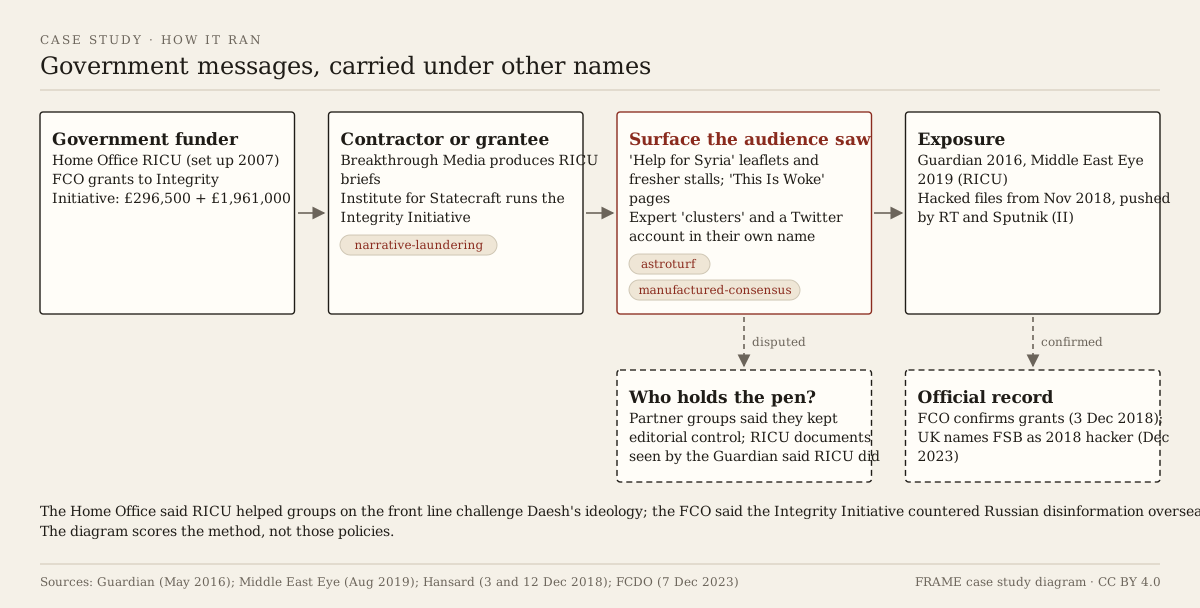
In one line: two UK government departments paid for messages that reached their audiences under other names: the Home Office's RICU through a contracted media firm and community-branded campaigns, and the Foreign Office through grants to a charity's "Integrity Initiative", whose government funding became public only after its files were hacked and leaked.
What happened
Strand 1: the Home Office's Research, Information and Communications Unit (RICU)
- 2007. RICU is set up under the Labour government of the day, as part of Prevent, the counter-radicalisation strand of the CONTEST counter-terrorism strategy. It was a cross-departmental unit shared by the Home Office, the Foreign and Commonwealth Office (FCO) and the Department for Communities and Local Government, based in the Home Office's Office for Security and Counter-Terrorism (OSCT). It appears in Commons Hansard under its own heading on 12 December 2007.
- 2 to 3 May 2016. A Guardian investigation by Ian Cobain, Alice Ross, Rob Evans and Mona Mahmood reports that much of RICU's work was contracted to a London firm, Breakthrough Media Network. Breakthrough produced websites, leaflets, videos, films, Facebook pages, Twitter feeds and online radio content, with titles such as The Truth about Isis and Help for Syria. The Guardian's headline described RICU as "inspired by the cold war".
- Help for Syria. According to the Guardian, this RICU campaign presented itself as advice on raising funds for Syrian refugees. It aimed to "influence conversations among young British Muslims" and discourage travel to the conflict. It distributed leaflets to 760,000 homes and spoke face to face with thousands of students at university freshers' fairs, and the recipients were not told it was a government programme.
- Editorial control. Partner community groups told the Guardian they kept editorial control of what they put out. The Guardian said RICU documents it had seen stated that RICU kept editorial control. In the documents, Breakthrough described its role as giving "RICU … effective ways of communicating its own messages through credible civil society organisations".
- Making A Stand (2014). Middle East Eye later reported that an internal government document listed #MakingAStand, a campaign fronted by the women's group Inspire, as a "RICU Product". Inspire said it was independent of government.
- August 2019. Middle East Eye reports that This Is Woke, a Facebook page and Instagram feed that called itself a "media/news company" discussing Muslim identity, tradition and reform, was made by Breakthrough Media for the Home Office's OSCT as part of Prevent. CNN followed up. The OSCT declined to release details, saying that disclosure would "prejudice the national security of the UK".
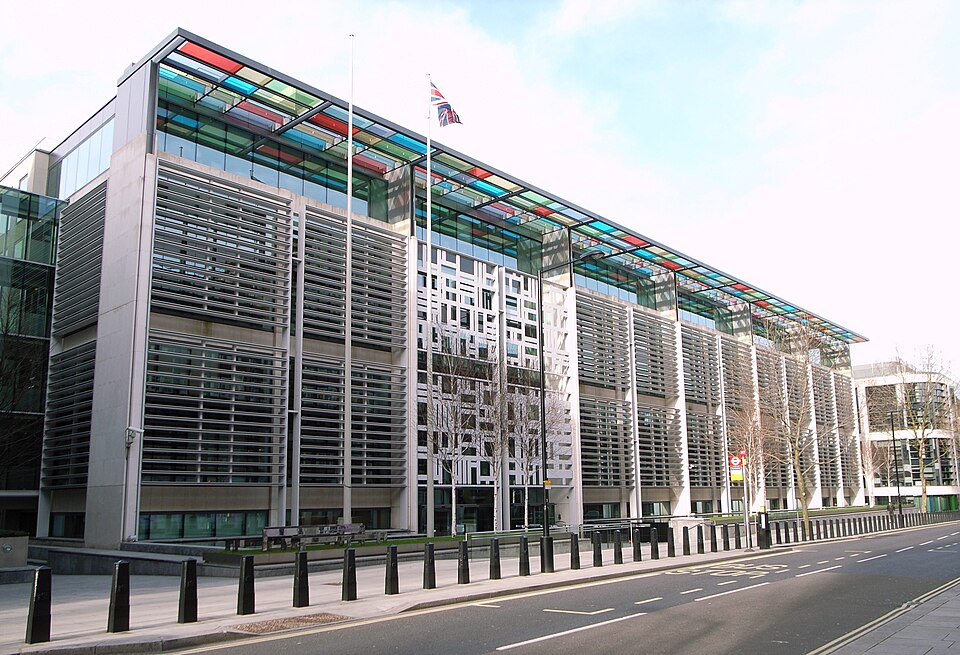
2 Marsham Street, Westminster, the Home Office headquarters where RICU is based. Photo by Steve Cadman, 2008, CC BY-SA 2.0, via Wikimedia Commons.
Strand 2: the Foreign Office and the Integrity Initiative
- 2015. The Institute for Statecraft, a charity registered in Scotland, launches the Integrity Initiative, which it describes as defending democracy against disinformation. Its method was a "cluster" approach: national groups of journalists, academics and officials who shared information and coordinated activity.
- 5 November 2018 onward. Documents from the Institute are posted on the CyberGuerrilla site under the name "Anonymous". Four batches appear between November 2018 and January 2019. Russian state outlets RT and Sputnik cover them heavily (RT's headline: "Anonymous blows lid off huge psyop in Europe"). The Institute said the published material was "some genuine, some falsified" and did not say which was which. An FCO spokesperson said the release was "intended to confuse audiences and discredit an organisation which is working independently to tackle the threat of disinformation".
- Operation Moncloa (June 2018), as described in the leaked files. On 7 June 2018 the new Spanish government was reported to be appointing Colonel Pedro Baños, a reservist officer and author, as director of the Department of National Security. According to the leaked documents, members of the Initiative's Spanish cluster coordinated on WhatsApp within hours, sent a dossier on Baños to El País and El Mundo, and recorded that the campaign had raised "noise" on Twitter. Politicians of the Partido Popular and Ciudadanos publicly asked the government to drop the appointment, citing Baños's views on Russia. On 18 June Miguel Ángel Ballesteros was appointed instead. The files show the cluster claiming credit. They do not show why the appointment changed, and the FCO did not confirm this episode.
- 3 December 2018. In a written parliamentary answer (question 196177), the FCO confirms it funded the Integrity Initiative £296,500 in financial year 2017/18 and £1,961,000 in 2018/19, both "through grant agreements": about £2.26 million in total.
- Early December 2018. Scotland's Sunday Mail reports that the Integrity Initiative's Twitter account had shared links to articles critical of the Labour leader Jeremy Corbyn and his aides, including one calling Corbyn a "useful idiot". Foreign Office minister Sir Alan Duncan told BBC Radio 4 he had asked officials to look into why.
- 12 December 2018. Answering an urgent question from the shadow foreign secretary Emily Thornberry, Duncan described the Institute as "an independent UK-based charity" and said the Initiative was working "to counter disinformation overseas by bringing together groups of experts to analyse and discuss the problem posed by Russian disinformation". He said FCO funding did not pay for activity in the UK, "nor does it fund the management of the Integrity Initiative's social media account". Thornberry replied that the project proposal submitted for funding included "social media activity".
- 13 December 2018. The Office of the Scottish Charity Regulator (OSCR) opens an inquiry into the Institute.
- April 2019. The Institute's founder, Christopher Donnelly, says the account had sent "something like 26,000 tweets", of which "about 400 made reference to some political party or politician, and they were roughly equal between the main political parties". He says they "should not have sent" them and that letters of apology went to Corbyn.
- 4 November 2019. OSCR publishes its inquiry report. As reported, it found governance failings and "severe reputational damage to the charity", and closed the inquiry after the charity had taken steps "to meet the charity test and to address the governance issues identified".
- 7 December 2023. The UK government states that Russia's FSB, through the group it calls Star Blizzard (assessed to be part of FSB Centre 18), hacked the Institute for Statecraft in 2018 and that documents were then leaked.
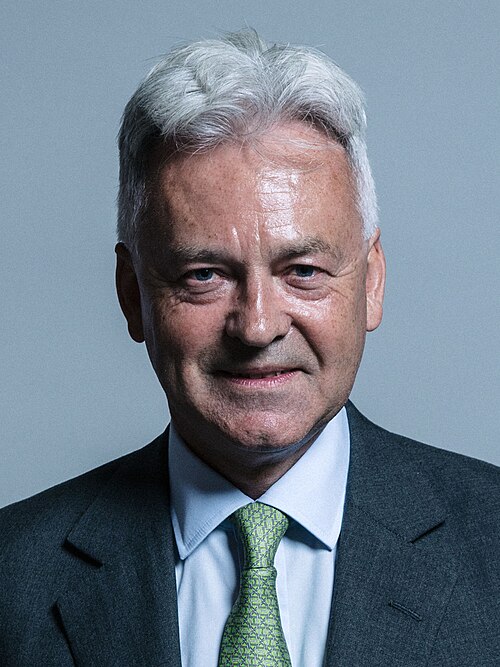
Sir Alan Duncan, Foreign Office minister, who answered for the FCO in the Commons on 12 December 2018. Official portrait by Chris McAndrew, 2017, CC BY 3.0, via Wikimedia Commons.
How it works
- Narrative laundering: in both strands a government department paid for the message, and the audience met it under another name. RICU's briefs went through a contractor, Breakthrough Media, and came out under campaign or community brands. FCO grants went to a Scottish charity whose project spoke as an independent network of experts. In each case the funding came to light through reporting or a leak, not from the messages themselves.
- Astroturfing: Help for Syria presented itself as refugee-fundraising advice, and This Is Woke called itself a "media/news company". According to the Guardian and Middle East Eye, both were government-commissioned products whose branding did not name the Home Office. This tag applies to those front brands. It is not applied to the community groups, which existed independently and chose to take part.
- Manufactured consensus (the Integrity Initiative, as the leaked files describe it): the cluster model brought journalists, analysts and officials in several countries into one coordinated network. The Moncloa documents record a single, same-day push on one appointment through press dossiers and Twitter, which the public would have seen as separate voices. This tag rests on documents whose authenticity was only partly confirmed. The FCO confirmed the grants and the Initiative's aims, not this episode.
Then and now
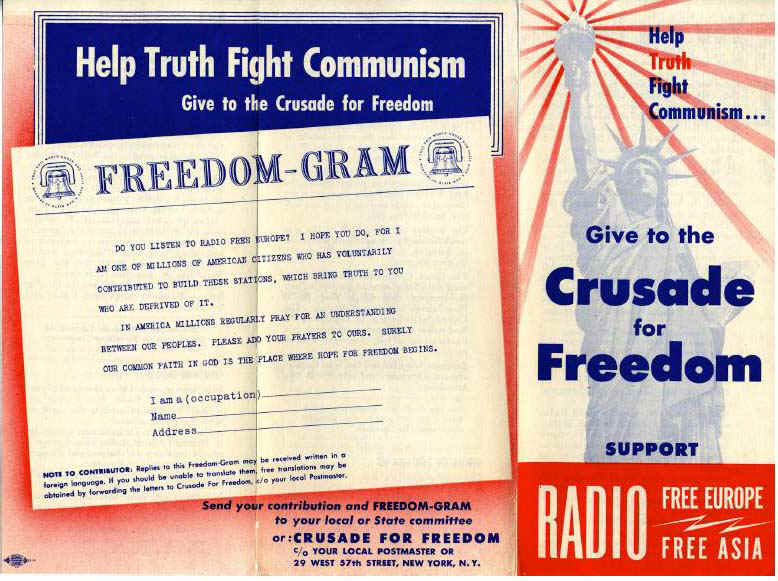
Freedom-Gram: Help Truth Fight Communism, Crusade for Freedom, 1952; covertly funded by the U.S. government through the CIA. Public domain.
The Guardian framed RICU through Britain's own Cold War precedent, the Foreign Office's Information Research Department (IRD). The IRD operated from the late 1940s until it was wound up in 1977. Its records, now in the National Archives (FO 1110), show it supplying unattributable briefings to journalists, broadcasters and others, so that government material appeared in print under other bylines. The U.S. counterpart above did the same thing with money: a citizens' "crusade" for Radio Free Europe, while most of the funding came from the government through the CIA. The difference in the 2010s was the channel, not the structure. The same arrangement of a government funder, a middle layer that looks independent, and an audience that does not see the funder now ran through Facebook pages, freshers' fair stalls and a charity's Twitter feed.
Positions on the record
- The Home Office's stated position: it works with communities, civil society groups and individuals to counter terrorists' "twisted narrative". It said: "We are proud of the support Ricu has provided to organisations working on the frontline to challenge the warped ideology of groups such as Daesh, and to protect communities." RICU said its guiding principle "has to be whether or not any organisation we work with is itself happy to talk publicly about what they do." On This Is Woke, a Home Office spokesperson told CNN: "We are committed to using all of the tools available to counter the threat from terrorism in the UK." The approach, as the 2016 reporting describes it, rests on the view that counter-messages carry more weight coming from credible community voices than from a ministry.
- The FCO's stated position: the Integrity Initiative counters Russian disinformation overseas. FCO money did not fund UK activity or the Twitter account. The leak was a hostile operation meant to discredit the project, and in 2023 the government named the FSB as the hacker.
- Critics' position: Frances Webber of the Institute of Race Relations said that the RICU programme risked undermining Muslim civil society if groups appeared to have been co-opted to a government agenda. Thornberry argued that the Initiative's funded proposal covered social media and that its account had attacked the opposition.
- This archive's reading: documented are RICU's existence and remit, the Breakthrough contract role, the named campaigns and their unbranded presentation (as reported by the Guardian and Middle East Eye), the FCO grant amounts, the minister's statements, the Twitter posts, the founder's apology and OSCR's inquiry. Not shown: that the FCO directed the Twitter posts about Corbyn (the FCO said it did not fund the account), or that the Spanish cluster caused the change in the Baños appointment. The leak's route (a Russian state hack, as the UK government later stated, amplified by RT and Sputnik) does not by itself confirm or refute any single document. This page relies on the leak only where the FCO or the Institute confirmed the facts, and it labels leak-only material as such.
Same-method test
The finding does not depend on the flag. The June 2024 Reuters investigation into a U.S. military campaign in the Philippines, which used fake local accounts to spread doubt about China's Sinovac vaccine, would be scored the same way here, as would the Russian Internet Research Agency's fake American pages (see Astroturfing). The UK strands are milder in one respect: the community groups and experts were real people who chose to take part, and the content was not shown to be false. They are the same in the respect this page scores: the audience could not see which government paid for the message. Both main UK parties are on the record: RICU was set up under a Labour government, and the named campaigns and the Integrity Initiative grants ran under Conservative-led governments.
How to spot it
- Ask who pays, not only who speaks. Look for a funder named in an annual report, a contract notice or a written parliamentary answer. It is often missing from the leaflet, the page's "About" section and the post itself.
- Be alert when a "campaign", "network" or "media company" has no named staff, no stated funder and polished production.
- When many voices make the same point on the same day, check whether they share a coordinator.
- Judge a leak's contents apart from how it arrived. Check which parts the named organisations have confirmed or denied, and use only those as facts.
Images
| Image | Source | Licence |
|---|---|---|
| Mechanism diagram (above) | Drawn for FRAME from this page's sourced facts (make_diagrams.py) |
CC BY 4.0, FRAME |
| 2 Marsham Street, Home Office HQ (2008) | Wikimedia Commons, Steve Cadman | CC BY-SA 2.0 |
| Sir Alan Duncan, official portrait (2017) | Wikimedia Commons, Chris McAndrew / UK Parliament | CC BY 3.0 |
| Freedom-Gram (1952) | FRAME gallery | Public domain (U.S. government work) |


Image gaps
- Help for Syria leaflets and This Is Woke posts. These are the actual products, but no openly licensed copies were found. As Crown-commissioned material they may fall under Crown copyright rather than the Open Government Licence, and the only reproductions seen were in copyrighted news reports. Possibly fillable through a Freedom of Information request or the National Archives' web archive.
- The 3 December 2018 written answer and the 12 December 2018 Hansard page. Parliamentary material is under the Open Parliament Licence, so a screenshot is permitted, but parliament.uk could not be reached from the environment used to build this page. This gap can be filled.
- IRD documents (FO 1110). Crown copyright, held at the National Archives. Not digitised on Commons. Fillable from a National Archives visit or order.
- Leaked Integrity Initiative documents. Deliberately not reproduced: stolen material that includes personal data, and only partly authenticated.
Sources
- The Guardian, 2 May 2016: Inside Ricu, the shadowy propaganda unit inspired by the cold war (Cobain, Ross, Evans, Mahmood)
- The Guardian, 2 May 2016: "Revealed: UK's covert propaganda bid to stop Muslims joining Isis", as summarised by IBTimes, May 2016 and Statewatch, May 2016
- Hansard, 12 December 2007: Research, Information and Communications Unit
- Middle East Eye: Top anti-extremism campaigner linked to UK "covert propaganda" firm
- Middle East Eye, August 2019: "This Is Woke": the media outfit that's actually a UK counter-terror programme
- CNN, 16 August 2019: "Woke" news platform for young Muslims is actually a secret UK counter-terror program
- UK Parliament written answer 196177, answered 3 December 2018: FCO funding of the Integrity Initiative
- Hansard, 12 December 2018: Institute for Statecraft: Integrity Initiative (urgent question)
- Civil Society News, December 2018: Foreign Office probes charity it funds for "anti-Corbyn" bias
- Civil Society News: Scottish regulator investigates charity "hacked by Russian state"
- The Ferret: Scottish charity watchdog damns group that attacked integrity of politicians
- TFN: OSCR concludes inquiry into Scots charity
- Skwawkbox, 8 April 2019: Integrity Initiative apologises to Corbyn (quoting Christopher Donnelly)
- BuzzFeed News: Russia targeting British institute in disinformation campaign
- RT, November 2018: "Anonymous blows lid off huge psyop in Europe" (cited as evidence of Russian state-media amplification)
- El Español, 7 June 2018: El coronel Pedro Baños será director de Seguridad Nacional
- El Español, 27 November 2018: Acusan a una ONG de dinamitar la elección de Pedro Baños
- UK government (FCDO), 7 December 2023: UK exposes attempted Russian cyber interference in politics and democratic processes
- The National Archives: FO 1110, Information Research Department general correspondence
- Rory Cormac, "The Information Research Department, Unattributable Propaganda, and Northern Ireland", English Historical Review
- Reuters, 14 June 2024: "Pentagon ran secret anti-vax campaign to undermine China during pandemic", as reported by Al Jazeera, 14 June 2024 and Military.com, 14 June 2024