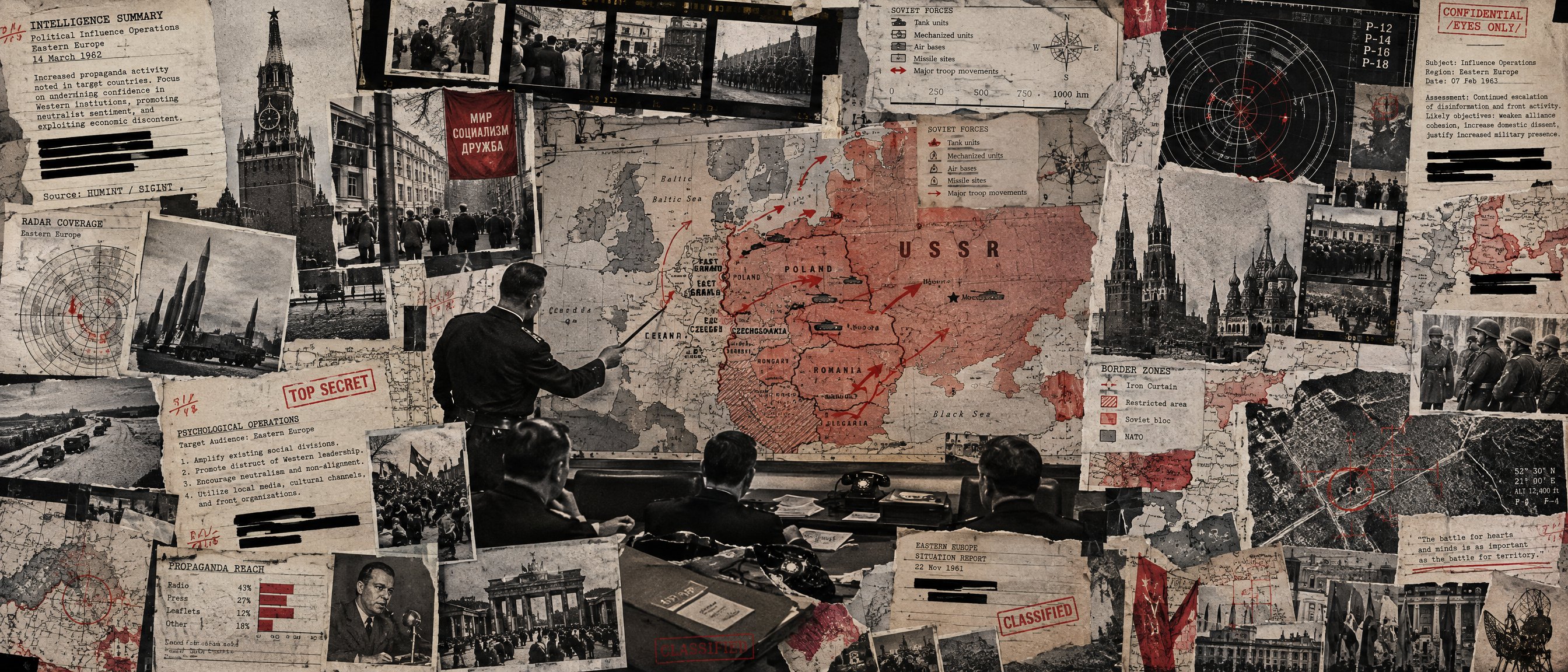
Also called Citation cartel, Astroturfed agreement
Create the appearance that independent voices independently arrived at the same conclusion.
The tell
Many outlets, one talking point, one origin; or many 'studies' from one shop.
Not this
Independent replication of a finding.
History and effect
Related to, but distinct from, Herman and Chomsky's manufacturing-consent model; here the consensus itself is staged rather than emerging from structural media incentives.
It convinces the audience that independent observers converged on a conclusion, when in fact one source is speaking through many mouths.
Lineage: Herman & Chomsky (partial); astroturf + volume; citation cartels
How it works
Manufactured consensus starts with a single origin: a ministry, a party office, a company or a contractor. The sender's problem is that one voice, however loud, reads as one voice. The technique solves it by multiplying the surfaces a message appears on while hiding that those surfaces share a source. The surfaces can be people (personas, recruited signatories, paid commenters), outlets (sites styled as local news or independent media) or documents (reports, studies, petitions and public comments). What matters is that each one looks as if it reached its conclusion on its own.
Documented operations tend to share a structure. A central team sets the talking point and the timing. The message then goes out with enough variation in wording, names, regions and formats that a casual reader does not see a template, and it is released in a short span so the audience meets it several times at once. The voices often cite one another, which gives each claim a trail of apparent corroboration that loops back to the same origin. In older forms the multiplication was organizational: meetings that passed near-identical resolutions, or open letters whose signatures were gathered by one office. In computational forms it is done with networks of accounts, generated text, or bulk submissions to public comment systems.
The audience's experience is the point. Readers rarely trace sources; they notice that a view seems to come from everywhere. Many independent voices agreeing is ordinarily good evidence, and the technique borrows that inference without earning it. It depends on three conditions: that the audience counts voices rather than origins, that the shared origin stays hidden at least until the message has done its work, and that dissenting voices are fewer, quieter or absent. The last condition can also be produced from the other direction, by removing competing accounts so that the one left standing looks agreed on, as in the The Gyirong flood and the official death toll case.
Why it works
Solomon Asch's line-judgment experiments showed how strongly a unanimous group pulls on an individual: when confederates gave an obviously wrong answer, participants went along on roughly a third of the critical trials, and a single dissenting ally cut that sharply (Sources: Asch 1956). The effect is real but not fixed. A meta-analysis of 133 Asch-type studies across 17 countries found that conformity varied by culture and had declined in the United States since the 1950s (Sources: Bond and Smith 1996). The lesson for this technique is about unanimity: manufactured consensus works best when dissent looks absent.
Robert Cialdini described the same pull outside the laboratory as social proof, the habit of treating what others appear to believe as evidence of what is correct, strongest when a situation is uncertain and the others seem similar to us (Sources: Cialdini 1984). FRAME's Learn library covers this in Social proof and Conformity. Stephen Harkins and Richard Petty found that the same arguments attributed to several sources prompted more thought than when attributed to one, and that strong arguments became more persuasive as a result (Sources: Harkins and Petty 1981). Their explanation is that separate sources imply separate perspectives, which is exactly the assumption a staged chorus exploits.
Two findings show how poorly people check whether the sources really are separate. Kimberlee Weaver and colleagues found that hearing one person repeat an opinion three times made it seem nearly as widespread as hearing three different people state it once (Sources: Weaver et al. 2007). Sami Yousif, Rosie Aboody and Frank Keil found that people gave repeated reports traced to a single original source almost as much weight as reports from genuinely independent sources, an effect they called the illusion of consensus (Sources: Yousif, Aboody and Keil 2019).
Perceived consensus also matters because people act on it. Elisabeth Noelle-Neumann's spiral of silence proposed that people who believe they hold a minority view speak up less, which makes the majority look larger still (Sources: Noelle-Neumann 1974). Later work has been mixed: a meta-analysis found only a small relationship between perceived opinion climate and willingness to speak out (Sources: Glynn, Hayes and Shanahan 1997), so the spiral is better treated as a tendency than a law. On the other side, experiments on climate change found that telling people about the actual level of scientific agreement shifted their estimates of that agreement and, more modestly, their own beliefs (Sources: van der Linden et al. 2015). The size and durability of that effect are debated, but the finding explains why consensus is worth faking.
Examples across eras and sides
- Soviet Union, 1958 and 1973: collective condemnation. After Boris Pasternak was awarded the Nobel Prize in 1958, Soviet newspapers printed letters from readers and resolutions from meetings condemning Doctor Zhivago, a novel that had not been published in the Soviet Union, and the Writers' Union expelled him (Sources: Finn and Couvée 2014). In 1973 Pravda published a letter signed by forty members of the Academy of Sciences denouncing Andrei Sakharov, followed by further letters from other professional groups (Sources: Sakharov 1990). In both cases a campaign organized from above was presented as the spontaneous verdict of readers, workers and scientists.
- China, 2010s: fabricated posts. Gary King, Jennifer Pan and Margaret Roberts analyzed leaked email archives from a county-level propaganda office and estimated that the Chinese government fabricates roughly 448 million social media posts a year, written by government employees posing as ordinary users (Sources: King, Pan and Roberts 2017). They found the posts mostly cheered the government and changed the subject rather than arguing, so the manufactured voice took the form of a visible chorus of contentment. The 2026 The Gyirong flood and the official death toll case shows the subtractive form: higher unofficial counts were removed until the official figure was the one most visible.
- United States, 2017: the FCC net neutrality docket. The New York Attorney General's investigation found that about 18 million of the more than 22 million comments submitted to the Federal Communications Commission on repealing net neutrality were fake (Sources: New York State Office of the Attorney General 2021). The fakes came from both sides of the fight: a campaign funded by the broadband industry, run through lead-generation firms, submitted millions of comments supporting repeal, many under the names of real people who had not agreed to them, while a single college student generated millions of comments opposing repeal using fabricated identities. The docket, which regulators treat as a measure of public sentiment, was flooded from both directions.
- United States military, 2017 to 2022: pro-Western personas. Graphika and the Stanford Internet Observatory analyzed a network that Twitter and Meta had removed, made up of accounts posing as independent media outlets and local users in Central Asia, Iran and the Middle East, promoting narratives favorable to the United States and its allies (Sources: Graphika and Stanford Internet Observatory 2022). Meta later linked the network to individuals associated with the U.S. military (Sources: Meta 2022). The researchers found that most of the accounts drew little authentic engagement, which is a reminder that staging a chorus does not guarantee anyone listens.
- Israel, 2024: personas aimed at U.S. lawmakers. Meta removed a network it attributed to STOIC, a political marketing firm in Tel Aviv, whose fake accounts posed as Jewish students, African Americans and other concerned citizens and posted comments supporting Israel's military on pages of U.S. lawmakers and media outlets (Sources: Meta 2024). OpenAI reported in the same period that it had disrupted the same firm's use of its models to generate such comments (Sources: OpenAI 2024). The New York Times reported that the campaign was paid for by Israel's Ministry of Diaspora Affairs (Sources: Frenkel 2024). The 2026 The Hanover Institute: reports written for chatbots to cite case applies the document form of the technique: a burst of unsigned reports from one contracted "institute" that could look like a body of independent research.
These cases differ widely in scale and consequence. A national campaign against a dissident scientist, a docket flooded with millions of fake comments and a persona network with little reach are not equivalent; they share only the structure of one origin speaking through many apparently separate mouths.
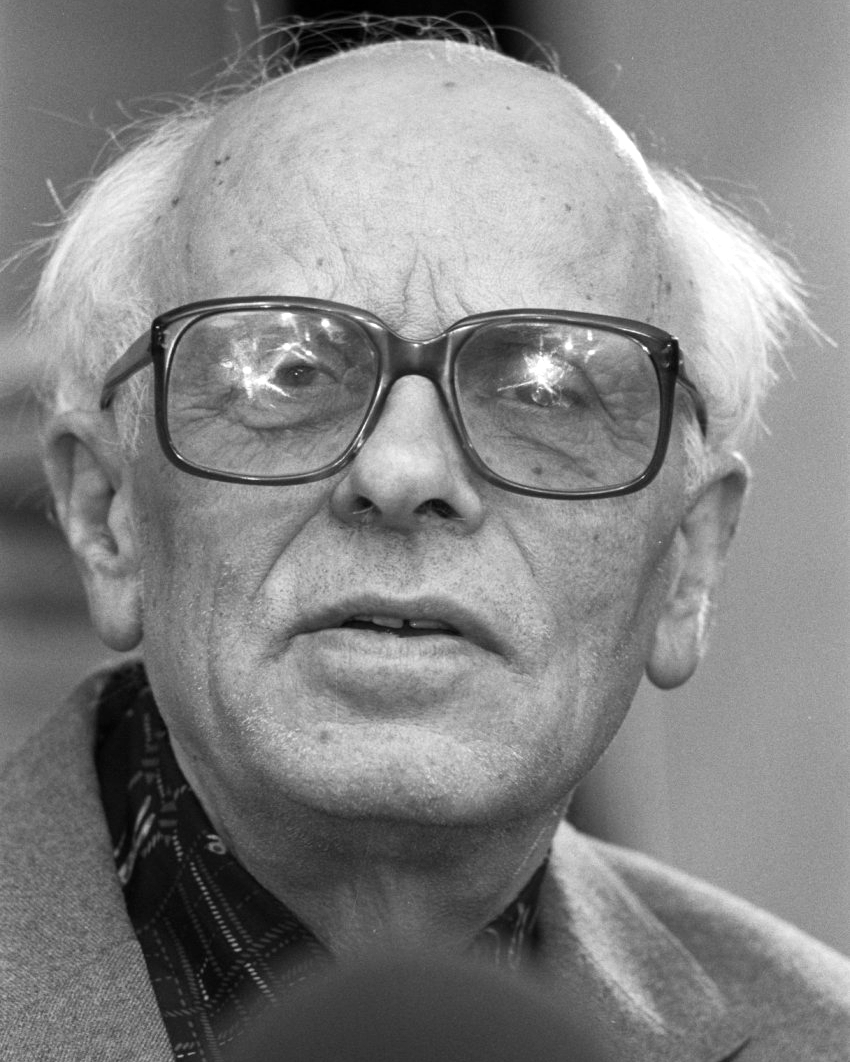
Andrei Sakharov and Yelena Bonner at Schiphol Airport, Amsterdam, 15 June 1989. In 1973 Pravda printed the letter of forty Academy of Sciences members denouncing him (see the first example above). Photo: Rob C. Croes / Anefo, Dutch National Archives, CC0 1.0.

Boris Pasternak, 1958, the year of the Nobel Prize and of the press and meeting resolutions condemning Doctor Zhivago (see the first example above). Wikimedia Commons; public domain (published in the United States without a copyright notice).
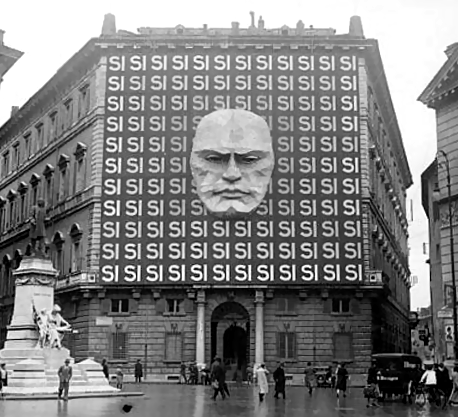
Palazzo Braschi, Rome, dressed for the single-list plebiscite of March 1934 with rows of "SI" (Yes), from the gallery entry Palazzo Braschi dressed for the 1934 plebiscite: rows of "SI" around the Duce. A visible unanimity staged by the party federation.
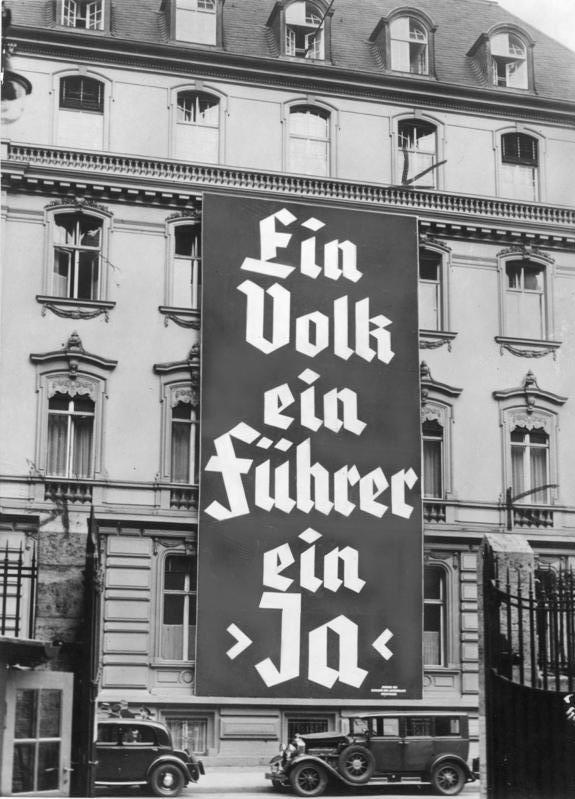
"Ein Volk, ein Führer, ein Ja" banner, Berlin, November 1933, from the gallery entry Ein Volk, ein Führer, ein Ja (One People, One Leader, One Yes). NSDAP campaign for the single-list election and referendum.
How to spot it
- Trace three or four of the voices back to their first appearance. If they converge on one press release, one account, one agency or one contractor, the agreement has one origin.
- Look for shared phrasing across supposedly independent sources, including the same unusual word choice, the same statistic or the same error.
- Check timing. Many voices arriving on the same day, or in a burst after a quiet period, suggests a release schedule rather than independent discovery.
- Check who the voices are. New accounts, outlets with no named staff or address, and signatories who cannot be reached are signs of staged numbers.
- Ask what happened to dissent. If contrary voices have been removed, labelled as rumors or never appear at all, the apparent agreement may be produced by subtraction.
- For research claims, see whether the "many studies" were funded, written or published by the same body, and whether any were independently replicated.
Where it ends: edge cases and legitimate persuasion
The closest neighbor is Astroturfing, which fakes the grassroots: a crowd, a local group or a citizen voice that is not what it claims. Manufactured consensus is the wider aim of making a conclusion look independently shared, and it can use astroturf, but it can also use real people who were organized, pressured or paid to sign the same letter, or documents from a single shop dressed as a literature. Bandwagon is the appeal to join a majority; manufactured consensus is the fabrication of the majority that a bandwagon appeal can then point to. Narrative laundering disguises where one message came from, while manufactured consensus multiplies it; the two often run together. Flooding the zone and Firehosing rely on volume to exhaust or confuse, not on the appearance of agreement.
A related variant is manufactured doubt, where the staged voices claim that experts disagree rather than agree. The tobacco industry's 1954 A Frank Statement to Cigarette Smokers advertisement announced an industry-funded research committee and told readers that "there is no agreement among the authorities", a case the archive tags as Bothsidesism and Card stacking. The mechanism is the same trick run in reverse: one interested source presented as a scientific community.
The boundary with honest communication is independence, not agreement. Scientists who reach the same result in separate laboratories, newspapers that run the same wire story with its credit line, and a coalition letter whose organizers and funders are named are all legitimate, because the audience can see how many origins there really are. Coordinated advocacy is also legitimate when it is disclosed. The test a reader can apply is this: if you traced every voice to its first source, would the count of independent origins match the count of voices you were shown? Where it matches, or where the coordination is stated openly, it is consensus or advocacy. Where many voices collapse into one hidden origin, or where the missing voices were removed, it is manufactured.
Sources
- Asch, Solomon E. 1956. "Studies of Independence and Conformity: I. A Minority of One Against a Unanimous Majority." Psychological Monographs: General and Applied 70(9): 1-70.
- Bond, Rod, and Peter B. Smith. 1996. "Culture and Conformity: A Meta-Analysis of Studies Using Asch's (1952b, 1956) Line Judgment Task." Psychological Bulletin 119(1): 111-137.
- Cialdini, Robert B. 1984. Influence: How and Why People Agree to Things. New York: William Morrow.
- Finn, Peter, and Petra Couvée. 2014. The Zhivago Affair: The Kremlin, the CIA, and the Battle over a Forbidden Book. New York: Pantheon.
- Frenkel, Sheera. 2024. "Israel Secretly Targets U.S. Lawmakers With Influence Campaign on Gaza War." The New York Times, 5 June 2024.
- Glynn, Carroll J., Andrew F. Hayes, and James Shanahan. 1997. "Perceived Support for One's Opinions and Willingness to Speak Out: A Meta-Analysis of Survey Studies on the 'Spiral of Silence'." Public Opinion Quarterly 61(3): 452-463.
- Graphika and Stanford Internet Observatory. 2022. Unheard Voice: Evaluating Five Years of Pro-Western Covert Influence Operations. Stanford Internet Observatory.
- Harkins, Stephen G., and Richard E. Petty. 1981. "Effects of Source Magnification of Cognitive Effort on Attitudes: An Information-Processing View." Journal of Personality and Social Psychology 40(3): 401-413.
- King, Gary, Jennifer Pan, and Margaret E. Roberts. 2017. "How the Chinese Government Fabricates Social Media Posts for Strategic Distraction, Not Engaged Argument." American Political Science Review 111(3): 484-501.
- Meta. 2022. Quarterly Adversarial Threat Report, Q3 2022. Menlo Park: Meta Platforms.
- Meta. 2024. Adversarial Threat Report, First Quarter 2024. Menlo Park: Meta Platforms.
- New York State Office of the Attorney General. 2021. Fake Comments: How U.S. Companies and Partisans Hack Democracy to Undermine Your Voice. New York: Office of the Attorney General.
- Noelle-Neumann, Elisabeth. 1974. "The Spiral of Silence: A Theory of Public Opinion." Journal of Communication 24(2): 43-51.
- OpenAI. 2024. AI and Covert Influence Operations: Latest Trends. San Francisco: OpenAI.
- Sakharov, Andrei. 1990. Memoirs. Translated by Richard Lourie. New York: Alfred A. Knopf.
- van der Linden, Sander L., Anthony A. Leiserowitz, Geoffrey D. Feinberg, and Edward W. Maibach. 2015. "The Scientific Consensus on Climate Change as a Gateway Belief: Experimental Evidence." PLOS ONE 10(2): e0118489.
- Weaver, Kimberlee, Stephen M. Garcia, Norbert Schwarz, and Dale T. Miller. 2007. "Inferring the Popularity of an Opinion from Its Familiarity: A Repetitive Voice Can Sound Like a Chorus." Journal of Personality and Social Psychology 92(5): 821-833.
- Yousif, Sami R., Rosie Aboody, and Frank C. Keil. 2019. "The Illusion of Consensus: A Failure to Distinguish Between True and False Consensus." Psychological Science 30(8): 1195-1204.
Case studies
- The Gyirong flood and the official death toll — The Gyirong flood and the official death toll
- The Hanover Institute: reports written for chatbots to cite — The Hanover Institute: reports written for chatbots to cite
- The Pentagon's retired military analyst outreach programme (2002-2008) — The Pentagon's retired military analyst outreach programme (2002-2008)
- RICU and the Integrity Initiative: UK government-funded messaging that did not show its source — RICU and the Integrity Initiative: UK government-funded messaging that did not show its source
- Israel's Strategic Affairs Ministry paid for news content, and a later ministry's STOIC campaign aimed at U.S. lawmakers — Israel's Strategic Affairs Ministry paid for news content, and a later ministry's STOIC campaign aimed at U.S. lawmakers
- Algeria 1954-1962: 'events', psychological action, and the FLN's single voice — Algeria 1954-1962: 'events', psychological action, and the FLN's single voice
- Xinjiang's 'vocational training centres': the government's messaging and its critics' — Xinjiang's 'vocational training centres': the government's messaging and its critics'
- Indian Chronicles: fake local outlets, revived NGOs and a borrowed professor — Indian Chronicles: fake local outlets, revived NGOs and a borrowed professor
- Facebook's April 2019 takedowns in India: a Congress IT cell, a BJP-linked IT firm and a Pakistani military network — Facebook's April 2019 takedowns in India: a Congress IT cell, a BJP-linked IT firm and a Pakistani military network
- Follow the science, Plandemic: COVID-19 messaging from officials and contrarians, 2020-2022 — Follow the science, Plandemic: COVID-19 messaging from officials and contrarians, 2020-2022
- The Reich Ministry of Public Enlightenment and Propaganda, 1933-1945 — The Reich Ministry of Public Enlightenment and Propaganda, 1933-1945
- Fascist Italy's propaganda machine: from the Duce's Press Office to the Ministry of Popular Culture — Fascist Italy's propaganda machine: from the Duce's Press Office to the Ministry of Popular Culture
- From a fire to a vote: the Reichstag Fire Decree and the Enabling Act, February-March 1933 — From a fire to a vote: the Reichstag Fire Decree and the Enabling Act, February-March 1933
- Bolshevik agitprop, 1917-1921: soviets, decrees, agit-trains and the ROSTA windows — Bolshevik agitprop, 1917-1921: soviets, decrees, agit-trains and the ROSTA windows
- The Lenin cult after 1924: an embalmed body, a mausoleum and a doctrine called "Leninism" — The Lenin cult after 1924: an embalmed body, a mausoleum and a doctrine called "Leninism"
- 'Trotskyism or Leninism': the press campaign that removed Trotsky from Soviet leadership (1924-1929) — 'Trotskyism or Leninism': the press campaign that removed Trotsky from Soviet leadership (1924-1929)
- The Moscow show trials: confession, spectacle and consent (1936-1938) — The Moscow show trials: confession, spectacle and consent (1936-1938)
- Propaganda of the Chinese Civil War, 1945-1949: land reform, surrender leaflets and the fall of the mainland — Propaganda of the Chinese Civil War, 1945-1949: land reform, surrender leaflets and the fall of the mainland
- The Mao cult before the state: 'Mao Zedong Thought' and 'The East Is Red', 1943-1949 — The Mao cult before the state: 'Mao Zedong Thought' and 'The East Is Red', 1943-1949
- The People's Court: the Volksgerichtshof as a stage for verdicts, 1934-1945 — The People's Court: the Volksgerichtshof as a stage for verdicts, 1934-1945
- Manufactured unanimity: the Nazi single-list plebiscites, 1934-1938 — Manufactured unanimity: the Nazi single-list plebiscites, 1934-1938
- The Agitprop Department: the Communist Party's standing propaganda apparatus, 1920-1991 — The Agitprop Department: the Communist Party's standing propaganda apparatus, 1920-1991
- The NKVD as its own propagandist: 'enemies of the people,' informants and the vigilant state (1934-1946) — The NKVD as its own propagandist: 'enemies of the people,' informants and the vigilant state (1934-1946)
- Pravda, Izvestia and TASS: the institutional structure of the Soviet press monopoly, 1912-1991 — Pravda, Izvestia and TASS: the institutional structure of the Soviet press monopoly, 1912-1991
- The Union of Soviet Writers and socialist realism, 1932-1969 — The Union of Soviet Writers and socialist realism, 1932-1969
- Zhongxuanbu: the Central Propaganda Department as the ruling party's standing ministry of message, 1949-2026 — Zhongxuanbu: the Central Propaganda Department as the ruling party's standing ministry of message, 1949-2026
- Xinhua News Agency: China's state press apparatus, 1931-present — Xinhua News Agency: China's state press apparatus, 1931-present
- The danwei: how the work unit became China's basic unit of political control, 1951-2003 — The danwei: how the work unit became China's basic unit of political control, 1951-2003
- The PLA's Political Commissar System: Dual Command, the General Political Department and PLA Daily — The PLA's Political Commissar System: dual command, the General Political Department and PLA Daily
- Nazi control of school curriculum and teachers, 1933-1938 — Nazi control of school curriculum and teachers, 1933-1938
- The Komsomol: youth pipeline, mass mobilization and internal discipline, 1918-1991 — The Komsomol: youth pipeline, mass mobilization and internal discipline, 1918-1991
- The Pavlik Morozov cult: a Soviet martyr built from a disputed murder — The Pavlik Morozov cult: a Soviet martyr built from a disputed murder
- From 'ill health' to Swan Lake: the GKChP's case for its own coup, 19-21 August 1991 — From 'ill health' to Swan Lake: the GKChP's case for its own coup, 19-21 August 1991
- Grief on schedule: Mao's death, Hua Guofeng's succession and the 'two whatevers', 1976-1978 — Grief on schedule: Mao's death, Hua Guofeng's succession and the 'two whatevers', 1976-1978
- The Gang of Four: arrest, denunciation and a trial that closed the Cultural Revolution's books (1976-1981) — The Gang of Four: arrest, denunciation and a trial that closed the Cultural Revolution's books (1976-1981)
- Boluan Fanzheng: how Deng Xiaoping's faction used a debate about truth to break Hua Guofeng's hold on power, 1977-1981 — Boluan Fanzheng: how Deng Xiaoping's faction used a debate about truth to break Hua Guofeng's hold on power, 1977-1981
- The 1981 Resolution: how the Chinese Communist Party engineered a single verdict on Mao — The 1981 Resolution: how the Chinese Communist Party engineered a single verdict on Mao
Images
| Image | Source | Licence |
|---|---|---|
| Andrei Sakharov and Yelena Bonner, Schiphol, 1989 | Wikimedia Commons (via Glasnost: the controlled opening that outran the Soviet state (1985-1989)) | CC0 1.0 |
| Boris Pasternak, 1958 | Wikimedia Commons (via The Union of Soviet Writers and socialist realism, 1932-1969) | Public domain (no copyright notice; see the case study) |
| Palazzo Braschi plebiscite decoration, 1934 | Gallery entry Palazzo Braschi dressed for the 1934 plebiscite: rows of "SI" around the Duce | See the gallery entry |
| "Ein Volk, ein Führer, ein Ja", 1933 | Gallery entry Ein Volk, ein Führer, ein Ja (One People, One Leader, One Yes) | See the gallery entry |
Image gaps
- The FCC net neutrality docket (2017): the protest photographs found on Wikimedia Commons outside the FCC carried non-commercial-only licences (CC BY-NC), so none is hosted. The New York Attorney General's 2021 report is a state publication with no clear free-reuse statement.
- The Chinese, U.S. military (Graphika/Stanford) and STOIC persona networks: reports and platform takedown notices are copyrighted and not hosted; see the case studies linked below.
- The 1973 Pravda letter against Sakharov: no scan with a verifiable free licence found.
.jpg)
