In one line: in the same week of August 2012, a pro-Obama super PAC released an ad in which a laid-off steelworker tied Mitt Romney to his wife's death from cancer, and Romney's own campaign launched ads saying President Obama had dropped welfare work requirements; the main fact-checkers rated both at or near their lowest level, and the two ads differed in who paid for them, how widely they ran, and how their sponsors answered the verdicts.
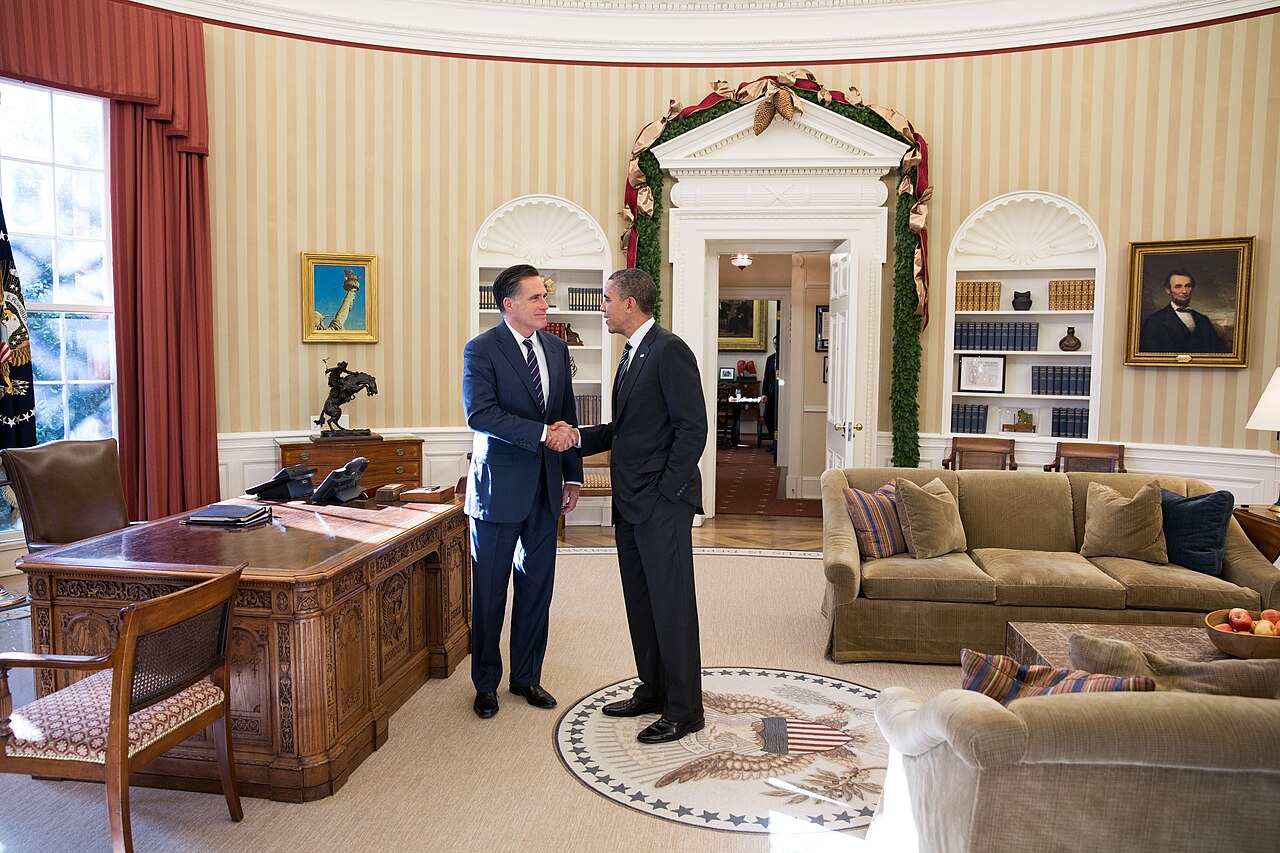
Barack Obama and Mitt Romney in the Oval Office after their post-election lunch, 29 November 2012. Official White House photo by Pete Souza. Public domain (U.S. government work). The photo is from after the campaign and is shown to identify the two candidates, not the ads.
What happened
- 1993 to 2001. Bain Capital buys GST Steel in Kansas City in 1993. The company goes bankrupt in 2001 and the mill closes, and more than 750 workers lose their jobs. Romney had left Bain to run the 2002 Salt Lake City Winter Olympics and was doing that when the plant closed (FactCheck.org).
- 12 July 2012. The Department of Health and Human Services (HHS) issues an Information Memorandum to state welfare administrators. It invites states to apply for waivers under section 1115 of the Social Security Act to test new ways of meeting the goals of Temporary Assistance for Needy Families (TANF). HHS Secretary Kathleen Sebelius later writes to Congress that this is "a very limited waiver opportunity for states that develop a plan to measurably increase the number of beneficiaries who find and hold down a job." States had to show their plans would move at least 20 percent more people into work (CNN).
- May 2012 (Obama campaign's own Bain ad). Obama for America runs a two-minute ad about GST Steel for one day in Ohio, Pennsylvania, Virginia, Iowa and Colorado. Former GST workers, including Joe Soptic, appear in it. Soptic also tells his story on a campaign conference call hosted by deputy campaign manager Stephanie Cutter (ABC News).
- 6 to 7 August 2012 (Romney campaign). Romney for President releases "Right Choice." Over pictures of President Bill Clinton signing the 1996 welfare law, a narrator says Clinton and a bipartisan Congress "helped end welfare as we know it by requiring work for welfare." It continues: "On July 12th, President Obama quietly announced a plan to gut welfare reform by dropping work requirements. Under Obama's plan, you wouldn't have to work and wouldn't have to train for a job. They just send you your welfare check" (PolitiFact). The welfare ads also say "'welfare to work' goes back to being plain old welfare." At least two sequels follow within about two weeks and add that Obama "has a long history of opposing work for welfare," citing a 1999 speech he gave as an Illinois state senator (Boston Globe, FactCheck.org).
- 7 August 2012 (Priorities USA Action). The super PAC releases "Understands." Soptic says that when Romney and Bain closed the plant he lost his health care, that "a short time after that my wife became ill," and that she died 22 days after her diagnosis. He says he does not think Romney realizes what he has done or is concerned (Washington Post Fact Checker, FactCheck.org). CBS News reports the ad as part of a $20 million television and online campaign on Romney's business record. "Understands" itself ran mainly online. Priorities USA said it aired once on television, in Cleveland, which it put down to a station error (FOX31 Denver, NBC News).
- 7 to 9 August 2012 (verdicts). PolitiFact rates the welfare ad's claim Pants on Fire. The Washington Post Fact Checker gives it Four Pinocchios and FactCheck.org says the plan "does neither" of the things the ad says. The Post Fact Checker also gives "Understands" Four Pinocchios, and Glenn Kessler writes: "On every level, this ad stretches the bounds of common sense and decency." FactCheck.org calls "Understands" "misleading on several counts."
- 8 August 2012. Cutter tells CNN "I don't know the facts" of the Soptic family's case, although she had hosted the May call. The same day Priorities chief Bill Burton defends the ad on CNN.
- 12 August 2012. Obama adviser David Axelrod says on ABC's This Week: "it's not running, by the way, the ad hasn't been on the air" (The Hill). Obama later says it is "an ad that I didn't approve, I did not produce, and as far as I can tell has barely run. I think it ran once."
- 28 August 2012. At an ABC News panel at the Republican convention in Tampa, Romney pollster Neil Newhouse says: "we're not going to let our campaign be dictated by fact-checkers." Obama quotes the line in his own speeches (ABC News).
- 2017. HHS rescinds the 2012 memorandum. Only one state, Ohio, had applied for a work-requirement waiver under it (2015 and 2017), and that application was denied (Administration for Children and Families).
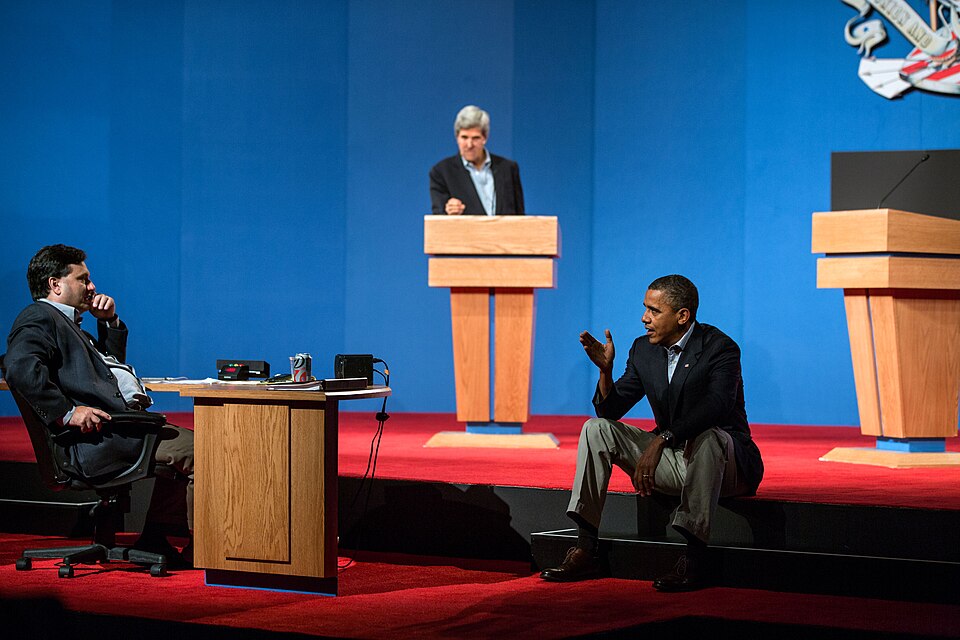
President Obama in a mock-debate rehearsal at the Westin Lake Las Vegas Resort and Spa, Henderson, Nevada, 2 October 2012, the day before the first presidential debate. Adviser Ron Klain is at the table; Senator John Kerry, at the lectern, plays the part of Mitt Romney. Official White House photo by Pete Souza. Public domain (U.S. government work).
How it works
- Card stacking (both ads). "Understands" places the plant closing, the loss of insurance, the illness and the death in one short sequence. It leaves out that the closure came in 2001, that Ranae Soptic had her own employer coverage until an injury in 2002 or 2003, that she was diagnosed and died in 2006, and that Romney had left Bain before the closure. "Right Choice" leaves out that waivers required a plan to raise employment, the 20 percent test, and the memo's stated aim of improving "employment outcomes." It says checks would be sent with no work or training. Both ads use real events. The misleading picture comes from what is omitted and how the rest is ordered.
- Testimonial ("Understands"). Soptic is a primary witness to his job loss and his wife's illness, and that part is not the technique. The technique is the step beyond what he witnessed: his grief is used to vouch for a claim about Romney's responsibility and Romney's state of mind, which the ad gives the viewer no dates to check.
- Transfer ("Right Choice"). The ad opens on Bill Clinton signing the 1996 law, borrowing a Democratic president's authority for the claim that Obama was undoing it. Clinton himself called the claim "not true." Fear appeal and scapegoating are not scored. Neither ad stages an imminent harm to the viewer. Whether the welfare ads cast an out-group as the cause of a harm is a contested reading of racial coding, so it is recorded under Positions on the record and not scored in this archive's voice.
Then and now
No image in this archive's gallery shows a U.S. campaign attack ad, so the comparison is in prose. The 1988 presidential race had the same split between an outside group and a campaign. An independent committee aired "Weekend Passes" about the Massachusetts furlough of Willie Horton, and the Bush campaign's own "Revolving Door" ad made a related point without Horton's face. That case is written up in Crime and victim attack ads in two U.S. presidential races: Horton and the furloughs (1988), James Byrd Jr. and hate-crimes law (2000). In 2012 the pattern was less tidy. The super PAC ad drew the harsher personal charge and the smaller documented airtime, while the candidate's own campaign carried the welfare claim, signed it with "I approve this message," and made it a large share of its August advertising.
The welfare dispute also had a later chapter that fact-checkers could not see in August 2012. The waivers the ads described were never granted. The memorandum was rescinded in 2017 after one state applied and was turned down.
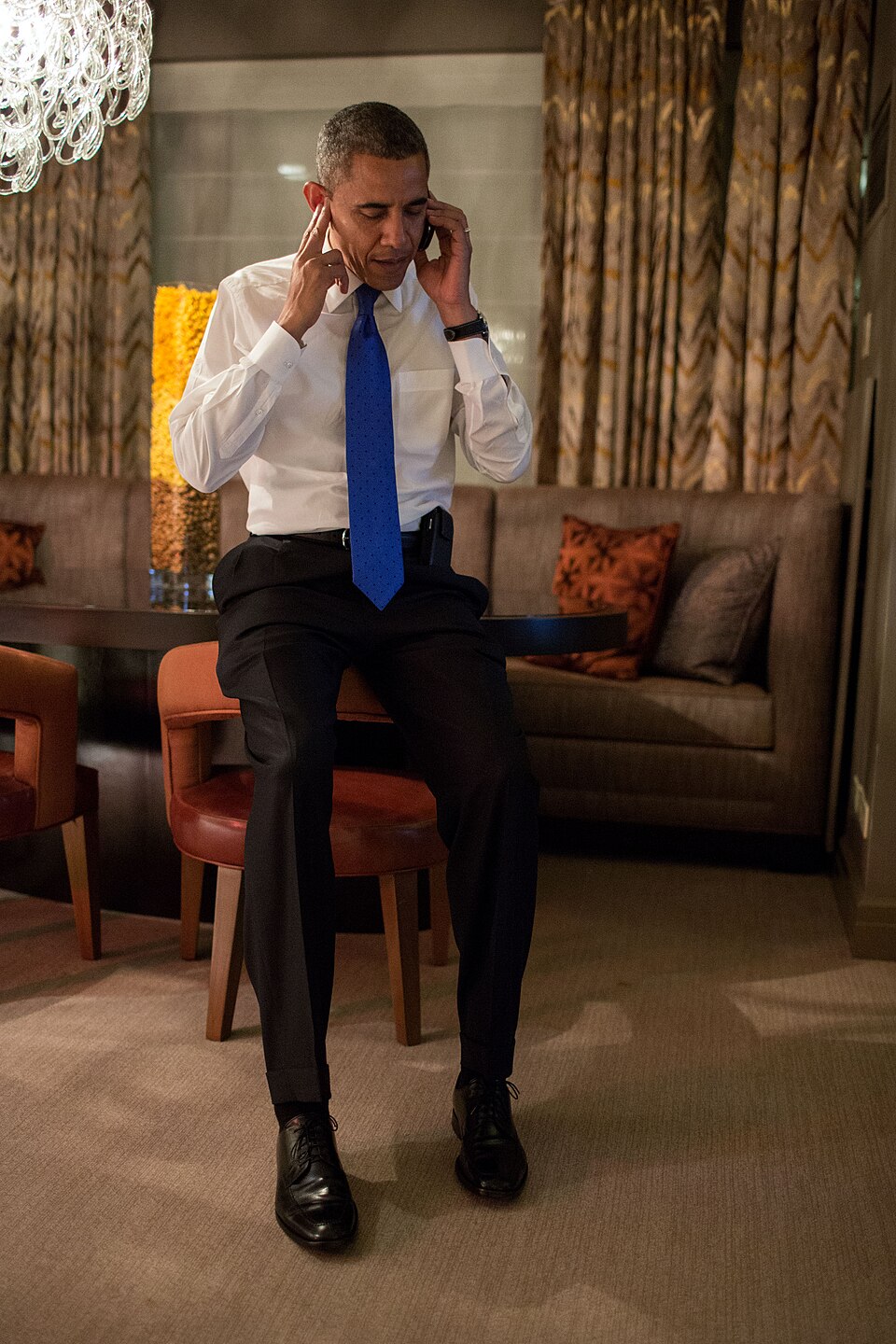
President Obama takes a telephone call from Mitt Romney conceding the election, Presidential Suite, Fairmont Chicago Millennium Park, 7 November 2012. Official White House photo by Pete Souza. Public domain (U.S. government work). Only one end of the call is shown.
Positions on the record
- Priorities USA Action: Burton said on CNN that the group was not blaming Romney for Ranae Soptic's death: "We would never make that case." He said the point was that Soptic "was fired from his job, and as a result of that, he wasn't able to hold onto health care benefits that were promised to him. And as a result, when his wife got sick, he didn't have health care." HuffPost's headline said the group defended the ad as "wildly successful."
- Obama campaign: it said it had no connection to the super PAC ad, which federal law bars campaigns from coordinating with. Cutter said she did not know the facts of the case, and Axelrod said the ad had not been on the air. Critics, and ABC News, noted that the campaign had used Soptic's story itself in May.
- Romney campaign on "Understands": Fox News reported the ad under the headline "campaign decries 'contemptible effort'." Romney spokeswoman Andrea Saul answered the ad by saying that people in Massachusetts under Romney's health plan would have had coverage.
- Romney campaign on the welfare ads: Saul said "Mitt Romney has consistently supported strong work requirements for welfare recipients." The policy case for the claim was set out by Robert Rector of the Heritage Foundation, whose 12 July 2012 commentary "Obama Guts Welfare Reform" argued that the waivers could let "state bureaucrats" count activities that are not really work. Asked about a 2005 letter in which Romney and other Republican governors sought more "waiver authority," the campaign said "They were talking about flexibility" and "Governor Romney was not asking for work requirements to be changed." Newhouse said the campaign would not be "dictated by fact-checkers." In 2016 he said he meant that every ad was fact-checked internally and that he would not let "independent newspaper guys" set the campaign's strategy.
- Fact-checkers and policy experts on the welfare ads: PolitiFact, FactCheck.org, the Post Fact Checker and CNN called the claim false. CNN wrote that it "inflames old resentments about able-bodied adults sitting around collecting public assistance." Ron Haskins, a Republican aide who helped write the 1996 law, said: "There's no plausible scenario under which it really constitutes a serious attack on welfare reform."
- Critics on racial coding: Princeton political scientist Tali Mendelberg said the ads were "implicitly [communicating] a racial message" and that "The implicit equation is black equals no work, white equals work." In a YouGov experiment, Michael Tesler showed the ad to half of about 1,000 respondents. The ad did not shift overall answers, but among those who saw it, racial resentment became a stronger predictor of whether they thought Romney would help the poor, the middle class and African Americans. MSNBC's Rachel Maddow called it "dog-whistle racism."
- Romney campaign's answer on race: an aide said the charge "doesn't deserve the dignity of a response." Newt Gingrich, sent out by the campaign to argue the welfare case, said: "To have an honest discussion about dependency doesn't mean you're racist, it means you're worried about the future." He called charges of race-baiting "absurd."
- This archive's reading: documented for "Understands": the timeline gaps, the Four Pinocchios rating, and the Obama campaign's earlier use of Soptic. Not shown: a paid TV run. The sponsor says it aired once on television, by a station's error; its reach came through news coverage and online views. Documented for the welfare ads: the Pants on Fire and Four Pinocchios ratings, the campaign's decision to keep running and expanding them, and reports that they took a large share of its August ad budget. Not shown: that the campaign intended a racial message. The Tesler experiment measures an effect on viewers, not intent, and the campaign denies it. Scale also differs. One ad was a super PAC spot that aired once on television. The others were candidate-approved ads in heavy rotation.
Same-method test
A Republican super PAC ad in which a widow said a Democrat's business decision led to her husband's death, leaving out a five-year gap and a second insurance policy, would be scored as card-stacking and testimonial here. A Democratic campaign ad that showed Ronald Reagan signing a law and said a Republican president had "quietly" scrapped it, when the change was an invitation to apply for conditional waivers, would be scored as card-stacking and transfer. The Obama campaign's own July 2012 "Firms" ad, which set Romney singing "America the Beautiful" against claims about outsourcing and offshore accounts, belongs in the same test. PolitiFact rated its outsourcing line Half True and its Swiss bank account line True. That is a milder verdict than either ad above, so it is noted here rather than scored as a third case.
How to spot it
- Put dates on every link in a cause-and-effect story. "A short time after that" is a claim about time. Here the gap was five years.
- When an ad quotes an official action, read the action. The July 2012 memo and the Sebelius letter set conditions that the ad's summary drops.
- Check who paid and who approved. A candidate's own ad and an outside group's ad carry different legal responsibility. Airtime can be tiny while news coverage of an ad is large.
- Separate what an ad says from what critics say it signals. Coding claims need evidence about the message or its effect, and the sponsor's answer belongs beside them.
Images
| Image | Source | Licence |
|---|---|---|
| Obama and Romney in the Oval Office, 29 November 2012 | Wikimedia Commons, Pete Souza, official White House photo | Public domain (U.S. government work) |
| Obama debate rehearsal with Ron Klain and John Kerry, 2 October 2012 | Wikimedia Commons, Pete Souza, official White House photo | Public domain (U.S. government work) |
| Obama takes Romney's concession call, 7 November 2012 | Wikimedia Commons, Pete Souza, official White House photo | Public domain (U.S. government work) |


Image gaps
- Frames from "Understands," "Right Choice" and the welfare sequels. The ads are copyrighted by their sponsors and are cited, not reproduced. Not fillable with an open licence.
- Frames from the Obama campaign's May 2012 GST Steel ad and July 2012 "Firms" ad. Copyrighted campaign material. Not fillable.
- The 12 July 2012 HHS Information Memorandum. A U.S. government work and so public domain, but hhs.gov and acf.gov could not be reached from the environment used to build this page. Fillable: a scan of the memo's first page would be a good addition.
- Campaign-era photos of Romney and of the ads' other principals (Soptic, Clinton signing the 1996 law). No public domain photo of Romney during the 2012 campaign was found; the two photos added here, both of President Obama, are official White House photographs, the only clearable campaign-period images located. The Oval Office photograph of 29 November 2012 is the only hosted image showing Romney. A public domain photo of the 1996 signing was searched for on Commons and not found.
- Campaign-era photos of each candidate. Gage Skidmore's CC BY-SA photos of Romney on Commons carry a personality-rights restriction tag, so they were set aside under this archive's rule.
Sources
- FactCheck.org: Is Romney to Blame for Cancer Death? (August 2012)
- Washington Post Fact Checker: New anti-Romney ad: same steelworker, tougher message (7 August 2012)
- PolitiFact: Pro-Obama group blames Romney in woman's death (9 August 2012)
- ABC News: Stephanie Cutter: I didn't know 'facts' of Joe Soptic's wife's sickness (August 2012)
- HuffPost: Priorities USA Action defends controversial Romney ad as 'wildly successful' (8 August 2012)
- CBS News: Priorities USA Action ad revives Bain attack (August 2012)
- Fox News: Ad links Romney to death of steelworker's wife, campaign decries 'contemptible effort'
- PolitiFact: Obama ad claims Romney, Bain left misery in wake of GST Steel takeover (16 May 2012)
- FactCheck.org: Lemon-Picking Bain Capital, Obama-style (May 2012)
- PolitiFact: Mitt Romney says Barack Obama's plan for welfare reform: "They just send you your check" (7 August 2012)
- FactCheck.org: Does Obama's Plan 'Gut Welfare Reform'? (August 2012)
- CNN: Fact check: Romney's welfare claims wrong (23 August 2012)
- Washington Post Plum Line: In new ad, Mitt Romney repeats false attack on Obama's welfare policy (13 August 2012)
- Boston Globe: Points amiss in Romney's ads on welfare (16 August 2012)
- NPR: Despite fact checks, Romney escalates welfare work requirement charge (22 August 2012)
- ABC News: President Obama quotes Romney pollster dismissing fact-checkers (August 2012)
- Zebra Fact Check: Quote check on "We're not going to let our campaign be dictated by fact checkers"
- Heritage Foundation, Robert Rector, 12 July 2012: Obama Guts Welfare Reform
- American Presidency Project: Romney campaign press release, The Romney Record: Protecting Welfare To Work
- The Hill: Gingrich: Attacks on welfare not race-baiting
- NBC News: Gingrich: Accusations of Republican race-baiting are 'absurd'
- Washington Monthly: Romney campaign mutes the racial dog whistles for Tampa (1 September 2012)
- YouGov (Michael Tesler): Testing the racializing influence of Romney's welfare ad
- NewsBusters: Maddow's response to Romney's welfare reform ad (10 August 2012)
- Congressional Research Service: TANF: Welfare Waivers (R42627)
- Administration for Children and Families: Work Requirements Restored for TANF (2017)
- ACF: TANF-ACF-IM-2017-01, rescinding the 2012 waiver guidance
- PolitiFact Ad Watch: A singing Romney is bashed for foreign business dealings ("Firms", 24 July 2012)
- PolitiFact: Mitt Romney had millions in a Swiss bank account, Obama campaign ad says (16 July 2012)
- FOX31 Denver: Controversial ad that's never aired backfiring on Obama campaign
- The Hill: Axelrod: Priorities ad doesn't blame Romney for woman's death
- ProPublica Itemizer: Priorities USA Action independent expenditures, 2012 cycle