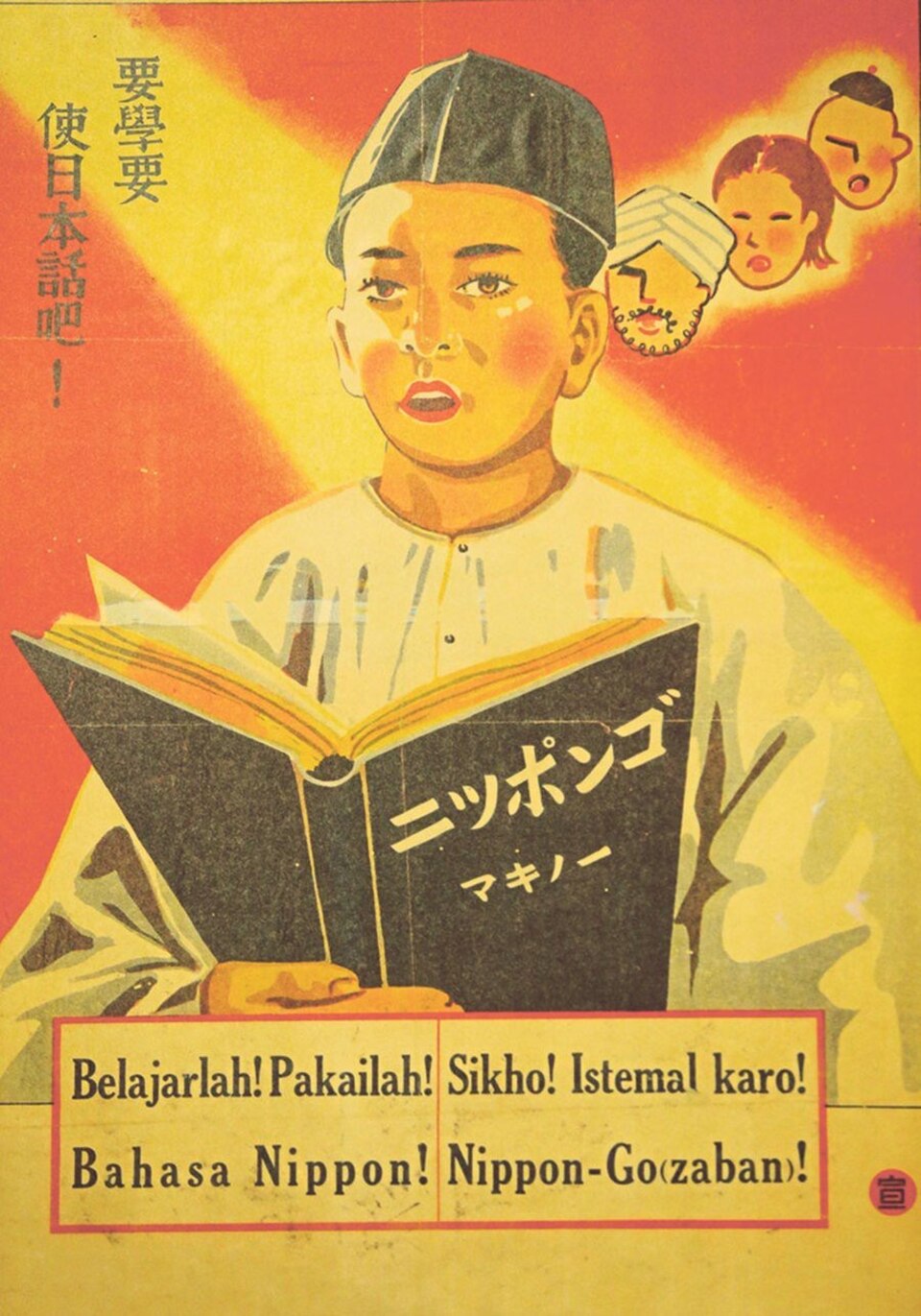
Belajarlah! Pakailah! Bahasa Nippon! (Learn! Use! The Japanese Language!)
A Malay youth in a songkok reads aloud from a book marked 'Nippon-go' while three smaller faces in a turban, a bun and a topknot fill the rays of light behind him. The panel beneath repeats 'Learn! Use! Japanese!' in Malay and in Hindustani, with a Chinese line at top left. The tell: several communities are pictured as taking up the language together, an appeal to join a general movement.
- Date
- 1942
- Period
- Second World War
- Made by
- Japanese occupation administration in Malaya (issuer given on Commons as Government of Japan; sponsor not printed)
- Region
- East Asia
- Country
- Empire of Japan
- Medium
- Poster
- Issuer type
- State
- Regime
- Showa Japan
- Leader
- Hideki Tojo
- Audience
- Foreign public
- Purpose
- Mobilize or secure compliance
- Themes
- Empire and colonialism, Media and information
- Event
- World War II
- Techniques
- Bandwagon
- Source
- Unidentified Source blurred: contractors, cutouts, buried disclosure
- Source
- Wikimedia Commons (reproduction credited to New Straits Times, 2017), retrieved September 29, 2026
- Rights
- Public domain (1942-45 occupation poster; Commons tag PD-Malaysia)
Japanese occupation administration in Malaya (unknown artist); via Wikimedia Commons.
Text on the object
要學要
使日本話吧!

[book cover:] ニッポンゴ

Belajarlah! Pakailah!
Bahasa Nippon!

Sikho! Istemal karo!
Nippon-Go(zaban)!

[red round seal, lower right:] 宣
Learn it, use it! Speak Japanese!

[book cover:] Nippon-go (Japanese language)

Learn! Use!
The Japanese language!

Learn! Use!
Japanese language (Nippon-go, 'zaban' = language)!

[seal:] 'announce / proclaim'
Languages: Malay, Hindustani in Roman script, Chinese and Japanese. The Chinese lines are vertical columns read right to left. A second line of katakana on the book cover is too small to read and is omitted. Translation is FRAME's own literal rendering, machine-assisted and not verified by a fluent reader.