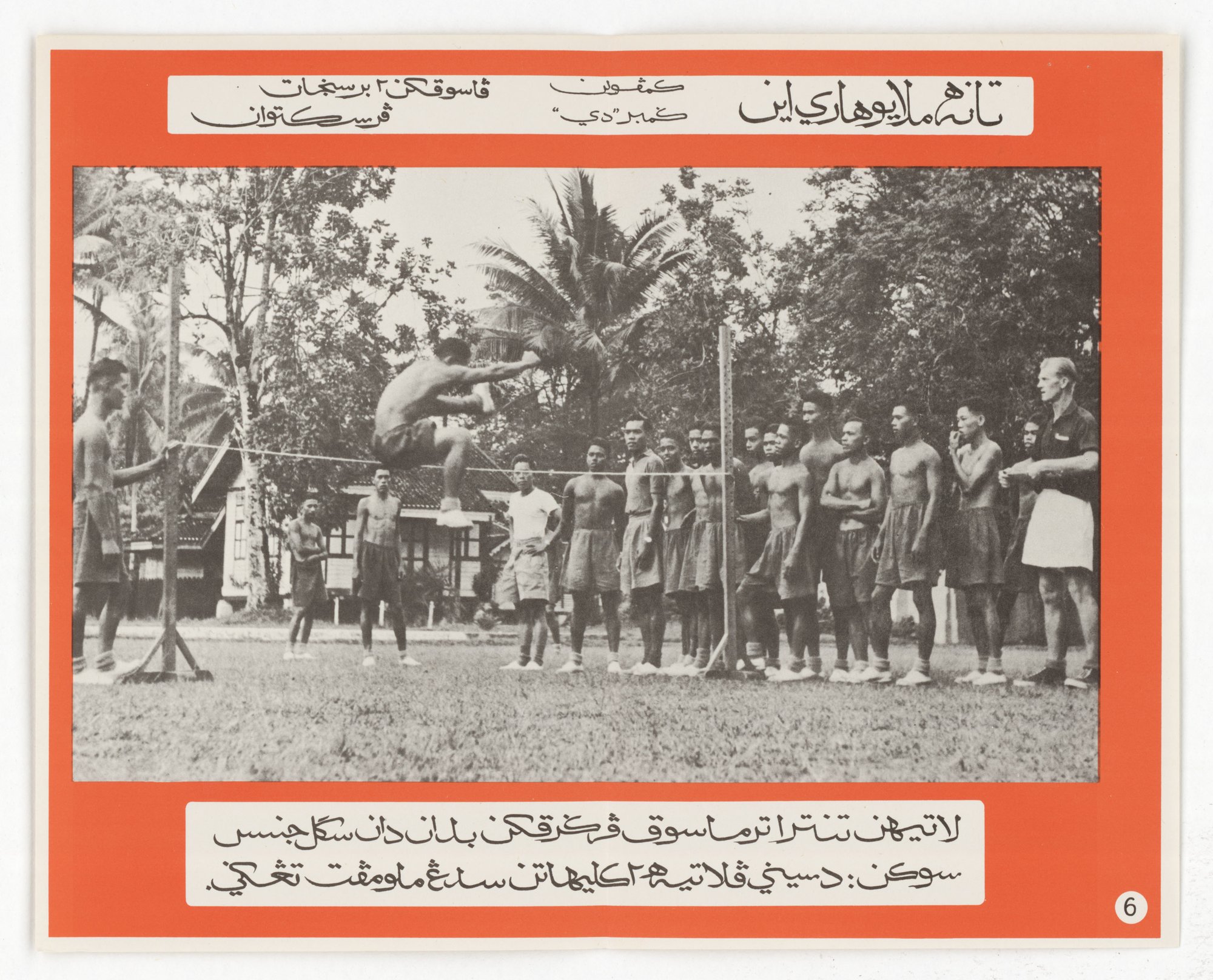
Malaya Today, Picture Set D, no. 6: Army athletics, recruits high-jumping (Malay Jawi-script photo poster distributed in Malaya)
A photograph of a bare-chested man mid-jump over a rope bar on a grass field, watched by a line of recruits in shorts and a coach at right. The Jawi-script Malay caption says army training includes physical exercise and all kinds of sport, and shows trainees high-jumping. The tell is plain-folks: soldiering is shown as sport among ordinary young men.
Propaganda techniques used in this poster
- Date
- September 3, 1953
- Period
- Cold War
- Made by
- U.S. Information Agency (predecessor: State Department International Information and Educational Exchange Program), Propaganda Posters Distributed in Asia series
- Region
- North America
- Country
- United States
- Medium
- Poster
- Issuer type
- State
- Regime
- Eisenhower Administration
- Leader
- Dwight D. Eisenhower
- Audience
- Foreign public
- Purpose
- Persuade or win support
- Themes
- War and the military, Empire and colonialism
- Event
- Cold War
- Source
- Unidentified Source blurred: contractors, cutouts, buried disclosure
- Source
- U.S. National Archives (NARA), Record Group 306, Propaganda Posters Distributed in Asia (NAID 1767935), retrieved October 3, 2026
- Rights
- Public domain (U.S. government work; NARA RG 306)
U.S. Information Agency / Department of State, September 3, 1953. National Archives, Record Group 306 (NAID 5730018, 306-PPA-117).
Text on the object
تانه ملايو هاري اين  كمفولن كمبر "دي"  ڤاسوقكن٢ برسنجات ڤرسكتوان

لاتيهن تنترا ترماسوق ڤرݢرقكن بدن دان سڠل جنس سوكن: دسيني ڤلاتيه٢ اكن ليهاتن سدڠ ملومبت تيڠݢي.

[6]
Malaya Today  Picture Set "D"  Armed forces of the Federation

Army training includes physical exercise and all kinds of sport: here the trainees are seen high-jumping.

[6]
Jawi script, read from the image; header reads 'Malaya Today, Picture Set "D", Armed forces of the Federation'. Some Jawi spellings (e.g. the words for 'seen' and 'high') are uncertain; the English follows the sense of the sentence.