Also called Common touch, Just like you
The speaker performs ordinary-person identity to make the message feel homegrown.
The tell
Costume, dialect, or 'as a mom/veteran/worker' as the warrant.
Not this
A person who actually is that thing, speaking in their own register.
History and effect
IPA 1937; a durable feature of electoral politics from the stump speech to the shirt-sleeves campaign photograph.
It lowers the audience's guard by signaling shared identity with the speaker rather than offering expertise or evidence.
Lineage: IPA 1937
How it works
Plain folks begins with a gap between the speaker and the audience. The speaker is usually more powerful, wealthier or more distant than the people being addressed: a candidate, a head of government, a company, a state agency. The technique tries to close that gap on the surface, without changing the relationship underneath, by performing ordinariness.
The performance is built from props and signals. Common ones are clothing (shirt-sleeves, work jackets, a cardigan), food and drink (a beer, a diner breakfast, a regional dish), setting (a farm, a factory floor, a kitchen table), speech (dialect, slang, a folksy register, "folks" and "friends"), and biography (humble origins, military service, being a parent). Often the speaker's own background is selected or reshaped so that only the ordinary parts show. A second, frequent move is contrast: the opponent is cast as elite, distant or out of touch, so the performance of ordinariness also becomes an attack.
What the audience experiences is recognition. The speaker seems to be "one of us", and the message seems to come from inside the group rather than from above it. The identity claim then does the work of a warrant: the audience is invited to trust the proposal because of who seems to be making it, not because of what it contains. The message depends on the audience noticing the signals and not noticing the staging, which is why the technique usually fails once the staging becomes visible (the candidate who does not know how to hold the prop, the persona whose biography turns out to be invented).
A newer form moves the performance from a single speaker to many invented ones. Instead of a politician dressing as a worker, an operation creates accounts that present themselves as ordinary local people. Here plain folks merges with Astroturfing, since the "ordinary person" is not only staged but fabricated.
Why it works
The best-established mechanism is similarity and liking. Donn Byrne's work on the attraction paradigm (1971) found that people like others who share their attitudes and traits, and Robert Cialdini (2001) lists liking, including liking based on similarity, among the core principles of compliance. A meta-analysis by Montoya, Horton and Kirchner (2008) found that perceived similarity predicts attraction more strongly than actual similarity does in existing relationships. That finding matters for plain folks: the technique only has to create the impression of sameness, not the fact of it.
A second mechanism is group prototypicality. The social identity approach to leadership (Haslam, Reicher and Platow 2011) argues that followers support leaders who seem to embody what is typical of the group, and that leaders work to be seen as "one of us" rather than simply as competent. This builds on social identity theory (Tajfel and Turner 1979), which FRAME's Learn library covers in Social identity. Performing ordinariness is one way of claiming that prototypical status.
A third mechanism is trustworthiness. The Yale persuasion program (Hovland, Janis and Kelley 1953) separated a source's expertise from its trustworthiness. Plain folks gives up any claim to expertise and bids for trustworthiness instead: the speaker has no hidden agenda because the speaker is supposedly just like the listener. The Elaboration Likelihood Model (Petty and Cacioppo 1986) predicts that such source cues matter most when the audience is not motivated or able to examine the argument closely, which describes much everyday political and commercial messaging.
The limits are worth stating plainly. Similarity effects are robust in laboratory settings, but how much a candidate's likability or "common touch" actually moves votes, compared with party loyalty and economic conditions, is debated among political scientists. The technique can also backfire when an audience detects the staging, since perceived inauthenticity lowers trust.
Examples across eras and sides
- The log cabin campaign (United States, Whig Party, 1840). After a Democratic-leaning newspaper mocked William Henry Harrison as a man who would be content with a log cabin and hard cider, the Whigs adopted both as campaign symbols, with cabin floats, cider and songs. Harrison came from a prominent Virginia planter family, and the campaign contrasted his cabin image with a portrait of President Martin Van Buren as a luxury-loving aristocrat (Sources: Gunderson 1957).
- The "Hitler myth" (Germany, 1930s). Nazi propaganda presented Adolf Hitler as a man of the people who had risen from modest origins and served as an ordinary front-line soldier in the First World War, a figure set apart from both the old elites and party functionaries. Ian Kershaw's study shows how much of Hitler's popularity rested on this constructed image rather than on the party's program (Sources: Kershaw 1987).
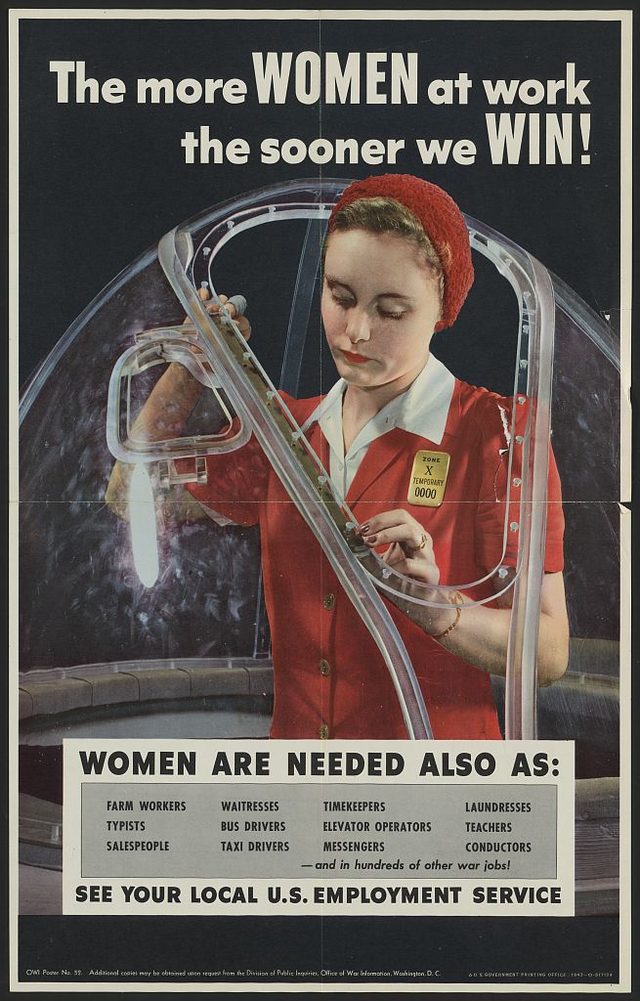
- "We Can Do It!" (United States, Westinghouse, 1943). The poster We Can Do It! was made for internal display at Westinghouse plants and shows a worker in a bandana and work shirt, presenting management's production message through an ordinary employee's face and pose. It was little known during the war and became widely famous only decades later (Sources: Kimble and Olson 2006).
- The "Checkers" speech (United States, Republican, 1952). Facing reports of a private political fund, vice-presidential candidate Richard Nixon went on national television and described his family's modest finances in detail, including his wife Pat's "respectable Republican cloth coat" and the family dog, Checkers, a gift he said they would keep. The speech mixed some financial disclosure with a heavy performance of ordinary family life, and it kept him on the ticket (Sources: Nixon 1962).
- The cardigan address (United States, Democratic, 1977). In a televised address on energy in February 1977, President Jimmy Carter sat by a fire in the White House library wearing a cardigan sweater and urged Americans to lower their thermostats. His early presidency also included walking in the inaugural parade and carrying his own luggage, deliberate signals of an unpretentious presidency (Sources: Kaufman 1993).
- Invented ordinary people (Russia 2016 and the United States 2022). The Internet Research Agency ran accounts that presented themselves as ordinary American activists and community members; see 'Miners for Trump' rally poster (Internet Research Agency) for one of their rally posters (Sources: SSCI 2019). In 2022, Graphika and the Stanford Internet Observatory described a network of accounts, some posing as ordinary residents and independent media in Central Asia and the Middle East, that promoted pro-Western narratives; Meta later linked the activity to individuals associated with the U.S. military (Sources: Graphika and SIO 2022; Meta 2022). Both are covert operations, which makes them a different and larger matter than a politician's costume, but the "just like you" persona is the same device.
How to spot it
- The message leans on the speaker's clothes, food, accent, setting or family rather than on the content of the proposal.
- The speaker's biography is presented selectively: the humble start is emphasized and the wealth, education or connections are left out.
- The opponent is described mainly as elite, rich, educated or out of touch, rather than as wrong on a specific point.
- Phrases like "as a mom", "as a working man" or "as a veteran" are used as the reason to accept a claim the identity does not bear on.
- Visual staging is noticeable on a second look: the props are new, the setting is borrowed, the register changes when the camera is off.
- An account or persona claiming to be an ordinary local person has a thin history, recycled photos or a biography that cannot be confirmed.
Where it ends: edge cases and legitimate persuasion
Named variants include the costume (dressing down for the occasion), the folksy register (dialect, slang and simple words from a speaker who does not normally use them), the humble-origins biography, the anti-elite contrast, and the invented grassroots persona. Plain folks sits close to Testimonial, since an "ordinary person" in an advertisement is often a testimonial from someone chosen to look like the audience. It overlaps with Transfer when the props (a flag, a farm, a factory) carry borrowed meaning, and with Identity fusion when the speaker claims not just to resemble the group but to be the group. When the ordinary person is fabricated, it becomes Astroturfing.
The technique ends where the identity is both real and relevant. A nurse describing working conditions on a ward speaks from experience, and her ordinariness is part of her evidence. A farmer testifying about a farm bill has a stake and knowledge that bear on the claim. Politicians who genuinely grew up poor may say so without it being propaganda. Plain speech is also not the problem: speaking clearly to a broad audience is good communication.
The test a reader can apply is twofold. First, is the identity claim true, or is it a costume, an edited biography or an invented person? Second, does the identity bear on the claim? If the proposal would look exactly the same with the costume removed, and the costume is doing the persuading, it is plain folks.
Sources
- Byrne, Donn. 1971. The Attraction Paradigm. New York: Academic Press.
- Cialdini, Robert B. 2001. Influence: Science and Practice. 4th ed. Boston: Allyn & Bacon.
- Graphika and Stanford Internet Observatory. 2022. Unheard Voice: Evaluating Five Years of Pro-Western Covert Influence Operations. Stanford Internet Observatory.
- Gunderson, Robert Gray. 1957. The Log-Cabin Campaign. Lexington: University of Kentucky Press.
- Haslam, S. Alexander, Stephen D. Reicher, and Michael J. Platow. 2011. The New Psychology of Leadership: Identity, Influence and Power. Hove and New York: Psychology Press.
- Hovland, Carl I., Irving L. Janis, and Harold H. Kelley. 1953. Communication and Persuasion: Psychological Studies of Opinion Change. New Haven: Yale University Press.
- Kaufman, Burton I. 1993. The Presidency of James Earl Carter, Jr. Lawrence: University Press of Kansas.
- Kershaw, Ian. 1987. The "Hitler Myth": Image and Reality in the Third Reich. Oxford: Clarendon Press.
- Kimble, James J., and Lester C. Olson. 2006. "Visual Rhetoric Representing Rosie the Riveter: Myth and Misconception in J. Howard Miller's 'We Can Do It!' Poster." Rhetoric & Public Affairs 9(4): 533–569.
- Meta. 2022. Quarterly Adversarial Threat Report: Q3 2022. Menlo Park, CA: Meta Platforms.
- Montoya, R. Matthew, Robert S. Horton, and Jeffrey Kirchner. 2008. "Is Actual Similarity Necessary for Attraction? A Meta-Analysis of Actual and Perceived Similarity." Journal of Social and Personal Relationships 25(6): 889–922.
- Nixon, Richard M. 1962. Six Crises. Garden City, NY: Doubleday.
- Petty, Richard E., and John T. Cacioppo. 1986. Communication and Persuasion: Central and Peripheral Routes to Attitude Change. New York: Springer-Verlag.
- Senate Select Committee on Intelligence (SSCI). 2019. Report on Russian Active Measures Campaigns and Interference in the 2016 U.S. Election, Volume 2: Russia's Use of Social Media with Additional Views. Washington, DC: U.S. Senate.
- Tajfel, Henri, and John C. Turner. 1979. "An Integrative Theory of Intergroup Conflict." In The Social Psychology of Intergroup Relations, edited by William G. Austin and Stephen Worchel, 33–47. Monterey, CA: Brooks/Cole.
Case studies
- Buy Empire, burn foreign cloth: the Empire Marketing Board and the swadeshi boycotts — Buy Empire, burn foreign cloth: the Empire Marketing Board and the swadeshi boycotts
- The second Ku Klux Klan: selling membership as '100% Americanism' — The second Ku Klux Klan: selling membership as '100% Americanism'
- Wartime radio voices: open and hidden broadcasts aimed at the enemy, 1939-1945 — Wartime radio voices, open and hidden
- Revolution, counter-revolution and Napoleon's bulletins, 1789-1815 — Revolution, counter-revolution and Napoleon's bulletins, 1789-1815
- The Institute for Propaganda Analysis (1937-1942) — The Institute for Propaganda Analysis (1937-1942)
- The U.S. Office of War Information and the Writers' War Board: a 'strategy of truth' meets the advertising men — The U.S. Office of War Information and the Writers' War Board: a 'strategy of truth' meets the advertising men
- Chinese wartime propaganda, 1937-1945: Chongqing, Yan'an and Wang Jingwei's Nanjing — Chinese wartime propaganda, 1937-1945: Chongqing, Yan'an and Wang Jingwei's Nanjing
- Before the state: the NSDAP's propaganda in its fringe years, 1920-1923 — Before the state: the NSDAP's propaganda in its fringe years, 1920-1923
- Bolshevik agitprop, 1917-1921: soviets, decrees, agit-trains and the ROSTA windows — Bolshevik agitprop, 1917-1921: soviets, decrees, agit-trains and the ROSTA windows
- Divide the land, label the enemy: propaganda and discipline in the Jiangxi Soviet (1927-1934) — Divide the land, label the enemy: propaganda and discipline in the Jiangxi Soviet (1927-1934)
- The Yan'an Rectification Movement: doctrine, self-criticism and the Rescue Campaign (1942-1945) — The Yan'an Rectification Movement: doctrine, self-criticism and the Rescue Campaign (1942-1945)
- The Gestapo's Denunciation Apparatus: Policing by Public Tip-Off, 1933-1945 — The Gestapo's denunciation apparatus: policing by public tip-off, 1933-1945
- The German Labour Front and Strength Through Joy, 1933-1945 — The German Labour Front and Strength Through Joy, 1933-1945
- The Agitprop Department: the Communist Party's standing propaganda apparatus, 1920-1991 — The Agitprop Department: the Communist Party's standing propaganda apparatus, 1920-1991
- Pravda, Izvestia and TASS: the institutional structure of the Soviet press monopoly, 1912-1991 — Pravda, Izvestia and TASS: the institutional structure of the Soviet press monopoly, 1912-1991
- The Hitler Youth: from a party wing to a legal duty, 1926-1945 — The Hitler Youth: from a party wing to a legal duty, 1926-1945
- The Bund Deutscher Mädel: raising Nazi Germany's girls for the Volk — The Bund Deutscher Mädel: raising Nazi Germany's girls for the Volk
- Two ladders to the top: the Napolas, the Adolf Hitler Schools, and the Reich's rival cadet pipelines (1933-1945) — Two ladders to the top: the Napolas, the Adolf Hitler Schools, and the Reich's rival cadet pipelines (1933-1945)
- Class struggle in the classroom: nationalizing China's school curriculum and textbooks, 1949-1977 — Class struggle in the classroom: nationalizing China's school curriculum and textbooks, 1949-1977