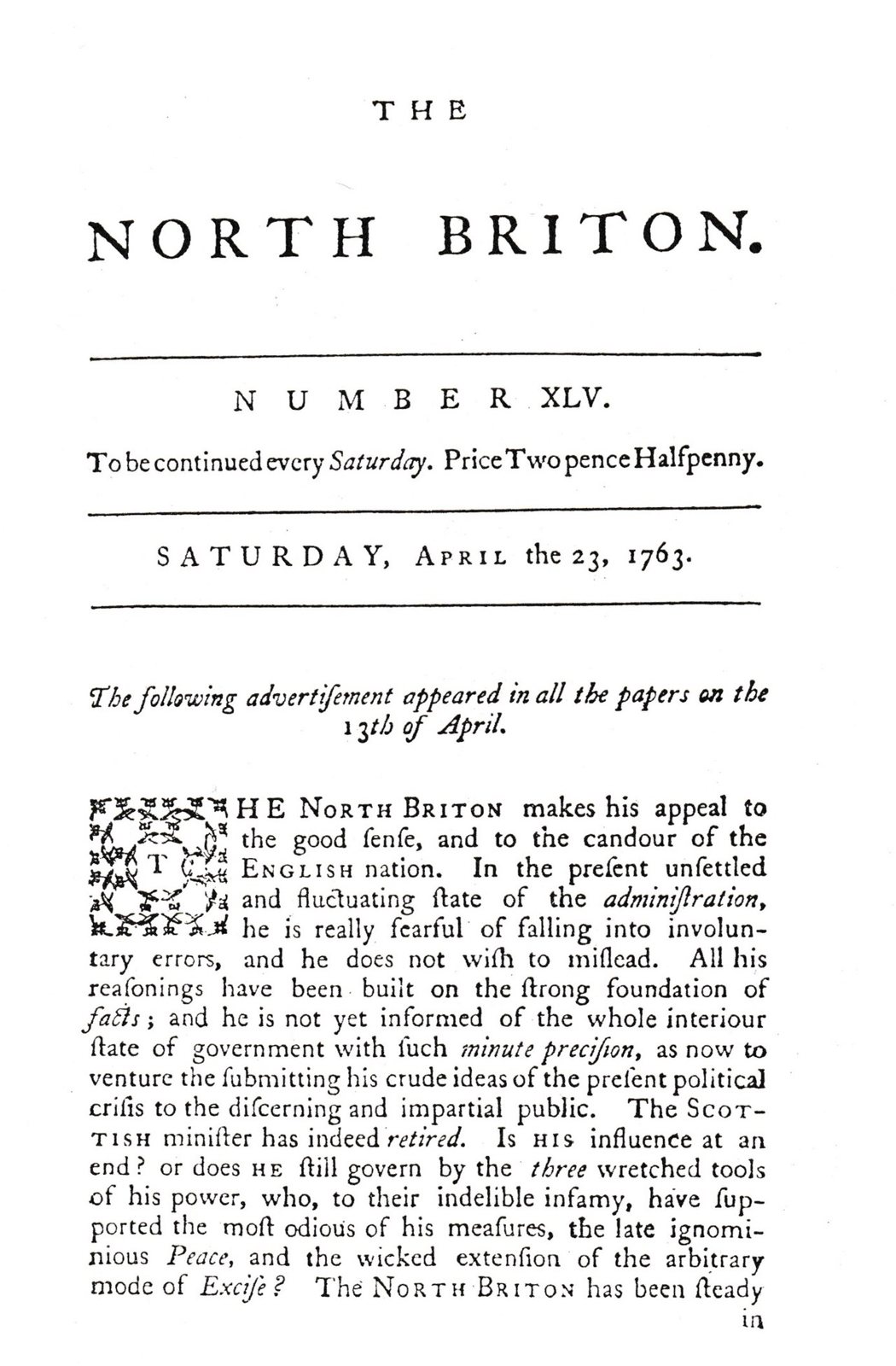
The North Briton, No. XLV, 23 April 1763 (John Wilkes), opening page
Opening page of the opposition weekly's No. XLV: title, date and price, then an italic note that an advertisement ran in all the papers on the 13th of April, and the first paragraph. Tell: the paragraph pins fixed hostile labels on ministers ('three wretched tools', 'most odious of his measures', 'ignominious Peace') while claiming only to appeal to 'the good sense' of the English nation.
- Date
- April 23, 1763
- Period
- Pre-1914
- Made by
- The North Briton, London (anonymous weekly edited by John Wilkes with Charles Churchill)
- Country
- Kingdom of Great Britain
- Medium
- Newspaper pages
- Issuer type
- Media
- Regime
- Grenville Government
- Leader
- George Grenville
- Audience
- Domestic public
- Purpose
- Persuade or win support
- Event
- Wilkes and Liberty
- Techniques
- Name-calling
- Source
- Identified Openly sourced: the speaker is who they say they are
- Source
- Wikimedia Commons (reproduction of the 1763 page in G. Gozzini, Storia del giornalismo, 2000), retrieved October 2, 2026
- Rights
- Public domain (printed London 23 Apr 1763; Commons file page: PD-old, CC-PD-Mark)
The North Briton, No. XLV, London, 23 April 1763; image via Wikimedia Commons
Text on the object
THE
NORTH BRITON.
NUMBER XLV.
To be continued every Saturday. Price Two pence Halfpenny.
SATURDAY, April the 23, 1763.

The following advertisement appeared in all the papers on the 13th of April.

THE NORTH BRITON makes his appeal to the good sense, and to the candour of the ENGLISH nation. In the present unsettled and fluctuating state of the administration, he is really fearful of falling into involuntary errors, and he does not wish to mislead. All his reasonings have been built on the strong foundation of facts; and he is not yet informed of the whole interior state of government with such minute precision, as now to venture the submitting his crude ideas of the present political crisis to the discerning and impartial public. The SCOTTISH minister has indeed retired. Is HIS influence at an end? or does HE still govern by the three wretched tools of his power, who, to their indelible infamy, have supported the most odious of his measures, the late ignominious Peace, and the wicked extension of the arbitrary mode of Excise? The NORTH BRITON has been steady in
Printed with the long s, rendered here as s; small capitals and italics not marked. The page ends mid-sentence ('steady / in'). Read by Claude from the committed image.