Content note: Shows bound captives before the king, and the inscription records the mutilation and public execution of rebel leaders, as the king's own account. This object is shown as it was published. Why
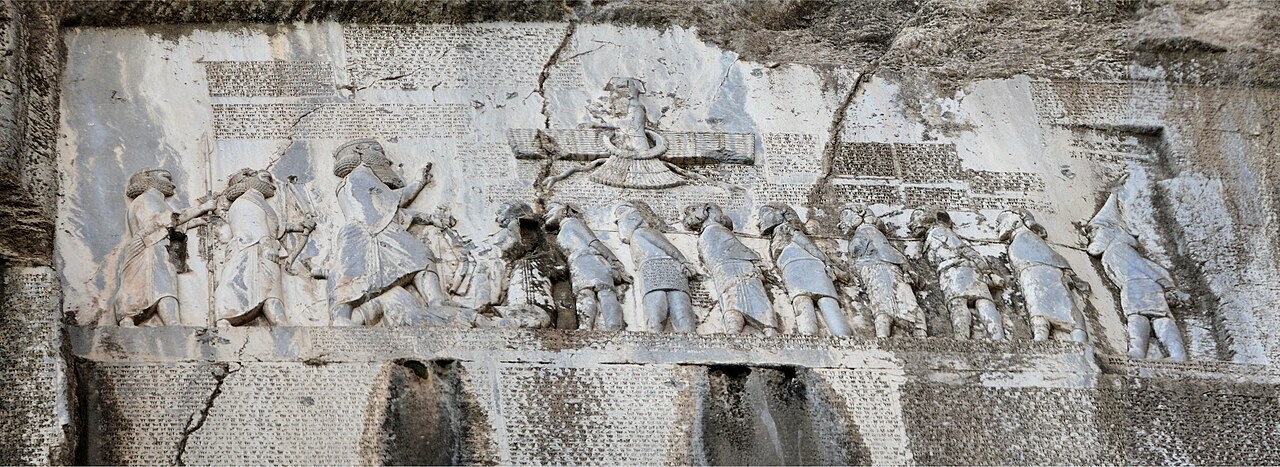
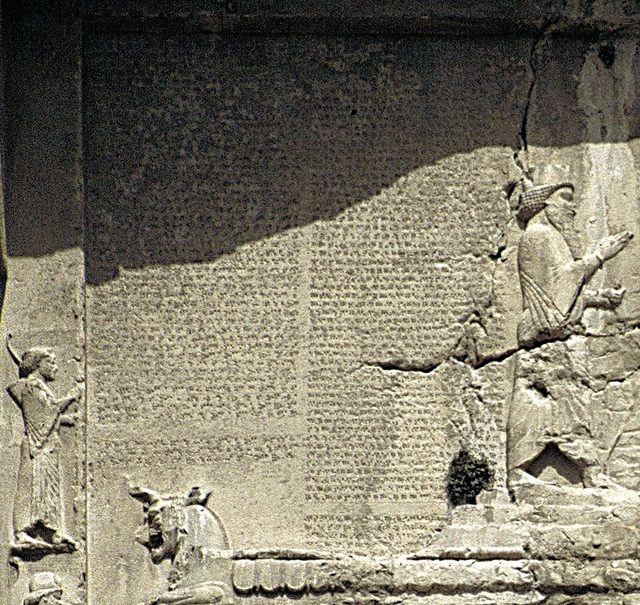
Behistun (Bisotun) rock relief and trilingual inscription of Darius I: the king, two attendants and the bound rebel leaders beneath the winged figure of Ahuramazda
A carved cliff panel beside the ancient road from Babylon to Ecbatana. Darius stands at left with a bowbearer and a spearbearer behind him and a figure lies under his foot; nine roped captives file toward him beneath a winged figure. Text in Old Persian, Elamite and Babylonian surrounds the scene and tells it as a story of lies defeated.
- Date
- 0000
- Period
- Pre-1914
- Made by
- Great King Darius I of Persia (Achaemenid royal court)
- Country
- Achaemenid Empire
- Medium
- Object
- Issuer type
- State
- Regime
- Achaemenid Empire
- Leader
- Darius I
- Audience
- Mixed
- Purpose
- Persuade or win support
- Techniques
- Card stackingName-callingTestimonial
- Regime
- Achaemenid Persia
- Source
- Identified Openly sourced: the speaker is who they say they are
- Source
- Wikimedia Commons, retrieved October 2, 2026
- Rights
- CC BY-SA 2.0 (Wikimedia Commons file page; Flickr original by Patrick C; ancient relief itself is out of copyright)
Photo: Patrick C ('dynamomosquito' on Flickr) and Pentocelo, via Wikimedia Commons, CC BY-SA 2.0
Text on the object
[Column IV, end of section 69 and section 70, Old Persian transliteration:]
thâtiy Dârayavauš xšâyathiya vašnâ Auramazdâha iyam dipîmaiy tyâm adam akunavam patišam ariyâ âha utâ pavastâyâ utâ carmâ grathitâ âha patišamaiy patikaram akunavam patišam uvadâm akunavam utâ niyapithiya utâ patiyafrasiya paišiyâ mâm pasâva imâm dipîm adam frâstâyam vispadâ atar dahyâva kâra hamâtaxšatâ
King Darius says: By the grace of Ahuramazda this is the inscription which I have made. Besides, it was in Aryan script, and it was composed on clay tablets and on parchment. Besides, a sculptured figure of myself I made. Besides, I made my lineage. And it was inscribed and was read off before me. Afterwards this inscription I sent off everywhere among the provinces. The people unitedly worked upon it.
Transliteration and English (King and Thompson, 1907, as adapted) from Livius.org's Behistun pages, where the web text breaks some words with stray spaces; those are joined here and the page's backslash word dividers are shown as spaces. Only this section is transcribed; the full text runs to over 400 lines in Old Persian. The monument also carries Elamite and Babylonian versions.