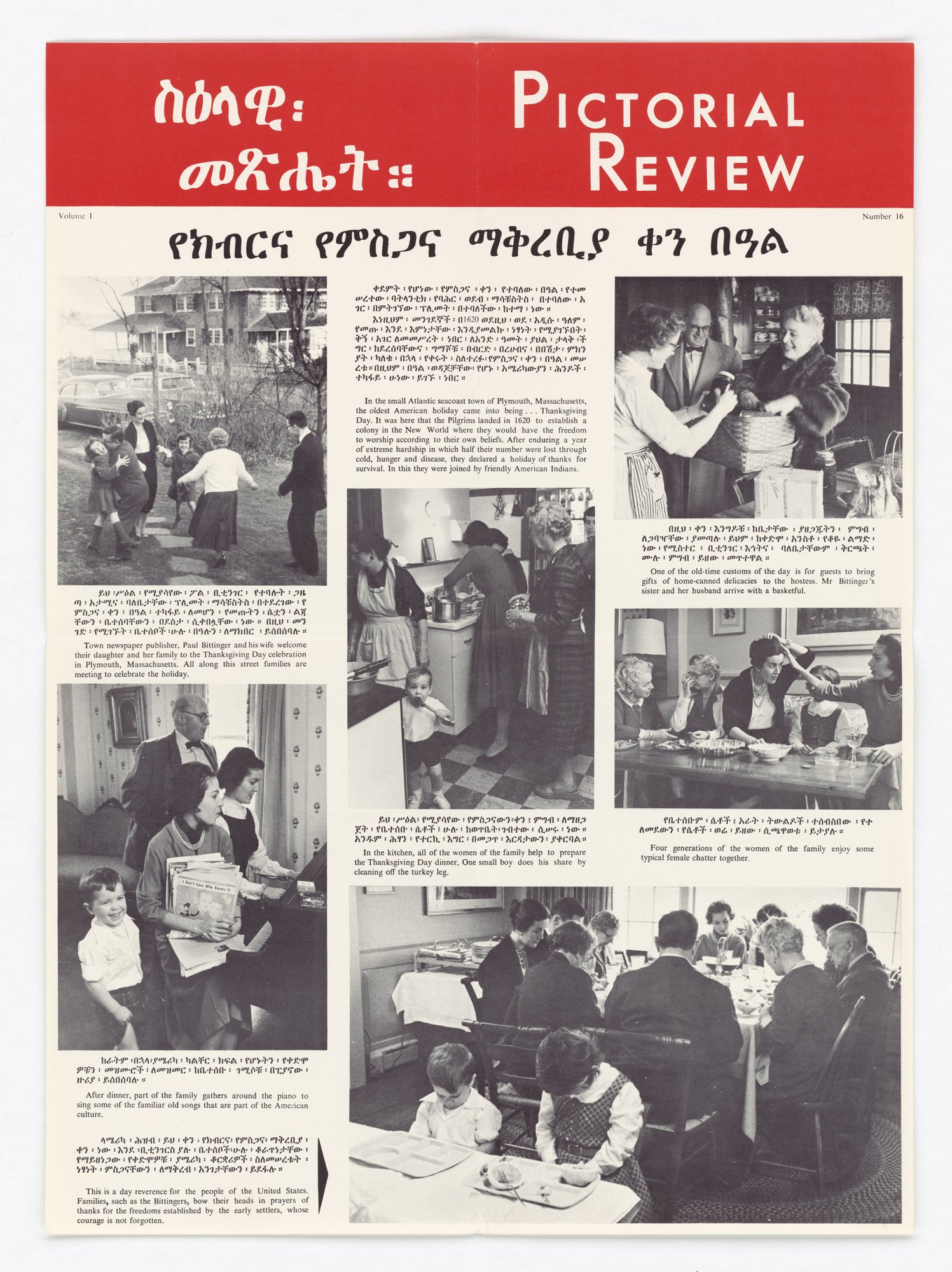
Pictorial Review No. 16: Thanksgiving Day in an American family (Amharic-English poster distributed in Addis Ababa)
A red-bannered Amharic-English photo sheet following one family's Thanksgiving Day in Plymouth, Massachusetts: greetings on the lawn, cooking in the kitchen, gifts of home-canned food, conversation, singing at the piano and grace at the table. The text explains the holiday's origin with the Pilgrims in 1620. The tell is plain-folks: an ordinary named family and household scenes stand for American life and its freedoms.
Propaganda techniques used in this poster
- Date
- November 15, 1958
- Period
- Cold War
- Made by
- U.S. Information Agency (predecessor: State Department International Information and Educational Exchange Program), Propaganda Posters Distributed in Asia, Latin America and the Middle East series
- Region
- North America
- Country
- United States
- Medium
- Poster
- Issuer type
- State
- Regime
- Eisenhower Administration
- Leader
- Dwight D. Eisenhower
- Audience
- Foreign public
- Purpose
- Persuade or win support
- Themes
- Home front, Religion
- Event
- Cold War
- Source
- Unidentified Source blurred: contractors, cutouts, buried disclosure
- Source
- U.S. National Archives (NARA), RG 306, Propaganda Posters Distributed in Asia, Latin America and the Middle East, retrieved October 3, 2026
- Rights
- Public domain (U.S. government work; NARA RG 306)
U.S. Information Agency / Department of State, November 15, 1958. National Archives, Record Group 306 (NAID 6948747, 306-PPB-14b).
Text on the object
ስዕላዊ፡ መጽሔት። / PICTORIAL REVIEW
Volume I    Number 16

[Amharic headline, not transcribed]

[Amharic caption, not transcribed]
Town newspaper publisher, Paul Bittinger and his wife welcome their daughter and her family to the Thanksgiving Day celebration in Plymouth, Massachusetts. All along this street families are meeting to celebrate the holiday.

[Amharic text, not transcribed]
In the small Atlantic seacoast town of Plymouth, Massachusetts, the oldest American holiday came into being . . . Thanksgiving Day. It was here that the Pilgrims landed in 1620 to establish a colony in the New World where they would have the freedom to worship according to their own beliefs. After enduring a year of extreme hardship in which half their number were lost through cold, hunger and disease, they declared a holiday of thanks for survival. In this they were joined by friendly American Indians.

[Amharic caption, not transcribed]
One of the old-time customs of the day is for guests to bring gifts of home-canned delicacies to the hostess. Mr Bittinger's sister and her husband arrive with a basketful.

[Amharic caption, not transcribed]
In the kitchen, all of the women of the family help to prepare the Thanksgiving Day dinner. One small boy does his share by cleaning off the turkey leg.

[Amharic caption, not transcribed]
Four generations of the women of the family enjoy some typical female chatter together.

[Amharic caption, not transcribed]
After dinner, part of the family gathers around the piano to sing some of the familiar old songs that are part of the American culture.

[Amharic caption, not transcribed]
This is a day reverence for the people of the United States. Families, such as the Bittingers, bow their heads in prayers of thanks for the freedoms established by the early settlers, whose courage is not forgotten.
English portions are as printed. The Amharic masthead reads 'Pictorial Review'; the Amharic headline and captions parallel the English captions and are not separately translated here.
English text transcribed in full. The Amharic (Ge'ez script) columns, which parallel the English captions, are not transcribed here and are marked [Amharic text, not transcribed]; the Amharic masthead is given. A visible sheet music title in one photograph ('I Don't Care Who Knows It') is not part of the printed text.