Masapul nga Agtitinnulong Dagiti Umili (The People Must Help One Another): Farmers' Almanac on the Rice Stem Borer (Iloko poster distributed in the Philippines)
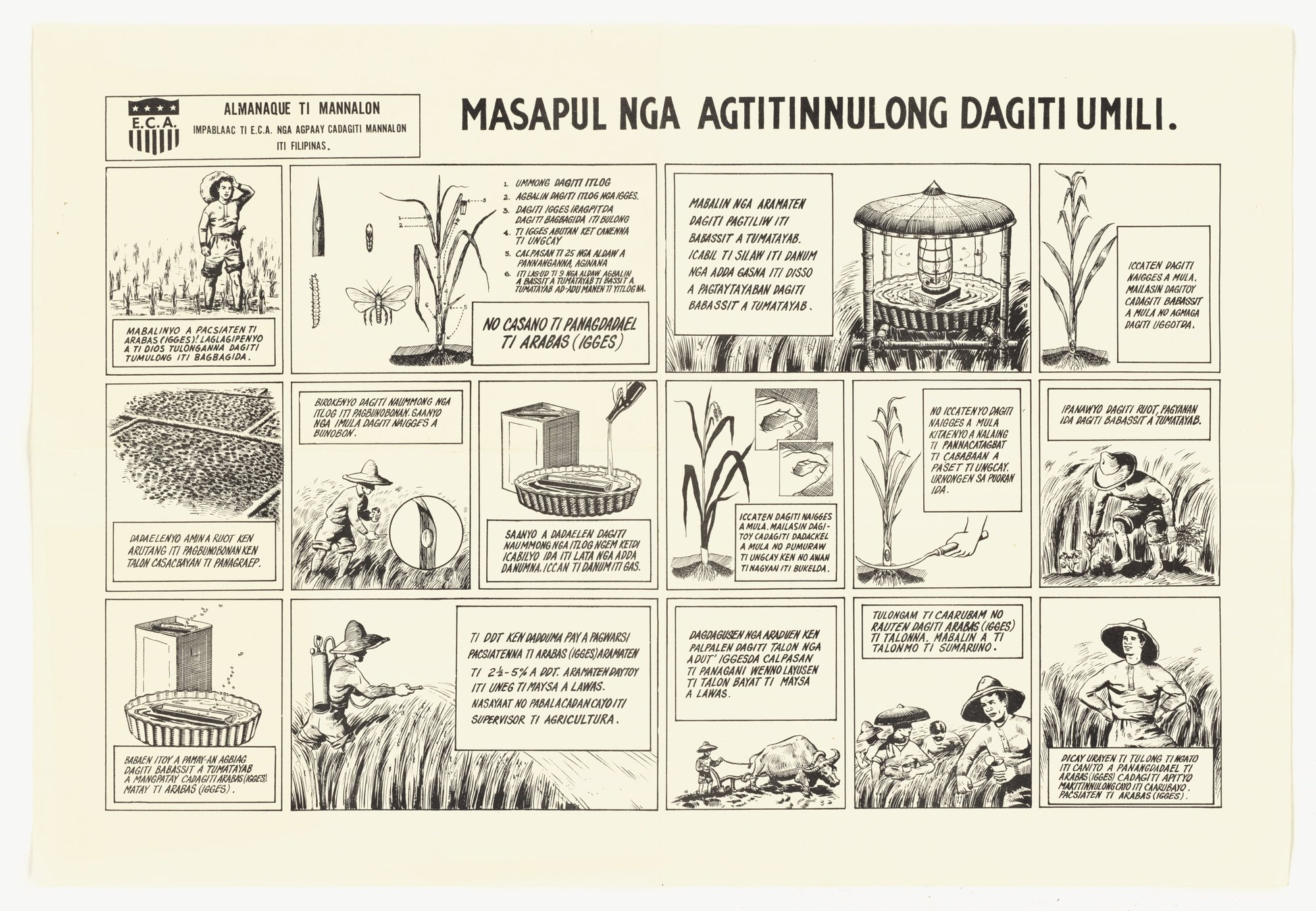
A 15-panel farm-extension sheet in Iloko headed 'The people must help one another', issued as a Farmers' Almanac by the Economic Cooperation Administration for Philippine farmers. Drawings show the rice stem borer's life cycle, a lamp trap, removal of infested plants, and spraying with 2.5 to 5% DDT, ending with neighbours acting together. The tell is plain-folks: farmers in field dress model each step, and the last panels cast pest control as a shared village task.
Propaganda techniques used in this poster
- Date
- December 10, 1951
- Period
- Cold War
- Made by
- Economic Cooperation Administration (E.C.A., as printed); U.S. Information Agency, Propaganda Posters Distributed in Asia series
- Region
- North America
- Country
- United States
- Medium
- Poster
- Issuer type
- State
- Regime
- Truman Administration
- Leader
- Harry S. Truman
- Audience
- Foreign public
- Purpose
- Warn or inform
- Themes
- Science and technology, Economy and finance
- Event
- Cold War
- Source
- Identified Openly sourced: the speaker is who they say they are
- Source
- U.S. National Archives (NARA), Record Group 306, Propaganda Posters Distributed in Asia, retrieved October 3, 2026
- Rights
- Public domain (U.S. government work; NARA RG 306)
U.S. Information Agency / Department of State, December 10, 1951. National Archives, Record Group 306 (NAID 5730062, 306-PPA-162).
Text on the object
ALMANAQUE TI MANNALON
IMPABLAAC TI E.C.A. NGA AGPAAY CADAGITI MANNALON ITI FILIPINAS.
[emblem: E.C.A.]

MASAPUL NGA AGTITINNULONG DAGITI UMILI.

[Panel 1] MABALINYO A PACSIATEN TI ARABAS (IGGES)! LAGLAGIPENYO A TI DIOS TULONGANNA DAGITI TUMULONG ITI BAGBAGIDA.
[Panel 2] 1. UMMONG DAGITI ITLOG
2. AGBALIN DAGITI ITLOG NGA IGGES.
3. DAGITI IGGES IRAGPITDA DAGITI BAGBAGIDA ITI BULONG
4. TI IGGES ABUTAN KET CANENNA TI UNGCAY
5. CALPASAN TI 25 NGA ALDAW A PANNANGANNA, AGINANA
6. ITI LAS-UD TI 9 NGA ALDAW AGBALIN A BASSIT A TUMATAYAB TI BASSIT A TUMATAYAB AD-ADU MANEN TI YITLOG NA.
NO CASANO TI PANAGDADAEL TI ARABAS (IGGES)
[Panel 3] MABALIN NGA ARAMATEN DAGITI PAGTILIW ITI BABASSIT A TUMATAYAB. ICABIL TI SILAW ITI DANUM NGA ADDA GASNA ITI DISSO A PAGTAYTAYABAN DAGITI BABASSIT A TUMATAYAB.
[Panel 4] ICCATEN DAGITI NAIGGES A MULA, MAILASIN DAGITOY CADAGITI BABASSIT A MULA NO AGMAGA DAGITI UGGOTDA.
[Panel 5] DADAELENYO AMIN A RUOT KEN ARUTANG ITI PAGBUNOBONAN KEN TALON CASACBAYAN TI PANAGRAEP.
[Panel 6] BIROKENYO DAGITI NAUMMONG NGA ITLOG ITI PAGBUNOBONAN. SAANYO NGA IMULA DAGITI NAIGGES A BUNOBON.
[Panel 7] SAANYO A DADAELEN DAGITI NAUMMONG NGA ITLOG NGEM KETDI ICABILYO IDA ITI LATA NGA ADDA DANUMNA. ICCAN TI DANUM ITI GAS.
[Panel 8] ICCATEN DAGITI NAIGGES A MULA. MAILASIN DAGITOY CADAGITI DADACKEL A MULA NO PUMURAW TI UNGCAY KEN NO AWAN TI NAGYAN ITI BUKELDA.
[Panel 9] NO ICCATENYO DAGITI NAIGGES A MULA KITAENYO A NALAING TI PANNACATAGBAT TI CABABAAN A PASET TI UNGCAY. URNONGEN SA PUORAN IDA.
[Panel 10] IPANAWYO DAGITI RUOT, PAGYANAN IDA DAGITI BABASSIT A TUMATAYAB.
[Panel 11] BABAEN ITOY A PAMAY-AN AGBIAG DAGITI BABASSIT A TUMATAYAB A MANGPATAY CADAGITI ARABAS (IGGES). MATAY TI ARABAS (IGGES).
[Panel 12] TI DDT KEN DADDUMA PAY A PAGWARSI PACSIATENNA TI ARABAS (IGGES) ARAMATEN TI 2½-5% A DDT. ARAMATEN DAYTOY ITI UNEG TI MAYSA A LAWAS. NASAYAAT NO PABALACADAN CAYO ITI SUPERVISOR TI AGRICULTURA.
[Panel 13] DAGDAGUSEN NGA ARADUEN KEN PALPALEN DAGITI TALON NGA ADUT' IGGESDA CALPASAN TI PANAGANI WENNO LAYUSEN TI TALON BAYAT TI MAYSA A LAWAS.
[Panel 14] TULONGAM TI CAARUBAM NO RAUTEN DAGITI ARABAS (IGGES) TI TALONNA. MABALIN A TI TALONMO TI SUMARUNO.
[Panel 15] DICAY URAYEN TI TULONG TI NGATO ITI CANITO A PANANGDADAEL TI ARABAS (IGGES) CADAGITI APITYO MAKITINNULONG CAYO ITI CAARUBAYO. PACSIATEN TI ARABAS (IGGES).
Farmers' Almanac. Published by the E.C.A. to help farmers in the Philippines. [emblem: E.C.A.]

The people must help one another.

[Panel 1] You can fight the borer (pest)! Remember that God helps those who help themselves.
[Panel 2] 1. The eggs are gathered. 2. The eggs become grubs. 3. The grubs bore into the stem of the plant. 4. The grub reaches and eats the pith. 5. After 25 days of feeding, it rests. 6. Within 9 days it becomes a small flier; the small flier lays more eggs. How the borer (pest) does its damage.
[Panel 3] Small fliers can be trapped: put a lamp in water with kerosene in the place where the small fliers fly.
[Panel 4] Remove the infested plants and set these apart from the small plants when their stems dry.
[Panel 5] Destroy all grass and weeds in the seedbed and in fields adjoining the planting.
[Panel 6] Look for gathered eggs in the seedbed. Do not plant the infested seedlings.
[Panel 7] Do not just destroy the gathered eggs but put them in a can that has water. Put kerosene on the water.
[Panel 8] Remove the infested plants; set them apart from the bigger plants when the pith turns white and there is no grain in the ear.
[Panel 9] When you remove the infested plants, see that the lower part of the stem is cut cleanly. Then burn them.
[Panel 10] Clear away the grass, where the small fliers stay.
[Panel 11] By this method the small fliers that kill the borers survive. The borer (pest) dies.
[Panel 12] DDT and other sprays fight the borer (pest). Use 2½-5% DDT. Use it within one week. It is good to ask the agriculture supervisor.
[Panel 13] Clean up and plough the fields that had many borers after harvest, or flood the field for one week.
[Panel 14] Help your neighbour if borers attack his field. Yours may be next.
[Panel 15] Do not wait for help from above in destroying the borer (pest) while you could help one another with your neighbours. Fight the borer (pest).
Small italic panel text read at reduced resolution; a few Iloko words are uncertain and the English is a literal gloss, not a polished translation. Spelling (c for k, 'cadagiti') follows the sheet.